

Spending three hours editing a Reel only to get two likes is demoralizing. But for thousands of authors, this is the daily reality of trying to sell books online. You wrote the book, edited the manuscript, and published it. Yet the marketing side feels like screaming into a void.
The problem usually isn't your book. It isn't even the algorithm, despite what Twitter threads might tell you. The problem is often a fundamental misunderstanding of how readers interact with authors in 2026. This leads to specific social media mistakes authors make that kill engagement before it even starts.
Most authors approach social media like a bulletin board. They pin up a flyer and walk away, hoping someone stops to read it. But social platforms have evolved into complex, human-centric living rooms. If you walk into a living room and start shouting "Buy my book!" through a megaphone, people won't just ignore you. They will kick you out.
We are going to fix that today. We will strip away the bad habits that are killing your reach. We will replace them with sustainable, high-engagement strategies that actually sell copies.
- Stop the "Buy My Book" spam: Constant promotion triggers the algorithm to bury your content. Use the 80/20 rule instead.
- Pick one platform: Trying to master TikTok, Instagram, and LinkedIn simultaneously is a recipe for burnout.
- Engagement is currency: Replying to comments matters more than posting new content.
- Data over feelings: If a post type doesn't work, stop doing it. Check your analytics.
1. The "Buy My Book" Megaphone (Spamming)
This is the most common social media mistake authors make. It is also the fastest way to lose followers. You have likely seen this author. Every post is a picture of the book cover. Every caption ends with "Available on Amazon!" Every tweet is a link to a purchase page.
This strategy fails for two reasons.
First, social media algorithms explicitly punish posts that encourage users to leave the platform. If you paste a link to Amazon in your caption, platforms like Instagram and LinkedIn will throttle your reach. They want users to stay on their app, not jump over to a retailer.
Second, it violates the social contract. Your followers are not an email list you can blast with coupons. They are real people looking for entertainment, education, or connection. When you treat them like open wallets, they tune you out.
The Fix: The 80/20 Content Rule
You need to shift your ratio. 80% of your content should be value-driven, entertaining, or personal. Only 20% should be promotional.
What counts as "Value" content?
- Behind the scenes: Show your writing desk. Share the ugly first draft. Readers love seeing the process.
- Genre discussions: If you write sci-fi, post about your favorite sci-fi movies or tropes.
- Personal stories: Why did you write this character? What struggles are you facing today?
- Visual storytelling: Create a mood board or a short video that captures the vibe of your story without explicitly selling it.
If you struggle with creating visual assets, you might want to look into book trailer video tips for authors to create content that entertains while it sells.
People don't buy goods and services. They buy relations, stories, and magic.
When you do promote your book in that 20% slice, make it count. Don't just say "Buy it here." Share a glowing review or a picture of a reader holding the book. Make the promotion feel like a celebration rather than a transaction.
2. Spreading Yourself Too Thin (Platform Strategy)
There is a pervasive myth that you need to be everywhere. You supposedly need a Facebook Page, an Instagram Business account, a TikTok, a Twitter/X, a LinkedIn, and maybe a YouTube channel.
This is a lie.
Unless you have a dedicated marketing team, you cannot maintain a high-quality presence on five platforms. When you try to do everything, you end up posting mediocre content everywhere. You cross-post the same Instagram photo to Twitter where the formatting looks terrible. You post it to LinkedIn where the tone is wrong.
This dilutes your brand. It makes you look like a bot.
The Fix: Master One, Maintain One
Pick one platform where your specific readers actually hang out. This is your "Master" platform. You will post here 3 to 5 times a week, engage with every comment, and learn every feature.
- Romance / Fantasy / YA: Your home is likely TikTok (BookTok) or Instagram. Visuals and emotional connection rule here.
- Non-Fiction / Business / Self-Help: You belong on LinkedIn or Twitter/X. Text-based value and professional networking are key.
- Older Demographics / Cozy Mystery: Facebook is still the king for these genres.
According to global social media usage data, there are over 4.8 billion users across these apps. But they don't all behave the same way. You don't need to reach all of them. You only need to reach your readers.
Once you pick your Master platform, pick a secondary "Maintenance" platform. This acts as a backup. You post here once a week just to show you are alive.
If you are struggling with general errors in your early career, check out our guide on common self-publishing mistakes to see where else you might be overextending yourself.
3. Ghosting Your Readers (Engagement)
Imagine you go to a book signing. A reader walks up to your table and says, "I really love your cover art!" You stare at them in silence, don't make eye contact, and then shout "BUY MY BOOK" at the next person in line.
That is exactly what you are doing when you don't reply to comments.
Many authors view social media as a broadcast channel. They post the content and close the app. They might check back later to see how many likes they got, but they ignore the comments section.
This kills your algorithmic ranking. Social platforms want to keep users on the app. When a post generates conversation (replies back and forth), the algorithm flags that post as "high quality" and shows it to more people.
The Fix: The 15-Minute Rule
You don't need to be glued to your phone. Set a timer for 15 minutes after you post. Stay on the app. Reply to early comments immediately. Ask follow-up questions.
- Comment: "Can't wait to read this!"
- Bad Reply: "Thanks!"
- Good Reply: "Thank you! I'm nervous about the ending. Let me know if you think I went too dark with the plot twist!"
See the difference? The second reply encourages another response. It builds a relationship.
End every caption with a question. "What's the last book that made you cry?" or "Coffee or tea while reading?" gives people an excuse to comment.
Recent industry analysis shows that actively responding to comments can boost your post performance by 20% to 30%. That is free reach just for being polite.
Stop Staring at a Blank Page
Publy is a distraction-free book editor with AI built in. Brainstorm plot ideas, get instant chapter reviews, or rewrite clunky paragraphs. 3 million free words included.

4. The Faceless Brand (Authenticity)
In 2026, polished is out. Raw is in.
One of the biggest social media mistakes is trying to look like a corporate publisher. Authors create stiff, formal graphics using Canva templates that look like bank advertisements. They use "we" instead of "I". They hide their face.
Readers connect with people. They want to know the person who stayed up until 3 AM inventing the magic system. They want to know that you struggle with writer's block just like they struggle with their jobs.
If your feed is nothing but book covers and stock photos of coffee cups, you are forgettable.
The Fix: Show Your Face (Literally and Metaphorically)
You don't have to be a model. You don't even have to look "good." You just have to look real.
- Video Content: A shaky video of you walking your dog and talking about a plot hole is often more effective than a high-production trailer.
- Failures: Did you get a bad review? Talk about how it hurt. Did you find a typo in your printed book? Laugh about it.
- Voice: Write your captions the way you speak. If you are sarcastic, be sarcastic. If you are emotional, be emotional.
Developing this persona takes time. If you are unsure what your "author voice" sounds like, reading about developing your unique writing voice can help you translate your literary style into social media captions.
- Authentic Content
- Polished Corporate Content
- High trust factor
- Looks expensive
- messy aesthetic
- Feels cold/distant
- easy to produce
- Hard to maintain
- builds community
- Low engagement
5. Ignoring the Data (ROI)
Authors are creative souls. We hate spreadsheets. We hate numbers. We just want to write.
But ignoring your analytics is like driving with your eyes closed. You might be moving, but you don't know if you are heading toward a cliff.
A common mistake is chasing vanity metrics. You might have a Reel that got 10,000 views. That feels great. But did it sell any books? Did anyone click the link in your bio? Meanwhile, a quiet post about your research process got only 100 likes, but 5 people bought the book.
If you don't look at the data, you will keep chasing the 10,000 views that pay you $0.
The Fix: Weekly Audits
Once a week, look at your "Insights" tab.
- Top Performing Post: Why did it work? Was it the time of day? The image? The hook?
- Lowest Performing Post: Why did it fail? Was it too promotional? Was the image blurry?
- Click-Throughs: Which posts actually got people to click your profile link?
Stop doing what doesn't work. If you hate dancing on TikTok and those videos get no views, stop doing them. If your text-heavy threads on Threads or X are getting shared, do more of that.
It is also vital to know what success actually looks like. Many authors panic because they don't know the benchmarks. Reviewing what makes a good sales rank will help you understand if your social efforts are actually moving the needle on Amazon.
Deep Dive: The 2026 Content Strategy for Authors
Now that we have covered the mistakes, let's look at what is actually working right now. The landscape has shifted. The strategies that worked in 2023 are dead.
The Rise of "Zero-Click" Content
Platforms are hoarding traffic. They do not want users to click links. This means your content itself must be the value. You cannot use a post just as a teaser to "read more on my blog." The post is the blog.
- Instagram: Use carousels (slideshows) to tell a complete story. Recent data indicates that carousels generate significantly higher engagement than single images. Use the slides to teach something or share a scene.
- LinkedIn/X: Write long-form posts. Give away the advice or the story right there in the feed.
Video is Non-Negotiable
You might hate it, but video is the primary language of the internet. This doesn't mean you need to do trend dances.
- Talking Head: Just talk to the camera. Answer a reader question.
- B-Roll: Film your coffee pouring, your fingers typing, or rain on the window. Put text over it. This is "Faceless Video" and it is incredibly popular on BookTok.
- Readings: Read one paragraph from your book. Do it with emotion.
If you are just starting out and this feels overwhelming, go back to basics. Check our writing tips for beginners to ensure your core product—the book—is strong enough to back up your marketing.
Building a Funnel
Social media is the top of the funnel. It is where people meet you. But you don't own your followers. If TikTok gets banned or Instagram changes its algorithm, you lose everything.
Your goal on social media should always be to move people to something you own. This includes your author website and your email list.
Every few posts, offer a "Reader Magnet" (like a free short story, a deleted scene, or a character guide) in exchange for an email address. This allows you to sell to them directly without fighting an algorithm.
How to Recover from a "Dead" Account
Maybe you have made all these social media mistakes. You spammed links, you ghosted followers, and now your engagement is zero. Is your account dead?
No. But it needs CPR.
- Stop Posting Links: Go cold turkey on promotion for 30 days.
- Engage Aggressively: Spend 20 minutes a day commenting on other people's posts. Find authors in your genre. Find readers using hashtags like #Bookstagram or #FantasyReaders. Be a human.
- Post High-Value Content: Share your best tips, your funniest stories, or your most vulnerable moments.
- Be Consistent: The algorithm needs to trust you again. Show up at the same time every day for a month.
It takes time to turn a ship around. But consumer frustration with irrelevant content is at an all-time high. If you can be the one author who provides actual value and connection, you will stand out immediately.
Quick Recap: The Do's and Don'ts
| Do This ✅ | Don't Do This ❌ |
|---|---|
| Reply to comments with questions to keep the chat going. | Post and ghost, leaving your commenters hanging. |
| Show your face and share the messy reality of writing. | Hide behind a logo and only post polished graphics. |
| Focus on one or two platforms and master them. | Auto-post to 5 different apps with the same caption. |
| Check your analytics to see what actually works. | Post randomly based on "feelings" or what's trending. |
| Give value (entertainment, education) 80% of the time. | Ask for sales in every single post. |
Dealing with Writer's Block on Social Media
Sometimes the mistake isn't how you post, but that you don't post at all because you don't know what to say. We treat social media posts like mini-novels. We try to make them perfect.
Lower the bar.
Your followers don't need a masterpiece. They need a pulse.
- Share a sentence you just wrote.
- Share a picture of the book you are currently reading.
- Share a struggle you are having with a plot hole.
If you are truly stuck, you can use the same techniques you use for your manuscript. Our guide on beating writer's block applies to Instagram captions just as much as it applies to Chapter 1.
Final Thoughts: It's About Connection, Not Clout
Social media mistakes happen. You will post something that flops. You will accidentally feed the trolls. You will forget to post for a week.
That is fine.
The goal isn't to be a perfect influencer. The goal is to find the 1,000 true fans who love your work enough to buy everything you write. You don't find them by spamming. You find them by being helpful, being human, and showing up.
Fix these 5 mistakes, and you will stop shouting into the void and start building a community.
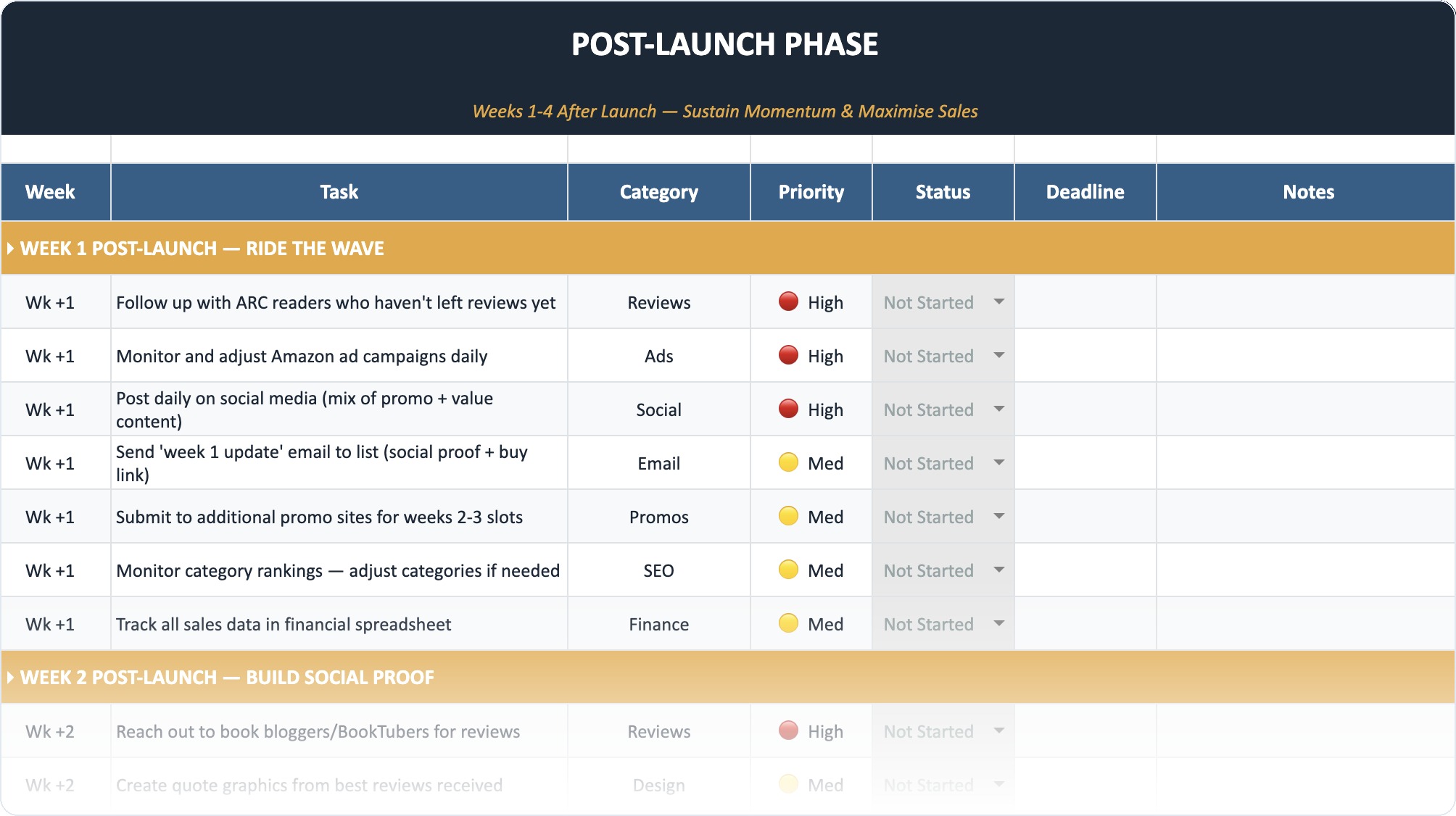
The Self-Publishing Launch Checklist (2026)
A week-by-week spreadsheet that walks you through every step of launching your book. Available as an Excel file and Google Sheet.
Frequently Asked Questions
Which social media platform is best for authors?
It depends entirely on your genre. TikTok (BookTok) and Instagram are dominant for Fiction, Romance, Fantasy, and YA because they are visual and emotional. LinkedIn and X (Twitter) are generally better for Non-Fiction, Business, and political writers. Facebook remains strong for older demographics and specific genres like Cozy Mysteries.
How often should I post on social media?
Consistency beats frequency. It is better to post 3 times a week consistently than to post 5 times a day for a week and then disappear for a month. For most authors, 3 to 4 high-quality posts per week is a sustainable target that keeps the algorithm happy without causing burnout.
Should I pay for social media ads to sell my book?
Not until you have an organic strategy that works. Ads simply amplify what is already there. If your organic posts aren't converting or engaging readers, throwing money at them won't fix the problem. Master organic engagement and your "hook" first. Then use ads to scale that success.
How do I handle negative comments on my posts?
If the comment is abusive or hate speech, delete and block immediately. Protect your mental health and your community. If it is a valid critique or just a grumpy reader, you can either ignore it or reply with extreme kindness. "I'm sorry you didn't enjoy the book, but thanks for giving it a shot!" often diffuses the situation and makes you look professional to other readers.
Can I just hire someone to do my social media?
You can, but be careful. Readers want to connect with you, the author. If you hire a virtual assistant, have them handle the scheduling, graphics, and data analysis. However, try to write the captions and reply to comments yourself. If the "voice" of the account feels like a marketing agency, readers will disconnect.