
Most writing advice gets it backwards. You do not need a cabin in the woods, a fancy degree, or "divine inspiration" to finish a book. You need a system that works when you do not want to work.
If you are looking for writing tips for beginners, you have probably heard the same clichés a thousand times. People say "Just write every day" or "Write what you know."
While well-intentioned, that advice is too vague to be useful when you are staring at a blank page at 6:00 AM before work.
The reality of starting a book is messy. It involves doubt, confusion, and a lot of bad sentences. But every favorite author on your bookshelf started exactly where you are right now. The difference is that they did not quit when it got hard.
This guide moves away from abstract theory. It covers the practical, dirty work of getting words onto the page and keeping them there.
- Ditch Perfectionism: Your first draft is supposed to be bad. Accept it.
- Schedule, Don't Wait: Inspiration is unreliable; discipline gets books written.
- Read to Analyze: Stop reading as a fan and start reading like a mechanic.
- Learn the Market: Understand advice for new authors regarding genre and publishing early on.
Why Most Writing Tips for Beginners Fail
The biggest problem with most writing tips for beginners is that they focus on the art of writing before the habit of writing. They tell you how to craft a metaphor before you have even established a routine that gets you to the chair.
If you focus on quality too early, you will paralyze yourself. The tips below are structured to help you build the foundation first. Once you are producing pages consistently, then (and only then) do we worry about making them pretty.
1. Embrace the "Vomit Draft" (And Stop Editing)
The number one reason new writers fail is perfectionism. You write a sentence. You delete it. You write it again. You change "walked" to "strolled." An hour passes. You have written three sentences.
This kills books before they even breathe.
You need to adopt the "Vomit Draft" mindset. This is exactly what it sounds like. You get the words out of your system and onto the page without judging them.
The Science of Momentum
When you stop to edit, you switch from your creative brain to your critical brain. These are two different modes. Switching back and forth exhausts your mental energy.
A 2024 survey of writers indicated that perfectionism and over-editing are among the top roadblocks preventing completion. If you allow yourself to write badly, you unlock speed. Speed prevents you from second-guessing your plot choices.
The first draft is just you telling yourself the story.
Terry Pratchett
Actionable Step: The Backspace Ban
Try this for your next session: Unbind your backspace key or turn off your monitor. Force yourself to move forward. If you realize a character name is wrong, do not go back and change it. Just start using the new name and fix it in the second draft.
Stop Staring at a Blank Page
Publy is a distraction-free book editor with AI built in. Brainstorm plot ideas, get instant chapter reviews, or rewrite clunky paragraphs. 3 million free words included.

2. Treat Writing Like a Job, Not a Hobby
Amateurs wait for inspiration. Professionals set a schedule.
If you only write when you "feel like it," you will never finish a novel. Inspiration is a fleeting emotion, not a business strategy. You do not wait for inspiration to show up to your day job, and you should not wait for it here.
Finding the Hidden Hours
"I don't have time" is usually a lie we tell ourselves. We have time. We just spend it on Netflix or scrolling TikTok.
Audit your day. Can you write for 20 minutes on your lunch break? Can you wake up 30 minutes earlier?
Use the "20-Minute Sprint" method. Set a timer for 20 minutes. Phone in the other room. No internet. Write until the alarm sounds. You can do anything for 20 minutes.
Consistency Beats Intensity
Writing 500 words every day is infinitely better than writing 5,000 words once a month. Daily engagement keeps the story fresh in your mind. If you take a week off, you spend the first two hours just remembering where you left off.
For more strategies on maintaining a routine, check out our guide on 8 Habits of Highly Productive Writers.
3. Read Like a Mechanic, Not a Passenger
Before you started writing, you read for pleasure. You let the story sweep you away.
Now, you need to read with a scalpel. This is crucial advice for new authors. When you read a book you love, stop and ask why you love it.
- How did the author introduce the main character?
- Why did this chapter end here?
- How much dialogue is used versus description?
The Analysis Technique
Take a book in your genre. Read the first chapter. Then, write a one-paragraph summary of what happened. You will realize that while it felt like a lot of action, the author probably only established three key facts.
This helps you understand pacing. Beginners often rush. They try to cram a whole life story into page one. Pros take their time.
If you want to deepen your understanding of narrative structure, you might want to explore some free creative writing courses that break these concepts down further.
4. Understand Your Genre (Before You Write)
One of the most common writing mistakes to avoid is ignoring the market.
You might think, "I just want to write a good story, I don't care about labels." But readers care about labels. If you write a mystery novel but the murder does not happen until page 150, mystery readers will hate it. If you write a romance with a sad ending, romance readers will revolt.
Genre Expectations vs. Formulas
This is not about following a formula. It is about fulfilling promises. When a reader buys a thriller, they are paying for suspense and pacing. When they buy a fantasy, they are paying for world-building and wonder.
Knowing these expectations helps you structure your book. It gives you a roadmap.
"B000FC0R88"
Check Price on Amazon →As an Amazon Associate, we earn from qualifying purchases.
5. Don't Go It Alone (The Feedback Loop)
Writing is solitary, but publishing is communal. You cannot see your own mistakes. Your brain will fill in the gaps because you know what you meant to say. A reader only knows what is on the page.
The Hierarchy of Feedback
- Self-Edit: Fix the obvious typos and plot holes.
- Beta Readers: Readers who enjoy your genre. They tell you if it is boring or confusing.
- Critique Partners: Other writers who can tell you why it is boring or confusing.
- Professional Editors: The final polish.
Be careful asking friends and family. They love you, so they will lie to you. They will say, "It's great!" even if it is a mess. You need honest, constructive criticism.
If you are struggling with confidence or feeling like a fraud, you are not alone. Read our article on how to overcome writer's block and the anxiety that comes with sharing your work.
6. The "Show, Don't Tell" Rule (And When to Break It)
You will hear this everywhere. "Show, don't tell."
Telling: "Mark was angry."
Showing: "Mark slammed his fist on the table, coffee spilling over the edges."
Showing creates an emotional experience. It puts the reader in the room. However, beginners often over-correct and try to show everything.
If Mark is just walking to the grocery store, you do not need to "show" every step, the wind in his hair, and the gravel under his shoes. Just tell us, "Mark walked to the store."
Rule of Thumb: Show the emotional peaks and important plot points. Tell the transitions.
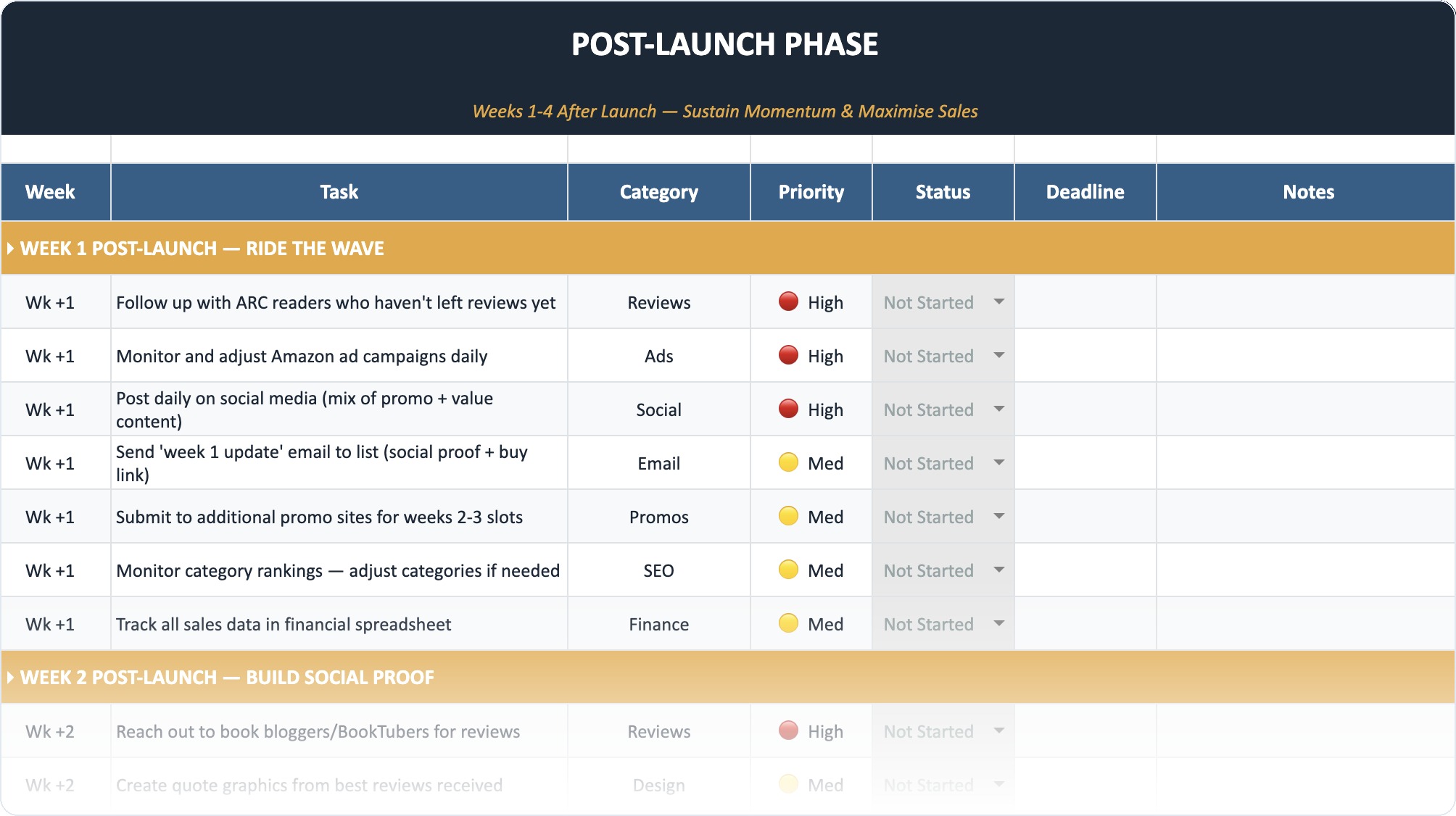
The Self-Publishing Launch Checklist (2026)
A week-by-week spreadsheet that walks you through every step of launching your book. Available as an Excel file and Google Sheet.
7. Master the Tools of the Trade
You do not need expensive software to write a bestseller. J.K. Rowling wrote Harry Potter on napkins and old typewriters. However, the right tools can save you time.
- Microsoft Word / Google Docs
- Free (mostly)
- Universally used
- Easy to share
- Gets laggy with long documents
- Hard to reorganize chapters
- Limited formatting options Scrivener
- Built for books
- Drag-and-drop chapters
- Great for outlining
- Steep learning curve
- Cost money
- Not cloud-based by default
The AI Question
Artificial Intelligence is a reality we can't ignore. According to recent data, roughly 40.8% of writers intend to use AI tools to assist their process.
Should you use it?
- Yes: For brainstorming, checking grammar, or generating character names.
- No: For writing the actual prose. AI prose is bland, repetitive, and lacks subtext.
Use AI as a junior assistant, not the CEO of your story.
8. Outline (Even if You Hate It)
There are two types of writers: Plotters (who outline) and Pantsers (who fly by the seat of their pants).
If you are a beginner, I strongly recommend you try plotting. Writing without a map is how you end up with 50,000 words that go nowhere.
You do not need a 40-page document. Just a simple roadmap:
- Beginning: Who is the hero? What do they want? What stops them?
- Middle: They try to get it. They fail. They try harder.
- End: Do they get it or not?
Having this structure prevents the dreaded "sagging middle" where the story loses momentum. For a deeper dive, check out our guide on structuring your book outline.
9. Focus on Clarity Over Vocabulary
New writers often try to sound "writerly." They abuse the thesaurus. They use words like "azure" instead of "blue" or "masticate" instead of "chew."
Just stop.
Good writing is invisible. It should act as a clear window through which the reader sees the story. If the reader notices your fancy words, they aren't looking at the story. They are looking at you.
Data backs this up. In the business world, 73% of professionals report that poor, overly complex writing wastes their time. The same applies to fiction. If a reader has to re-read a sentence to understand it, you have broken the spell.
10. Understand the Publishing Options
Before you finish your book, you should know where it is going. The industry has changed massively.
- Traditional Publishing: You get an agent. They sell to a publisher. You get an advance. Pros: Prestige, distribution. Cons: Slow, lower royalties, gatekeepers.
- Self-Publishing: You act as the publisher. You hire the editor and cover designer. Pros: Control, higher royalties, speed. Cons: You pay upfront, you do the marketing.
Surveys suggest that a growing number of authors are taking control, with 61.6% of writers planning to self-publish rather than chase agents.
Neither path is "better." It depends on your goals. If you want to learn more about the indie route, read about distribution through platforms like IngramSpark.
Also, verify if you are ready for either path by reading Self-Publishing vs Traditional Publishing.
How to Start Writing Today
The scariest part of writing is the blank page. It represents infinite possibility, which is terrifying.
Here is how to start writing right now:
- Open a document.
- Write "Chapter One."
- Write one sentence. It can be "The cat sat on the mat."
- Write the next sentence.
That is it. You are now a writer. The only difference between you and Stephen King is that he has written more sentences.
Do not worry about being good. Worry about being present. If you show up every day, the quality will come.
If you hit a wall, try these 7 Simple Tricks to Beat Writer's Block Today.
Frequently Asked Questions
What is the best software for beginner writers?
For most beginners, Google Docs or Microsoft Word is perfectly fine. They are simple and let you focus on the words. As your project grows, you might consider Scrivener for its organizational features, but do not let a lack of fancy software stop you from starting.
How many words should I write a day?
A good target for a beginner is 500 words. This is manageable (about one typed page) and can be done in 30 to 45 minutes. If that is too much, aim for 200. The specific number matters less than the habit of hitting it daily.
Do I need a degree to be a writer?
Absolutely not. Readers do not care about your credentials. They care about your story. While a degree can teach you literary theory, the best way to learn writing is by reading great books and practicing your craft.
Should I edit as I write?
No. Editing while drafting is a major productivity killer. Finish the chapter or even the whole draft first. Your "creative brain" and "critical brain" work best separately.
Is self-publishing a good idea for beginners?
Yes, it is a viable career path. It requires you to be entrepreneurial, but it allows you to build an audience directly. However, it requires a budget for editing and cover design to compete with traditionally published books.