
Seventy-five percent of self-published authors earn less than $1,000 a year from their writing. That statistic hits hard because it clashes with the dream we all have of passive income and creative freedom. I learned the hard way that avoiding self-publishing mistakes is more about business strategy than writing talent.
- Marketing is mandatory: You cannot wait until launch day to start talking about your book.
- Covers sell books: Readers judge quality instantly by the cover art.
- Editing is non-negotiable: Typos destroy your credibility faster than bad plotting.
- Build a list: Your email list is the only asset you truly own.
Most of us start with a Word document and a lot of hope. We press "publish" on Amazon KDP and wait for the sales to roll in. They usually don't. The difference between the authors who make rent money and the ones who buy a coffee once a month often comes down to preparation.
The market in 2026 is crowded. There were over 2.6 million self-published titles released in 2023 alone. Standing out requires you to stop acting like an artist and start acting like a publisher.
Here is what I wish someone had told me before I uploaded my first file.
1. The "Field of Dreams" Strategy is a Lie
The biggest lie in publishing is "if you build it, they will come." They won't. You can write the Great American Novel, but if no one knows it exists, it will sit at Amazon sales rank #3,000,000 forever.
I used to think marketing was something I could do after the book was out. I was wrong. The algorithms on Amazon and other retailers favor books that generate sales velocity immediately upon release. If you launch to crickets, the system assumes your book is irrelevant and buries it.
You need to build anticipation. This means sharing your cover reveal, teasing snippets of the draft, and gathering a launch team weeks or months in advance.
Start marketing when you write Chapter 1. Share your progress on TikTok or Threads. Let people see the messy process. It builds investment.
A solid launch plan involves more than just posting "My book is live!" on Facebook. You need to coordinate newsletter swaps, price promotions, and perhaps even paid ads. If you are unsure where to begin, you should look into creating an effective book launch strategy to map out your timeline.
2. Your Cover is Not Art, It's Packaging
I made the classic mistake of designing my own cover because I "knew Photoshop." It looked nice to me. To everyone else? It looked homemade.
Your cover has one job. It is not to represent the soul of your story. It is to signal genre. When a reader scrolls through the sci-fi category, your book needs to look exactly like the bestsellers in that list. If you write romance but your cover looks like a thriller, you will lose sales.
Common Cover Mistakes:
- Typography: Using standard fonts like Times New Roman or Papyrus.
- Contrast: Titles that blend into the background image.
- Resolution: Blurry images that look terrible as thumbnails.
Readers click on thumbnails. If the thumbnail doesn't grab them, they never see your blurb. Pay a professional. If you cannot afford a custom illustration, buy a high-quality premade cover. It is the best money you will spend.
3. Professional Editing is the Barrier to Entry
You cannot edit your own work. Your brain fills in the gaps because you know what you meant to say.
Readers in 2026 have zero tolerance for errors. A single typo on the first page can lead to a refund and a one-star review. Those bad reviews stick like glue. They warn other readers away for years.
There are different types of editing you need to consider:
- Developmental Editing: Fixes plot holes, pacing, and character arcs.
- Line Editing: Polishes the prose, flow, and word choice.
- Proofreading: Catches the final typos and punctuation errors.
If you are on a budget, you might swap critiques with other authors for the developmental phase. But you should pay cash for proofreading. If you want to dive deeper into the different passes your manuscript needs, read our guide on editing your manuscript.
Stop Staring at a Blank Page
Publy is a distraction-free book editor with AI built in. Brainstorm plot ideas, get instant chapter reviews, or rewrite clunky paragraphs. 3 million free words included.

4. An Email List is Your Retirement Fund
Social media is rented land. TikTok could ban your account tomorrow. Twitter (X) could change its algorithm and hide your posts. But you own your email list.
I waited until my third book to start a newsletter. That was a massive error. I lost the chance to capture thousands of readers who bought my first two books.
Why you need a list:
- Direct Sales: You can sell direct to fans and keep 90% of the profit instead of the 70% (or 35%) retailers pay.
- Launch Power: You can email 1,000 people on launch day to drive sales and spike the Amazon charts.
- Review Team: Your subscribers are your best source for early reviews.
Put a link in the back of your book. Offer a free short story or a bonus chapter in exchange for their email address. This is called a "Reader Magnet." Do it for your very first book.
5. Avoiding Common Self-Publishing Mistakes in Metadata
Metadata sounds boring. It is actually the secret weapon of six-figure authors. Metadata includes your keywords, your categories, and your book description (blurb).
Most new authors rush this part. They pick two generic categories like "Fiction" and write a blurb that sounds like a summary.
The Blurb Rule:
Your blurb is sales copy. It should not summarize the plot. It should hook the reader.
- Bad: "This book is about a boy named Harry who finds out he is a wizard."
- Good: "Harry Potter lives in a closet. He thinks he's ordinary. He's wrong."
Your keywords help Amazon connect your book to shoppers. You need to find phrases that people actually type into the search bar. Terms like "publishing advice" or "indie author lessons" might be relevant for non-fiction. For fiction, get specific. Instead of "Romance," use "Enemies to Lovers Office Romance."
If you struggle with writing persuasive sales copy, check out our tutorial on how to write a book description for Amazon.
6. Format Wars: Ebook, Print, and Audio
In 2025, the market shifted. While ebooks are still king for volume, audiobooks are growing fast. The global audiobook market is projected to expand significantly over the next few years. Ignoring audio is leaving money on the table.
The "Wide" vs. "Exclusive" Debate:
- KDP Select (Exclusive): You give Amazon exclusive rights to your ebook for 90 days. In exchange, you get paid for page reads via Kindle Unlimited (KU). This is great for new authors who need visibility.
- Going Wide: You publish on Kobo, Apple Books, Barnes & Noble, and Google Play. This takes longer to build but offers more security.
You also need to think about print quality. Readers love hardcovers and special editions. It used to be hard to do this, but now print-on-demand services make it easy. You should compare KDP vs IngramSpark for hardcovers to see which fits your budget.
The best marketing is a newsletter. The second best is a BookBub deal.
David Gaughran
7. The Financial Reality of Publishing Costs
You need a budget. Self-publishing is a business startup. You can start cheap, but "free" usually looks cheap.
Here is a realistic breakdown of publishing costs for a quality launch in 2026:
| Expense Category | Budget (DIY/Low) | Budget (Pro) |
|---|---|---|
| Cover Design | $50 – $150 (Premade) | $500 – $1,000+ |
| Editing | $200 (Proofread only) | $1,500 – $3,000 |
| Formatting | $0 (Reedsy/Kindle Create) | $250 (Vellum/Atticus) |
| Marketing | $0 (Hustle) | $500+ (Ads/Promos) |
| Total | ~$250 – $400 | ~$2,500 – $5,000 |
You do not need to spend thousands, but you must spend smart. If you have $500, put $300 into the cover and $200 into a newsletter service and website hosting.
According to a WordsRated analysis of industry data, the number of self-published titles has exploded to over 2.6 million annually. This volume means you cannot rely on organic visibility alone. You have to pay to play, or hustle twice as hard.
8. Pricing is Psychology
I priced my first ebook at $0.99 because I thought cheap meant more sales. It often just means "low quality" to a buyer.
Standard Pricing Tiers:
- $0.99: Good for the first book in a series or a limited-time sale.
- $2.99 – $4.99: The sweet spot for full-length genre fiction ebooks.
- $9.99+: Non-fiction or established brands.
If you price too low, you make pennies (35% royalty on Amazon for books under $2.99). If you price too high, unknown readers won't take the risk. Research your genre. What are the top 100 books selling for? Match them.
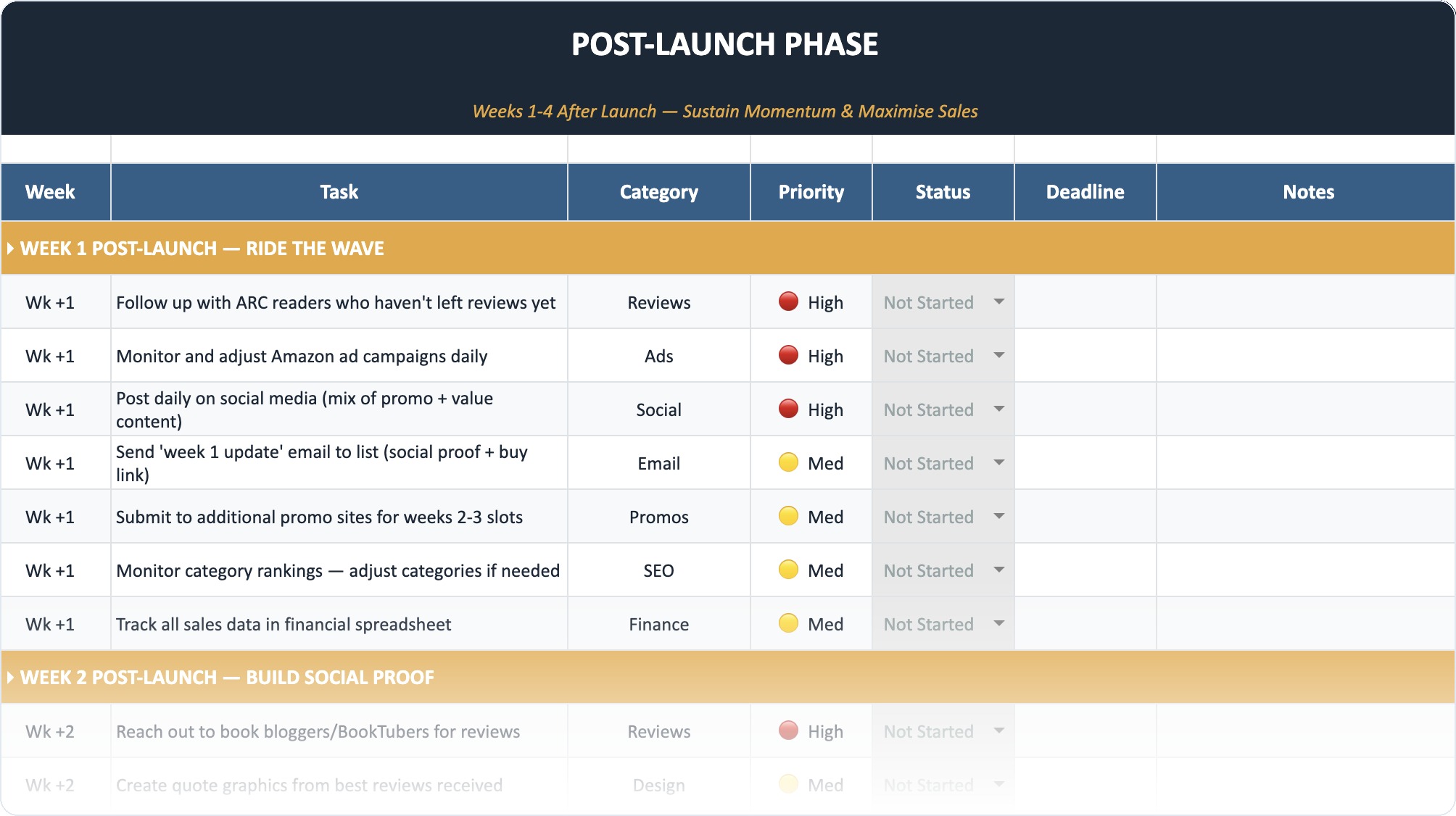
The Self-Publishing Launch Checklist (2026)
A week-by-week spreadsheet that walks you through every step of launching your book. Available as an Excel file and Google Sheet.
9. Reviews Are Social Proof
You need reviews. Strangers will not buy your book if it has zero stars. It looks abandoned.
How to get reviews legally:
- ARC Teams: Advanced Reader Copies. Send free digital copies to readers before launch in exchange for an honest review.
- BookSprout / BookSirens: Services that connect authors with reviewers.
- The Ask: Put a polite request at the end of your book. "If you enjoyed this, please leave a review."
What NOT to do:
Never pay for reviews. Amazon will ban you. Never review swap with other authors in a "you scratch my back" arrangement if you haven't read the book. The algorithms are smart and will catch you.
"B0867X79G6"
Check Price on Amazon →As an Amazon Associate, we earn from qualifying purchases.
10. Burnout is the Real Enemy
The biggest mistake isn't a bad cover or a typo. It's quitting.
Writing the book is 20% of the work. The other 80% is administrative. This includes formatting, uploading, emailing, tweeting, and checking dashboards. It is exhausting.
I burned out after book two because I was trying to do everything perfectly. I learned that "done" is better than "perfect." You can always update the ebook file later if you find a typo. You cannot update a book you never published.
For more insights on the emotional hurdles of this industry, read about 12 mistakes first-time authors always make.
The Importance of a Series
One standalone book is hard to sell. It is expensive to market one product to one person one time.
The most successful indie authors write series. When you market Book 1, you are actually marketing Book 2, 3, and 4. This is called "read-through."
If you spend $5 in ads to sell a book, and you only make $3 back, you lose money. But if that reader goes on to buy the next three books in the series, that $5 ad spend might generate $15 in profit.
If you are just starting, consider planning a trilogy before you publish the first one.
The Hybrid Model
You don't have to choose one path forever. Many authors use a hybrid model. They self-publish some projects and query agents for others.
Self-publishing gives you control and higher royalties. Traditional publishing gives you bookstore distribution and prestige. Understand the trade-offs. Check out our comparison on self-publishing vs traditional publishing to decide what fits your current project.
Why 2026 is Different
The landscape has changed with AI. Tools like ChatGPT and Midjourney are everywhere.
The AI Trap:
Don't use AI to write your book. Readers can tell. It lacks the emotional nuance of human experience. However, do use AI for brainstorming, outlining, or drafting marketing emails. It is a tool, not an author.
The Audio Boom:
AI narration is now passable for non-fiction, though fiction readers still prefer human actors. A report by Grand View Research highlights that the audiobook market is growing by over 26% annually. If you cannot afford a $3,000 narrator, look into high-quality AI narration for your backlist, but label it clearly.
Final Thoughts
Publishing is a marathon. It takes time to build a backlist and a fan base.
According to the Alliance of Independent Authors, while the majority of authors earn little, those who treat it as a business and have a catalogue of 25+ books see median earnings jump significantly.
Don't let the stats scare you. Let them prepare you. Fix the cover. Hire the editor. Build the list. And keep writing.
For practical tips on keeping your momentum, see our guide on writing tips for beginners.
Frequently Asked Questions
What is the biggest mistake in self-publishing?
The biggest mistake is rushing to publish without professional editing or a cover design that fits the genre. This signals low quality to readers immediately.
How much does it cost to self-publish a book?
Costs vary wildly. You can do it for under $500 if you use budget tools and premade covers, but a professional launch typically costs between $2,000 and $5,000.
Is self-publishing worth it in 2026?
Yes, if you treat it as a business. The global self-publishing market is valued at over $1.85 billion and growing, offering higher royalty rates than traditional deals.
Do I need an ISBN for Amazon KDP?
No. Amazon provides a free ASIN. However, if you want to distribute your book to other retailers or libraries (like via IngramSpark), you should buy your own ISBN.
Can I fix mistakes after publishing?
For ebooks, yes, you can upload a new file anytime. For print books, you can fix typos, but you cannot change the title, author name, or page count significantly without a new ISBN.