
- BookBub ads give you direct access to 10 million active readers without the gatekeepers of Featured Deals.
- Author targeting is your strongest weapon; target authors with 10k-30k followers for the best ROI.
- CPC bidding is safer for beginners than CPM to avoid draining your budget on low-click impressions.
- Testing creatives is mandatory; ads with the word "Free" in the image often see a 32% higher click-through rate.
Selling books shouldn't feel like shouting into a void. But for most independent authors, it does. You publish a book, post about it on social media, and watch the Amazon sales rank flatline. The problem isn't your book. The problem is that you are trying to sell to people who are scrolling for memes, not stories.
This is where BookBub ads change the math. Unlike Facebook or TikTok, where your book is an interruption, BookBub is a platform exclusively for people who are actively looking for their next read. They aren't there to connect with friends. They are there to buy books.
If you have tried Amazon Advertising and found the costs prohibitive, or if you are tired of the "pay-to-play" nature of social media, BookBub offers a dedicated ecosystem of power readers.
Why BookBub Ads Are Different
Most authors confuse the ad platform with BookBub Featured Deals. Featured Deals are the "holy grail," which are curated, highly selective email blasts that accept less than 20% of submissions. They generate massive spikes in sales but are incredibly hard to get.
BookBub ads are the self-serve platform at the bottom of those emails. You don't need to be selected. You don't need editorial approval. You just need an account and a budget.
The Audience Advantage
The platform hosts a community of over 10 million book buyers. These aren't just casual readers; they are "power readers" who consume books weekly. According to BookBub's own partner data, targeting these specific readers often yields higher conversion rates than broader platforms.
- Complete control over budget
- No editorial gatekeepers
- Direct access to 10M+ readers
- High conversion potential
- Steeper learning curve than boosting posts
- Creative assets must be designed manually
- Auction system can be volatile
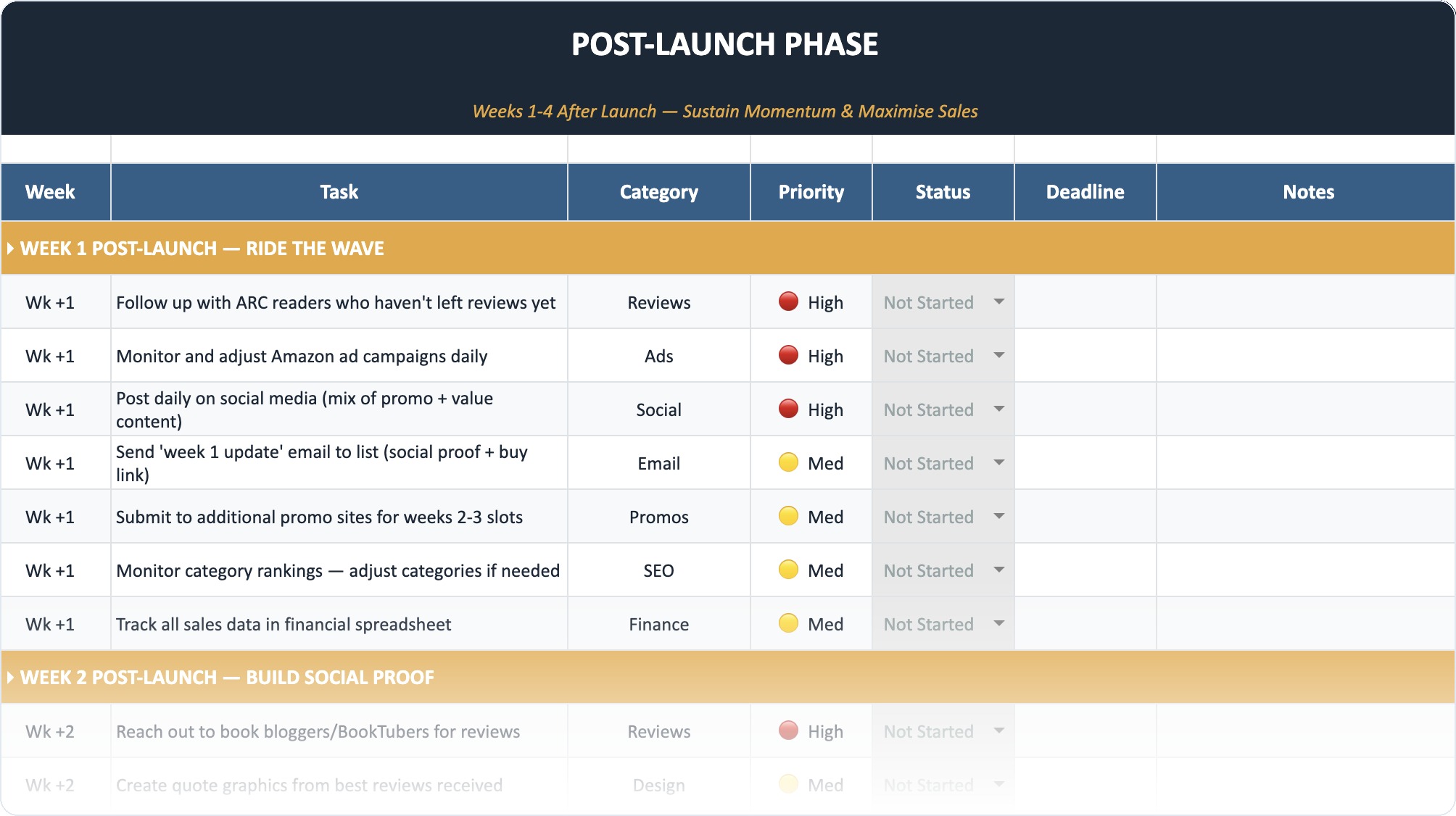
The Self-Publishing Launch Checklist (2026)
A week-by-week spreadsheet that walks you through every step of launching your book. Available as an Excel file and Google Sheet.
Setting Up Your First Campaign
The interface for creating BookBub ads is deceptively simple. Unlike the labyrinth of Facebook Business Manager, BookBub fits everything on one page. But simplicity can be a trap. If you don't tweak the right dials, you will burn money fast.
1. Targeting: The "Author Alike" Strategy
This is where campaigns live or die. You can target by category (Mystery, Romance) or by author interest.
Never target by category alone. It is too broad. You will pay for impressions from readers who might like the genre but hate your specific trope.
Instead, use Author Targeting. You want to show your ad to readers who follow authors similar to you.
Don't just target the biggest names like Stephen King or Nora Roberts. Their audiences are too broad and expensive. Look for "mid-list" authors with 10,000 to 30,000 followers. Their fans are usually more engaged and specific to the sub-genre.
Research suggests that author targeting generally leads to a 60% higher average CTR compared to category targeting. You are essentially borrowing the trust that other authors have built with their fanbase.
2. The Creative: Images That Click
You have limited space. The standard ad size is 300×250 pixels. You don't need to be a Photoshop wizard, but you do need to understand visual hierarchy.
- The Book Cover: Make it large and legible.
- The Hook: A short, punchy sentence. "She thought she was safe."
- The Button: A clear "Buy Now" or "Read for Free" button graphic.
If your book is discounted or free, say it loud. Ads that include the word "Free" in the image see a 32% higher click-through rate. Readers are scanning these emails quickly; you have less than a second to grab their attention.
You can learn more about crafting compelling visuals in our guide on designing A+ content for books, which shares principles that apply directly to ad creatives.
3. Bidding: CPC vs. CPM
BookBub gives you two ways to pay:
- CPM (Cost Per Mille): You pay for every 1,000 times your ad is shown.
- CPC (Cost Per Click): You pay only when someone clicks.
For beginners, always start with CPC. It protects your budget. If your ad creative is bad and nobody clicks, you don't pay. Once you have a "unicorn" ad with a high Click-Through Rate (CTR), you can switch to CPM to scale it up more cheaply.
Current data shows that efficient campaigns can see CPCs as low as 0.25 to 0.34 dollars for well-targeted ads.
Fine-Tuning Your Strategy
Launching the ad is just step one. The real work happens when you look at the numbers the next morning.
Analyzing the Click-Through Rate (CTR)
Your CTR is the heartbeat of your campaign.
- Below 0.5%: Your targeting is off, or your image isn't resonating. Kill the ad.
- 0.5% – 1.0%: Decent. Keep it running but try to optimize.
- Above 1.0%: Gold. Scale this up or move it to CPM bidding.
If your CTR is low, don't throw out the whole campaign. Change one variable at a time. Change the image but keep the target. Or keep the image and change the target author. If you change everything at once, you won't know what fixed the problem.
The "Sweet Spot" for Pricing
Ad performance relies heavily on the price of the book you are promoting. While full-price books can sell, the friction is higher. A price range of $2.99 to $4.99 is often considered a "sweet spot" for full-price ad performance.
However, if you are looking to build a newsletter or push a series starter, a $0.99 or Free price point will always yield the highest volume of clicks. This is a classic "loss leader" strategy. You might lose money on the ad spend for book one, but you make it back on read-through to books two and three.
To understand if your book description is doing the heavy lifting once they click, check our guide on how to write a book description for Amazon. Even the best ad can't fix a bad blurb.
Stop Staring at a Blank Page
Publy is a distraction-free book editor with AI built in. Brainstorm plot ideas, get instant chapter reviews, or rewrite clunky paragraphs. 3 million free words included.

Advanced Tactics: The "Chirp" Factor
BookBub also owns Chirp, an audiobook retailer. You can run BookBub ads specifically for audiobooks. The competition here is significantly lower than for ebooks. If you have audio rights, this is an untapped market where CPCs are often lower because fewer authors are bidding.
The best marketing strategy isn't shouting the loudest. It's finding the people who are already listening.
Common Mistakes That Drain Budgets
I see authors make the same errors repeatedly. Avoid these to keep your ROI healthy.
1. "Set It and Forget It"
BookBub audiences fatigue quickly. Unlike Amazon ads, which capture search traffic that renews every day, BookBub ads appear in emails. Once a user has seen your ad a few times, they stop noticing it. You need to refresh your creatives every few weeks.
2. Ignoring Retailer Preferences
You can target readers who use Kobo, Apple Books, or Barnes & Noble specifically. Most authors dump all their budget into Amazon. However, Kobo and Apple readers are often starved for content and less bombarded by ads. Targeting these "wide" retailers can sometimes offer a better ROI than fighting for scraps in the Kindle Store.
For a broader look at how paid traffic fits into your career, see our breakdown of Amazon KDP advertising costs and benefits. It helps to compare the two platforms side-by-side.
3. Bidding Too Low
Remember, this is an auction. If you bid $0.10 when the average winning bid is $0.50, your ad will never serve. BookBub will show you a "bid range" when you set up. Bid on the higher end of that range to get initial impressions, then lower it once you see data coming in.
ROI: The Hard Truth
Can you make a living off BookBub ads alone? Probably not. They are a scalpel, not a sledgehammer. They work best when used to spike a ranking, launch a new release, or breathe life into backlist titles.
A well-targeted campaign can achieve conversion rates of 8–17%, which is remarkably high compared to social media standards. But this requires constant vigilance and testing.
If you are struggling with the basics of getting your book ready for this level of traffic, you might want to revisit how to become a bestseller as a self-published author to ensure your foundation is solid before spending money on ads.
Recommended Tools for Creatives
You don't need expensive software.
- Canva: The standard for DIY design.
- BookBrush: Specifically designed for authors, with 3D book mockups built-in.
- Photoshop: If you want total control and layers.
"B085C55K5R"
Check Price on Amazon →As an Amazon Associate, we earn from qualifying purchases.
Final Thoughts on Strategy
Don't be afraid to experiment. The minimum budget is low, often just $5 or $10 per day. You can run a test for three days, spend $15, and learn more about your audience than you would in a month of organic posting.
If you are just starting out, check out 10 things I wish I knew before self-publishing my first book for more context on where ads fit into the bigger picture.
Also, if you are stuck on the creative side, these writing tips for beginners can help you refine the hooks you use in your ad copy. And if you are worried about making errors, review the 12 mistakes first-time authors always make.
Start small. Target narrow. Watch your CTR. That is the formula.
Frequently Asked Questions
What is the minimum budget for BookBub Ads?
You can start a campaign for as little as $5. This makes it highly accessible for authors testing the waters. You set a daily budget or a total campaign budget, so you never spend more than you planned.
Should I use my book cover as the ad image?
Yes, but not just the flat cover. Use a 3D mockup of the book to make it pop. Ensure the text on the cover is legible even at small sizes, as many users are viewing these ads on mobile devices.
How do I know if my ad is successful?
Look at your ROI (Return on Investment). If you spend $10 and make $15 in royalties, it is a success. If you are running a free promo, look at the Cost Per Download. A good benchmark for free books is $0.20 – $0.50 per download.
Can I run ads for a pre-order?
Absolutely. Pre-order ads are a great way to bank sales before release day, which can help shoot your book up the bestseller lists the moment it goes live.
Why is my ad not serving impressions?
This usually means your bid is too low or your audience is too small. Try increasing your bid per click or adding more author targets to widen the pool of potential readers.