

Getting picked by book clubs is the single most efficient way to scale your readership without burning a fortune on ads. You sell ten to twenty copies in a single transaction. You gain ten to twenty potential reviews. You create a room full of people obligated to discuss your work for two hours.
Most authors wait to be chosen. They hope a club stumbles upon their novel in a bookstore. But hope is not a strategy. You need to pitch your book directly to the people who are already gathering to read.
- Book clubs are high-volume buyers. Members are 323% more likely to purchase books monthly than the average reader.
- You must create a "Book Club Kit" that includes discussion questions, author interviews, and thematic recipes to make the host's job easy.
- Niche groups like Silent Book Clubs and genre-specific meetups are easier to pitch than general fiction groups.
- Virtual visits via Zoom allow you to tour the country without leaving your desk.
Why Book Clubs Are the Holy Grail for Authors
Marketing often feels like screaming into a void. You post on social media. You run Amazon ads. You beg for newsletter signups. Usually, the return on investment is one sale at a time.
Book clubs break this linear math. When a club chooses your book, you unlock a multiplier effect. One "yes" from a group organizer equals a bulk order. However, the value goes deeper than just the initial royalty check.
The Super-Reader Statistic
Book club members are not average readers. They are the "whales" of the publishing industry. According to market research on reading habits, club members are 323% more likely to buy books at least once a month compared to non-members. They don't just read the assigned book. They read the author's backlist. They recommend titles to friends outside the group. They buy gifts.
A single book club selection can trigger a word-of-mouth cascade that no advertising budget can buy.
The Commitment Factor
People quit books all the time. They get bored on page fifty and stop. In a book club, social pressure keeps them reading. They have to finish the book to participate in the discussion. This gives you a captive audience that will actually reach the end of your story. Consequently, this dramatically increases the chances of them leaving a review or signing up for your newsletter.
Understanding the Modern Book Club Scene
If you picture a book club as a group of suburban retirees drinking Chardonnay and discussing historical fiction, your data is outdated. The market has shifted.
The global book clubs market was valued at $1.8 billion in 2024 and continues to grow. Younger demographics and new formats are driving this expansion.
The Rise of Gen Z and Millennials
Younger generations are flocking to reading communities to combat digital loneliness. They organize online via Discord, meet in breweries, or gather in parks. A report on literary social trends indicates a significant increase in participation among Millennials and Gen Z, challenging the stereotype that book clubs are only for older demographics.
These younger clubs often focus on specific genres:
- Romantasy: Groups dedicated specifically to books that mix romance and fantasy (think Sarah J. Maas).
- Horror/Thriller: Clubs that want to be scared.
- Non-Fiction/Self-Help: Groups focused on personal development or business.
The "Silent Book Club" Phenomenon
Introverts love reading but often hate the pressure of "performing" smart opinions in a group discussion. Enter the Silent Book Club. In these gatherings, people meet up at a bar or cafe, order a drink, and read their own chosen books in silence for an hour. Afterward, they might chat briefly about what they are reading.
You cannot "pitch" a specific book to the whole group for a Silent Book Club since everyone reads what they want. However, these are prime locations for local marketing. Showing up, being a member, and having your book visible is a subtle way to build interest.
Virtual and Hybrid Models
Post-2020, many clubs stayed online. They use Zoom or specialized apps like Bookclubs or Fable. This removes geographic barriers. You can pitch your book to a club in London while living in Seattle. It also makes author visits easier. You don't need to travel. You just need a webcam.
The Secret Weapon: The Discussion Guide
You cannot expect a book club host to do all the work. Hosts are busy. They are often scrambling to find a book, coordinate schedules, and clean their house before members arrive. If you make their life easier, they will love you.
You need to create a "Book Club Kit" or a comprehensive discussion guide. This is not just a list of questions. It is a marketing package.
Do not hide your discussion guide inside the book. Put it on your website as a free, downloadable PDF. This acts as a lead magnet for club organizers.
What Goes in the Kit?
Your kit needs to provide value and entertainment.
- The Questions: Include 10 to 15 open-ended questions. Avoid "yes/no" questions. Ask about motivation, ethics, and "what would you do" scenarios. If you write fantasy, you might reference how to write a story about a magical world in your guide to help readers analyze your world-building.
- The "Behind the Scenes": Write a brief essay about why you wrote the book. Share the struggle. Share the research.
- The Playlist: A Spotify link to songs that fit the mood of the book.
- The Menu: Recipes that match the setting. If your book is set in Italy, provide a recipe for a specific pasta dish mentioned in Chapter 4.
- The Drink: A signature cocktail or mocktail named after the protagonist.
You need a place to host these files. Your author site needs a dedicated "Book Clubs" page. If you are unsure how to structure this, check our guide on essential author website elements to ensure you are setting it up correctly.
How to Pitch Your Book (Without Being Annoying)
You have the book. You have the kit. Now you need to find the clubs.
Strategy 1: The Local Angle
Start with your zip code. Public libraries almost always run book clubs. Independent bookstores run them too.
- Step 1: Print a physical copy of your Book Club Kit.
- Step 2: Walk into your local library. Ask to speak to the adult services librarian.
- Step 3: Offer them a free copy of your book and the printed kit. Say, "I'm a local author. If your group ever needs a fill-in book or a local angle, I'd be happy to donate copies or come in for a Q&A."
Librarians love "local." It ticks a box for their community programming.
Strategy 2: Meetup.com and Facebook
Search for "Book Club [Your City]" or "Sci-Fi Book Club." You will find dozens.
Do not join the group and immediately post "Buy my book!" You will be banned.
Instead, contact the organizer privately.
The Script:
"Hi [Name], I see you run the [City] Sci-Fi Book Club. I noticed you guys read [Similar Book] recently. I’m a local sci-fi author. I have a novel that explores similar themes of [Theme]. I’ve put together a discussion kit for clubs. If you guys are ever looking for a new title, I’d be happy to provide a free PDF copy for you to check out first to see if it’s a good fit. No pressure at all. Thanks for organizing such a cool group."
Strategy 3: The "Author Visit" Offer
The biggest incentive you can offer is yourself. Offer to Zoom in for the last 20 minutes of their meeting. This turns a regular meeting into a special event. Clubs love exclusive access. It makes them feel like insiders.
Stop Staring at a Blank Page
Publy is a distraction-free book editor with AI built in. Brainstorm plot ideas, get instant chapter reviews, or rewrite clunky paragraphs. 3 million free words included.

Leveraging Digital Communities
If you cannot find local clubs, go digital. The app Bookclubs boasts over 1.2 million members. Goodreads groups are still active, though clutter is high. The newest giant is TikTok (#BookTok).
Using TikTok to Find Clubs
BookTok isn't just for viral dances. It is a massive collection of micro-communities. Search for hashtags like #bookclub or #readalong. Influencers often host "readalongs" where thousands of people read a book simultaneously.
Getting picked by a major influencer is like winning the lottery, but micro-influencers (1k-10k followers) are accessible. Send them a professional inquiry. If you are unfamiliar with the platform, read up on TikTok for authors to understand the culture before you pitch.
Creating Characters Worth Discussing
Book clubs do not choose books solely based on plot. They choose books based on discussion potential. A fast-paced thriller might be fun to read, but if the characters are shallow, there is nothing to talk about for two hours.
To get picked, your characters need gray areas. They need to make questionable decisions. If your protagonist is perfectly good and the villain is perfectly evil, the discussion ends in five minutes. "Yeah, he was bad. She was good."
You want the group to argue. You want half the room to defend the protagonist and the other half to condemn them.
If you are struggling to add this depth, look at our guide on creating characters readers actually care about. Complex characters generate complex conversations.
The Do's and Don'ts of the Author Visit
Congratulations. A club picked your book and asked you to join the meeting. This is a performance. Do not mess it up.
The Rules of Engagement
- Do Not Dominate: You are a guest. Let them talk. Answer questions, but do not give a 20-minute lecture on your writing process unless asked.
- Thicken Your Skin: You might hear someone say they didn't like a character or a plot point. Do not get defensive. Do not explain why they are wrong. Smile and say, "That's a fascinating interpretation. I love that you saw it that way."
- Have Fun Facts Ready: Prepare three interesting anecdotes about the book that are not in the book. "I actually based that murder scene on a nightmare I had," or "That character was originally a dog."
- The Upsell: At the end, casually mention you have a newsletter or a next book coming out. Do not be a salesperson. Be a friend they want to hear from again.
Pros and Cons: Traditional vs. Niche Clubs
When targeting clubs, you need to decide where to focus your energy.
- Traditional Neighborhood Clubs
- usually high commitment
- buy physical books
- loyal to recommendations
- hard to find (often private)
- rarely read outside their comfort zone
- heavily focused on bestsellers Niche/Genre Clubs
- actively looking for new content
- excited about specific tropes
- easier to target online
- smaller membership numbers
- might prefer ebooks/Kindle Unlimited
- can be critical of genre deviations
Incorporating Book Clubs into Your Launch Plan
Book clubs should not be an afterthought. They should be part of your launch strategy. When you are building your book marketing plan, allocate time to build your database of potential clubs.
Timeline:
- 3 Months Pre-Launch: Draft your Discussion Guide.
- 1 Month Pre-Launch: Research local libraries and Meetup groups.
- Launch Week: Send your pitches. "My book just dropped, and I'd love to send a copy to your club organizer."
Why Some Books Fail in Clubs
Not every book works for this format. Books that are purely plot-driven often fail in a group setting. If the only question is "what happens next," the discussion dies once everyone knows the ending.
Books that succeed deal with:
- Moral Ambiguity: Was the character right to do that?
- Social Issues: Race, class, gender, technology.
- Unreliable Narrators: Did we see the truth?
- Open Endings: What happens after the last page?
If you are a first-time author, avoid the common mistakes first-time authors make, specifically the mistake of writing a story that plays it too safe. Safe books are boring to discuss.
The Role of Swag
Physical touches matter. If a club chooses your book, offer to send a "Swag Box" to the host.
This doesn't have to be expensive.
- 10 signed bookplates (stickers you sign that they can put in their books).
- Bookmarks.
- A handwritten thank you note to the group.
This costs you maybe $5 in postage, but it buys you loyalty for life. That host will remember you when your next book comes out.
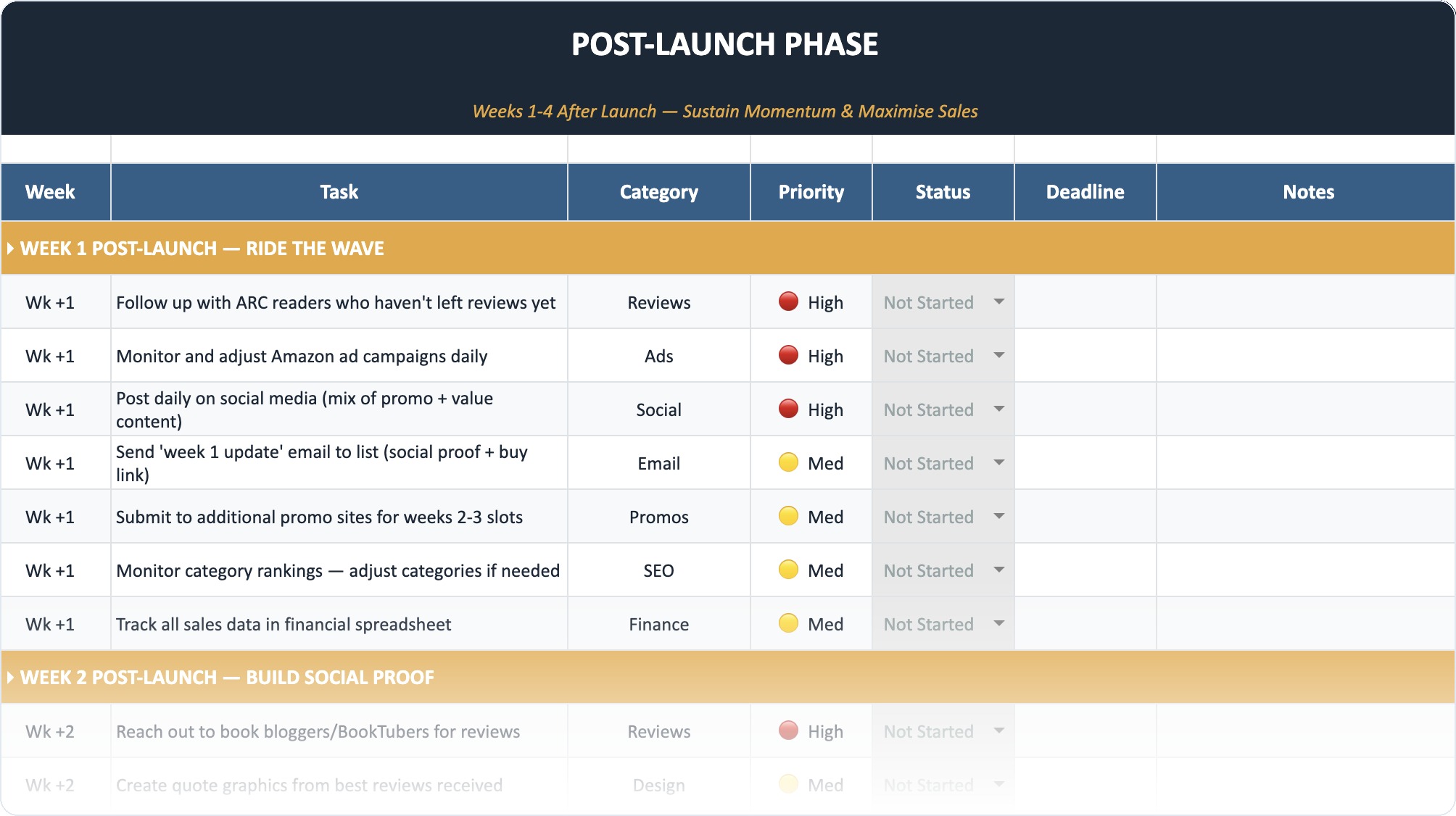
The Self-Publishing Launch Checklist (2026)
A week-by-week spreadsheet that walks you through every step of launching your book. Available as an Excel file and Google Sheet.
Troubleshooting: When You Get No Response
You sent fifty emails. You got zero replies. Why?
- You asked for too much. Did you ask them to buy the book? Never ask them to buy it initially. Offer a review copy to the organizer.
- You didn't personalize. "Dear Book Club" goes to the trash. "Dear Sarah" gets read.
- Wrong Genre. Did you pitch a sci-fi book to a group that only reads memoirs? Do your homework.
- Your Email was too long. Keep it under 150 words. Who are you? What is the book? What is the offer?
Expanding Your Reach with "Reading Guides"
Another tactic is reaching out to websites that host reading guides. Sites like LitLovers or ReadingGroupGuides are databases for clubs. While some are reserved for big publishers, many smaller blogs and sites curate lists for specific genres.
If you have a strong blog presence, write a post titled "Top 10 Books for Clubs Who Love [Your Genre]" and include your own book in the list. This is classic SEO. When an organizer searches for recommendations, they find your list. For more on creating content that draws readers in, check out our advice on writing tips for beginners.
Conclusion
Getting your book into book clubs is a long game. It requires research, persistence, and a willingness to put yourself out there. But the reward is a dedicated army of readers who will advocate for your work. Don't wait for the call. Make the kit. Send the email. Join the discussion.
Frequently Asked Questions
How do I find book clubs in my area?
Check with your local library first; they almost always host or know of local groups. Independent bookstores are another prime spot. Websites like Meetup.com and the app Bookclubs are excellent for finding specific genre groups near you.
Should I charge book clubs for an author visit?
Generally, no. If you are a self-published or mid-list author, the value of selling 10-15 books and gaining loyal fans outweighs a speaking fee. If a library or institution invites you for a formal presentation, that is different. However, for a private living-room book club, do it for free.
What if my book contains controversial content?
Controversy is actually great for book clubs. Groups thrive on debate. If your book tackles difficult subjects, highlight that in your pitch. Frame it as "a book that sparks conversation about [Topic]."
How long should my discussion guide be?
Keep it between two to four pages. Include 10-15 questions, a brief author bio, and maybe a letter to the readers. Any longer and it becomes a homework assignment rather than a helpful tool.
Can I start my own book club to promote my book?
You can, but be careful. If you start a club just to make them read your book, it looks self-serving. It is better to start a genre club (e.g., "The Austin Sci-Fi Club"), build a community around reading various authors, and eventually introduce your book as one of the monthly picks.
"B086M2B6X8"
Check Price on Amazon →As an Amazon Associate, we earn from qualifying purchases.