

A character finds a key that doesn't fit any lock in their house. It opens a forgotten box in their grandmother's attic, which holds a single, impossible photograph. Your first chapter is that key. It has one job: make the reader desperate to open the box. To write a first chapter hook that works, you must pose an irresistible question, introduce a voice that grabs them, and promise an unforgettable journey, all within the first few pages.
- Start in Action: Begin in medias res (in the middle of things). Ditch the morning routine and drop the reader directly into a moment of tension or decision.
- Raise a Question: Your first page must make the reader ask, "What is going on here?" or "What happens next?" This creates immediate curiosity.
- Establish Voice: Let the character's personality bleed onto the page through their thoughts, words, and actions. A unique voice is more memorable than a perfect plot point.
- Promise the Premise: Hint at the central genre and conflict of your story. If it's a fantasy, show a spark of magic. If it's a thriller, introduce a shadow of danger.
Why Your First Chapter Hook is Everything in 2026
The slush pile isn't a pile anymore. It's a digital mountain, and it's growing. With manuscript submissions expected to climb, literary agents and editors are looking for any reason to say "no" fast. They don't have time for a slow burn that pays off in chapter three. You get one page, maybe two, to prove your story is worth their time.
This isn't just about agents. Readers browsing on Amazon or in a bookstore operate the same way. They read the first page, and if it doesn't grab them, the book goes back on the shelf. The hook is more than a clever opening line; it’s the entire experience of the first chapter, a promise that this story is one they can't afford to miss. The goal is to make putting the book down feel like a mistake.
How to Write a First Chapter Hook: 7 Proven Techniques
Forget complex theories. Hooking a reader relies on a few powerful, actionable strategies. You don't need to use all of them, but the best openings layer two or three to create an undeniable pull.
1. Start In Medias Res (In the Middle of Action)
This is Latin for "in the middle of things," and it's the single most powerful novel opening technique. Instead of starting with your character waking up, having breakfast, and thinking about the day, you drop the reader directly into a scene already in progress.
Why it works: It bypasses boring setup and creates immediate forward momentum. The reader is instantly playing catch-up, forcing them to ask questions: Where are we? Who are these people? How did they get into this situation?
- Bad Example: "The alarm blared at 6:00 AM. Sarah groaned and rolled over, slapping the snooze button. She hated Mondays. She dragged herself out of bed, shuffled to the kitchen, and put on a pot of coffee, thinking about the boring budget meeting she had at 9:00."
- Good Example: "The getaway car smelled like cheap air freshener and panic. Sarah gripped the wheel, ignoring the blare of sirens behind them and the man in her passenger seat shouting something about a briefcase."
See the difference? The first example has no stakes. The second is packed with tension and questions. We want to know who the man is, what's in the briefcase, and if they'll escape. That's a hook. If you're outlining your novel, our guide on how to outline your book for faster writing can help you pinpoint the perfect in-action starting point.
2. Raise a Question Immediately
Curiosity is a powerful engine. Your opening page should function like a mystery box. You don't need to show the reader everything inside; you just need to make them desperate to know what's in it. The questions can be big or small.
- Big Question: "The man in black fled across the desert, and the gunslinger followed." (Stephen King, The Gunslinger). Who is the man in black? Why is the gunslinger following him?
- Small Question: "It was a bright cold day in April, and the clocks were striking thirteen." (George Orwell, Nineteen Eighty-Four). Why thirteen? What kind of place is this?
Your goal is to create an information gap that the reader feels an urge to fill. Don't answer the question right away. Let it simmer. This is especially vital if you want to write a murder mystery, where the entire plot is built on a foundation of questions.
3. Introduce a Powerful, Unmistakable Voice
Plot can be generic, but a character's voice is unique. Voice is the personality of your narrator or protagonist shining through the words on the page. It's their worldview, their humor, their cynicism, their fears. A strong voice can make even a simple plot feel fresh and exciting.
[quote author="An Agent's Perspective"]Agents look for voice, tone, mood, setting, urgency, pace, description, dialogue, and a natural approach to your characters.[/quote]
Think about Holden Caulfield in The Catcher in the Rye or Frank McCourt in Angela's Ashes. You would recognize their narration anywhere. You establish voice through:
- Internal Thought: What does your character think but not say?
- Word Choice: Do they use slang or formal language? Are they poetic or blunt?
- Observation: What details do they notice about the world around them? A cynical character might notice the peeling paint, while an optimistic one notices the single flower growing through a crack in the pavement.
A strong voice is one of the key elements agents look for. In fact, many agents will read sample pages before even finishing the query letter because the writing has to stand on its own.
4. Show a Character in Meaningful Action
This connects directly to starting in medias res. The action doesn't have to be a car chase or a duel, but the character must be doing something that reveals who they are.
The cardinal sin of first chapters is starting with a character waking up. Why? Because it's passive. Nothing is happening. There are no stakes. It's a pointless, everyday activity that tells us nothing unique about the character.
- Meaningless Action: Waking up, brushing teeth, making coffee, driving to work.
- Meaningful Action: Trying to pick a lock, hiding a body, rehearsing a breakup speech in the mirror, desperately trying to fold a fitted sheet.
Each of those "meaningful" actions tells us something about the character's situation and personality. It gives them an immediate, tangible goal, even if it's small. The action should define the character. If you need inspiration, our guide on how to write fight scenes can teach you a lot about showing character through high-stakes action.
5. Make the "Promise of the Premise"
Your first chapter is a contract with the reader. It needs to accurately advertise the kind of story they're about to read. If you're writing a high-fantasy epic, the first chapter should contain a hint of magic, lore, or the coming conflict. If it's a gritty detective story, it should feel dark and dangerous.
Misleading the reader is a betrayal. Don't start with a quiet, literary character study if the book is actually an action-packed thriller. The first chapter sets the tone, genre, and stakes.
For example, if you plan to write a fantasy series, your opening must deliver on that promise. Show us a dragon flying overhead, a character casting a simple spell, or an ancient prophecy being whispered. This assures the reader they've picked up the right book.
6. Create Immediate Conflict or Tension
Conflict is the heart of story. Every scene needs it, but the first chapter needs it most. Conflict takes many forms beyond physical fights. It can be:
- Internal Conflict: A character wrestling with a difficult decision.
- Interpersonal Conflict: A tense conversation between two characters with opposing goals.
- Environmental Conflict: A character battling the elements, like being stuck in a blizzard.
The conflict in chapter one should be a micro-version of the book's larger conflict. If the book is about a woman learning to stand up to her overbearing mother, the first chapter could feature a small argument over what to have for dinner. This introduces the central dynamic and hints at the larger struggles to come. If you're struggling with this, our guide on how to write your first book walks you through how to build these foundational conflicts.
7. Use a Startling or Contrarian Opening Line
The first sentence is your handshake. Make it firm. A great opening line often introduces a strange situation, a contrarian thought, or a profound statement.
- "Happy families are all alike; every unhappy family is unhappy in its own way." (Leo Tolstoy, Anna Karenina)
- "I am a sick man… I am a spiteful man." (Fyodor Dostoevsky, Notes from Underground)
- "It is a truth universally acknowledged, that a single man in possession of a good fortune, must be in want of a wife." (Jane Austen, Pride and Prejudice)
These lines work because they make you stop and think. They establish a strong voice and a clear theme from the very first breath of the story.
Common First Chapter Mistakes (And How to Fix Them)
Knowing what to do is half the battle. Knowing what to avoid is the other half. Most aspiring authors make the same handful of mistakes in their opening pages.
The Info-Dump Catastrophe
This is the most common and deadly mistake. An info-dump is when the author stops the story to deliver a chunk of exposition about the world's history, the magic system, or a character's backstory. It's boring, and it kills all momentum. The reality is, readers don't need to know everything at once.
- The Fix: Weave information in naturally through dialogue and action. Instead of telling us two kingdoms have been at war for a century, show us a border town with ruined buildings and suspicious guards. Instead of explaining the magic system, show a character using a spell to solve a problem.
Think of backstory and world-building like spices. You want to sprinkle them into the story to add flavor, not dump the whole jar in at once.
The Passive Protagonist Problem
A passive protagonist is one who doesn't make decisions. They're dragged along by the plot, reacting to things instead of acting. This is a problem because readers connect with characters who have goals and actively pursue them.
- The Fix: Give your protagonist a clear, immediate goal on page one. It doesn't have to be "save the world." It can be "convince my boss not to fire me," "find my lost dog," or "ask my crush out on a date." An active character is always more interesting.
Starting Too Early (The "Waking Up" Sin)
We've covered this, but it's worth repeating. Your story begins at the moment your character's normal life is about to change forever. Don't show us the "normal life" for ten pages. Start one minute before the inciting incident. Find the first truly interesting moment and begin there.
Drowning in Description
Description is important for setting the scene, but too much of it, especially at the beginning, can slow the pace to a crawl. Over-describing a room, a character's outfit, or the landscape before anything has happened makes the reader's eyes glaze over.
- The Fix: Filter description through your character's point of view. What do they notice? A thief casing a house won't notice the color of the curtains; they'll notice the type of lock on the window. A character who is late and panicking won't be admiring the architecture. Let the character's emotional state dictate the level of detail.
The Prologue Debate: To Use or Not to Use?
Many agents and editors sigh when they see a prologue. This isn't because all prologues are bad; it's because most are used incorrectly. A bad prologue is often a disguised info-dump or a scene that could have been woven into the main story later.
However, a good prologue can be incredibly powerful. A strong prologue should:
- Be short and punchy.
- Take place at a different time or from a different POV than the main story.
- Introduce a key mystery or piece of foreshadowing that will pay off later.
- Raise a question that makes the reader eager to get to Chapter One.
If your prologue doesn't do all of these things, you probably don't need it. Cut it and see if the story still works.
Stop Staring at a Blank Page
Publy is a distraction-free book editor with AI built in. Brainstorm plot ideas, get instant chapter reviews, or rewrite clunky paragraphs. 3 million free words included.

First Page vs. First Chapter
Think of your opening on two different scales. The first page has a more urgent job than the first chapter as a whole.
| Element | The First Page's Goal | The First Chapter's Goal |
|---|---|---|
| Pacing | Urgent. Create immediate intrigue. | Establish rhythm. Introduce the story's pace. |
| Question | Pose one big question. Make the reader turn the page. | Introduce the main conflict. Hint at the story's central problem. |
| Character | Establish voice. Show personality through a single action or thought. | Introduce the protagonist. Show their situation, desire, and flaw. |
| Plot | Hint at action. A moment of tension. | Set the scene. Ground the reader in the setting and time period. |
| Reader Goal | Make them read the next page. | Make them emotionally invested in the protagonist's journey. |
The first page is the hook. The first chapter is what sets the hook and begins to reel the reader in. If you're trying to publish shorter pieces, our guide on how to self-publish a short story for beginners can provide more focused advice.
What Literary Agents Actually Look For in 2026
The publishing world is fiercely competitive. Agents are swamped with submissions and need to make quick decisions. When they open your manuscript, here is what they hope to find.
They're looking for a story that grabs them from the first sentence. They want a distinct voice and a clear sense of urgency. The writing itself has to be polished and confident. Just look at agent wish lists. Genres like Young Adult (YA) and LGBTQ+ fiction are consistently in high demand.
They want to see that you, the author, have a clear vision for your story. A strong first chapter demonstrates that you know your characters, you have a grip on your plot, and you have the writing skill to execute your premise. It shows them you're an author with a book, not just a writer with an idea. Making sure your manuscript is clean and readable is a big part of that, and comparing tools like ProWritingAid vs Grammarly can help you present your best work.
They're looking for a book they can't put down, because if they feel that way, they know readers will too. Your first chapter is your one and only chance to create that feeling.
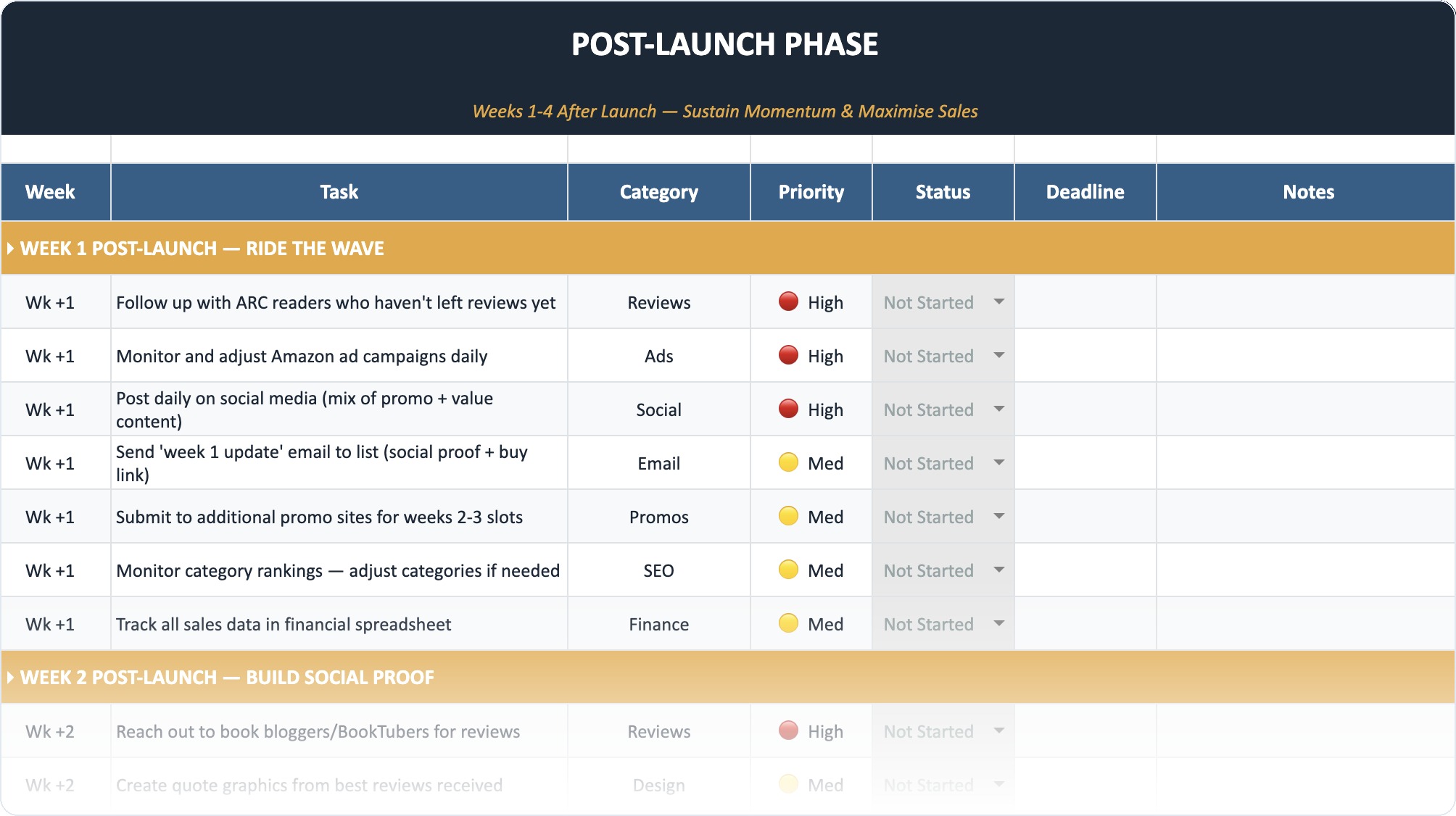
The Self-Publishing Launch Checklist (2026)
A week-by-week spreadsheet that walks you through every step of launching your book. Available as an Excel file and Google Sheet.
Frequently Asked Questions
How long should a first chapter be?
There's no magic number, but a typical first chapter for a novel falls between 1,500 and 5,000 words. The key is to make it long enough to introduce your character and their initial situation, establish the tone, and present a hook they can't ignore, but short enough that it doesn't drag or feel bloated with unnecessary setup.
Is it okay to start a story with dialogue?
Absolutely. Starting with a line of dialogue can be an excellent way to hook a reader. It throws them directly into a scene and can immediately reveal character and conflict. Just make sure the line is intriguing and raises a question, like "It wasn't supposed to be you."
Can my first chapter be slow if the rest of the book is fast-paced?
This is risky. Your first chapter sets the reader's expectations for the rest of the book. Starting slow can signal to the reader that the entire book will have a slower pace, causing them to put it down if they were looking for action. It's better to match the first chapter's energy to the overall energy of your novel.
Should I introduce the villain in chapter one?
You don't have to introduce the villain themselves, but you should introduce the threat of the villain or the central conflict they represent. A hint of danger, an unsolved crime, or a character living in fear can be more powerful than a full-blown appearance by the antagonist on page one.
What's the difference between a hook and an inciting incident?
A hook is what grabs the reader's attention on the first page or two, often a question or a striking voice. The inciting incident is the precise event that kicks off the main plot and forces the protagonist out of their normal life. The hook gets the reader to the inciting incident, which usually occurs later in the first chapter or a few chapters in.