
The global children’s book market will hit nearly $11 billion in 2026. Yet, most new authors quit before they ever hold a physical copy of their book. They underestimate the technical difficulty of the format.
Writing a story is only the first step. You are actually engineering a physical product that must survive sticky hands, repeated readings, and the cold math of online retailers. If you want to publish a children's book that actually sells, stop thinking like a writer and start thinking like a publisher.
- Market Growth: The industry is valued at over $10 billion in 2026, driven by digital innovation and high demand for early literacy.
- Strict Formats: Most picture books must be exactly 32 pages.
- Word Count: Keep it under 500 words for ages 3-7.
- Illustrations: This is the most expensive part of the process; expect to pay for quality.
- Distribution: Use Amazon KDP for speed and IngramSpark for wider library distribution.
Why Publish a Children's Book Now?
The time to enter this market is now. But you must know the numbers. The industry isn't shrinking. It is changing. A 360iResearch market report projects the global children's book market will reach USD 10.99 billion in 2026.
Traditional bookstores aren't the only drivers here. A surge in digital-first lines, interactive eBooks, and high demand for educational materials in the Asia-Pacific region fuels this growth.
Parents look for books that do heavy lifting. While they want entertainment, they also demand tools that help with brain development and education. If you can write a book that solves a problem (like potty training, dealing with grief, or learning about new cultures) you have a built-in audience.
However, the competition is fierce. Overall U.S. consumer book sales dipped slightly in early 2025. Jane Friedman's sales update notes this decline. You can't rely on luck. You need a plan to separate your book from the thousands of titles uploaded every day.
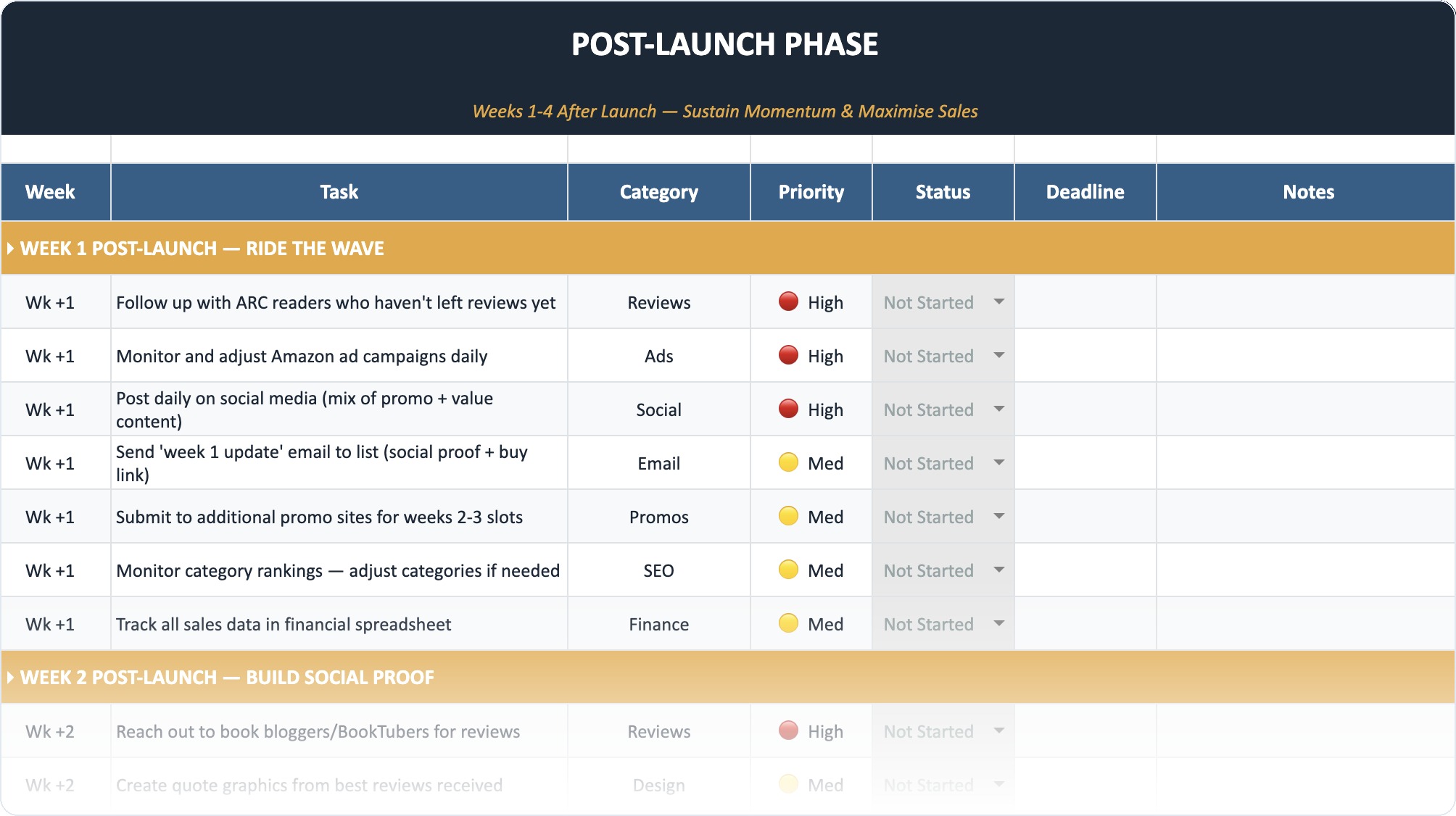
The Self-Publishing Launch Checklist (2026)
A week-by-week spreadsheet that walks you through every step of launching your book. Available as an Excel file and Google Sheet.
The Picture Book Format Explained (The 32-Page Rule)
Remember one thing from this guide. Standard picture books are 32 pages.
Not 30. Not 34. Exactly 32.
This rule exists for a manufacturing reason, not to annoy you. Books are printed on large sheets of paper folded into groups of 8, 16, or 32 pages. These are called "signatures." If you submit a 34-page file to a printer, you end up with blank pages at the end. That looks unprofessional.
Here is how those 32 pages usually break down:
- Page 1: Title Page (Right side).
- Page 2-3: Copyright and Dedication.
- Page 4-5: The story begins.
- Page 32: The end (or a call to action/author bio).
The Word Count Trap
New authors usually write too much. Standard picture books for ages 3 to 7 should have under 500 words. If you are pushing 800 or 1,000 words, you are writing a "storyteller" book. Those are harder to sell in the current market.
Parents are tired. They don't want to read a novel at bedtime. They want a snappy, fun story they can finish in five minutes.
Go to a library and type out the text of 10 best-selling picture books. You will be shocked at how short they are. Most come in under 400 words.
Writing the Story: Prose vs. Rhyme
Should you rhyme? No.
Bad rhyme is the main reason agents reject manuscripts and readers ignore them. Writing in rhyme forces you to twist sentences to fit a meter. The story stops making sense. "The cat sat on the mat / he saw a bat / and wore a hat." Reading that hurts.
Unless you are a trained poet who knows meter, stress, and scansion, write in prose. Prose lets you focus on the story arc, character growth, and the emotional heart of the book.
The "Page Turn" Technique
Turning the page is part of the pacing in a picture book. You need to write your story so every right-hand page (the odd-numbered pages) ends with a mini-cliffhanger. This makes the child want to turn the page.
- Weak: "The dog went to sleep."
- Strong: "The dog closed his eyes, but then he heard a strange scratch at the door…"
This interaction keeps the child interested. If you struggle to structure your narrative, check our guide on writing a story from a picture. It helps generate visual-first ideas.
Illustrating Your Book: The Make or Break Factor
You can't publish a children's book with bad art. Children learn visually. They read the pictures before they read the words. If your cover looks amateur, parents will scroll past it on Amazon without a second thought.
You have three options here. They vary wildly in cost and quality.
1. Hire a Professional Illustrator
This is the standard path. You can find illustrators on sites like Reedsy, Upwork, or Instagram. A full 32-page spread costs between $2,000 and $10,000. Experience dictates the price.
Hiring involves more than looking for pretty pictures. You need an artist who keeps characters consistent. The main character must look the same on page 4 as they do on page 32. This is harder than it sounds.
2. The Hybrid/Agency Model
Some services act as a middleman. They pair you with vetted artists. This adds a layer of safety but raises the price. Austin Macauley's 2026 publishing guide notes that hybrid models are becoming popular for authors who want professional results without managing a freelancer directly.
3. DIY or AI (The Controversial Route)
If you are an artist, great. If not, don't try to draw it yourself. Stick figures won't cut it.
Regarding AI art: Tools like Midjourney are powerful. But they struggle with consistency. Getting the same character in different poses across 32 pages is a technical nightmare. Also, the copyright status of AI-generated art remains murky in 2026. Human artistry is safer if you want to own your intellectual property.
Words and pictures are yin and yang. Married, they produce a progeny more interesting than either parent.
Dr. Seuss
Avoid common design errors. Just as with novels, poor design signals low quality. Check our breakdown of 7 book cover mistakes that are costing you sales to make sure your illustrator hits the mark.
Stop Staring at a Blank Page
Publy is a distraction-free book editor with AI built in. Brainstorm plot ideas, get instant chapter reviews, or rewrite clunky paragraphs. 3 million free words included.

Layout and Formatting for Print
Writing the text and getting the art is only half the battle. You must combine them into a printable file. Many self-publishing authors fail here.
Text Hierarchy and Placement
You can't just slap text over an image. It might look readable on your screen. Once printed, dark text on a dark background becomes invisible.
- Full Bleed: Images should extend 0.125 inches past the edge of the page. This prevents white stripes at the edges when the printer trims the paper.
- The Gutter: The center of the book where the pages are glued is the gutter. Don't put important faces or text there. They will vanish into the binding.
- Font Choice: Use a large, clear font. Sans-serif fonts like Century Gothic or Comic Neue (yes, really) work better for early readers than serif fonts.
Software Tools
Don't use Microsoft Word for layout. It can't handle print-ready PDF export with bleed correctly.
- Adobe InDesign: The industry standard. High learning curve, but gives total control.
- Canva: Usable. Be careful with "Print PDF" settings. You must select CMYK color profile, not RGB.
- Atticus: Great for novels. Currently limited for complex picture books with many images.
For a closer look at the technical side, especially the front matter, review what a title page in a book should look like.
Publishing Platforms: KDP vs. IngramSpark
Where should you upload your files? Amazon KDP (Kindle Direct Publishing) and IngramSpark are the giants. Most successful indie authors use both.
Amazon KDP
KDP is the easiest start. Uploading is free. Your book appears on Amazon within 72 hours. But KDP doesn't offer a hardcover option with a dust jacket (only case laminate). Their paper quality is "good enough," not premium.
IngramSpark
IngramSpark distributes to bookstores and libraries. If you want your book in a physical Barnes & Noble or a local library, you need IngramSpark. They offer premium paper options and cloth-bound hardcovers.
- Amazon KDP
- Free to upload
- Fast approval
- Dominates online sales
- No library distribution
- Limited hardcover options
- Higher print costs for color IngramSpark
- Global distribution
- Premium print quality
- Returns program available
- Upload fees (often waivable)
- Terrible interface
- Slower approval times
High production costs block new entrants, according to Global Market Statistics analysis. Calculate your royalties with care. A 32-page color book costs much more to print than a black-and-white novel. You might have to price your paperback at $12.99 or higher to profit.
For a direct comparison of print-on-demand services, read our guide on Lulu vs. Amazon KDP.
The ISBN Question
Do you need an ISBN?
If you publish on KDP, Amazon gives you a free ISBN. Don't take it.
Using Amazon's free ISBN lists Amazon as the publisher. You can't take that ISBN to another printer. If you want to publish on IngramSpark later, you need a new ISBN. This creates a duplicate listing of your book.
Buy your own ISBNs from Bowker (in the US) or Nielsen (in the UK). This makes you the publisher of record. It lets you use the same ISBN everywhere. It looks more professional and gives you control over your metadata.
Register your work to protect it once you have your ISBN. See our copyright registration walkthrough for the exact steps.
Marketing Your Children's Book
Publishing is easy. Selling is hard. You can't just tweet a link and expect sales.
1. Reviews are Oxygen
You need 10+ reviews in the first week to trigger Amazon's algorithm. Send PDF copies to friends, family, and beta readers before launch. Ask them to leave an honest review on launch day.
2. Amazon Advertising
This is pay-to-play. Target keywords like "bedtime stories for toddlers" or target particular competitor books. Start with a low budget ($5/day) and test different ad copy.
3. Local Outreach
Children's books sell well in person. Contact local libraries for story time slots. Reach out to independent toy stores (not just bookstores) and ask if they carry local authors.
4. School Visits
This is the big goal. Booking school visits can sell hundreds of books in a single day. You need an interesting presentation, not just a reading.
Series Potential
One book rarely makes a business. The most successful children's authors create characters that sustain a series. If "Pete the Cat" only had one book, the author wouldn't be famous.
Think about the character's future when planning your first book. Can they go to school? Can they visit the moon? Can they learn to share? A series builds a backlist. A backlist builds passive income.
Visual consistency matters if you turn your book into a series. Learn more about maintaining a brand across multiple titles in our guide to creating a consistent look for book series covers.
Final Checklist for Aspiring Authors
Run through this list before you hit publish. If you miss one, you aren't ready.
- Is the story under 500 words? (For ages 3-7).
- Is the page count exactly 32? (Or multiples of 8).
- Do you own your own ISBN?
- Are your images 300 DPI CMYK? (High resolution for print).
- Is your text legible against the background?
- Have you ordered a physical proof copy? (Never publish without seeing the physical book).
Writing a children's book is harder than it looks. It requires brevity, visual smarts, and patience. But seeing a child laugh at your joke or ask to read your story "one more time" is special. A spreadsheet can't give you that feeling.
Adopt a structured schedule to keep your momentum going. Check out my exact daily writing routine to see how professionals organize their creative time.
Frequently Asked Questions
How much does it cost to publish a children's book?
It varies. A professional self-published picture book typically costs between $3,000 and $6,000. Illustration takes most of the budget (usually $2,000+). You can do it for less, but quality often suffers.
Can I use Amazon KDP for hardcover books?
Yes, KDP offers hardcover options now. But they are "case laminate" (art printed directly on the cover). They don't currently offer cloth-bound books or dust jackets. You need IngramSpark for those features.
How do I find an illustrator?
Platforms like Reedsy, Upwork, and Fiverr are common starts. Instagram is often the best place to find talent. Search hashtags like #childrensbookillustration or #kidlitart. Message the artist directly for their rates.
What is the standard size for a picture book?
Common trim sizes are 8.5" x 8.5" (square) or 8" x 10" (portrait). Square books fit shelves easily. They also work with almost all print-on-demand machines.
Should I copyright my book before sending it to illustrators?
Technically, you own the copyright the moment you write the story. Professional illustrators have no interest in stealing your text. You can register your copyright with the US Copyright Office for legal protection before publishing though.
Do I need a literary agent to self-publish?
No. Agents are only necessary if you want a traditional publishing deal with major houses like Penguin Random House. If you are self-publishing, you are the boss.