

70% of readers decide to buy a book based on its cover alone. If your design fails, the other 30% won't matter. They will never click on your book in the first place.
Most authors spend years writing a manuscript only to wrap it in a design that yells "amateur" within milliseconds. The reality of the book market is brutal. You aren't just competing with other indie authors. You are fighting traditional publishing houses that spend thousands of dollars on market research and design teams.
We will break down the most common book cover mistakes that kill sales before they happen. Let's look at why these errors occur, how to identify them in your own work, and exactly how to fix them to ensure your book gets the attention it deserves.
- Genre signals matter more than art. If your thriller looks like a romance, you lose both audiences instantly.
- Thumbnails drive discovery. 70% of browsing happens on mobile. If your text is unreadable at 150 pixels, your book is invisible.
- Typography is not an afterthought. Bad font choice is the number one indicator of a DIY cover.
- Consistency builds careers. Changing your design style halfway through a series confuses readers and hurts read-through rates.
1. Ignoring Genre Expectations (The "Confused Cat" Problem)
The single biggest sales killer is category confusion. This happens when an author puts "cool art" ahead of clear communication. A book cover isn't a piece of art to hang in a gallery. It is commercial packaging intended to signal a specific product to a specific buyer.
If you write a cozy mystery, readers expect bright colors, illustrated vectors, and perhaps a cat or a teacup. If you deliver a dark, moody, photographic cover because you think it looks "more serious," you failed. The cozy mystery reader will scroll past because it looks like a thriller. The thriller reader will click, realize it's a cozy mystery, and bounce immediately.
According to a report on visual storytelling, category confusion is the top reason for underperforming book sales. Readers have been trained by thousands of books to associate specific colors, fonts, and layouts with specific emotions. Breaking these rules doesn't make you a maverick; it makes you invisible.
The Fix: Market Research
Go to the Amazon Best Sellers list for your specific sub-genre. Look at the top 20 books. Don't look at what you like. Look for patterns.
- Color Palettes: Are they dark and blue? Bright and yellow? Red and black?
- Imagery: Is it mostly illustrated? Mostly photographic? Mostly typography?
- Fonts: Are they serif (fancy feet) or sans-serif (blocky)?
Take screenshots of the top 50 books in your genre. Shrink them down to thumbnail size and put your cover in the middle. If yours stands out too much, that is usually a bad thing. You want to fit in then stand out.
Your goal is to look like you belong on the shelf next to the bestsellers. You can learn more about how visual signals impact your position in our guide to ranking on Apple Books, where consistent genre signaling is a primary ranking factor.
Stop Staring at a Blank Page
Publy is a distraction-free book editor with AI built in. Brainstorm plot ideas, get instant chapter reviews, or rewrite clunky paragraphs. 3 million free words included.

2. The Thumbnail Fail (Invisibility at 150px)
Smartphones dominate discovery. Most readers will encounter your book for the first time as a tiny image on a small screen. This image is often no larger than 150 pixels wide.
One of the most frequent book cover mistakes is designing for the print version first. Authors fall in love with details: subtle gradients and complex scenes that look beautiful on a 27-inch monitor or a physical paperback. Shrink that same image down to the size of a postage stamp. It becomes a muddy, illegible blur.
The "Squint Test"
If you cannot read the title and identify the central image while squinting at the cover on your phone, the design failed. High contrast is your best friend here.
- Contrast: You need strong differences between light and dark. A dark gray title on a black background vanishes at small sizes.
- Composition: Stick to one central focal point. A character, a symbol, or a weapon. Trying to show a whole battle scene usually results in visual soup.
- Text Hierarchy: Your title needs to be the biggest thing on the cover. Your author name should be second. Everything else is clutter.
If you aren't sure if your design holds up, test it relentlessly. A cover that pops at full size but fails at thumbnail size is useless for digital sales.
3. Typography Crimes (The "Bleeding Eyes" Font)
Nothing screams "self-published" louder than bad typography. You can have an award-winning illustration, but if you slap standard Word Art or a default system font on top of it, you ruined the product.
Common Typography Errors:
- Papyrus and Comic Sans: Never use these. Ever.
- Unreadable Script: Fancy, swirling fonts might look romantic, but if the reader has to guess what the word is, they will keep scrolling.
- Poor Color Choice: Putting red text on a blue background causes a visual vibration that hurts the eyes. Putting white text on a light background makes it invisible.
- Touching the Edges: Amateur designers often put text too close to the edge of the cover. This creates tension and looks like a mistake.
Professional typography treats the text as part of the image, not a sticker pasted on top. The font should interact with the elements. Perhaps a character's head obscures part of a letter, or the text weaves behind a building. This creates depth.
Typography is the voice of your cover. If the font is weak, the book whispers. If the font is strong, the book shouts.
For a deeper look into how professional designers handle text across multiple books, check out our article on book series cover design.
4. The DIY Disaster and Cheap Stock Photos
Budget concerns drive many authors to design their own covers using free tools or cheap stock photos. While money is a valid worry, your cover is your main marketing asset. Skimping here is expensive in the long run because it costs you sales.
The Stock Photo Trap
Using a generic stock photo of a "sad woman looking out a window" might seem safe. But thousands of other authors have access to that same image. Readers notice when the same model appears on ten different book covers in the same month. It cheapens your brand.
The AI Art Controversy (2026 Context)
By 2026, generated covers flooded the market. While tools like Midjourney can create striking images, they often lack the human touch and specific composition needed for a book cover. They struggle with text and often create uncanny artifacts (like six fingers) that readers spot immediately.
Relying entirely on AI without legal vetting can also land you in hot water regarding copyright. If you consider using generated assets, understand the legal landscape first. We cover the risks and rights in our Midjourney book covers legal guide.
According to 99designs, the trend for 2026 moves heavily toward "anti-AI" styles. This includes visible brush strokes, texture, and human imperfections that signal authenticity.
5. Cluttered Composition (Where Does the Eye Go?)
A common mistake among new authors is trying to tell the entire story on the cover. They want the protagonist, the villain, the magic sword, the castle, the pet dragon, and the moon all in one image.
This leads to a cluttered mess.
The Rule of One
Your cover should focus on one core concept or emotion. It doesn't need to summarize the plot. It needs to sell the feeling of the plot.
- Romance: Focus on the couple or the chemistry.
- Thriller: Focus on the danger or the mystery.
- Non-Fiction: Focus on the benefit or the result.
White space (or negative space) is not wasted space. It allows the eye to rest and directs attention to the most important elements: usually the title and the central image.
If you write fantasy, it is tempting to show off your worldbuilding. However, a complex map or city scene often lacks the emotional punch of a single, powerful symbol. Save the detailed descriptions for the interior. For advice on building those worlds inside the book, see our fantasy worldbuilding tips.
6. Inconsistent Series Branding
Series covers must look like siblings. They don't need to be identical twins, but they must clearly belong to the same family.
A massive mistake is changing the font, the layout style, or the artist halfway through a series. This breaks the visual link for the reader. If a reader finishes Book 1 and loves it, they will look for Book 2. If Book 2 looks completely different, they might not realize it's the sequel.
Elements to Standardize:
- Title Font: Use the exact same font for every book in the series.
- Author Name Placement: Keep it in the same spot at the same size.
- Composition Structure: If Book 1 has a character at the bottom and the title at the top, Book 2 should follow a similar layout.
This branding helps you sell the backlist. When a reader sees a grid of your books, they should look like a unified set.
Branding expectations are very tight if you write in a specific niche like zombie fiction (gritty textures, green/red palettes). Deviating from this breaks the promise to the reader. You can see how specific genre tropes dictate design in our guide on how to write a zombie book.
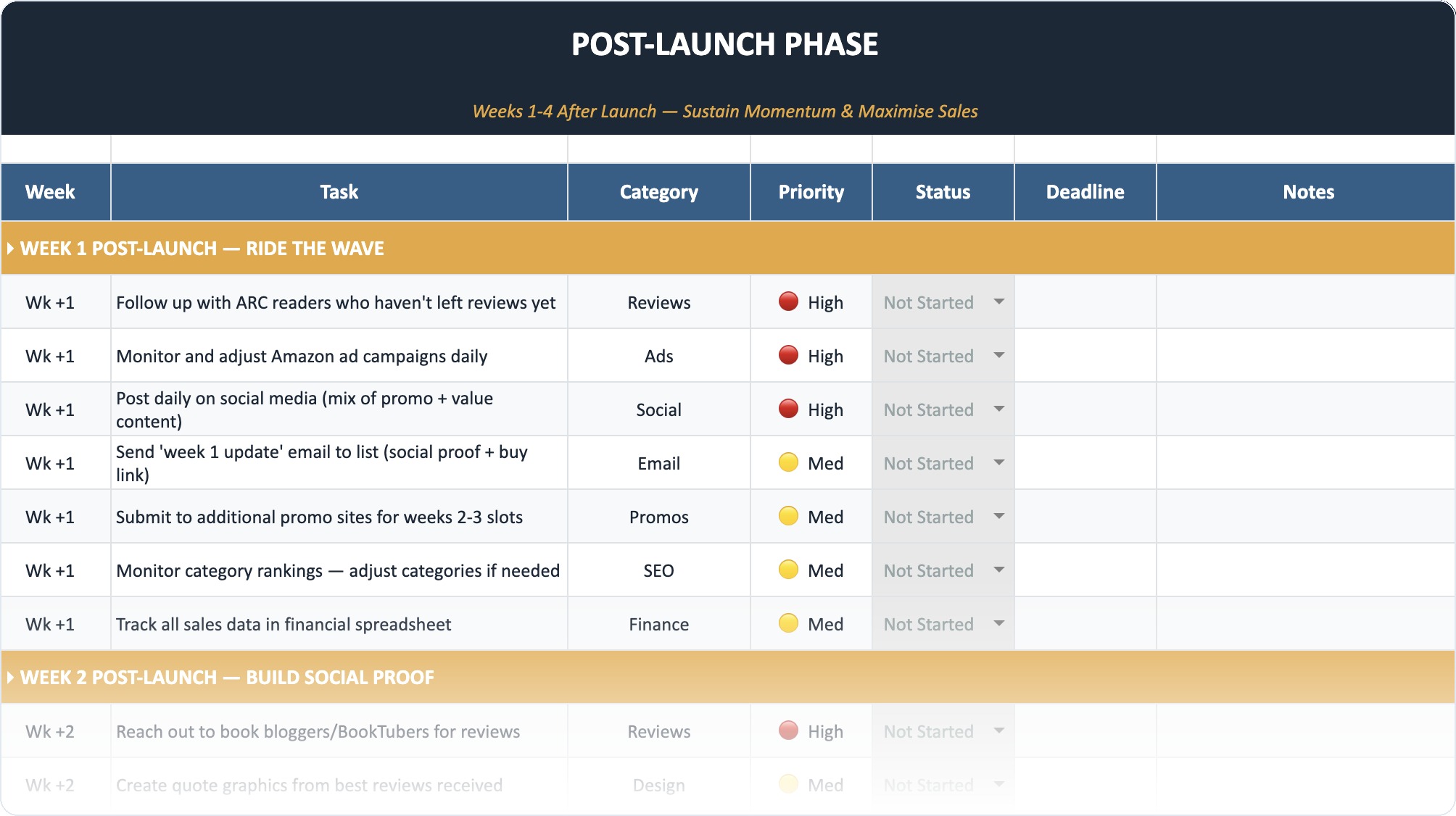
The Self-Publishing Launch Checklist (2026)
A week-by-week spreadsheet that walks you through every step of launching your book. Available as an Excel file and Google Sheet.
7. Ignoring the Back Cover and Spine
The front cover gets all the glory, but the spine and back cover are workhorses for physical sales. If you plan to sell paperbacks or get into libraries and bookstores, these elements are non-negotiable.
The Spine
The spine is often the only thing a browser sees in a bookstore. It must contain the title, author name, and preferably the publisher logo or a small icon. The text must be legible and run top-to-bottom (in the US/UK markets). A blank spine or a spine with misaligned text screams "amateur."
The Back Cover
The back cover is your sales pitch. It needs to feature:
- The Blurb: A catchy summary of the story.
- Social Proof: Endorsements or review quotes.
- Author Bio: Short and relevant.
- Barcode/ISBN: Placed correctly so it doesn't cover text.
A mistake here is using a font that is too small or placing text over a busy background image. Readability is king.
If you are creating a book for younger readers, the physical appeal of the book matters even more. The brightness of the spine and the clarity of the back cover are critical for catching a parent's eye. See our related article on how to publish a children's book for more on physical formatting.
Comparison: Professional vs. Amateur Cover Impact
To visualize the cost of these mistakes, look at the performance difference between professionally designed covers and amateur attempts.
| Feature | Professional Cover | Amateur/DIY Cover | Sales Impact |
|---|---|---|---|
| Thumbnail | Clear title, strong contrast | Blurry text, muddy colors | Pro covers get +40% more clicks |
| Typography | Custom kerning, genre-specific font | Default fonts, poor spacing | Poor fonts reduce trust instantly |
| Imagery | Single focal point, emotional hook | Cluttered, literal scene depiction | Clutter confuses the buyer |
| Series Look | Consistent branding across all books | Disjointed styles | Consistency increases read-through |
| Market Fit | Matches bestseller trends | Ignores genre conventions | Wrong fit attracts wrong readers |
- Hiring a Professional Designer
- Access to market expertise
- High-quality assets
- Time-saving
- High upfront cost
- Longer turnaround time
- Less creative control for author
How to Test Your Cover Before Launching
You don't have to guess if your cover is good. You can test it.
Before you publish, use tools like PickFu or run Facebook ads to test two different cover variations. Ask strangers, not friends. Friends will lie to protect your feelings. Strangers will tell you the truth with their wallets.
Ask specifically:
- "What genre do you think this book is?"
- "Which cover would you click on?"
If the answers don't match your book, you have a problem. Feedback is painful. Frankly, it is cheaper to fix a cover now than to launch a book that fails. For strategies on dealing with harsh feedback, read our guide on handling negative reviews, which applies to pre-launch critiques as well.
2026 Design Trends You Can't Ignore
The book cover landscape changes fast. What worked in 2020 might look dated today.
According to Damonza's 2026 predictions, we are seeing a shift toward "Big Bold Typography." This trend uses the title as the main visual element; it often interacts with the imagery. It solves the thumbnail problem because the text is massive and legible.
Another trend noted by ClearVoice is the move toward "Surrealist Minimalism." This involves using strange, abstract juxtapositions to create intrigue rather than showing a literal scene from the book.
Finally, Troubador highlights the resurgence of "Retro Vibes." Specifically, 70s and 80s nostalgia dominates fonts and color palettes, particularly in the literary fiction and horror genres.
"B08748D4P5"
Check Price on Amazon →As an Amazon Associate, we earn from qualifying purchases.
Frequently Asked Questions
Can I design my own book cover?
Yes, you can, but it carries risk unless you have graphic design experience. If you choose to DIY, stick to simple, typography-driven designs and avoid complex compositions. Use tools like Canva or Photoshop, but be wary of templates that thousands of other authors use.
How much should I pay for a book cover?
Prices vary wildly. A pre-made cover can cost between $50 and $200. A custom design from a mid-level designer ranges from $300 to $800. Top-tier illustrators and designers can charge $1,500 to $5,000. Invest what you can afford, but remember that the cover is your primary marketing tool.
Does the back cover matter for eBooks?
For eBooks, the back cover is rarely seen by the buyer before purchase. However, the copy (the blurb) that would go on the back cover is used for the Amazon product description. So while the design of the back matters less for digital-only, the text is still vital.
What if I realized my cover is a mistake after publishing?
The beauty of self-publishing is that you can change your cover. This is called a "re-cover." If your book has good reviews but low sales, a new cover often revitalizes the book. Many authors re-cover their backlist every few years to keep up with trends.
How do I know if my cover fits my genre?
Look at the "also bought" section of books similar to yours on Amazon. If your cover looks like it belongs in that grid, you are on the right track. If it sticks out like a sore thumb (in a bad way), you likely missed the genre conventions.