

An author in Ohio went from making $200 a month to over $5,000 by realizing her book wasn't a product; it was the beginning of a business. Relying solely on book royalties is like building a house on a single pillar: it's unstable and terrifying. The truth is, building multiple income streams for fiction writers is not a sign of failure, but the mark of a savvy author-entrepreneur who refuses to let their career depend on the whims of a single algorithm.
- Foundation First: Maximize your core income from ebooks, print books, and audiobooks before diversifying. These are your most direct revenue sources.
- Leverage Your IP: Monetize your stories beyond the book through serialized fiction on platforms like Patreon, selling short stories, and even optioning film rights.
- Use Your Skills: Your writing expertise is valuable. Offer freelance editing, author coaching, or create online courses to generate writer side income.
- Build a Brand: Sell merchandise to superfans and use affiliate marketing to recommend tools you already use and love.
The Foundation: Squeezing Every Drop from Your Book Sales
Before you chase shiny new objects, make sure your primary asset, your book, is working as hard as it can. If you're wondering why your books aren't selling on Amazon, fix that first. These three streams are the bedrock of any author's income.
1. Ebook Royalties (The Digital Workhorse)
Ebooks are the engine of modern self-publishing. With the global ebook market projected to hit $23.6 billion by 2031, this is a non-negotiable income stream. For most indie authors, Amazon KDP is the starting point, but don't ignore other platforms.
- How it Works: You upload your formatted manuscript to platforms like Amazon KDP, Kobo Writing Life, or Apple Books. They handle the sales and delivery, and you get a percentage, called a royalty.
- Income Potential: Royalties vary. Amazon offers either 35% or 70%, depending on your book's price. Kobo and Apple generally offer a flat 70%. In 2025, self-published authors on Amazon averaged $1 to $5 per book sold.
- Who It's For: Every single author. This is step one.
Don't go exclusive with Amazon's KDP Select unless you have a clear strategy. "Going wide" by distributing to Kobo, Apple, and others can build a more resilient, long-term income, even if it's slower at first.
2. Paperback & Hardcover Sales (The Tangible Prize)
There's nothing like holding your own book. Thanks to Print-on-Demand (POD) services, you don't need a garage full of inventory to sell physical copies. Services like KDP Print and IngramSpark print and ship a book only when a customer buys one.
- How it Works: You upload a print-ready PDF of your book's interior and cover. When an order is placed on Amazon or another retailer, the POD service prints it and sends it directly to the customer. You earn a royalty after printing and distribution costs are deducted.
- Income Potential: This is where self-publishing really beats traditional deals. A self-published author might earn $4 to $8 per paperback, while a traditionally published author gets around 7.5% of the list price, which often works out to just $1 or $2.
- Who It's For: Authors who want to offer a premium product, do in-person events, or reach readers who prefer physical books.
3. Audiobook Royalties (The Fastest-Growing Market)
If you're ignoring audio, you're leaving a pile of money on the table. The audiobook market is exploding, with a projected growth to over $93 billion by 2034. It's the fastest-growing segment in all of publishing.
- How it Works: You can hire a professional narrator or, if you have the voice and equipment, narrate it yourself. Platforms like Amazon's ACX and Findaway Voices distribute your audiobook to Audible, Apple, and dozens of other retailers. Our complete guide to self-publishing audiobooks breaks down the entire process.
- Income Potential: ACX offers either a 40% royalty (if exclusive to Audible/Amazon) or a 25% royalty (non-exclusive). You can also choose a Royalty Share option, where you split the 40% royalty with your narrator instead of paying them upfront.
- Who It's For: Authors with a proven book or series. It's a significant investment of time or money, so it's best to test the waters with a book that already sells well as an ebook.
Your books are assets. They will continue to sell for your whole life and for 70 years after you die. Think long term.
Joanna Penn, The Creative Penn
Expanding Your Income Streams for Fiction Writers
Once your books are earning consistently, it's time to diversify. This is how you build a stable, full-time career and stop worrying about Amazon's latest algorithm change. These author income ideas use your existing skills and intellectual property to create new revenue.
4. Serialized Fiction & Subscriptions (Building a Community)
Before novels were sold as books, they were published in pieces in magazines. Charles Dickens was a master of the serial. This model is back in a big way on platforms like Patreon, Substack, and Kindle Vella.
- How it Works: You release your novel one chapter at a time to paying subscribers. They get early access, bonus content, or a direct connection with you. It builds a loyal community of superfans who are invested in your journey.
- Income Potential: It varies wildly. Some writers make a few hundred dollars a month, while others earn tens of thousands. According to one 2025 analysis, creators on Patreon collectively earn over $2 billion annually. For many, it's a game-changer.
- Who It's For: Prolific writers who can stick to a schedule and enjoy community interaction. It's perfect for genres like romance, sci-fi, and fantasy where readers are hungry for content. There are many great serialized fiction platforms to choose from.
5. Short Story Markets (Earn While You Hone Your Craft)
Writing short stories is a fantastic way to experiment with new ideas, reach new readers, and get paid for your words. Many professional authors got their start selling to magazines.
- How it Works: You write a short story and submit it to online or print magazines that fit your genre. Publications like Clarkesworld, The Magazine of Fantasy & Science Fiction, and various literary journals pay for stories.
- Income Potential: Payment ranges from token amounts to professional rates of 8 cents per word or more. A 5,000-word story could net you $400 from a pro market. It's not a get-rich-quick scheme, but it's a solid writer side income. Our guide on how to sell short stories for money covers the best markets for 2026.
- Who It's For: Any writer. It's great for beginners who want to build credentials and for established authors looking to stay sharp and connect with the core of their genre.
6. Freelance Editing & Author Coaching (Using Your Expertise)
You've learned how to write, edit, and publish a book. Those skills are incredibly valuable to other writers who are just starting out. Offering your services is a direct way to monetise your writing knowledge.
- How it Works: You can offer services like developmental editing (big picture story structure), copy editing (grammar and prose), or coaching (accountability and guidance). You can find clients through your own author network, social media, or on marketplaces like Reedsy.
- Income Potential: This can be very lucrative. Developmental editors charge between $0.04 and $0.08 per word, per 2025 data. For an 80,000-word novel, that's $3,200 to $6,400. Coaching can be billed hourly, often from $50 to $150 per hour.
- Who It's For: Experienced authors who have a good grasp of story craft and enjoy helping others. You need to be patient, organized, and a good communicator.
7. Creating Courses & Workshops (Teaching Your Process)
If one-on-one coaching isn't scalable, teaching one-to-many is. You can package your knowledge into a digital course, a live workshop, or a paid webinar.
- How it Works: You create video, text, or audio lessons on a specific topic, like "How to Outline a Fantasy Novel" or "Mastering Deep Point of View." You host it on a platform like Teachable or Podia and sell it to your audience.
- Income Potential: Highly variable. A mini-course might sell for $49, while a comprehensive flagship course could go for $499 or more. If you have an email list of 1,000 fans and 2% buy your $199 course, that's nearly $4,000.
- Who It's For: Authors who have a specific, teachable process and are comfortable with marketing and a bit of tech.
Stop Staring at a Blank Page
Publy is a distraction-free book editor with AI built in. Brainstorm plot ideas, get instant chapter reviews, or rewrite clunky paragraphs. 3 million free words included.

Advanced Monetization for Established Authors
These streams work best when you already have a dedicated readership. They are about deepening the connection with your superfans and capitalizing on the world you've built.
8. Merchandise & Book Swag (Engaging Superfans)
Your readers don't just love your book; they love your characters and your world. Merchandise allows them to bring a piece of that world into their lives.
- How it Works: Using POD services like Printful or Redbubble, you can create t-shirts with character quotes, mugs with map artwork, or stickers of your book cover. You can also sell smaller items like signed bookplates or custom bookmarks directly from your website.
- Income Potential: This is usually more of a marketing tool than a primary income source, but it can add a nice supplemental stream. Profits per item are typically small ($5 to $10), but it strengthens fan loyalty.
- Who It's For: Authors with a passionate fanbase, especially in genres like fantasy, sci-fi, or romance where world-building and characters are central.
9. Film & TV Option Rights (The Lottery Ticket)
This is the dream for many authors: seeing your story on the big screen. An "option" is when a production company pays you for the exclusive right to try to develop your book into a movie or show for a set period, usually 12-18 months.
- How it Works: A producer or studio expresses interest. You (or more likely, your agent) negotiate a deal. They pay you an option fee. If they successfully develop and produce the project, they "exercise" the option and pay you a much larger purchase price.
- Income Potential: Option fees can range from $500 to $50,000 or more, depending on the book and the company. The purchase price is typically 2-3% of the production budget. It's a long shot, but it's a life-changing one.
- Who It's For: Authors with high-concept, commercially viable stories. This is largely a game of luck and connections.
10. Affiliate Income (Recommending Tools You Love)
You already use software and services to run your author business. Affiliate marketing is simply earning a small commission for recommending those products to other writers.
- How it Works: You sign up for the affiliate program of a product you use (like Scrivener, ProWritingAid, or even a bookseller like Bookshop.org). You get a unique link. When someone clicks your link and makes a purchase, you get a percentage of the sale. You can place these links on your blog, in your newsletter, or even inside your books.
- Income Potential: This is a slow burn. You might make a few dollars a month at first. But as your audience grows, it can become a steady passive income stream of several hundred dollars or more. The rules around using Amazon affiliate links in Kindle ebooks can be tricky, so be sure to read the terms of service.
- Who It's For: Authors who have a platform (blog, podcast, YouTube channel) where they talk about writing and their tools. Authenticity is key; only recommend what you genuinely use.
Building a Resilient Author Business
Trying to do all ten of these things at once is a recipe for burnout. The goal is to build a stable business, not a frantic mess.
Author Income Stream Comparison
| Income Stream | Income Potential | Startup Effort | Passive Potential |
|---|---|---|---|
| Ebooks | High | Medium | High |
| Print Books | Medium | Medium | High |
| Audiobooks | High | High | High |
| Serialized Fiction | High | High | Low |
| Short Stories | Low | Medium | Low |
| Editing/Coaching | High | Medium | None |
| Courses | High | High | Medium |
| Merchandise | Low | Medium | Medium |
| Film/TV Rights | Very High | Low | None |
| Affiliate Income | Medium | Low | High |
A Sobering Word on AI
The rise of generative AI is a major concern for authors. A recent survey revealed that 51% of novelists believe AI could replace their work, and 39% already feel it has hurt their income. The fear of our work being used to train models without consent or compensation is real and valid.
While AI can be a tool for brainstorming or marketing copy, it cannot replicate the human experience that lies at the heart of a great story. Learning how writers should actually use ChatGPT without losing your voice is a critical skill for the modern author. Your unique perspective is your greatest asset and your best defense. Double down on what makes your writing human. Your readers will thank you for it. And if you're just starting, our guide on how to write your first book can help you lay that essential human foundation.
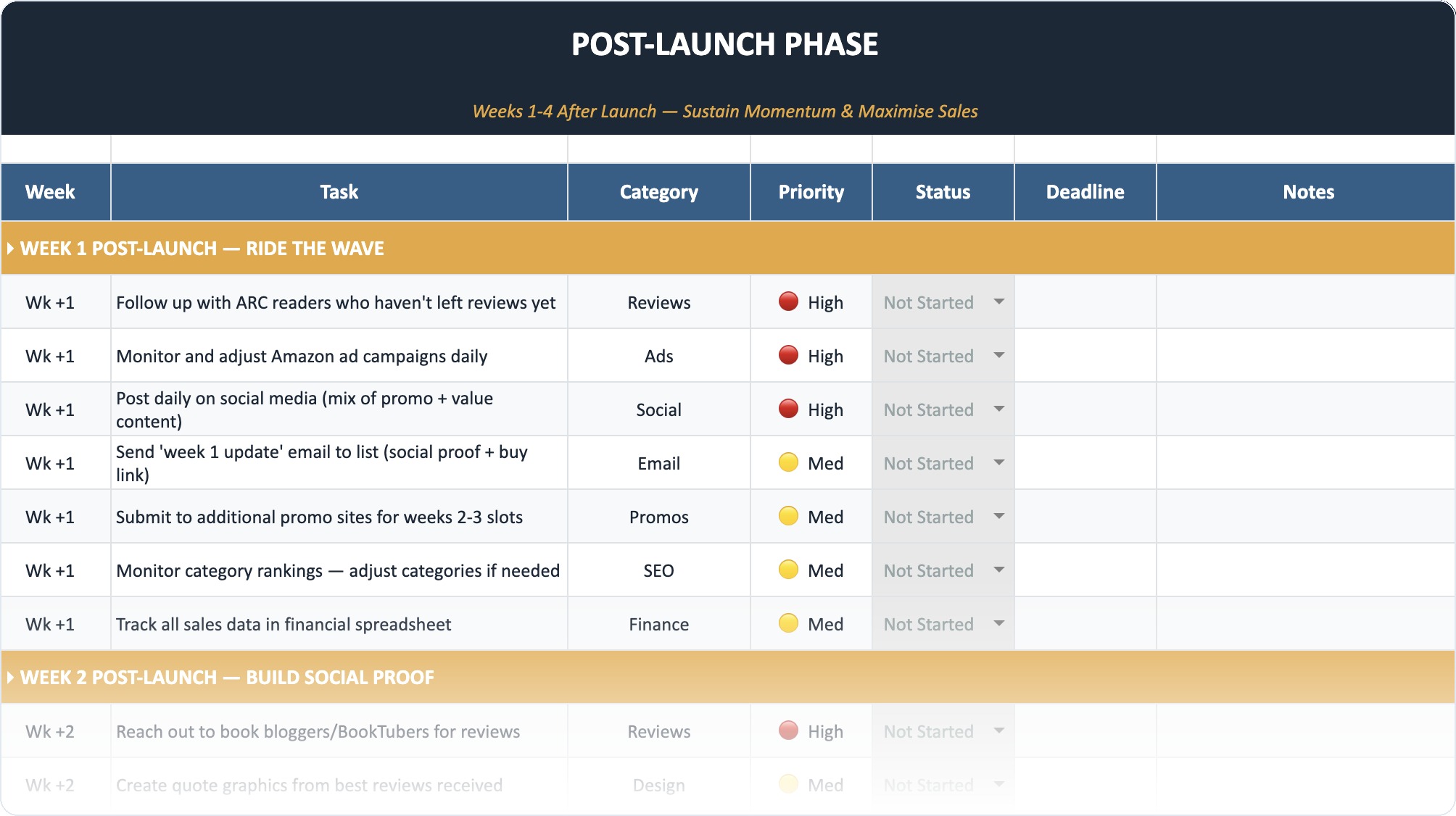
The Self-Publishing Launch Checklist (2026)
A week-by-week spreadsheet that walks you through every step of launching your book. Available as an Excel file and Google Sheet.
Frequently Asked Questions
How much do fiction writers really make?
It's a huge range. While some full-time authors earn six figures, the median earnings for self-published authors in 2023 were around $12,700. Many writers start part-time, earning a few hundred to a few thousand dollars a month as they build their backlist.
Is traditional publishing or self-publishing better for income?
It depends on your goals. Traditional publishing offers an advance (a median of about $25,000 for debuts), but royalties are much lower (around 7.5% for paperbacks). Self-publishing has no advance, but you earn much higher royalties (up to 70%) and have full control, which can lead to far greater long-term earnings if your books sell well.
Can I make a full-time living just from writing fiction?
Yes, but it's very hard to do it just from a single book's sales. The authors who make a full-time living are those who treat it like a business. They publish multiple books and build several of the income streams discussed here, creating a stable financial foundation.
Which income stream is best to start with?
Always start with your books. Focus on publishing your first book as an ebook and paperback. Once that is earning some money, the next logical step for most is an audiobook or starting a simple newsletter to build a direct connection with readers. Don't try to launch a course or merchandise before you have an audience.
How is AI affecting author incomes in 2026?
It's a major point of concern. Many authors worry about copyright infringement from their work being used to train AI models without permission. There is also a fear that AI-generated content could flood the market, making it harder for human authors to be discovered and devaluing the craft of writing.