
One author went from a jumbled mess of notes to a finished first draft in under 30 days. They didn't have the AI write the book for them. They changed how they used the AI, turning it from a soulless ghostwriter into a brilliant, tireless research assistant. That's the secret. The discussion around AI writing is noisy, but the correct answer to how writers should use ChatGPT is simple: use it as an intern, not an author.
Use it to break through blocks, build worlds, and outline plots. Never, ever let it touch your final prose. Your voice is the only thing that makes your work unique. Handing that over to an algorithm is creative suicide. This guide shows you exactly how to use this tool to speed up your process without sacrificing your art.
[tldr]
- Use It as an Assistant: Treat ChatGPT as a brainstorming partner, an outliner, and a research intern. It’s there to generate ideas and structure, not to write sentences.
- Never Let It Write Prose: Do not ask ChatGPT to write chapters, scenes, or even paragraphs. This is the fastest way to lose your unique authorial voice and produce generic, soulless content.
- Protect Your Work: Avoid pasting large sections of your unpublished manuscript into the tool. The data you input can be used to train future models, and the copyright implications are still a messy legal area.
- You Are the Director: Your job is to make the creative choices. The AI provides options; you provide the taste, emotion, and final decision. That’s how you keep your voice.
How Writers Should Use ChatGPT: The Assistant, Not the Author
The biggest mistake writers make with AI is asking it the wrong questions. They ask it to "write a chapter" when they should be asking it to "give me ten potential conflicts for a chapter where a detective confronts their corrupt partner."
Think of yourself as a film director. You're in charge of the vision, the emotion, the pacing, and the final product. ChatGPT is your crew. It can be your location scout (research), your script supervisor (outlining), or a group of actors you workshop ideas with (brainstorming). But you, the director, are the one who calls "action" and decides what ends up on screen.
ChatGPT's Strengths:
- Speed: It can generate 100 plot ideas in the time it takes you to make coffee.
- Pattern Recognition: It can structure a story using frameworks like the Hero's Journey or Save the Cat because it has analyzed thousands of them.
- Data Synthesis: It can summarize complex topics, giving you the research you need without having to read ten dense textbooks.
ChatGPT's Weaknesses:
- No Lived Experience: It has never felt heartbreak, smelled a rainy street, or tasted victory. Its emotional descriptions are hollow echoes of human writing it has ingested.
- No Soul or Voice: It defaults to the most statistically probable word, which creates prose that is bland, predictable, and utterly generic. Finding your unique writer's voice is a journey of discovery, not a task you can outsource.
- It Hallucinates: It will confidently state incorrect facts. All research must be verified.
The philosophy is simple: use AI for the grunt work, not the art.
The "Do Use It For" List: Your New Superpowers
Here's how this works in practice. These are the exact tasks where ChatGPT can improve your writing process and output. These are the jobs you can safely give your new AI assistant.
Brainstorming Plots and Characters
Writer's block is often just a lack of options. ChatGPT is an infinite option-generation machine. The key is to give it good constraints.
Don't just say, "Give me a story idea." That's too broad. Instead, get detailed with your prompts.
Good Prompt Example for Plot:
"Act as a seasoned thriller author. I need 10 unique plot ideas for a novel set in a near-future Tokyo where memories can be bought and sold. The protagonist is a memory thief who gets a job that goes horribly wrong. Focus on high-stakes conflicts and surprising twists."
Good Prompt Example for Characters:
"Create a character profile for a reluctant hero. He is a former starship mechanic living a quiet life on a remote farming planet. Give him a deep backstory, a deep-seated fear, a secret desire, and a physical description that reflects his past. Provide three people from his past who could show up to complicate his life."
You can then iterate on these ideas. Pick one you like and dig deeper: "Let's expand on idea #4. What are three possible moral dilemmas the memory thief could face? Who is the main antagonist and what is their motivation?" This turns a blank page into a playground of possibilities.
Worldbuilding on Steroids
For fantasy and sci-fi authors, worldbuilding can be a colossal task that takes months or years. ChatGPT can act as a worldbuilding consultant, helping you flesh out the details of your setting at lightning speed.
Use it to generate ideas for:
- Magic Systems: "Design a hard magic system based on the manipulation of sound waves. What are its rules, limitations, costs, and potential for conflict?"
- Political Structures: "Outline a feudal political system for an underwater civilization of merfolk. What are the main noble houses, what are their conflicts, and what is the title of their ruler?"
- Cultures and Religions: "Describe the core tenets, major holidays, and funeral rites of a religion centered around the worship of a giant, petrified forest."
This is one of the best uses for AI. It helps you build a rich, detailed setting that feels real to the reader. For a closer look at this process, check out our guide on how to create a fictional world your readers won't want to leave.
Outlining and Structuring Your Novel
Staring at a great idea with no idea how to structure it is a common problem. ChatGPT is excellent at providing scaffolding for your story. You can feed it your basic premise and ask it to organize it according to established storytelling structures.
Prompt Example for Outlining:
"Here is my story premise: A young librarian discovers a book that writes back to her, revealing a conspiracy that threatens her entire town. Please create a 15-chapter outline for this story using the Three-Act Structure. Identify the Inciting Incident, Rising Action, Climax, and Resolution."
The outline it gives you is not a set of commandments. It's a starting point. You can rearrange it, combine chapters, and add your own unique subplots. It simply provides a logical flow, which can be one of the best ways of boosting your writing productivity.
Dialogue Practice and Refinement
Writing natural-sounding dialogue is hard. ChatGPT can be a great sparring partner to help you find the voice of your characters. Don't ask it to write the dialogue for your scene. Instead, use its chat function to practice the dialogue yourself.
Use the "roleplay" prompt to find your character's voice. Start a conversation where you play one character and the AI plays another. This helps you discover how your character speaks, their verbal tics, and their conversational rhythm in a low-stakes environment.
Prompt Example for Dialogue Practice:
"Let's roleplay a conversation. You are a skeptical, world-weary police detective named Miller. I am an overly enthusiastic paranormal investigator named Alistair. We are both at a crime scene that Alistair believes is the work of a ghost. I will start."
A real-time conversation helps you naturally discover how your characters would interact. You might find a line of dialogue you love and can use in your book, but the main benefit is internalizing the character's voice. This exercise can sharpen your ability to write dialogue that sounds natural and believable. For more in-depth techniques, our guide to writing realistic dialogue is a great resource.
A Research Assistant That Never Sleeps
Need to know the average cruising altitude of a Boeing 747 or the proper etiquette for addressing a duke in Regency England? ChatGPT can often provide a faster, more direct answer than a standard Google search. Use it to quickly summarize information you need for your story.
Prompt Example for Research:
"Explain the process of mummification in ancient Egypt as you would to a 12-year-old. What were the key steps and what materials were used? List 5 interesting facts that are not common knowledge."
A Critical Warning: ChatGPT can and will make things up. It is not a perfect search engine. It's a language model that predicts the next most likely word. For critical facts, dates, or technical details, always verify the information from a reputable source. Treat it as a starting point for research, not the final word.
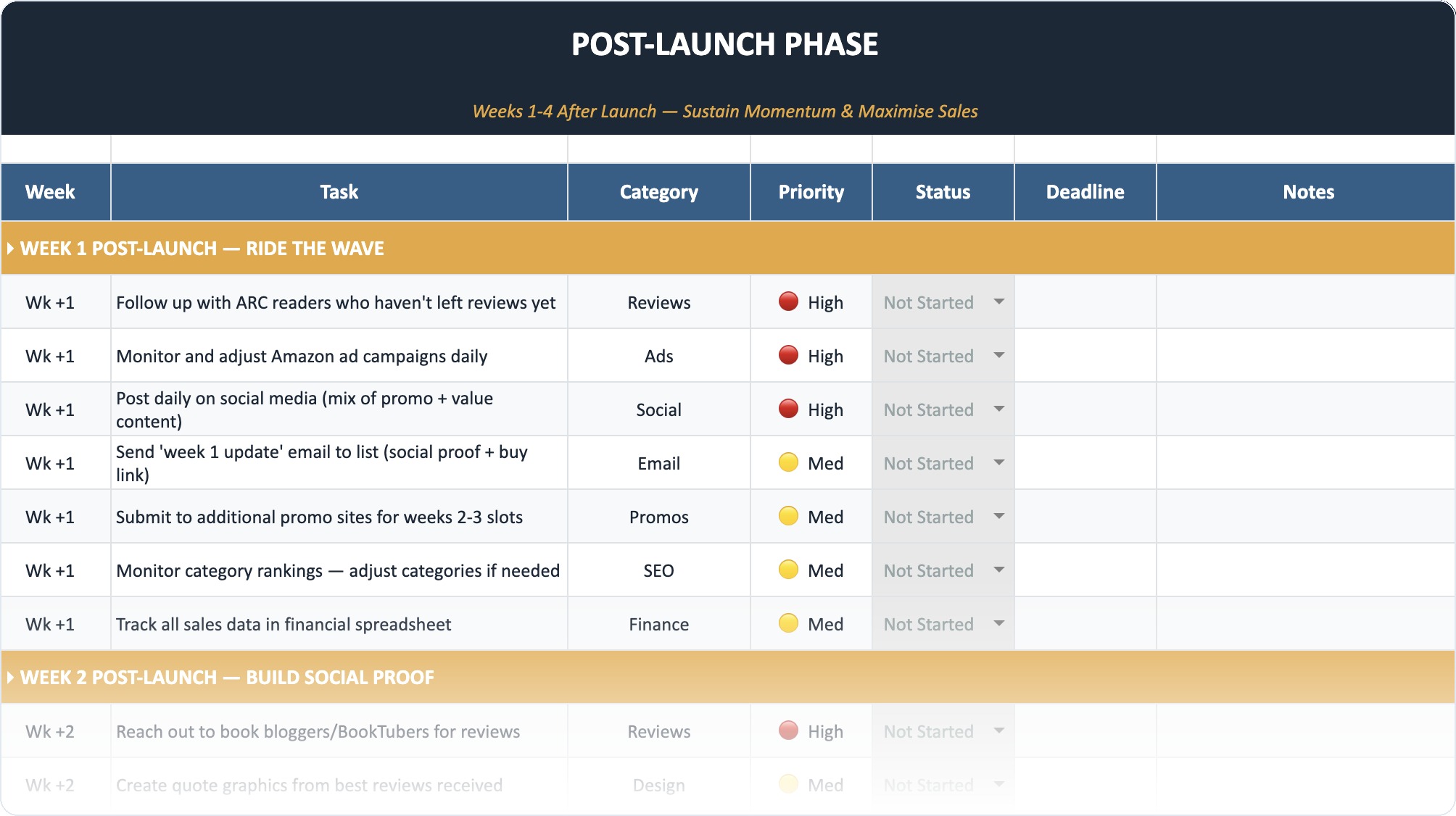
The Self-Publishing Launch Checklist (2026)
A week-by-week spreadsheet that walks you through every step of launching your book. Available as an Excel file and Google Sheet.
The "Do NOT Use It For" List: Preserving Your Art
Frankly, knowing what not to do is more important than knowing what to do. Misusing these tools can damage your work, your reputation, and your creative spirit.
Writing Your Actual Prose (The Biggest Mistake)
This is the cardinal sin. Don't ask ChatGPT to write a scene, a chapter, or even a descriptive paragraph. The moment you do, you surrender your voice.
AI-generated prose is a lukewarm soup of clichés. It's built on the average of millions of books and articles it has read. It cannot create a truly original metaphor. It cannot craft a sentence with a rhythm that breaks a reader's heart. It has no style. Your style, your voice, is built from your unique experiences, your weird obsessions, and your personal taste.
You cannot automate soul.
A Wise Writer
Letting AI write for you is like hiring a karaoke machine to perform at your sold-out stadium concert. It might hit the notes, but there's no life behind them. The bigger question of whether AI can replace writers hinges on this very point: it can replicate patterns, but it cannot originate art.
Pasting Your Entire Draft (A Copyright Nightmare)
Pasting chapters of your work-in-progress into ChatGPT for feedback or editing is a terrible idea for two main reasons:
- Privacy & Training: Depending on the platform's terms of service, your text could be used to train future versions of the AI. You are essentially giving your unpublished work away for free to a massive tech company.
- Copyright: The legal landscape is still a minefield. The U.S. Copyright Office has been very clear that it will not grant copyright to works created entirely by AI. Using it to generate large portions of your text puts your ownership of the work at risk.
Protect your intellectual property. Use the AI for ideas and structure, but keep your manuscript on your own computer.
Final Editing
ChatGPT can function as a basic proofreader. It can catch typos and grammatical errors. But it's a horrible line editor and a worse developmental editor.
It does not understand:
- Subtext: It can't tell you if a character's dialogue is subtly revealing their true, sinister motives.
- Pacing & Rhythm: It won't recognize that a long, complex sentence is killing the tension in a fast-paced action scene.
- Emotional Arc: It has no concept of a character's journey or whether a scene is emotionally satisfying for the reader.
For editing, you need human intelligence. Hire a professional editor or, at the very least, use dedicated writing software like ProWritingAid or AutoCrit, which are designed just for fiction analysis.
Keeping Your Voice: The Human Element in an AI World
Your voice isn't just the words you choose. It's the choices you make.
- It's the decision to kill a beloved character.
- It's the specific, quirky metaphor you use that no one else would think of.
- It's the theme you weave through your story about found family or the cost of ambition.
AI can give you a hundred generic plot points. Your voice is choosing the one that clicks with you and executing it in a way only you can. The reality is that the best way to use AI is to generate a wide field of options, then apply your human taste and experience to select and refine the best one.
Think of it as a collaboration. The AI builds the marble block; you are the sculptor who carves it into a masterpiece.
Stop Staring at a Blank Page
Publy is a distraction-free book editor with AI built in. Brainstorm plot ideas, get instant chapter reviews, or rewrite clunky paragraphs. 3 million free words included.

A Table of Good vs. Bad Prompts for Writers
| Task | ❌ Bad Prompt (Vague & Low-Effort) | ✅ Good Prompt (Detailed & Constrained) | Why It's Better |
|---|---|---|---|
| Plot Ideas | "Write a story about a dragon." | "Give me 5 plot hooks for a fantasy story where a young, pacifist dragon is forced to team up with a cynical dragon-slaying knight to stop a magical plague." | Provides genre, character archetypes, core conflict, and a direct request (5 hooks). |
| Character Creation | "Make a cool villain." | "Create a villain for a cyberpunk novel. Their motivation is a twisted form of utilitarianism. They believe sacrificing a few will save the many. Give them a physical weakness and a past relationship with the hero." | Defines motivation, genre, and defined character elements, creating a much more complex antagonist. |
| Worldbuilding | "Describe a fantasy city." | "Describe a port city built into the shell of a colossal, dead sea turtle. What are its main industries (e.g., pearl diving, shell-crafting)? What is the name of the city, and what is its most famous landmark?" | Gives a strong visual anchor (turtle shell) and asks for concrete details that bring the city to life. |
| Dialogue Help | "Write some dialogue." | "Let's roleplay. You are a starship captain whose ship is failing. I am the ship's AI, who is developing emotions. I'll start the conversation. My goal is to convince you to abandon ship. Your goal is to find a way to save it." | Sets up a clear conflict, defined roles, and goals for each character, which leads to much more dynamic dialogue practice. |
The Future is a Partnership
AI writing tools are not a threat to serious writers. They are a threat to mediocre, uninspired content. For authors who have a voice, a vision, and a story to tell, these tools are a powerful force multiplier. They can help you organize your thoughts, smash through writer's block, and build more immersive worlds faster than ever before.
Use the tool, but don't forget you're the artist. The tech is just a paintbrush; you're the one holding it. For more direct ways to apply these ideas, explore these 15 ChatGPT hacks for authors to streamline your workflow even more.
Frequently Asked Questions
Can I copyright a book written with ChatGPT?
It's complicated. You cannot copyright work generated solely by AI. However, if you use AI as a tool for ideas or outlining and write the actual text yourself, the work is yours and is copyrightable. The key is substantial human authorship. Always be transparent with platforms like Amazon KDP, which require you to disclose the use of AI tools in your work.
Will using ChatGPT make me a lazy writer?
It can, if you let it. If you use it to write your prose, it will weaken your writing muscles. But if you use it for the tasks outlined in this guide: brainstorming, research, outlining. It can actually make you a more productive and ambitious writer by handling the preparatory work, leaving you more energy for the creative act of writing.
What's the best version of ChatGPT for writers?
Generally, the latest paid version (like GPT-4 or newer models) is much better for creative tasks. It understands subtlety, follows complex instructions more accurately, and is less prone to generic responses than the free versions. The investment is often worthwhile for serious authors who plan to integrate it into their workflow.
How can I make my prompts better?
The best prompts are detailed, provide context, and define a role for the AI. Instead of "give me ideas," try "Act as a Golden Age detective novelist and give me five red herrings for a locked-room mystery set on a train." Give it a job, give it constraints, and tell it the format you want the output in.
Is it cheating to use AI for writing ideas?
No. Writers have always used tools to generate ideas, from brainstorming with friends to using plot generator websites or pulling tarot cards for inspiration. ChatGPT is just a much more powerful version of those tools. It's not cheating to get an idea from an AI, just as it's not cheating to get an idea from a dream or a newspaper headline. The art is in the execution, which must be your own.