⚠️ Note: AI returned incomplete/malformed JSON. Showing raw output.
Too Long; Didn't Read
- Amazon Ads convert better (approx. 10%) because readers are already shopping, but costs are rising ($0.50-$1.25 CPC in 2026).
- Facebook Ads offer cheaper clicks ($0.10-$0.20) and massive scale for series, but require constant creative testing to fight ad fatigue.
- For non-fiction and standalone novels, Amazon Ads usually provide a faster ROI.
- For long fiction series and wide distribution, Facebook Ads allow you to scale profits through read-through.
- See the full case study data below for a breakdown of 2026 metrics.
It is 2026, and the "golden era" of cheap clicks is officially behind us. If you are an author trying to push your book up the rankings, you know that organic reach is practically dead. You have to pay to play. The question that keeps most of us up at night is not if we should advertise, but where we should put our limited budget.
I talk to authors every day who burn through their royalty checks on ads that do not convert. They throw money at Mark Zuckerberg or Jeff Bezos and hope the algorithm takes mercy on them. Hope is not a strategy. Data is a strategy.
In this guide, I am going to break down the battle of facebook ads vs amazon ads for books using the latest data from late 2025 and early 2026. We are going to look at why Amazon is becoming a "pay-to-play" search engine, why Facebook is a creative treadmill, and exactly which platform suits your specific genre and budget.
The Core Difference: Intent vs. Interruption
Before we look at the spreadsheets, you have to understand the psychology of the human on the other end of the screen. This is the single biggest factor in your conversion rate.
Amazon: The Search Engine for Buyers
When I open the Amazon app, I am usually holding my credit card. I am there to buy something. Maybe it is toothpaste, maybe it is a new thriller. But I am in "shopping mode."
This is why Amazon Ads have such a high conversion rate. You are putting your book directly in front of someone who just typed "best sci-fi space opera" into the search bar. You are not trying to convince them to read; they already want to read. You are just convincing them to read your book.
Data supports this. Recent reports show that Amazon advertising boasts an impressive average conversion rate of 9.96%. Compare that to the standard e-commerce conversion rate of 1.33% elsewhere. If you get the click on Amazon, you have a 1 in 10 chance they buy. That is huge.
Facebook: The Scroll Stopper
Facebook (and Instagram) is different. When I am on Instagram, I am avoiding work. I am looking at photos of my cousin's wedding or watching a dog video. I am not looking for a book.
Facebook Ads are interruption marketing. You have to stop the user's thumb in mid-scroll, distract them from the dog video, and convince them that your book is worth leaving the app for. This is a much harder sell.
However, the upside is scale. Amazon only has so many people searching for "historical romance" every day. Facebook has billions of users. If you can crack the code on a creative ad that hooks people, you can scale your traffic to the moon in a way Amazon simply cannot match.
Free AI Writing ToolStop Staring at a Blank Page
Publy is a distraction-free book editor with AI built in. Brainstorm plot ideas, get instant chapter reviews, or rewrite clunky paragraphs. 3 million free words included.
AI Chat + Ideas Review + Rewrite Export PDFStart Writing Free
2026 ROI Data Snapshot: The Numbers
Let's look at the hard costs. The cost of advertising has gone up across the board, but the gap between the two platforms is widening in interesting ways.
According to 2025-2026 projections, here is what you can expect to pay:
Metric Amazon Ads (KDP) Facebook / Meta Ads Avg. Cost Per Click (CPC) $0.50 – $1.25 $0.10 – $0.40 Conversion Rate (CVR) 10% – 15% 2% – 5% User Intent High (Buying) Low (Browsing) Creative Needs Low (Book Cover + Keywords) High (Video, Copy, Graphics) Scale Potential Limited by Search Volume Unlimited (Audience Interest) Setup Time Fast Slow (Testing Required) The takeaway here is clear. Amazon clicks cost more, but they are "smarter" money for beginners because they convert better. Facebook clicks are cheap, but you need a lot of them to make a sale.
Deep Dive: Amazon Ads for Authors
If you are exclusive to Amazon (Kindle Unlimited), this is your home turf. I often tell new authors to start here because the feedback loop is tighter. You see results—or a lack of them—very quickly.
The "KDP Ads" Ecosystem
Amazon gives you three main flavors of ads, but for most of us, Sponsored Products are the bread and butter. These are the ads that appear in search results and on the product pages of other books.
The beauty of Sponsored Products is that they look native. They barely look like ads. If I am looking at a Stephen King novel, and your horror book appears in the "Products related to this item" carousel, I assume it is relevant.
The Rising Cost of Visibility
Here is the bad news. Amazon's ad revenue is projected to hit over $65 billion by 2026. That revenue comes from us—the sellers. The average CPC for books used to be pennies. Now, competitive genres like Thriller or Romance see CPCs pushing $0.80 or more.
To survive this, you need to be precise. You cannot just target "books." You need to use Publisher Rocket or similar tools to find hundreds of specific, long-tail keywords. Targeting "fantasy book" is financial suicide. Targeting "urban fantasy books with strong female protagonist" is where the profit lives.
Best Use Cases for Amazon Ads
- Non-Fiction: If you wrote a book on "How to Bake Sourdough," targeting people searching for "sourdough starter kits" or "bread baking books" is a no-brainer.
- Series Launches: If you have a read-through rate (people buying Book 2 after Book 1), you can afford to break even or lose money on the ad for Book 1.
- Kindle Unlimited (KU): KU readers browse heavily. Ads help you get those page reads, which contribute to your rank even if they don't buy the book outright.
Deep Dive: Facebook Ads for Books
If Amazon is a sniper rifle, Facebook is a shotgun. You are spraying a message to a wide area hoping to hit targets. But when you hit them, you can hit thousands at once.
The Scale Factor
The main reason six-figure authors love Facebook is scale. On Amazon, if only 1,000 people search for your keyword this month, you can only sell to 1,000 people. On Facebook, you can target "Stephen King fans" and reach 5 million people.
Clicks are also significantly cheaper. As noted in recent advertising data, Facebook clicks can be as low as $0.10. This means you can drive a flood of traffic to your book page for $20.
The Creative Burden
Here is the catch: You have to be a graphic designer and a copywriter. On Amazon, your book cover is the ad. On Facebook, you need an "image creative" or a video.
Video is king in 2026. If you are comfortable on camera, or good at editing, this helps. If you are camera-shy, you might want to check out some BookTok ideas for introverts because the style of "faceless" video content that works on TikTok also crushes it on Facebook and Instagram Reels ads.
You also need to write "ad copy"—the text above the image. It needs a hook. "Meet the detective who can't die" is better than "My new book is out now, please buy it."
The "Ad Fatigue" Problem
Facebook audiences get bored. Fast. You might have an ad that performs amazing for two weeks, and then suddenly the cost skyrockets. This is "ad fatigue." The same people have seen it too many times. You have to constantly make new images and write new hooks. It is a lot of work compared to Amazon's "set it and forget it" nature.
Cost Analysis: Where Does Your Money Go?
Let's talk about the math of staying profitable.
Budgeting for Amazon (The "Slow Burn")
Amazon ads are notoriously slow to spend. You might set a budget of $10 a day, and Amazon might only spend $2. This frustrates people, but it is actually a safety mechanism. Amazon only shows your ad if it thinks the searcher is relevant.
To spend more on Amazon, you usually have to bid higher. This eats into your margins. You need to calculate your royalties carefully. If you make $2.00 per ebook sale, and your conversion rate is 10% (1 in 10 clicks buys), you can pay $0.20 per click to break even. If clicks cost $0.50, you are losing money on every sale—unless you have a series.
I recommend reading up on all costs and fees involved in KDP so you know exactly what your break-even point is before you bid a single cent.
Budgeting for Facebook (The "Front-Load")
Facebook will spend whatever budget you give it. If you tell Mark Zuckerberg to spend $100 a day, he will spend $100.00 by midnight, even if he has to show your ad to people who hate books.
This makes Facebook dangerous for beginners. You need to monitor it daily. However, the attribution window is tricky. Someone might see your ad on Monday, but not buy the book until Friday.
The Series Factor: Read-Through ROI
This is the secret weapon for profitable advertising. If you have only written one book, it is very hard to make a profit with paid ads in 2026. The CPCs are just too high compared to the royalty of a $4.99 ebook.
But if you have a series? The math changes.
Let's say you have a 3-book series.
- Book 1: $0.99 (Low profit, acts as a hook)
- Book 2: $4.99
- Book 3: $4.99
If a reader buys Book 1, and 50% of them go on to buy Book 2 and Book 3, your "Customer Lifetime Value" is much higher than just the price of the first book.
Facebook Ads shine here. You can afford to pay $1.50 to acquire a reader on Facebook because you know that over the next month, they will buy the rest of your series. This is why you see so many box sets advertised on Facebook.
If you are planning a series, understanding how to structure it for maximum read-through success is more important than the ad settings themselves.
Friction Points & Learning Curves
Neither platform is perfect. They both try to confuse you into spending more money than you need to.
Amazon's "Set and Forget" Myth
People say Amazon ads are passive. They aren't. If you stop adding new keywords or adjusting your bids, your ads will slowly die. Competitors will outbid you, or search trends will change. You need to check them weekly.
A major pain point for authors on Amazon is the interface. It is clunky, the reporting is delayed by 12-24 hours, and the "Auto-Targeting" feature often wastes money on irrelevant terms.
Facebook's Complexity
Facebook's Ads Manager is like the cockpit of a 747. There are buttons everywhere. "Lookalike Audiences," "Pixels," "Custom Conversions." It is overwhelming.
The biggest issue for authors is the iOS privacy changes (which started years ago but still hurt us in 2026). Tracking who actually bought your book after clicking a Facebook ad is difficult because Amazon does not share that data with Facebook. You are often flying blind, guessing if your sales spike is from the ad or something else.
SpreadsheetThe Self-Publishing Launch Checklist (2026)
A week-by-week spreadsheet that walks you through every step of launching your book. Available as an Excel file and Google Sheet.
8-week pre-launch plan Launch day battle plan Post-launch trackerDownload Sheet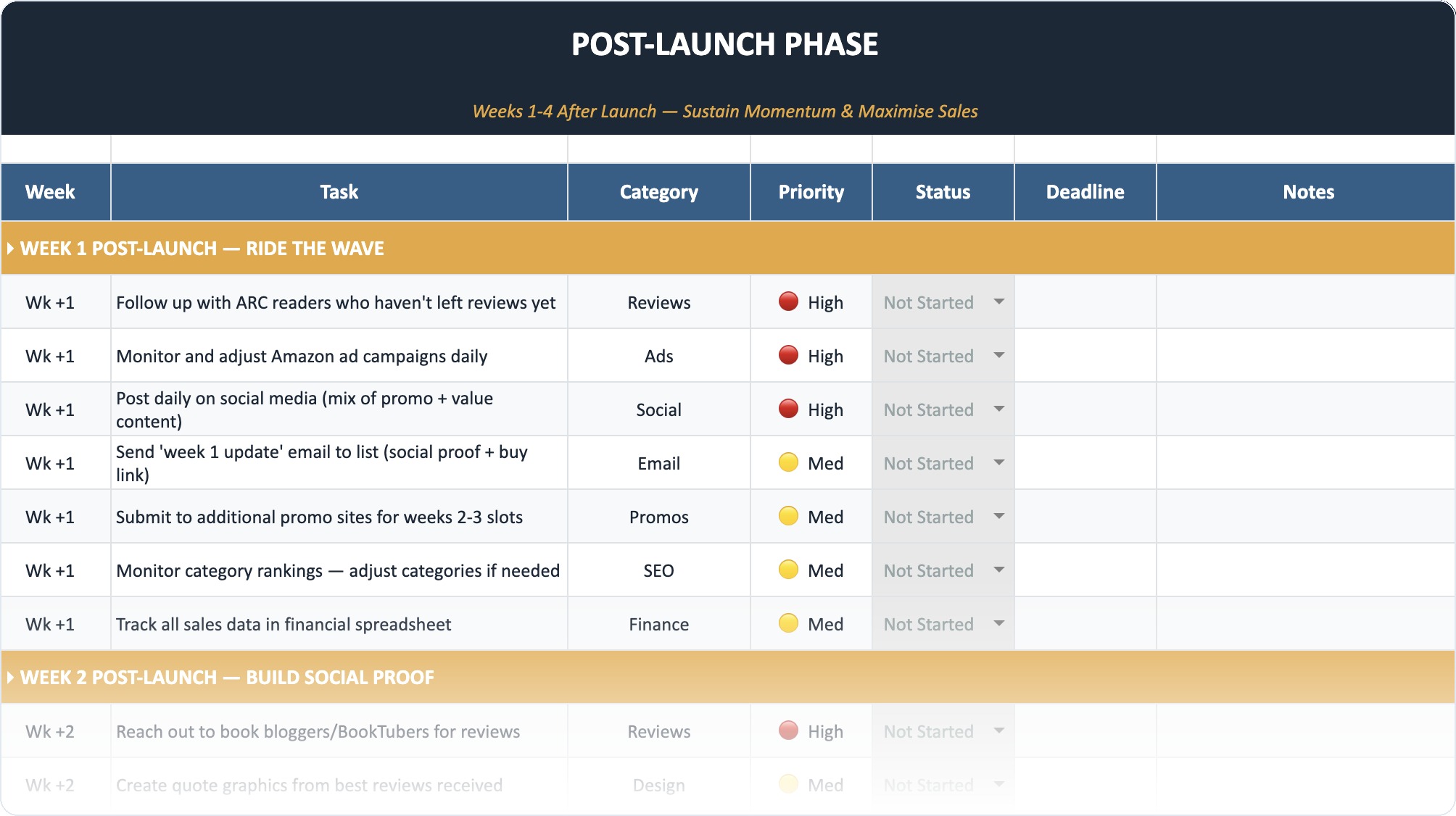
Hybrid Strategy: Using Both Together
You do not have to choose just one. The smartest authors use a hybrid approach.
I like to use Facebook Ads to drive traffic to a "Reader Magnet"—a free short story or prequel—to get people on my email list. Once they are on my email list, I own that relationship. I can sell them my books for free forever.
Then, I use Amazon Ads to keep my book visible in the store for people who are actively browsing my genre.
Also, consider your content format. If you are creating Reels for Instagram ads, you can reuse those templates. If you need inspiration, check out these Instagram Reels templates for authors. Efficient marketing means reusing assets.
Case Studies: Who Wins Where?
Based on the data we have reviewed, here is how different author types should bet their money.
The Debut Novelist
- Winner: Amazon Ads.
- Why: You have no fanbase. You need high intent. You want people searching for "new mystery books." Your budget is likely low. Amazon allows you to start small.
The Non-Fiction Expert
- Winner: Amazon Ads.
- Why: People search for solutions. "Cure back pain," "Learn Python." If your title matches the search, you win.
The Prolific Fiction Author (Series)
- Winner: Facebook Ads.
- Why: You need volume. You need to feed the beast. You have 10 books, so you can afford to pay more for a lead. You can target "Fans of Game of Thrones" and scale up to $100/day spend.
The "Wide" Author (Kobo, Apple, B&N)
- Winner: Facebook Ads.
- Why: Amazon Ads only sell books on Amazon. Facebook Ads can send traffic to a "universal link" that lets the reader choose their store (Apple, Kobo, etc.).
Visuals and Video: The 2026 Requirement
We cannot ignore the shift to video. In 2024, static images worked fine. In 2026, motion is required to get cheap clicks on Facebook.
You do not need a film crew. Simple animations of your book cover, or scrolling text over a moody background, work wonders. If you are handy with tools, you can even make book trailers that serve as high-converting ads.
On Amazon, "Sponsored Brands" video ads are now taking up huge real estate in search results. These autoplay videos grab attention way better than a static book cover. If you have the budget, testing video on Amazon is a powerful move.
Is Goodreads an Option?
I often get asked if we should just skip the tech giants and advertise on Goodreads. Honestly? The data is mixed. While it is where the readers are, the ad platform has historically been clunky and expensive for the return. However, giveaways are a different story. If you are curious about that route, look at the data on Goodreads Giveaways ROI before spending your cash there.
Conclusion: The Verdict
So, who wins in the battle of Facebook Ads vs Amazon Ads for books?
- For Sales & ROI: Amazon Ads win. The intent to buy is unmatched.
- For Scale & Branding: Facebook Ads win. You can reach the world, not just the search bar.
My advice? Start with Amazon. Master the keywords. Get your conversion rate up. Once you have a series and a proven hook, take that profit and move to Facebook to scale your business to the six-figure level.
Frequently Asked Questions
Which platform is cheaper for beginners?
Amazon Ads are generally safer for beginners because you only pay when someone clicks, and the people clicking are usually shoppers. Facebook can spend your budget very fast on people who are just scrolling, leading to wasted money if you don't watch it closely.
Can I run Facebook ads if I don't have a website?
Yes, you can send Facebook traffic directly to your Amazon book page. However, you lose the ability to track "conversions" perfectly. Many authors use a landing page or a service like BookFunnel to bridge the gap and track data better.
How much budget do I need to start?
For Amazon, you can start with as little as $5 a day, and often you won't even spend that much if your bids are conservative. For Facebook, you really need $10-$20 a day minimum to get enough data to see if an ad is working.
Do ads work for individual books or just series?
Ads are much harder to make profitable for standalone books. With a single book priced at $2.99 or $4.99, the cost of the click often eats the entire profit. Ads work best for series where one sale leads to the purchase of 3, 4, or 5 more books.
What is a good Cost Per Click (CPC) for books?
In 2026, a good CPC on Amazon for fiction is between $0.35 and $0.60. For non-fiction, it can be higher ($0.80+). On Facebook, you are looking for clicks under $0.25. If you are paying more than that, you likely need to improve your ad image or targeting.
META_DESCRIPTION: Struggling to choose between Facebook Ads vs Amazon Ads for books? We compare 2026 costs, ROI, and conversion rates to help you sell more copies.