

A debut sci-fi author in Nebraska sold her first 1,000 copies without a publisher, an agent, or a single ad. Her secret wasn't a viral video or a lucky break. It was a small but dedicated group of readers she had been talking to for a year before her book was even finished. This is the power of a modern author platform. If you want to sell books in 2026, you have to learn how to build an author platform from the ground up. Frankly, it’s the single biggest asset you can create for your writing career.
- Build Your Home Base: Start with a simple author website. You own this space, unlike social media accounts that can disappear overnight.
- Focus on Email: Your email list is your most valuable asset. It's a direct, unfiltered line to your biggest fans. Start building it from day one.
- Pick One Social Media Channel: Don't burn out trying to be everywhere. Pick one platform where your readers hang out (like TikTok for YA or Facebook for older audiences) and master it.
- Connect, Don't Just Broadcast: Share your process, talk about themes in your genre, and engage with readers. Your goal is to build a community, not just an audience.
What Is an Author Platform, Really? (And Why You Can't Skip It)
Let's kill the jargon. An author platform is your connection to your readers. It's the collection of people who know you, trust your work, and are ready to buy your next book the day it comes out. It’s your author website, your email list, your social media followers, and your reputation within a community of readers.
In the past, the publisher handled all the marketing. That world is gone. The self-publishing market is exploding, projected to reach a massive $6.16 billion by 2033. Publishers and agents now look at your platform before they even read your manuscript. A built-in audience proves there's a market for your book.
Forget slick marketing. Building a platform is about finding your people and giving them a reason to stick around.
Stop Staring at a Blank Page
Publy is a distraction-free book editor with AI built in. Brainstorm plot ideas, get instant chapter reviews, or rewrite clunky paragraphs. 3 million free words included.

How to Build an Author Platform That Actually Sells Books
Feeling overwhelmed? That's normal. Most authors try to do everything at once and burn out. The key is to focus on a few high-impact activities and do them consistently. Forget the thousand-item checklist. You only need to work on these four steps to get started.
Step 1: Lay the Foundation with Your Author Website
Your website is the only piece of online real estate you truly own. Facebook can change its algorithm. TikTok could get banned. Your email provider could shut down your account. But your website is yours. A 2024 survey showed that 65% of authors build their own sites using tools like WordPress or Squarespace. You can too.
You don't need a fancy, expensive website to start. A clean, simple site with the essential pages works far better than a complicated one you never update.
Your website must have these five pages at a minimum:
- Home Page: A clear, concise introduction to you and your latest book. The goal is to get a visitor to the next step, whether that's buying a book or signing up for your newsletter.
- About Page: This is where you connect with readers on a personal level. Tell your story. Share why you write what you write. This is also the perfect place to include a professional author bio; you can learn how to write an author bio for a book that grabs attention.
- Books Page: A dedicated page for each book you've written. Include the cover, the blurb, and clear links to all the stores where it's available. If you have great reviews, feature them here.
- Blog / Content Hub: You need a reason for people to come back to your site. A blog is a great way to do this. You can share writing updates, deleted scenes, articles about the themes in your books, or character interviews.
- Contact Page: A simple way for readers, agents, or media to get in touch with you. A simple contact form works best.
Your website is your central hub. Every social media post, every email, every podcast interview should point people back to your site.
Step 2: Master the Most Powerful Tool: Your Email List
If you only do one thing to build your platform, do this. Your email list is your single most important marketing asset. It’s a direct line to your readers' inboxes, a space completely free from algorithms and shadowbans. These are your superfans.
So, where do you start?
-
Choose a Provider: Don't use your personal Gmail account. You need an Email Service Provider (ESP) to manage subscribers and send mass emails legally.
- Free Options: MailerLite and Mailchimp offer free plans for your first 1,000-2,000 subscribers. They are perfect for beginners.
- Paid Options: ConvertKit is built for creators and authors, with handy automation and tagging features. It’s worth the investment once your list starts growing.
-
Create a "Lead Magnet": Why should someone give you their email address? You have to offer them something valuable in return. This is your lead magnet.
- Fiction Authors: An exclusive short story set in your book's world, a deleted chapter, a character profile sheet, or the first three chapters of your book. Many authors find they can sell short stories for money, but giving one away for free works wonders for building a list.
- Non-Fiction Authors: A checklist, a resource guide, a workbook, or a short video course related to your book's topic.
-
Promote Your List Everywhere: Put a signup form on your website's homepage, at the end of every blog post, and in the back matter of your books. Mention it on social media. Your goal is to make it impossible for an interested reader to miss it.
What should you send to your list? A mix of personal updates, behind-the-scenes content, links to interesting articles, and, of course, news about your books. Aim to email them at least once or twice a month to keep the connection warm.
Step 3: Choose Your Social Media Battlefield (Wisely)
Here's the truth most gurus won't tell you: you don't need to be on every social media platform. Trying to manage Facebook, Instagram, TikTok, X, Bluesky, and whatever comes next is a recipe for burnout. It's the fastest way to hate marketing and stop writing.
The strategy is to pick one, maybe two, platforms and go deep.
How do you choose? Go where your readers are.
| Social Media Platform | Who It's For | Engagement Rate | Author Usage (2025) |
|---|---|---|---|
| TikTok | YA, Romance, Fantasy, Sci-Fi. Younger audiences. | Very High (up to 17.5%) | Rapidly growing, especially for new authors |
| Highly visual genres: Fantasy, Travel, Cookbooks, Children's Books. | High (around 5.6%) | 51% of authors use it weekly | |
| Older audiences. Genres like Thrillers, Mystery, Historical Fiction. | Very Low (0.09%) | 62% of authors use it, but engagement is weak | |
| Bluesky/X | Writers, journalists, and industry professionals. Good for networking. | Low (0.2-0.9%) | 29% plan to use Bluesky more in 2025 |
The data is clear. Over 78% of authors use at least one social media platform. But usage doesn't equal results. Facebook is popular but has terrible engagement. TikTok and Instagram are where real reader connection is happening, especially with video. Authors who published after 2020 are using TikTok more than twice as much as authors who debuted before 2010 for a reason: it works.
Pick your platform, then focus on creating content designed for that space. Don't just post "Buy my book!" links. For example, if you're on Instagram, you need great visuals. Learn how to create videos that grab attention and get some Instagram reels ideas for authors to get started.
Step 4: Create Content That Connects, Not Just Sells
Your author platform can't be a constant commercial. You need to provide value and build a relationship with your audience. The best way to do this is by setting up "content pillars." These are 3-5 topics you'll talk about consistently. Only one of them should be "my books."
Your content pillars could be:
- Pillar 1: Your Writing Process: Share snippets of your work-in-progress, talk about your outlining method, show your writing space.
- Pillar 2: Your Genre: Talk about other books you love in your genre. Post reviews, recommend hidden gems, discuss tropes. This positions you as an expert and a fan.
- Pillar 3: A Related Hobby/Interest: Are you a historical fiction author who loves medieval reenactment? A romance author who bakes? Share that. It makes you a relatable human being.
- Pillar 4: Your Books: Yes, you can talk about your books! Share cover reveals, release dates, character art, and excerpts.
This approach gives you endless content ideas and prevents you from sounding like a broken record. You can use tools to help you brainstorm; learning how writers should actually use ChatGPT can generate dozens of ideas for blog posts and social media updates without sacrificing your unique voice.
Advanced Platform Building Strategies
Once you have the basics in place, you can move on to more advanced tactics.
Engage Directly with Reader Communities
Instead of trying to pull readers to you, go to where they already are. This means participating in online communities genuinely.
- Goodreads: Actively rate and review books in your genre. Participate in group discussions.
- Reddit: Subreddits like r/fantasy, r/romancebooks, or r/suggestmeabook are filled with passionate readers. Answer questions, offer recommendations, and become a trusted voice. Just read the rules carefully; most subs have strict policies against self-promotion.
- Facebook Groups: Find groups dedicated to your specific subgenre. Again, the key is to participate first and promote second.
- Discord: Many authors and book communities have dedicated Discord servers for real-time chat and community building.
Collaborate with Other Authors
Author marketing is not a zero-sum game. A reader who loves another author's space opera is very likely to love yours, too. Partnering with other authors in your genre is one of the fastest ways to grow your audience.
- Newsletter Swaps: You agree to feature another author's book in your newsletter, and they do the same for you.
- Social Media Takeovers: Host another author on your Instagram stories for a day, or do a joint live video.
- Box Sets & Anthologies: Team up with a group of authors to release a collection of books or stories at a discounted price. This exposes all of you to each other's audiences.
The publishing world is all about collaboration now. Don't see other authors as competition; see them as colleagues. Thinking this way is especially important as you start looking for feedback partners. Finding the right community is key, and it helps to know how to find beta readers and critique partners who can support your journey.
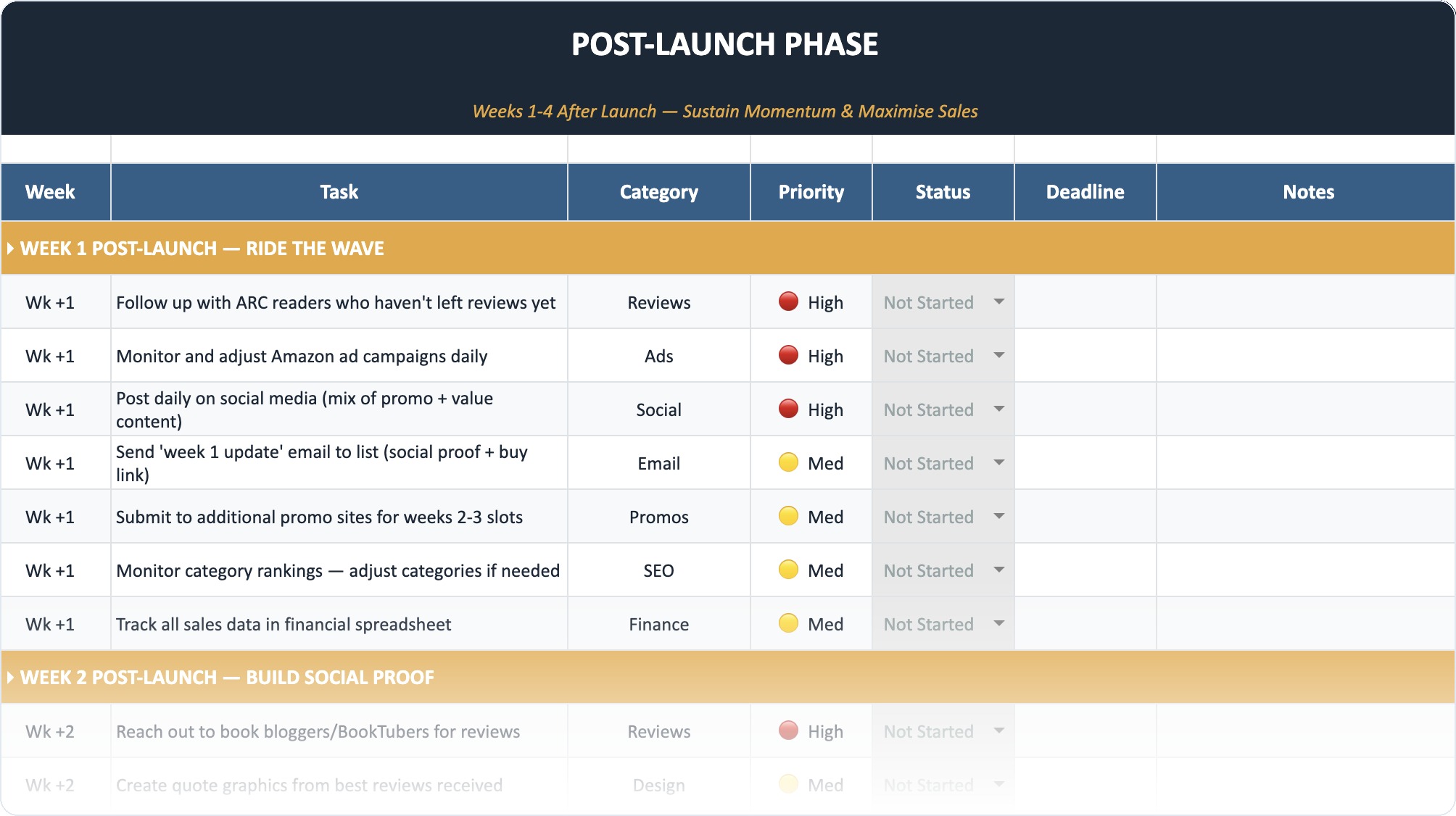
The Self-Publishing Launch Checklist (2026)
A week-by-week spreadsheet that walks you through every step of launching your book. Available as an Excel file and Google Sheet.
Setting Realistic Expectations: Timelines and Tools
Building an author platform is a marathon, not a sprint. It takes time and consistency. Too many authors give up after three months because they don't see explosive growth. You need to be patient. For many authors, setting and achieving your self-publishing goals means playing the long game.
Timeline Expectations:
- Months 1-3: Focus on setting up your systems: your website, your email list, your chosen social profile. You might only get a handful of email subscribers. That's okay.
- Months 4-9: Consistently create content and interact with your community. You should start to see slow, steady growth.
- Months 9-12+: You should have a small but active audience. You'll begin to see the results of your efforts in book sales and reader feedback.
This process is a slow burn, much like developing complex character relationships in a novel. The payoff for this patience is an audience that sticks with you for years. Getting a handle on this slow, consistent effort can even improve your writing, especially if you want to learn how to write a slow burn that destroys the reader. The rules of patience and payoff are the same for platforms and plots.
Free vs. Paid Tools
You don't need to spend a fortune to build your platform. You can start entirely for free and invest in paid tools as you grow.
| Tool Category | Free Options | Paid Options (Worth It Later) |
|---|---|---|
| Website | WordPress.org (requires hosting), Carrd | Squarespace, Wix (easier to use) |
| Email Marketing | MailerLite (up to 1k subs), Mailchimp (up to 500 subs) | ConvertKit, ActiveCampaign |
| Social Media Graphics | Canva | Canva Pro, BookBrush |
| Link Management | Direct links | BookLinker, Geniuslink (for universal book links) |
Start with the free tools. Master them. Once you see what's working and your income from writing increases, you can strategically upgrade to paid options that save you time or offer better features.
Frequently Asked Questions
Do I need to build a platform before I finish my book?
Yes, you should start as soon as possible. Building a platform takes time. If you wait until your book is published, you'll be launching to an empty room. Start by talking about your writing journey, the themes you're writing about, and books you love in your genre.
Which social media is best for fiction authors?
It depends on your genre and target reader. As a general rule for 2026: TikTok and Instagram are fantastic for genres with strong visuals and younger audiences like YA, Romance, and Fantasy. Facebook can work for authors writing for readers over 40, such as in thrillers or historical fiction. The most important thing is to pick one you enjoy using.
How often should I email my newsletter list?
Consistency is more important than frequency. A quality newsletter once a month is better than a rushed, spammy email every week. Aim for once or twice a month to stay top-of-mind without annoying your subscribers.
What if I'm an introvert and I hate social media?
You are not alone. Many authors feel this way. Here's what to do: focus on what you can control. Double down on your email newsletter and your website's blog. These are asynchronous platforms that don't require constant, real-time interaction. You can write thoughtful content on your own schedule.
How much does it cost to build an author platform?
You can start for under $100 per year. A domain name costs about $15/year, and basic web hosting is around $5-$10/month. You can use free tiers for your email provider and social media tools like Canva. The biggest investment isn't money; it's your time.
Can I hire someone to build my platform for me?
You can, but it's expensive and often doesn't work well in the early stages. Readers want to connect with you, the author, not a marketing agency. It's better to learn the basics yourself to build an authentic connection. Once you're established, you can hire a virtual assistant to help with scheduling and graphics.