
80% of book purchases are impulse buys. Shoppers on Amazon or in a bookstore spend about 10 seconds glancing at your cover and title. If those two elements do their job, the reader flips the book over or scrolls down. That specific moment is where you win or lose the sale.
The text on the back cover isn't just a summary. It is a sales pitch. That is your book description.
Most authors treat this section like a book report. They summarize the plot. They introduce five different characters. They try to explain the entire backstory of their fantasy world. This is a mistake. A fatal one. Readers do not care about your plot yet. They care about how your book will make them feel.
- Hook fast: You have less than 10 seconds to grab attention, so start with a high-stakes conflict or a burning question.
- Sell the emotion: Don't summarize the plot; focus on the risk, the tension, and why the reader should care.
- Optimize for search: Use relevant keywords naturally to ensure your book appears in retailer search results.
If you get this right, you turn a browser into a buyer. If you get it wrong, your book sinks to the bottom of the rankings, invisible and unread.
The Anatomy of a High-Converting Book Description
A book description (often called a blurb) needs to do three specific things. It must hook the reader, agitate the problem or conflict, and demand action. It sounds simple, but it is not.
You are not writing prose here. You are writing copy. The goal is conversion, not literary excellence.
1. The Hook (The First Sentence)
The first sentence is the most important sentence in your entire marketing plan. On Amazon, the "Read More" button cuts off your text after a few lines. If your hook doesn't land before that cut-off, nobody clicks "Read More." Nobody buys.
A good hook introduces a character and a massive problem immediately.
Bad Hook:
John lived in a small town in Ohio and he liked to ride his bike.
Good Hook:
John has twenty-four hours to find the antidote, or the entire town of Ohio burns.
See the difference? One is a fact. The other is a threat.
2. The Body (The Stakes)
Once you have their attention, you need to deepen the conflict. For fiction, this means explaining what stands in the protagonist's way. For non-fiction, this means validating the reader's pain.
Do not list every plot point. Focus on the "Why." Why is this hard? What happens if they fail?
3. The Climax or Promise
End with a question or a statement of stakes. Leave the reader hanging. You want them to feel uncomfortable. The only way to relieve that discomfort is to buy the book and find out what happens.
The goal of the blurb is not to tell the story. It is to sell the story.
Why Most Book Descriptions Fail
You might think your current description is fine. However, if you aren't seeing sales, the data suggests otherwise. According to market research on consumer behavior, 80% of purchases rely on that immediate impulse triggered by the cover and description. If you bore them, you lose them.
The "And Then" Syndrome
This happens when you list events chronologically. "Harry went to school. And then he found a wand. And then he fought a troll."
This is boring. It reads like a police report. Instead, focus on causality. "Harry went to school hoping for a normal life, but the wand he found had other plans." Use "but," "however," and "until" to create friction.
The Character Soup
Stop naming everyone. Your reader can handle one or two names max in a short description. The Protagonist and the Villain. That’s it. If you mention the best friend, the love interest, and the wise mentor by name, the reader's eyes will glaze over. Call them "a mysterious stranger" or "a loyal ally" instead.
The Vague Promise
"This book will change your life." How? Be specific. "This book will help you save $5,000 in tax write-offs this year." Specificity sells. Vagueness kills conversion rates.
If you are struggling with the basics of structuring your narrative before you even get to the description, you might want to look at short story structure guides which often mirror the punchy nature of a good blurb.
Stop Staring at a Blank Page
Publy is a distraction-free book editor with AI built in. Brainstorm plot ideas, get instant chapter reviews, or rewrite clunky paragraphs. 3 million free words included.

Copywriting for Authors: Genre Matters
A thriller blurb should feel like a punch in the face. Short sentences. Fast pacing. A romance blurb should feel like a warm hug or a racing heart. It needs emotional words.
Writing Fiction Blurbs
Focus on the Character, the Conflict, and the Stakes.
- Character: Who are we rooting for?
- Conflict: What stands in their way?
- Stakes: What terrible thing happens if they don't get what they want?
If you are writing in a specific genre, say, vampires or supernatural romance, you need to hit the tropes readers expect. If you want to see how this works for massive bestsellers, check out our breakdown on how to write a book like Twilight, which relied heavily on high-stakes romantic tension in its marketing.
Writing Non-Fiction Blurbs
This is different. You aren't selling a story; you are selling a solution.
- Identify the Pain: "Tired of dieting without results?"
- Agitate the Pain: "Most diets destroy your metabolism and leave you hungrier than before."
- Offer the Solution: "This protocol resets your hormones in 14 days."
- Social Proof: Mention your credentials or how many people you have helped.
- Short & Punchy
- Easier to read on mobile
- Higher click-through rate
- Harder to convey complex plots
- Risks sounding generic Long & Detailed
- Establishes world-building
- Showcases writing style
- Visual wall of text
- Lower mobile engagement
SEO: The Invisible Engine of Sales
Your book description isn't just for humans. It is for the Amazon algorithm (A9) and Google. You need to include keywords that readers actually type into the search bar.
If you are writing a sci-fi novel about space pirates, your description needs phrases like "space opera," "galactic war," or "rogue spaceship." If you leave these out, Amazon doesn't know who to show your book to.
However, do not keyword stuff. It needs to sound natural. "A thrilling space opera for fans of Star Wars" works. "Space opera sci-fi book novel funny space" does not work.
For a deeper dive on how to pick these terms, read our guide on Amazon KDP keywords. It explains how the backend keywords work in tandem with your public description.
The Visuals: Formatting for Skimmers
Most people do not read. They skim. If your book description is one giant block of text, they will skip it. You need to break it up.
- Use Bold Text: Highlight the hook or the main selling point.
- Use Bullet Points: Especially for non-fiction. List the benefits of the book.
- Short Paragraphs: Two or three sentences max.
- White Space: Give the eyes a place to rest.
A study on book metadata shows that titles with rich descriptive data, including formatted descriptions and reviews, see sales 72% higher than those without. You simply cannot afford to have a messy blurb.
Step-by-Step Guide to Drafting Your Blurb
Do not try to get it right on the first try. Writing short is harder than writing long. As Mark Twain (might have) said, "I didn't have time to write a short letter, so I wrote a long one instead."
Step 1: The Brain Dump
Write down everything that happens in your book. Don't worry about length. Just get it all on the page.
Step 2: The Hatchet
Cut the first paragraph. It is usually warm-up fluff. Cut the ending. You gave away too much. Cut any sentence that doesn't advance the central conflict.
Step 3: The Polish
Look at your verbs. Are they passive? Change "He was walking" to "He strode." Change "She felt sad" to "Grief crushed her." Strong verbs drive sales.
Step 4: The Comparative Title Check
Look at the bestsellers in your category. What words do they use? How long are their descriptions? Mimic their structure, but use your own content.
If you are still stuck on the actual writing mechanics or finding the right words, sometimes the issue is the manuscript itself. You might need to revisit developmental vs copy editing to ensure the core story is clear enough to be summarized.
Using AI for Book Descriptions
We have powerful tools available now. You should use them, but use them wisely.
AI tools are great for generating ideas. You can paste your synopsis into a tool and ask for ten different hooks. You can ask it to extract the main themes.
But do not copy and paste the AI output directly to Amazon. AI tends to be repetitive. It loves words like "testament," "tapestry," and "delve." It lacks the human spark of irregularity. Use AI to get 80% of the way there, then rewrite the final 20% with your own voice.
Paste your draft description into a text-to-speech reader. If you stumble or get bored while listening, your customer will too. Cut those parts.
A/B Testing Your Description
You are never done writing your description. Even after you publish, you should be testing.
If your ads are getting clicks but your book isn't selling, your description is likely the problem. Change the hook. Swap the first paragraph. Add a review quote at the top.
Recent data indicates that 95% of customers read reviews before buying. If you have a great review, put a snippet of it right in your description bolded at the top. This acts as immediate social proof.
Checklist: Is Your Description Ready?
Before you hit publish, run your text through this gauntlet:
- Does it start with a hook?
- Is it under 250 words? (Usually best for fiction).
- Did you name fewer than three characters?
- Is the genre obvious within the first three sentences?
- Did you use bold text for emphasis?
- Did you include a Call to Action (CTA)? (e.g., "Scroll up and click Buy Now").
Advanced Tactics: The "Power Words"
Certain words trigger psychological responses. "Secret," "Obsession," "Betrayal," "Proven," "Instant." These words carry weight. Sprinkle them in.
But be careful. If you promise a "shocking twist" and don't deliver, you will get bad reviews. The description writes the check; the book must cash it.
Another tactic is the "imaginary question." Start your non-fiction description with: "What if you could double your reading speed in an hour?" You force the reader to imagine the benefit before you even tell them what the book is.
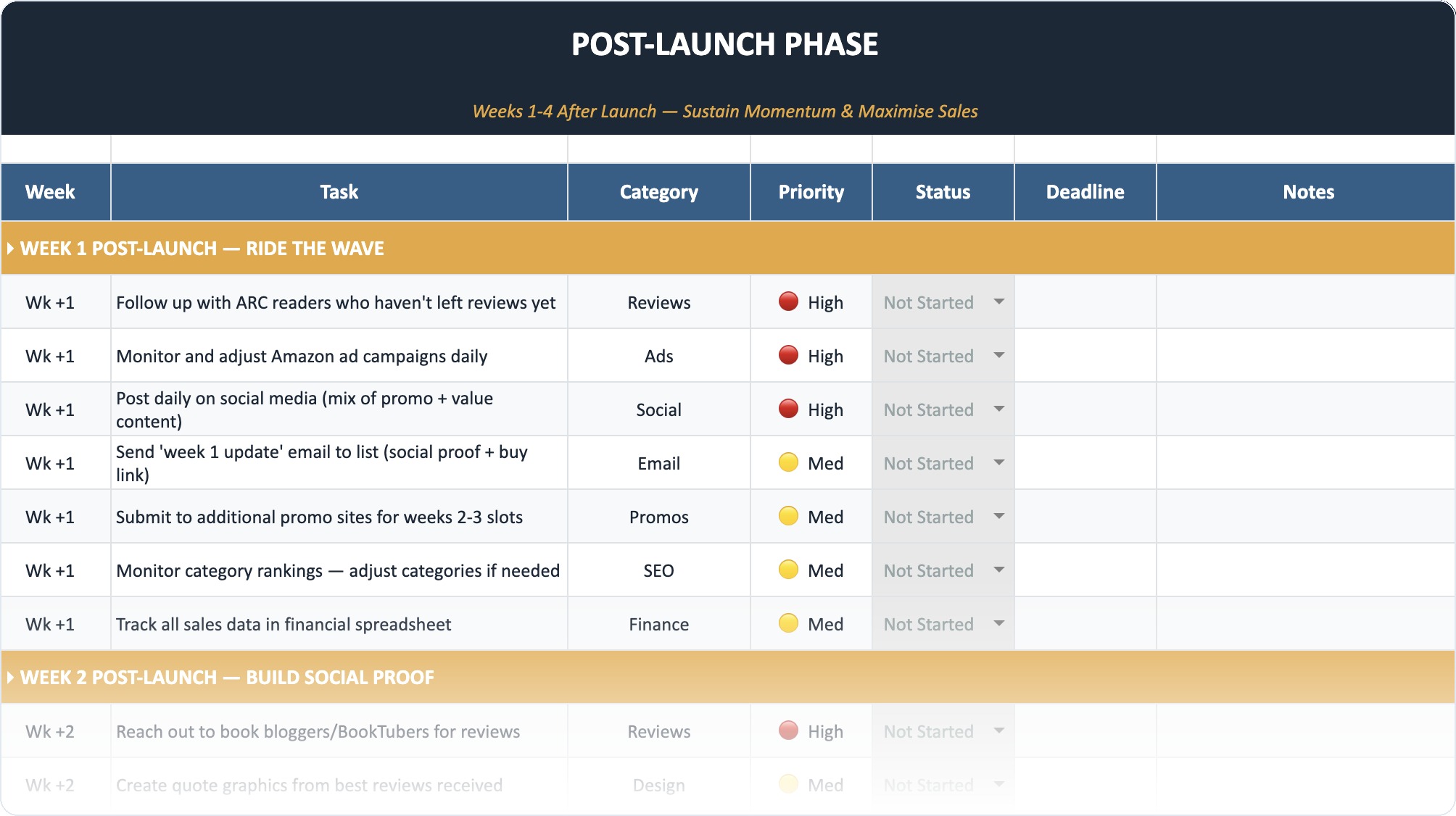
The Self-Publishing Launch Checklist (2026)
A week-by-week spreadsheet that walks you through every step of launching your book. Available as an Excel file and Google Sheet.
The Role of Metadata and Categories
Your description does not live in a vacuum. It lives alongside your price, your cover, and your categories. If your cover looks like a horror novel but your description reads like a cozy mystery, you will confuse the reader. Confusion kills sales.
Ensure your tone matches your packaging. Consistency builds trust.
Also, consider the size of the market. The global publishing market is projected to be worth around $126.9 billion in 2025. There is plenty of money on the table, but the competition is fierce. You cannot afford to be lazy with your metadata.
Common Formatting Mistakes to Avoid
- Giant Blocks of Text: I mentioned this before, but it bears repeating. Hitting "enter" is free. Use it.
- All Caps: DO NOT WRITE YOUR DESCRIPTION LIKE THIS. It feels like you are screaming. It is hard to read. Use all caps sparingly for headers only.
- Fancy Characters: Specific symbols or emojis might not render correctly on all devices (like older Kindles). Stick to standard text and HTML tags like
<b>(bold) and<i>(italics).
Final Thoughts: It’s a Living Document
Your book description is not carved in stone. It is digital ink. You can change it tomorrow. You can change it next week.
If your book isn't selling, don't blame the market. Don't blame the cover art (though check that too). Look at your description. Is it boring? Is it confusing? Is it invisible?
Fix the words, and you fix the sales.
If you are just starting out and this feels overwhelming, check out our list of mistakes first-time authors make to ensure you aren't tripping over other common hurdles. You might also want to read about character development to make sure the characters you are describing are actually deep enough to sustain a reader's interest. And for general advice, our writing tips for beginners guide is a great place to reset your mindset.
Writing the book was the hard part. Writing the description is the smart part. Do it well.
Frequently Asked Questions
How long should a book description be?
For fiction, aim for 150 to 250 words. You want it punchy and fast. For non-fiction, you can go longer, up to 400 words, because you need to list specific benefits and bullet points. However, never simply fill space. If you can say it in 100 words, do it.
Should I include reviews in my book description?
Yes, absolutely. If you have editorial reviews or praise from other authors, place a snippet at the very top or bottom of your description. It adds immediate credibility. Use bold text to make the source stand out.
Can I use AI to write my book description?
You can use it to generate ideas or drafts, but you should not copy-paste raw AI output. AI often lacks the specific emotional nuance required to hook a human reader. Use it as a tool, not a replacement for your own marketing brain.
What is the difference between a synopsis and a description?
A synopsis is a full summary of the plot, including the ending, usually sent to agents or editors. A description (or blurb) is a sales pitch that teases the conflict but hides the resolution to make the reader buy the book.
How often should I update my book description?
Update it whenever you have new relevant information, like winning an award or getting a major new review. You should also update it if your sales are flatlining; sometimes a fresh hook is all you need to restart the algorithm.