

A memorable plot twist feels inevitable in hindsight, but many of them fall flat. They leave readers feeling cheated instead of shocked. The real difference isn't the surprise; it's the careful setup that makes the impossible feel true. If you want to write a plot twist that sticks with your readers, you must earn it. You do this by planting seeds, misleading with purpose, and respecting their intelligence.
- Earn the Twist: Don't just drop a surprise on the reader. Build to it with clues and character motivation so it feels logical, not random. The best twists change the meaning of the entire story.
- Hide Your Clues: Plant small, hidden clues throughout the story. Use symbols, dialogue with double meanings, and minor details that only make sense after the reveal.
- Use Misdirection: Guide readers down a believable but wrong path with red herrings and unreliable viewpoints. This makes the actual truth hit harder.
- Pass the "Reread Test": A great twist makes someone want to immediately reread your book to spot the clues they missed. All the pieces should click into place on a second pass.
A plot twist is more than a simple surprise. It's a basic change in the reader's view of the story. It changes the meaning of everything that came before it, turning the story on its head and revealing a deeper, often more complex, truth. Your aim isn't just to shock. It's to create a moment of genuine revelation that lifts the entire story from good to unforgettable.
How to Write a Plot Twist That Actually Works
The secret to a killer twist is that it's not a secret to you, the author. You must know the twist before you write a single word of your first draft. This lets you weave the threads in from the very beginning, creating a strong foundation for the eventual reveal. Think of yourself as a magician. The audience only sees the final, impossible act, but you know every hidden mechanism and every bit of sleight of hand that made it work.
Many writers try to tack on a twist at the end, thinking it will add excitement. This almost always fails. It feels cheap, unearned, and disconnected from the story. A much better approach is to work backward from your twist. Once you know the final truth, you can carefully build the path of lies, wrong ideas, and hidden clues that will lead your reader to it. This requires a solid plan, which is why following a guide on how to write an outline for a book is an essential first step.
The Foundation: Earning Your Twist
A twist that feels like it came out of nowhere is a failure. It breaks the reader's trust. To avoid this, you must "earn" your twist by making it a logical, though unexpected, result of the story's events and character motivations. Once the truth is out, it should feel like the only possible conclusion.
The twist must have consequences. It needs to seriously raise the stakes, change the protagonist's goals, or force them to confront a terrible truth. What most people get wrong here is thinking any surprise will do. A twist for the sake of a twist is just a gimmick; a twist that changes everything is powerful storytelling. For instance, the revelation shouldn't just be "the mentor was evil." It should be "the mentor was evil, and every skill he taught the hero was designed to help the villain win, meaning the hero's greatest strengths are now their biggest liabilities."
Timing is also a key factor. Research shows that the sweet spot for a major plot twist is around the 75% to 80% mark of the story. This gives the reader enough time to get invested in the initial story but also leaves enough room to explore the fallout from the revelation. It prevents the twist from feeling like a cheap last-minute shock and allows its consequences to shape the story's climax.
Planting the Seeds: The Art of Subtle Hints
Foreshadowing is what makes a plot twist feel earned. It's the art of dropping hints so subtle that they go unnoticed on the first read but seem blindingly obvious on the second. According to one analysis, about 70% of readers report that effective foreshadowing seriously boosts their engagement by creating a sense of anticipation.
Your clues should never scream "I'm a clue!" They need to be hidden within the text, serving other purposes.
Foreshadowing Tips That Work:
- Dialogue with Double Meanings: A character might say something that seems innocent but takes on a sinister new meaning after the twist. For example, a seemingly protective father telling his daughter, "I'd do anything to keep you safe," hits differently when you learn he's the one who created the danger. Mastering this is key to learning how to write dialogue that sounds natural while still serving the plot.
- Symbolism and Motifs: A recurring object, image, or phrase can be a strong tool. A character who constantly fusses with a locket might just seem sentimental. But if the twist reveals the locket contains a key to the villain's lair, that repeated action becomes a major clue.
- Setting and Atmosphere: The description of a place can hint at its true nature. A beautiful, serene garden that has a single, strangely withered patch of ground could foreshadow a dark secret buried beneath. Using these techniques well is a core part of great writing, and you can practice it with show, don't tell exercises.
- "Throwaway" Details: A seemingly minor detail mentioned early on can be the key to the entire twist. A character's casual mention of a childhood allergy to strawberries becomes a critical piece of evidence when a suspect is later seen eating a strawberry tart without a problem.
The best foreshadowing does double duty. A clue shouldn't just be a clue; it should also be a piece of characterization, world-building, or plot movement. This makes it harder for the reader to spot and makes the story feel tighter and more planned.
Remember the "rule of three." In storytelling, audiences often need to hear or see something three times to fully register it. Plant your clues in different forms and at different points in the story to plant them in the reader's mind without making them too obvious.
Stop Staring at a Blank Page
Publy is a distraction-free book editor with AI built in. Brainstorm plot ideas, get instant chapter reviews, or rewrite clunky paragraphs. 3 million free words included.

Leading Them Astray: Clever Misdirection Techniques
While you're subtly planting the real clues, you also need to be actively misleading the reader. This is done with misdirection. The key to good misdirection is "fair play." You can't lie to the reader, but you are allowed to let the characters (and by extension, the reader) lie to themselves.
Misdirection works by presenting a believable, alternative solution that grabs the reader's attention.
Twist Writing Techniques for Misdirection:
- Red Herrings: This is the most famous misdirection tool. A red herring is a false clue designed to lead readers down the wrong path. In a mystery, you might spend a whole chapter investigating a character with a strong motive and no alibi, only to reveal later they're innocent. This is a basic skill needed if you want to write a murder mystery that keeps readers guessing.
- The Obvious Suspect: Make one character seem so obviously guilty that the reader starts to doubt it. Or, make them so suspicious that the reader focuses all their energy on them, ignoring the real culprit hiding in plain sight.
- Manipulating Point of View: If your story is told from a character's limited perspective, their own biases and blind spots become a powerful tool for misdirection. The reader only knows what the character knows. So if the character is wrong, the reader is wrong, too. This technique is especially powerful when you want to write a villain that readers secretly root for, as you can hide their true nature behind a likeable but flawed perspective.
- The Unreliable Narrator: This is a tougher technique where the narrator themselves cannot be trusted. They might be lying, insane, or simply misremembering events. This forces the reader to question everything they're told.
The goal of misdirection is to make the reader feel smart for figuring out the "wrong" answer. This makes the shock of the "right" answer even greater.
The Ultimate Litmus Test: Does Your Twist Pass the Reread?
The final test of a plot twist is what's known as the "Reread Test." A hallmark of a successful plot twist is that it enhances a second reading of the book instead of ruining it.
After the reveal, a reader should be able to go back to page one and see the trail of breadcrumbs you left. The dialogue with a double meaning should now be clear. The detail that seemed like a throwaway should now stand out. The strange behavior of a character should now make perfect sense. This creates a deep sense of satisfaction. The reader doesn't feel tricked; they feel like they were part of a brilliant puzzle all along.
If your twist relies on information that was never presented to the reader or flat-out contradicts earlier events, it fails the reread test. It will feel like a cheat, and readers will resent it. But if rereading the book is a rewarding experience of discovery, you've created a brilliant story surprise.
A Breakdown of Twists: Common Types and Ideas
While twists can be unique, they often fall into several common types. Knowing these can help you brainstorm plot twist ideas and find the right framework for your story.
| Twist Type | Description | Spoiler-Free Example |
|---|---|---|
| Identity Reveal | A character isn't who they seem to be. | The quiet librarian is revealed to be a retired master spy. |
| Motive Reveal | The true reason behind a character's actions is exposed. | The villain's hunt for a powerful artifact isn't for greed, but to destroy it because it corrupted their family. |
| Reality Shift | The basic reality of the story is different than what the reader was led to believe. | The "haunted house" isn't possessed by ghosts; it's a thinking alien ship trying to communicate. |
| Timeline Shift | The chronological order of events is revealed to be different, changing the story's context. | Two separate storylines following different characters are revealed to be taking place decades apart. |
| False Protagonist | The character we thought was the hero is killed off or becomes secondary early on. | The brave knight leading the quest is killed in chapter three, and his inexperienced squire must take his place. |
| Unreliable Narrator | The person telling the story is revealed to be dishonest, biased, or mentally unstable. | The narrator recounting their heroic deeds is revealed to be a patient in a mental institution, making up the entire adventure. |
These are not rigid boxes. The best twists often combine elements from multiple types to create something fresh and unexpected. The rise of serialized fiction on digital platforms has made these kinds of cliffhangers and reveals even more popular, as they keep readers coming back for the next installment.
Common Twist Failures (And How to Avoid Them)
For every brilliant twist, there are a dozen that make readers groan. Knowing these common traps is the first step to avoiding them in your own writing.
The Deus Ex Machina
This is a Latin term meaning "god from the machine." It refers to a twist where an unsolvable problem is suddenly fixed by the unexpected interference of some new event, character, or ability that was never hinted at before.
- The Problem: It feels like the author wrote themselves into a corner and cheated to get out.
- The Fix: Make sure the solution to your story's central problem comes from elements you've already established. The hero should win using a skill they learned in Chapter 2, not a magic sword that appears out of thin air in the final battle.
The "Out of Nowhere" Surprise
This is a twist with zero setup. The reader is given no chance to figure it out, no matter how clever they are.
- The Problem: It breaks the reader's trust and makes the story feel random.
- The Fix: Always plant your seeds. Even the most shocking twist needs a logical foundation. A story should be able to stand on its own, with the twist improving it rather than being its only support.
The Predictable Cliché
Some twists have been used so many times they've lost all impact. Examples include the evil twin, "it was all a dream," or the butler doing it.
- The Problem: The reader sees it coming a mile away, and the reveal is met with a sigh instead of a gasp.
- The Fix: If you use a common trope, you must add your own spin to it. What if it was an evil twin, but the "good" twin is the one we've been following all along, and the "evil" one is actually trying to stop them?
The Logic Breaker
This is a twist that directly contradicts the established rules of your world or the known personality of a character.
- The Problem: It destroys the reader's belief in the world you've built.
- The Fix: Maintain your internal logic. Before you commit to a twist, double-check your manuscript to make sure it doesn't create any plot holes or character problems.
The Toothless Twist (No Consequences)
This is a revelation that ultimately changes nothing. The story continues on the same path it was on before the twist was revealed.
- The Problem: It feels pointless and kills the story's pace.
- The Fix: Make your twist matter. It should force characters to make new choices and send the plot veering in a new direction. This is vital for crafting satisfying book endings.
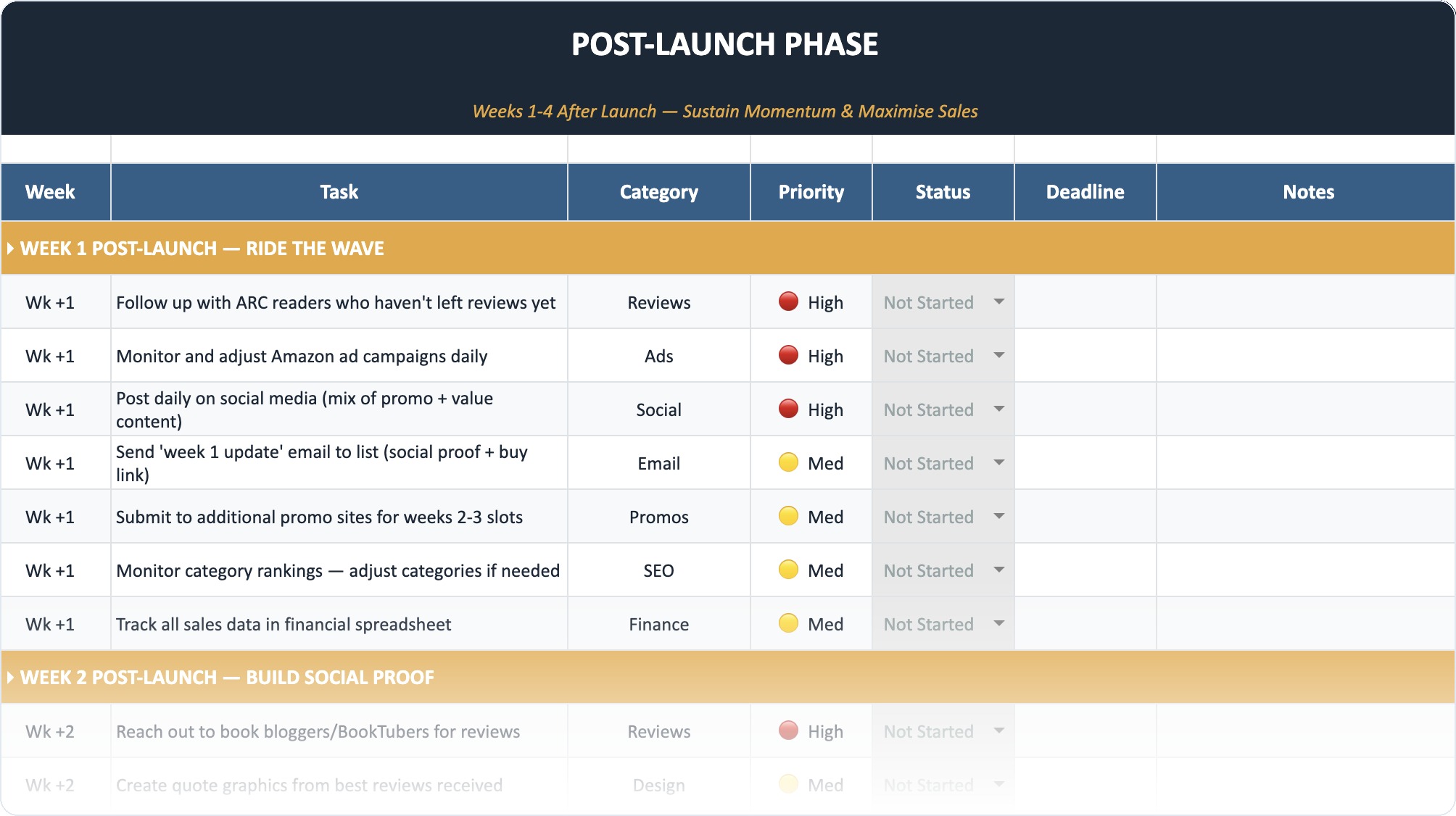
The Self-Publishing Launch Checklist (2026)
A week-by-week spreadsheet that walks you through every step of launching your book. Available as an Excel file and Google Sheet.
The Final Polish: Testing Your Twist with Beta Readers
You're too close to your own story to judge if your twist lands correctly. You know the secret, so you can't be surprised by it. This is where beta readers are a huge help. They provide a fresh set of eyes to test your illusion.
However, you need to ask them the right questions. Don't just ask, "Were you surprised?"
Instead, ask specific questions like:
- "At what point in the story did you first suspect [the twist]?"
- "Was there any point where you felt confused or that something didn't make sense?"
- "After finishing, did the ending feel earned and logical based on the rest of the book?"
- "Are there any clues you noticed on your first read that hinted at the ending?"
Their answers will tell you if your foreshadowing is too obvious, too hidden, or just right. They can also point out potential plot holes you missed. Working with beta readers is a professional step, and it's helpful to know the common practices around it, including whether beta readers get paid. Their feedback is the final, vital piece in crafting a plot twist that will leave your readers breathless.
Frequently Asked Questions
What makes a plot twist good?
A good plot twist is surprising but feels completely logical in hindsight. It should be set up properly, have real consequences for the story, and pass the "reread test," making the story even better on a second reading.
How do you foreshadow without giving away the twist?
The key is to make your clues serve more than one purpose. A clue hidden in a piece of character development, a description of the setting, or a seemingly unrelated subplot is much harder to spot. Use subtle hints, symbols, and dialogue with double meanings instead of obvious ones.
Can a story have too many twists?
Yes. A story with too many twists can leave the reader feeling tired and disconnected. Each twist lessens the impact of the next one. It's generally better to have one or two major, well-earned twists than a constant stream of minor surprises that don't change the stakes.
What's the difference between a red herring and a plot hole?
A red herring is an intentional false clue planted by the author to mislead the reader. It's a deliberate part of the story's design. A plot hole is an unintentional inconsistency or logical error in the story that contradicts information you've already given. One is a tool, the other is a mistake.
How early should I plan my plot twist?
You should know your major plot twist before you start writing the first draft. Planning the twist from the beginning allows you to weave in the necessary hints and misdirection from page one, making the final reveal feel like a natural part of the story.
Can a plot twist happen at the beginning of a story?
Yes, this is known as an inciting twist. It happens near the beginning and kicks off the entire plot, often by revealing that the protagonist's initial view of their world or situation is completely wrong. While less common than end-of-story twists, it can be a very effective way to hook a reader immediately.