

89% of writers who attempt a 30-day novel challenge fail to cross the finish line. They don't fail because they lack talent or ideas. They fail because they treat writing like a polite hobby instead of a raw, messy demolition derby. If you want to write a book in 30 days, you have to stop trying to be good and start trying to be done.
- Commit to Quantity: You need 1,667 words daily for a 50,000-word draft.
- Outline First: A roadmap prevents you from getting stuck in the "sagging middle."
- No Editing: Delete your backspace key mentally. Editing is for next month.
- Use Sprints: Short, high-intensity writing bursts beat long, meandering sessions.
Writing a book in a month sounds impossible to the uninitiated. Yet, thousands of authors do it every year during events like NaNoWriMo (National Novel Writing Month). It isn't magic. It is math. It requires a shift in psychology from "artist" to "bricklayer." You aren't painting a masterpiece right now. You are shoveling sand into a box so you can build a castle later.
This guide covers the exact schedule, mindset, and tactics you need to finish your zero draft in one month.
Why Attempt to Write a Book in 30 Days?
Most people spend years talking about the book they are going to write. They wait for inspiration. They wait for the stars to align. They wait until they retire. The problem with waiting is that fear grows in the silence. The longer you wait, the scarier the blank page becomes.
Fast drafting kills fear. When you force yourself to write at breakneck speed, you outrun your inner critic. Your internal editor, that nagging voice saying "this sentence is trash," can't keep up with your typing speed. By the time it notices a plot hole, you are already three chapters ahead.
Speed also creates consistency. If you write sporadically, you lose the thread of your story. You spend the first twenty minutes of every session just remembering what your main character was doing.
When you write every single day for 30 days, the story stays alive in your subconscious. You dream about it. You solve plot problems while brushing your teeth. The immersion makes the writing easier.
Is the book going to be perfect? No. It might be terrible. But a terrible book can be fixed. A blank page cannot be fixed. As stated in recent writing data, the average first-time author takes 6 to 12 months to finish a draft. You are compressing that learning curve into a pressure cooker.
You can always edit a bad page. You can’t edit a blank page.
Jodi Picoult
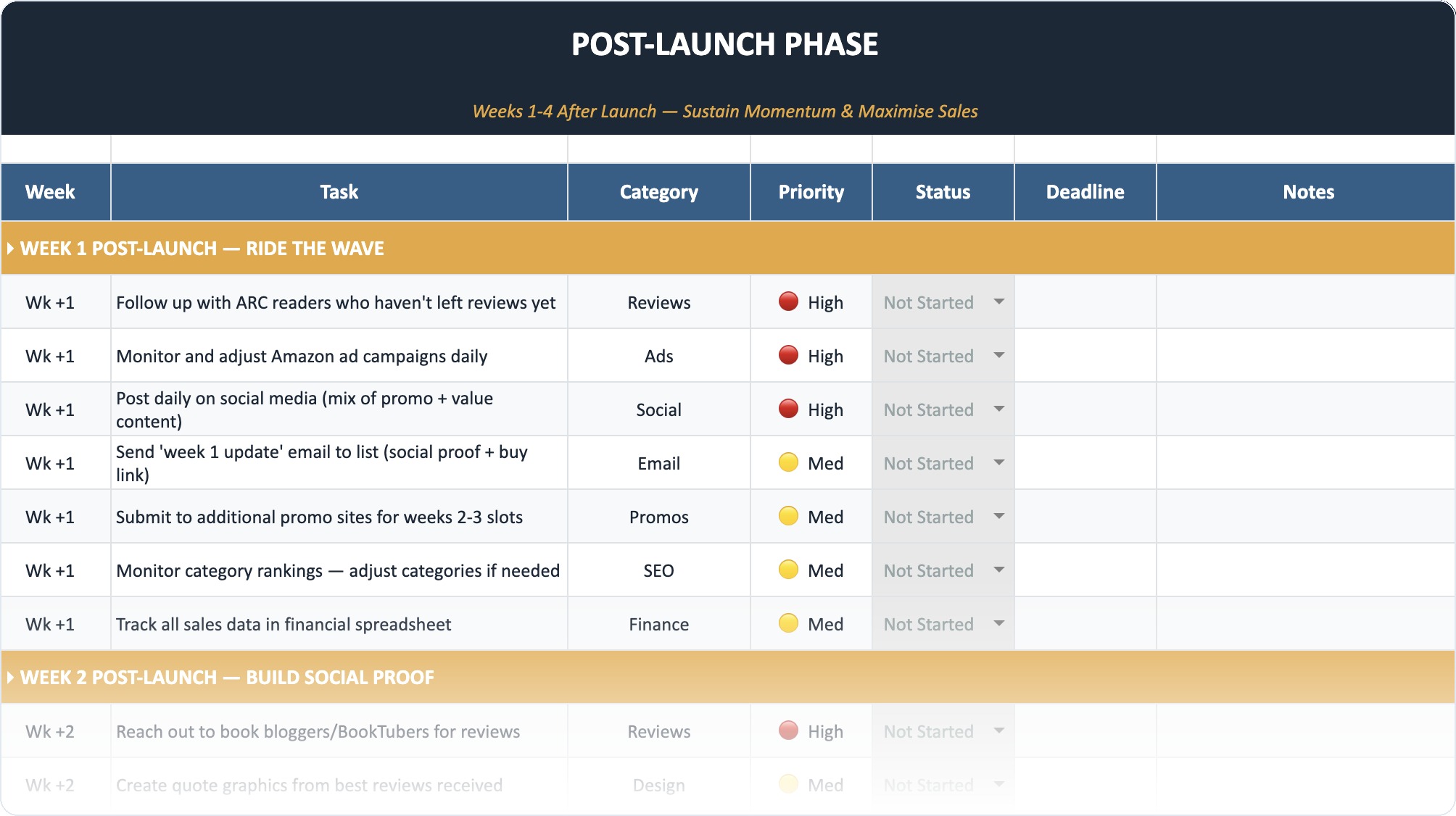
The Self-Publishing Launch Checklist (2026)
A week-by-week spreadsheet that walks you through every step of launching your book. Available as an Excel file and Google Sheet.
Phase 1: The Setup (Days 1-2)
Do not start writing on Day 1 without a map. If you drive cross-country without a GPS, you will end up in a ditch. The same applies here. You need two days of solid prep work before you start the clock on your word count.
The "Good Enough" Outline
You don't need a 40-page treatment. You need a list of scenes. Fast drafting relies on knowing what happens next. If you have to stop and think "what should he do now?" you will lose momentum.
Use a simple structure like the "Save the Cat" beat sheet or the 3-Act Structure. Write down 30 to 40 scene ideas.
- Act 1: The setup, the inciting incident, the decision to leave normal life.
- Act 2: The new world, the tests, the failures, the midpoint twist, the "all is lost" moment.
- Act 3: The rally, the final battle, the resolution.
Keep each scene description to one sentence. "John finds the bomb." "Sarah breaks up with Mike." "The dog runs away." That is all you need.
If you get stuck on your outline, use Scrivener novel templates to visualize your beats. The corkboard view lets you move scenes around before you commit to writing them.
Character Sketches
Who are these people? You don't need their entire backstory, but you need their motivation.
- What do they want? (To save the world, to get the girl, to survive).
- Why can't they have it? (The villain, their own fear, the ticking clock).
- What happens if they fail? (Death, heartbreak, poverty).
If you know these three things, you can write any scene. If you don't know them, your characters will wander around aimlessly talking about the weather.
The Mathematics of the Month
Let's break down the daily word count goals.
- Goal: 50,000 words (Standard novella/short novel length).
- Duration: 30 days.
- Daily Target: 1,667 words.
That number, 1,667, is your new god. You do not sleep until you hit it. You do not watch Netflix until you hit it.
If 1,667 sounds high, break it down. The average person types 40 words per minute. If you type continuously, that is only 42 minutes of writing. Even with thinking time, breaks, and staring at the wall, you can do this in two hours.
Buffer Days: Life happens. You will get sick. You will have to work late. Aim for 2,000 words a day. This builds a "bank" of words so you can take a day off later without guilt.
| Strategy | Daily Goal | Total Word Count | Risk Level |
|---|---|---|---|
| The Minimum | 1,667 words | 50,010 | High (One missed day kills you) |
| The Buffer | 2,000 words | 60,000 | Medium (Allows for off days) |
| The Weekend Warrior | 500 (weekdays) + 5,000 (weekends) | ~50,000 | Extreme (Burnout likely) |
Phase 2: The Execution (Days 3-25)
Now the real work starts. This is where most people quit. The novelty wears off around Day 7. The plot holes appear around Day 12. The exhaustion sets in around Day 15.
Fast Drafting Techniques
You need to generate text quickly. Here are three methods to speed up your output.
1. Word Sprints
Set a timer for 20 minutes. Write as fast as you can. Do not correct typos. Do not fix grammar. Just get the story out. When the timer goes off, take a 5-minute break. Repeat. This is often called the Pomodoro Technique. It works because it gamifies the process. You aren't writing a book; you are trying to beat the clock.
2. The "[TK]" Method
If you don't know a fact, don't look it up. Research is the enemy of fast drafting. If you need to know the name of a specific gun or the layout of 19th-century London, write "[TK]" and move on.
- Example: "He pulled out a [TK gun name] and fired."
You can fill in the blanks in December. Right now, you just need the action.
3. Write Out of Order
If you are bored writing a scene, your reader will be bored reading it. Skip it. Write the ending. Write the big explosion. Write the kiss. You can stitch the scenes together later. Momentum matters more than chronology.
Fighting the Inner Editor
Your brain will try to stop you. It will say, "This character motivation makes no sense." It will say, "You used the word 'said' five times in this paragraph."
You must ignore this voice. Perfectionism is fear in a tuxedo.
Accept that your first draft will be garbage. Hemingway said the first draft of anything is garbage. You are creating the clay, not the statue. You can't sculpt air. You need the raw material on the page before you can make it beautiful.
For more on managing this mental load, look into setting realistic writing goals that focus on input (time spent) rather than just output (quality).
Dealing with the "Sagging Middle"
Around Day 15 (25,000 words), you will hit the wall. The excitement of the beginning is gone, and the end is too far away. This is the "Sagging Middle."
This happens because you ran out of plot. Your outline wasn't detailed enough.
- The Fix: Throw a rock at your character.
If things are going too smoothly, blow something up. Introduce a new villain. Kill a mentor. Reveal a secret. Force your protagonist to react. Conflict drives word count. If they are just talking, have someone kick down the door with a gun.
Stop Staring at a Blank Page
Publy is a distraction-free book editor with AI built in. Brainstorm plot ideas, get instant chapter reviews, or rewrite clunky paragraphs. 3 million free words included.

Phase 3: The End Game (Days 26-30)
You are tired. Your hands hurt. You are sick of these characters. But you are close.
The final week is about closing loops. Look at your outline. What promises did you make in Chapter 1? Did you promise a mystery would be solved? Did you promise a romance would happen? You need to pay these off now.
The Sprint to the Finish
You might find yourself behind schedule. This is normal. If you have 10,000 words left and only 3 days, you have to go into "bunker mode." Cancel your social plans. Wake up an hour early.
This is where NaNoWriMo tips come in handy:
- Dictation: Use voice-to-text software while you drive or walk. You can speak 3x faster than you type.
- Lower Standards: If a scene needs to be dialogue-heavy to move fast, make it dialogue-heavy. Description can wait.
- Write "The End": Even if you aren't at 50,000 words, write the ending scene. It gives you a psychological win. You can backfill the missing word count with extra scenes later.
Tools of the Trade
You don't need fancy software to write a book. J.K. Rowling wrote Harry Potter on paper napkins (or so the myth goes). But the right tools can help you organize the chaos.
Specialized Writing Software
Word processors like Microsoft Word are designed for business letters, not 80,000-word manuscripts. As your document grows, scrolling becomes a nightmare.
- Scrivener: The gold standard. Allows you to break your book into small chunks. You can view your research side-by-side with your writing.
- Atticus: A newer player that combines writing and formatting. Great for those planning to self-publish immediately.
- Google Docs: Simple, free, and cloud-based. Good for writing on multiple devices, but it lags with long documents.
AI Assistants
Writers today have access to tools that didn't exist a few years ago. AI can be a controversial topic, but for fast drafting, it is a tool like any other.
- Brainstorming: Stuck on a plot point? Ask an AI to give you 10 ideas for a plot twist.
- Description: "Describe a spooky forest in the style of Stephen King." Use the output as inspiration, not the final text.
- Sudowrite: Built specifically for fiction writers. It can suggest sensory details or help you rewrite a clunky sentence.
According to recent tech reviews, AI tools are becoming essential for overcoming writer's block and speeding up the drafting phase, though they should not replace the human voice.
Distraction Blockers
If you have the willpower of a toddler (like most of us), you need to lock yourself out of the internet.
- Freedom: Blocks social media and distracting websites across all your devices.
- Cold Turkey Writer: Turns your computer into a typewriter. You cannot exit the app until you hit your word count goal.
The Mental Game: Surviving the Month
Writing a book in 30 days is physically and emotionally draining. You are mining your own brain for content for hours a day.
Physical Health
- Eyes: Follow the 20-20-20 rule. Every 20 minutes, look at something 20 feet away for 20 seconds.
- Wrists: Carpal tunnel is real. Stretch your wrists before and after every session.
- Hydration: Your brain is mostly water. If you are dehydrated, you will get brain fog.
Managing Burnout
There will be days when you hate your book. You will think it is the worst thing ever written. This is part of the process.
If you hit a wall, do not stop. Write garbage. Write "I hate this book I hate this book" over and over until a real sentence comes out. The goal is to keep the habit alive.
If you feel completely fried, read our guide on recovering from author burnout. Taking one intentional rest day is better than quitting entirely.
The "Zero Day" Rule
Your goal is 1,667 words. But some days, everything goes wrong. You get a flat tire. Your kid gets sick.
On these days, your goal changes. Your goal is "Non-Zero."
Write 10 words. Write one sentence. Open the document and change a comma. Do not let a day go by with zero progress. A zero day breaks the psychological chain. A 10-word day keeps the chain alive.
- Speed
- Momentum
- No time for doubt
- Finished draft quickly
- Messy draft
- High burnout risk
- Requires heavy editing
- Shallow plot holes
What Happens on Day 31?
Congratulations. You have a 50,000-word manuscript.
Now, do the most important thing: Put it away.
Do not read it. Do not edit it. Do not show it to your mother.
Your brain is too close to the story. You need distance. Let the file sit for at least two weeks. Ideally, a month. When you come back to it, you will read it with fresh eyes. You will see the plot holes clearly. You will see the typos. You will also see the brilliance. You will find sentences you don't remember writing that are actually good.
Curious about how this compares to the norm? Check out how long it takes to write a book on average to see just how much time you've saved.
The Editing Phase
Editing is where the book is actually written. The draft is just the sketch.
- Pass 1: The Big Picture. Fix the plot holes. Move chapters around. Cut characters who don't do anything.
- Pass 2: Scene Work. Strengthen the dialogue. Add sensory details.
- Pass 3: The Polish. Grammar, spelling, typos.
Do not try to do all three passes at once. You will go crazy.
Conclusion: Just Start
The only difference between a published author and a person with an idea is that the author finished the book.
You have the roadmap. You know the math. You have the tools. The only thing left is to sit down, open a new document, and type Chapter One.
The 30 days are going to pass anyway. You can either have a book at the end of them, or you can have nothing. Choose the book.
Frequently Asked Questions
Can you really write a good book in 30 days?
You can write a draft in 30 days. It likely won't be "good" by publishing standards yet. The 30-day challenge is about getting the raw story down on paper so you can edit it into something good later.
How many hours a day does it take to write 1,667 words?
For the average typist, it takes about 1.5 to 2 hours of focused writing. If you are a slow typist or need lots of breaks, plan for 3 hours. Using fast drafting techniques like sprints can reduce this time significantly.
What if I miss a day?
Don't panic. You can make it up by writing an extra 500 words for the next few days. Do not try to write 3,500 words in one day to catch up unless you have a full free day, or you risk burnout.
Should I edit as I go?
No. Editing uses a different part of your brain than creating. If you stop to edit, you kill your momentum. Turn off your spell check and keep moving forward.
Is 50,000 words a full novel?
It is considered a short novel or a novella. Most commercial fiction (thrillers, fantasy, sci-fi) runs between 70,000 and 100,000 words. However, 50,000 words is a perfect length for a first draft or a Category Romance.
What is the best software for fast drafting?
Scrivener is widely considered the best for organization, but simple distraction-free tools like FocusWriter are excellent for pure speed. Use whatever helps you get words on the page.