

You have spent months, maybe years, writing a series of books. You have individual titles sitting on digital shelves, gathering reviews and finding readers one by one. But you are leaving money on the table. A lot of it. I see authors make this mistake constantly: they treat a box set as an afterthought or a "nice to have" bonus feature.
It isn't.
An ebook box set strategy is one of the most aggressive and effective ways to scale your backlist revenue. It turns a $3.99 reader into a $9.99 reader instantly. It revitalizes "dead" books from three years ago. It opens up advertising avenues that are too expensive for single titles.
The answer to "when" is simple: Release a box set as soon as you have three full-length novels in a series. Do not wait for the series to finish. Do not wait until you have ten books. The moment you hit book three, you have a bundle product that can arguably double your visibility.
In this post, I am going to walk you through exactly how to execute this. We will look at the royalty math that makes box sets profitable, the technical hurdles of formatting a massive file, and the specific launch tactics that differ from a standard book release.
- The "Rule of Three": Launch your first box set immediately after publishing the third book in a series. You do not need to wait for the series to conclude.
- Royalty Math Wins: Box sets allow you to sell high-ticket items (e.g., $9.99) with a single click, often earning higher royalties per transaction than individual sales.
- Binge Reader Appeal: A 2025 market analysis shows subscription models now capture over 55% of the market, proving readers prefer bulk access and binge-ready content.
- Wide vs. Exclusive: Box sets are the perfect vehicle for "going wide" (Kobo, Apple, B&N) because merchandising teams on those platforms love discounting bundles.
Why Box Sets Are a Revenue Multiplier
I want to start with the psychology of the buyer because it explains why this strategy works.
When a reader looks at a single book for $4.99, they evaluate it based on the cover and the blurb. When they look at a box set of three books for $9.99, they stop evaluating the story and start evaluating the deal. The math takes over. "Three books for ten dollars? That's barely over three dollars a book."
You have shifted the conversation from "Do I want to read this?" to "Is this a good bargain?"
The Read-Through Guarantee
The biggest enemy of series income is "read-through" drop-off. You might sell 1,000 copies of Book 1. Maybe 600 people buy Book 2. By Book 3, you might only have 400 readers left. You lose people at every step. They forget. They get distracted. They lose the link.
A box set guarantees 100% read-through for the books contained within it. When a reader buys the bundle, they have Books 1, 2, and 3 on their device immediately. The friction of buying the next book is removed entirely. Even if they don't read them all immediately, you have already been paid for all three.
Increasing Average Order Value (AOV)
In ecommerce, AOV is a metric everyone watches. In publishing, we ignore it too often. If you run a Facebook ad for a $0.99 or $2.99 book, your margins are razor thin. You might spend $2.00 to sell a $2.99 book, leaving you with pennies after royalties.
If you advertise a box set priced at $9.99, you can afford to spend $5.00 or $6.00 to acquire that customer and still make a healthy profit. This allows you to bid higher on Amazon Ads and Facebook Ads, outcompeting authors who are only pushing single titles.
The Golden Rule of Timing: The "Rule of Three"
I mentioned this in the intro, but let's break it down. Why three books?
Two books is not a "box set"; it's a duet. It doesn't carry the perceived weight of a bundle. Four or five books is great, but waiting that long means you are losing months or years of potential revenue.
Three is the minimum viable product for a box set.
Ongoing Series vs. Completed Series
You do not need a completed series to release a box set. If you are writing a 9-book sci-fi epic, you should release:
- Box Set 1: Books 1-3 (Release this as soon as Book 3 is out).
- Box Set 2: Books 4-6 (Release this as soon as Book 6 is out).
- Complete Series Collection: Books 1-9 (Release this when the series ends).
This "rolling bundle" strategy means you have multiple high-ticket products generating income while you write the later books. It also gives you a massive marketing event every time you hit a multiple of three.
Pricing Strategy: Navigating the Royalty Cliff
This is where things get technical, and where many authors lose money.
On Amazon KDP, you earn a 70% royalty on ebooks priced between $2.99 and $9.99.
If you price your book at $10.00 or higher, your royalty drops to 35%.
The $9.99 Sweet Spot
For most 3-book or 4-book box sets, $9.99 is the magic number.
- Price: $9.99
- Royalty Rate: 70%
- Earning per sale: ~$6.95 (minus delivery fees)
If you price your box set at $12.99 because you think it's worth more (and it is!), look what happens:
- Price: $12.99
- Royalty Rate: 35%
- Earning per sale: ~$4.55
You literally earn less money by charging the customer $3.00 more. I have seen authors make this mistake and wonder why their ads aren't converting. Unless your box set is massive (5+ books) and you can justify a price of $19.99 or higher where the volume offsets the percentage drop, stick to $9.99 on Amazon.
Pricing for Wide Platforms
Here is the exception. Kobo, Apple Books, Google Play, and Barnes & Noble do not have this royalty drop. They generally offer huge royalties (often 70%) regardless of the price point.
If you are distributing wide, you can price your box set at $14.99 or $19.99 and still keep 70%. This is a massive incentive to take your box sets off Amazon exclusivity. According to data from Draft2Digital, authors who "go wide" can see up to 25% more revenue coming from these non-Amazon channels, often driven specifically by higher-priced box sets that merchandising teams love to feature.
Stop Staring at a Blank Page
Publy is a distraction-free book editor with AI built in. Brainstorm plot ideas, get instant chapter reviews, or rewrite clunky paragraphs. 3 million free words included.

Platform Strategy: KDP Select vs. Going Wide
You have a difficult choice to make with a box set.
The Case for KDP Select (Kindle Unlimited)
If you put your box set in Kindle Unlimited (KU), you get paid per page read. A box set of three 300-page novels is roughly 1,500 KENP (Kindle Edition Normalized Pages).
At the current payout rate (approx $0.004 per page), a full read of that box set earns you about $6.00.
This is slightly less than a $9.99 sales royalty ($6.95), but it is much easier to get a KU subscriber to download a "free" box set than to get a customer to pay $10. Amazon's algorithm rewards movement. High page reads push your rank up, which sells more copies.
If you are a new author or your genre (Romance, LitRPG) is dominated by KU, keep your box set exclusive to Amazon.
The Case for Going Wide
If you have a strong backlist, I recommend taking your box sets wide. Apple Books and Kobo have specific sections for "Bundles" and "Series Starters." They frequently run "First in Series Free" or "Box Set Sale" promos that are not available on Amazon.
Because you can price higher on these platforms without the 35% penalty, a wide box set strategy can stabilize your income so you aren't 100% dependent on Amazon's algorithm.
However, moving to a wide strategy requires you to understand the different ecosystems. You need to know the viability of Kindle Unlimited versus the long-tail stability of wide retailers before you pull the trigger.
Technical Execution: Creating the Box Set File
You cannot simply zip three Word docs together and upload them. The user experience will be terrible. Readers get annoyed when they finish Book 1 and can't easily jump to Book 2, or when the "Time Left in Book" feature is broken because the file is so large.
1. The Table of Contents (TOC) is Critical
In a single novel, a TOC is nice. In a box set, it is mandatory. You need a two-tier TOC:
- Tier 1: Links to the start of Book 1, Book 2, Book 3.
- Tier 2: Links to the chapters within those books.
If a reader hates Book 2, they might skip to Book 3. If you don't give them a link to do that, they will just stop reading and delete the file.
2. Managing File Size
Amazon charges a "delivery fee" based on file size (roughly $0.15 per MB). If your box set is full of high-res images, your delivery fee could be $2.00 per sale, eating into your profits.
- Compress your cover images.
- Remove unnecessary images inside the manuscript.
- Use a guide to digital formatting to ensure your CSS is clean and not bloated.
3. Tools of the Trade
Do not try to do this manually in Word.
- Vellum (Mac): The gold standard. It has a specific "Box Set" feature that handles the TOC hierarchy automatically. It creates beautiful, clean code.
- Atticus (PC/Mac): A strong competitor to Vellum that works in your browser. Good for box sets.
- Calibre (Free): Powerful but requires technical know-how. You can use the "Epub Merge" plugin to combine files, but you will often need to edit the HTML manually to fix the TOC.
Cover Design: The 3D Bundle Look
Your cover needs to scream "Value."
If you just use the flat cover of Book 1 for the box set, readers will be confused. They will think it's just Book 1. You need a 3D mock-up that shows the "spines" of the books. This visual shorthand tells the reader's brain: This is a stack of books. This is a lot of content.
- Amazon: Paradoxically, Amazon officially recommends flat 2D images, but almost every bestseller uses a 3D image or a 2D image designed to look like a 3D stack. The click-through rate on 3D bundles is almost always higher.
- Apple Books: They strictly enforce 2D covers. If you upload a 3D spine image, they might reject it. You may need a separate "flat" version for Apple.
For specific advice on how to handle typography and genre expectations on these bundles, look into tips for eye-catching cover design. The title on the box set cover should usually be the series name (e.g., "The Solar War Trilogy") rather than a list of individual titles, which can look cluttered.
Marketing Your Box Set
A box set release is a "New Release" in the eyes of the retailer algorithms. This is a second chance to launch your books.
1. The "Discount" Angle
Your marketing copy should focus on the savings.
"Get the complete trilogy for $0.99 for a limited time!"
"Save 40% compared to buying individually."
2. Targeting a New Audience
Market the box set to "Binge Readers." Use keywords like "omnibus," "collection," "complete series," and "binge read."
These are different readers than the ones who buy serial installments. They want to know the story is finished or that they have a lot of content ahead of them.
3. Using the Box Set to Sell the Backlist
Some authors make the first box set (Books 1-3) permanently free or $0.99. This acts as a massive "lead magnet" for the later books in the series (Books 4-6, 7-9). If you can get a reader hooked on three books for free, they are highly invested in the characters and likely to pay full price for the rest of the series.
When writing your product page, the description is vital. You aren't just summarizing one plot; you have to pitch the arc of the series. If you struggle with this summary, review the basics of writing a compelling book description that hooks the reader instantly.
Market Data Support
It's worth noting the scale of this opportunity. The global ebook market is projected to reach over $18.85 billion in 2026. This isn't a shrinking industry; it's a growing one, and the growth is being driven by convenience and value—two things box sets provide in spades.
Furthermore, Amazon currently holds approximately 67% of the US ebook market. While that dominance is real, it leaves a full third of the market available on other platforms, reinforcing the "wide" strategy I mentioned earlier.
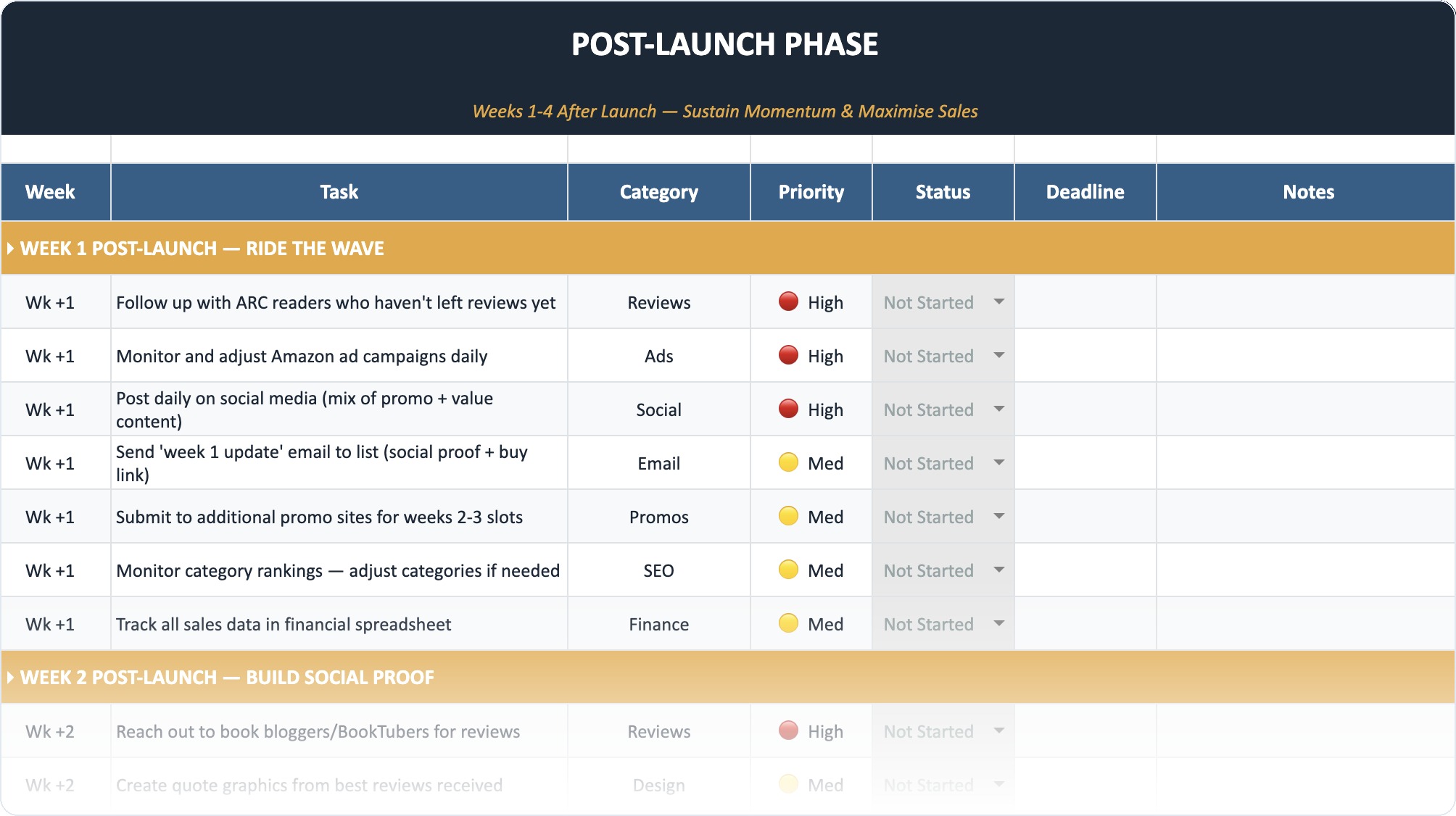
The Self-Publishing Launch Checklist (2026)
A week-by-week spreadsheet that walks you through every step of launching your book. Available as an Excel file and Google Sheet.
Handling Reviews for Box Sets
A common frustration for authors is that reviews for individual books do not automatically transfer to the box set. The box set is a unique product ID (ASIN). You start from zero reviews.
This can be daunting, but it is also a clean slate. If Book 1 had some mixed reviews because of a slow start, the box set reviews often average out higher because the reader has the immediate payoff of Book 2 and Book 3.
You need to recruit your ARC (Advance Review Copy) team to review the box set specifically. Send them the file and ask them to post a review on the new box set page, even if they reviewed the individual books years ago.
Pros and Cons of Ebook Box Sets
| Feature | Pros | Cons |
|---|---|---|
| Revenue | Higher price point ($9.99), higher royalty per transaction. | Lower royalty rate if priced above $9.99 on Amazon. |
| Visibility | "New Release" visibility boost; appeals to bargain hunters. | Can cannibalize sales of individual books. |
| Reader Experience | Seamless reading; higher retention/read-through. | Large file sizes; difficult navigation if formatted poorly. |
| Marketing | Better ROI on ads due to higher AOV. | Requires new cover art and formatting effort. |
Final Thoughts on Strategy
The ebook box set strategy is not just about bundling old files. It is about creating a premium product for a specific type of high-consumption reader.
I recommend you look at your backlist today. Do you have three books in a series? If yes, you are losing money every day you don't have a box set live.
Get a 3D cover designed. Merge your files with a clean TOC. Price it at $9.99 (or higher on wide platforms). And launch it as a new product.
The market data supports this move. With subscription platforms capturing 55.72% of ebook revenue in recent years, the trend is moving away from single-purchase inputs toward bulk access. Box sets bridge that gap, offering the "bulk" feel with a transactional purchase.
Don't let your backlist collect dust. Bundle it up and let it find a new audience.
Frequently Asked Questions
How many books do I need for a box set?
You need a minimum of three full-length books to create a viable box set that readers perceive as a high-value bundle. While you can bundle two books, the marketing data suggests that "Trilogies" or "3-Book Collections" drive significantly higher click-through rates.
Should I remove my individual books from sale?
No, never remove your individual books. The box set and the individual titles serve different customers. Some readers prefer to buy one book at a time to minimize risk. The box set is an additional product, not a replacement.
Can I include a novella in a box set?
Yes, including exclusive content like a novella or a bonus short story is a fantastic way to sell the box set to superfans who already own the individual books. Label it clearly on the cover: "Includes Exclusive Bonus Novella."
Does a box set hurt my individual book sales?
It can cannibalize individual sales slightly, but the overall revenue usually increases. A reader who buys the box set for $9.99 might have only bought Book 1 for $3.99 and then stopped. The box set captures the full value of that reader upfront.
How do I handle audiobooks for box sets?
Audiobook box sets are incredibly popular on Audible. Because Audible credits have a fixed value (usually around $15), listeners love using one credit to get 30+ hours of audio. If you have the audio rights, combining your audiobooks into a single bundle is one of the most profitable moves you can make.