

You are likely tired of the hamster wheel. You write a book, launch it, watch the royalties spike, and then watch them plummet thirty days later. This cycle is the reality for almost every author relying solely on retailers like Amazon or Kobo. You are constantly hunting for new readers because you have no reliable way to monetize the ones you already have on a recurring basis.
The industry is shifting. The old model of "transactional" reading—where a reader buys one book and disappears—is being replaced by "relational" reading. This is where subscriptions for authors come into play. It is not just about slapping a price tag on a blog post. It is about building a predictable, stable income stream that frees you from the volatility of the algorithm.
I have seen authors transform their careers by moving just 10% of their audience to a subscription model. Suddenly, you know exactly how much money is hitting your bank account on the first of the month. That financial floor changes how you write. It changes how you plan.
This guide will walk you through exactly how to build this model, the platforms you should use, and why 2026 is the year direct-to-reader sales overtake traditional retailer dominance for mid-list authors.
- Stability over Spikes: Subscriptions provide recurring revenue, smoothing out the "feast or famine" cycle of book launches.
- Platform Ownership: Selling directly or via subscription allows you to own the customer data, unlike Amazon where you do not know your buyers.
- Higher Margins: Direct sales and subscriptions can net you 90-95% of the revenue, compared to the 35-70% standard on retailers.
- Market Growth: The creator subscription market is booming, projected to hit $25.6 billion by 2033, making it a prime time to enter.
The Economic Case for Author Subscriptions
For years, we accepted 70% royalties as "good." We accepted 35% on lower-priced books as "standard." But when you look at the macroeconomics of the creator economy, those numbers start to look like robbery.
The global Creator Subscription Platform market was valued at USD 6.7 billion in 2024. According to market analysis by DataHorizzon Research, this sector is projected to reach USD 25.6 billion by 2033. This 16.2% growth rate proves that consumers are increasingly willing to pay for direct access to the creators they love.
Why the "Retailer Only" Model is Failing
When you sell a book on Amazon, you do not get a customer. You get a royalty. Amazon keeps the customer. You do not know their name, their email, or what else they like to read. If Amazon changes their algorithm tomorrow, your business can vanish.
With a subscription model, you own the relationship. You control the pricing. You control the delivery.
Financial Variance:
- Retailer Model: $5,000 in January (launch), $400 in February.
- Subscription Model: $2,500 in January, $2,600 in February, $2,700 in March.
The goal is not necessarily to replace your book sales but to build a floor. If your rent or mortgage is covered by your subscription income, you can take creative risks with your books.
The Margin Difference
The math is simple. If you sell a $10.00 ebook on a subscription platform or direct site, you often keep $9.00 to $9.50. On a retailer, you keep $7.00. Over thousands of transactions, that difference funds your covers, your editing, and your marketing.
Authors who sell directly from their websites can retain 90-95% of the sale price. This is a massive jump from the traditional split. This extra margin allows you to spend more on acquiring readers or simply keep more profit.
Choosing Your Platform: Ream, Patreon, or Direct?
This is the most common question I get. "Should I use Patreon? I heard Ream is better for writers."
The answer depends on what you are selling. Are you selling a community, or are you selling books?
Patreon: The Community Giant
Patreon is the 800-pound gorilla. Everyone knows it. Readers trust it.
Pros:
- Trust: Readers are already there. They likely support other creators.
- Integrations: Connects seamlessly with Discord for community chat.
- Billing: Robust handling of declined cards and international VAT.
Cons:
- The Reading Experience: Reading a long story on Patreon is painful. The interface is built for blog posts, not chapters. Users have to scroll endlessly. It does not save their spot.
- Discovery: Patreon has historically been poor at helping new people find you. You have to bring your own traffic.
Ream: Built for Fiction
Ream is the new challenger, built specifically by fiction authors for fiction authors. It solves the biggest problem Patreon has: the reading interface.
Pros:
- E-reader Experience: Ream looks like a Kindle or Apple Books app in the browser. It saves the reader's spot. It allows for chapter navigation.
- Story Scheduling: You can upload a whole book and drip-feed chapters automatically.
- Community: They are building discovery features specifically for readers looking for serialized fiction.
Cons:
- Newer Platform: Less name recognition than Patreon (though this is changing fast).
- Niche: Really focused on fiction. If you are a non-fiction author, the features might not align perfectly with your needs.
The Direct Membership Site
This is for the control freaks (like me). You use WordPress with a plugin like MemberPress or Paid Memberships Pro, or you use Shopify with an app.
Pros:
- 100% Control: You own the code. No one can de-platform you.
- No Platform Fees: You only pay credit card processing fees (usually 2.9% + 30 cents).
Cons:
- Technical Headache: You are the IT department. If the site breaks, you fix it.
- Friction: Asking a reader to enter their credit card on a random author website is harder than asking them to click "Support" on Patreon.
Comparison Table
| Feature | Patreon | Ream | Direct Site (WordPress/Shopify) |
|---|---|---|---|
| Fee Structure | 5% – 12% + Processing | 10% + Processing | ~2.9% + Plugin Costs |
| Reading Interface | Poor (Blog style) | Excellent (E-reader style) | Varies (Depends on plugin) |
| Community Features | High (Discord/Comments) | Medium (Community tab) | Low (Requires plugins) |
| Ease of Setup | Very Easy | Very Easy | Hard |
| Best For | Non-fiction, Community, Audio | Serialized Fiction, Backlists | Tech-savvy Authors, Huge Lists |
Core Subscription Models for Authors
You cannot just say "give me money." You need a value proposition. What are subscriptions for authors actually selling? Here are the three most successful models I see working right now.
1. The ARC Subscription (The "Early Access" Model)
This is the easiest transition for most authors. You are already writing books. You simply let subscribers read them while you write them, or a month before they hit Amazon.
- How it works: You write Chapter 1. You post it to your subscribers. They read it. You write Chapter 2.
- Why readers pay: They are impatient. In genres like Romance and Fantasy, readers are voracious. They do not want to wait six months for the next installment.
- The Hook: "Read my next book as I write it, 6 months before it launches on Amazon."
This model turns your writing process into content. It requires zero "extra" writing. You are just sharing what you are already creating.
2. The Exclusive Content Library (The "Backlist" Model)
If you have a backlog of short stories, deleted scenes, or older books that are not selling well on retailers, you can bundle them into a membership site.
- How it works: Tier 1 gets access to a vault of 50 short stories that are not available anywhere else.
- Why readers pay: Completionism. Superfans want to read everything you have ever written.
- The Hook: "Get access to the 'Lost Files'—stories you can't buy on Amazon."
3. The Audio Experience
Audio is exploding. The global audiobook market is projected to reach $35.47 billion by 2030, growing at a CAGR of 26.2%. This creates a massive opportunity for an audiobook market analysis derived strategy.
- How it works: You narrate your own stories (or use high-quality AI narration if your budget is tight) and release episodes to subscribers.
- Why readers pay: Commuters and visual-impaired readers need audio. Offering a private RSS feed (which Patreon and Ream both support) adds immense value.
- The Hook: "Listen to the new book on your morning commute, chapter by chapter."
Stop Staring at a Blank Page
Publy is a distraction-free book editor with AI built in. Brainstorm plot ideas, get instant chapter reviews, or rewrite clunky paragraphs. 3 million free words included.

Designing Your Tiers: Pricing Psychology
Do not overcomplicate this. Authors tend to create ten tiers because they think more choice is better. It is not. Choice paralysis kills conversion.
The "Supporter" Tier ($3 – $5)
This is the digital tip jar.
- Rewards: Early access to cover reveals, voting on character names, a "thank you" in the back of the book.
- Goal: Volume. You want 80% of your people here.
The "Reader" Tier ($5 – $10)
This is the content tier.
- Rewards: The ARC subscription (chapters as you write), digital copies of the final book, short stories.
- Goal: This is your bread and butter. This is where the exclusive content lives.
The "Superfan" Tier ($20 – $50+)
This is for the whales.
- Rewards: Signed paperbacks sent once a year, monthly Zoom hangouts, merchandise discounts.
- Goal: High margin, low volume. You only need a few of these to make a massive difference.
Pro Tip: Anchor your pricing. If you want people to buy the $10 tier, offer a $5 tier that seems "okay" and a $25 tier that seems "expensive." The $10 tier suddenly looks like the perfect middle ground.
Overcoming the "Content Treadmill"
The biggest fear authors have is burnout. "I have to write a book AND a newsletter AND manage a subscription?"
The secret is repurposing. Do not create new content for your subscription. Use the sawdust from your main project.
- Did you cut a chapter? That is not trash; that is "Deleted Scene: Exclusive for Subscribers."
- Did you do character research? That is "Character Profile: Behind the Scenes."
- Are you outlining? Share the outline.
Your process is the product. You do not need to perform. You just need to document. This aligns perfectly with a content marketing strategy where every piece of output serves multiple purposes.
Managing Churn
Churn is when people cancel. It will happen. Subscription churn rates dropped to 5.4% recently, which is good, but you need to fight for every percent.
- Voluntary Churn: They choose to leave. Fix this by constantly reminding them of the value. "Next month, the big battle scene drops!"
- Involuntary Churn: Their card failed. Platforms like Patreon handle this well, retrying the card automatically.
The Self-Publishing Launch Checklist (2026)
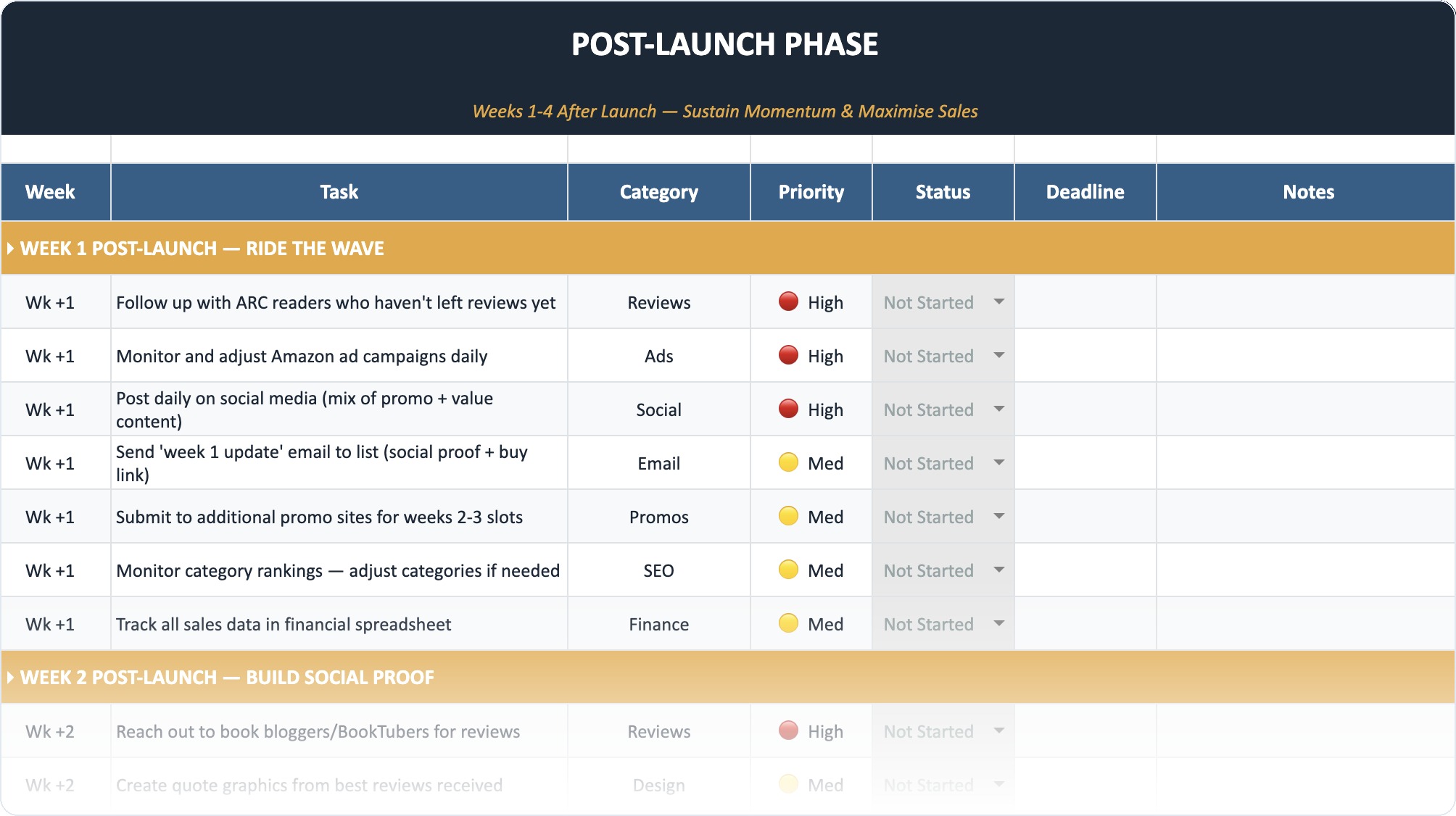
A week-by-week spreadsheet that walks you through every step of launching your book. Available as an Excel file and Google Sheet.
Marketing Your Subscription
You cannot just put a link in your bio and expect people to sign up. You have to sell the experience.
The "Velvet Rope" Strategy
Do not just say "Support me on Patreon." Say "Join the Inner Circle to read Chapter 5 right now." Create a sense of FOMO (Fear Of Missing Out). When you post on social media, share a snippet of a steamy scene or a cliffhanger, then cut it off with "Read the rest on Ream."
The Newsletter Funnel
Your email list is your most powerful asset. Email list size strongly correlates with author income. Data shows that authors earning over $10,000 per month have an average of 18,327 subscribers.
You should have an automated sequence for new subscribers.
- Email 1: Free book (cookie).
- Email 2: Did you like the book?
- Email 3: By the way, if you want the sequel right now, you can get it on my subscription.
This is why optimizing your newsletter signup incentives is the first step before you even launch a paid subscription. If you cannot get people on a free list, you will struggle to get them on a paid one.
Technical Setup: Reducing Friction
If you choose the direct route, or even if you use Ream, you need to think about how readers actually get the files.
BookFunnel is Mandatory
If you are sending ebooks to readers, do not email them a PDF. They will not know how to get it onto their Kindle. They will email you for tech support. You do not want to be tech support.
Use BookFunnel. It integrates with Patreon, Ream, and direct stores. It automatically delivers the correct file (EPUB, MOBI, PDF) to the reader’s device and handles all the tech support questions for you.
Taxes and VAT
If you sell directly via PayPal or Stripe on your own site, you are responsible for collecting and remitting VAT (Value Added Tax) for customers in Europe. This is a nightmare. This is the main reason I suggest starting with Patreon, Ream, or a "Merchant of Record" like Lemon Squeezy or Paddle. They handle the taxes so you do not go to jail.
Expanding into Audio and Merchandise
Once your subscription is stable, you can layer in more value.
Merchandise:
You do not need to hold inventory. Print-on-demand services can integrate with your store. A "Merch Club" tier could get a new sticker or bookmark every month.
Audio:
We mentioned the growth of audiobooks earlier. But producing audio is expensive. Or is it? With the rise of AI narration, costs are plummeting. While some listeners prefer human narration, a significant portion of the market just wants the story. You can offer "AI-Narrated Early Access" as a lower tier benefit.
Case Study: The Hybrid Author
Let's look at a hypothetical scenario based on real data.
- Author: Sarah, writes Cozy Mystery.
- Backlist: 5 books.
- List Size: 2,000 free email subscribers.
Sarah launches a Ream subscription.
- Tier 1 ($5): Read the next book chapter-by-chapter.
- Tier 2 ($10): All of Tier 1 + access to her 5 backlist audiobooks.
She converts 4% of her list (80 people).
- 60 people take the $5 tier = $300/mo.
- 20 people take the $10 tier = $200/mo.
Total: $500/month.
That is $6,000 a year. That covers her editing and covers for the next two years. And as she writes more, she mentions the subscription in the back of every book. The flywheel spins faster.
This predictable income allows Sarah to experiment. Maybe she tries the zero drafting method to speed up her production because she knows her subscribers are waiting for the next chapter. The pressure is positive, not paralyzed.
Challenges and Pitfalls
It is not all passive income and sunshine.
The Content Hamster Wheel
If you promise a chapter a week, you must deliver a chapter a week. If you get sick, or have a family emergency, you need a buffer. I recommend having at least 4-8 weeks of content scheduled in advance before you launch.
Platform risk (Yes, even here)
While you have more control than on Amazon, if Patreon decides your content violates their Terms of Service (common for darker romance or horror), they can shut you down. Always back up your subscriber list. Always have a way to contact them outside the platform.
The Future of Author Subscriptions
The trend is clear. 2025 data indicates that 56% of authors earn over $100 monthly from these models, and the "middle class" of authors is growing. We are moving away from a winner-take-all market dominated by a few bestsellers to a niche-dominated market where 1,000 true fans can support a full-time living.
The integration of "Agentic AI" into these platforms will likely help with churn reduction and dynamic pricing in the coming years. But the core remains human connection.
You are not just selling paper and ink. You are selling a relationship. You are selling escape. And people are more than willing to subscribe to that.
The question is not "can you make money from Amazon," but rather, are you leaving money on the table by only using Amazon? Making money from Amazon self-publishing is a volume game. Subscriptions are a value game. You need both to build a resilient career in 2026.
- Diversify Revenue: Do not rely solely on retailers; build a recurring income stream.
- Start Simple: An ARC subscription (early access) is the easiest way to start without creating new content.
- Use the Right Tools: BookFunnel for delivery, Ream or Patreon for the platform to handle taxes and payments.
- Own the Data: The ultimate goal is to build a list of buyers you can contact directly, bypassing algorithms.
Frequently Asked Questions
What is the best subscription platform for fiction authors?
Ream is currently the best platform specifically designed for fiction authors. It offers an e-reader-like experience, chapter scheduling, and features tailored to serialized storytelling, which Patreon lacks.
How much content do I need to start a subscription?
You do not need a massive backlist. You can start with one active work-in-progress. The "ARC Subscription" model relies on future content (chapters you are writing now) rather than past content.
Can I use Amazon KDP and a subscription model together?
Yes, but with caveats. If your book is in KDP Select (Kindle Unlimited), you cannot distribute that digital content elsewhere, including your subscription. However, you can offer it on your subscription before you enroll it in KU, or simply keep your books "wide" (not in KU) to have full freedom.
How do I price my author subscription tiers?
A common structure is $3-$5 for early access and digital support, and $10+ for exclusive content, backlist access, or audiobooks. Avoid having too many tiers; 2-3 well-defined options usually convert best.
Do I need a completed book to launch?
No. In fact, many successful authors use the subscription model to monetize the writing process itself, releasing a book chapter by chapter. This is known as serialization and allows you to earn money while you write.
How do I handle taxes for international subscribers?
Using a platform like Patreon, Ream, or a Merchant of Record (like Lemon Squeezy) is recommended because they automatically calculate, collect, and remit VAT and sales tax for you, saving you from complex legal headaches.