

Most writers believe a massive vocabulary makes them sound smart. It doesn't. Your sentence structure does. You might know every million-dollar word in the dictionary, but if you string them together in a monotonous drone, you will lose your reader before they finish the first paragraph.
Writing is music. It has a beat. When you vary that beat, you create interest. When you keep it the same, you create a lullaby.
Good prose isn't just about following strict grammatical rules or avoiding fragments. It is about mechanics and engineering. You build sentences to carry weight, to snap with tension, or to flow like a river. If your writing feels flat, boring, or "off," the problem usually isn't your ideas. It is the architecture of your sentences.
- Sentence structure controls the rhythm, pacing, and emotional impact of your writing.
- Varying sentence length prevents reader fatigue and highlights key information.
- Use Left-Branching sentences for suspense and Right-Branching sentences for clarity.
- Short sentences create tension; long sentences build immersion.
- Pro Tip: Read your work aloud to catch rhythm issues that your eyes might miss.
Why Sentence Structure is the Anatomy of Your Prose
Think of sentence structure as the skeleton of your writing. It holds everything up. If the bones are weak or misshapen, the body collapses.
Technically speaking, sentence structure refers to the physical arrangement of words, phrases, and clauses. It dictates how your reader processes information. A well-structured sentence leads the reader by the hand. A poorly structured one forces them to hack through a jungle of clauses just to find the verb.
This isn't just stylistic preference. It is backed by data. According to a study on syntactic complexity, complex constructions require significantly more cognitive effort from readers. If you make them work too hard without a payoff, they bounce.
But it is not just about keeping things simple. It is about prose rhythm.
The Sound of Silence (and Noise)
Gary Provost, a writing teacher, famously illustrated this. He wrote a paragraph of five-word sentences. It was boring. It droned on.
Then he varied the length. He made some short. He made some long. The writing began to sing.
When you master structure, you control the reader's breath. You decide when they speed up and when they slow down. You are the conductor.
The 4 Basic Sentence Types (A Necessary Refresher)
Before we get to the advanced tricks that will actually fix your writing, you need to know the baseline. There are four primary ways to build a sentence in English.
You probably learned this in school. You probably forgot it. That is fine. Here is the crash course.
1. The Simple Sentence
One independent clause. It has a subject and a verb. It creates a complete thought.
- Example: "The dog barked."
- Use it for: Clarity, punchiness, and high-impact statements.
2. The Compound Sentence
Two independent clauses joined by a conjunction (for, and, nor, but, or, yet, so) or a semicolon.
- Example: "The dog barked, and the cat ran away."
- Use it for: Connecting two equally important ideas.
3. The Complex Sentence
One independent clause and at least one dependent clause. The dependent clause cannot stand alone.
- Example: "When the dog barked, the cat ran away."
- Use it for: Showing cause and effect or relationships between ideas.
4. The Compound-Complex Sentence
Two or more independent clauses and at least one dependent clause. This is the heavyweight champion of sentences.
- Example: "When the dog barked, the cat ran away, but the bird stayed on the fence."
- Use it for: Nuanced, detailed descriptions or complicated sequences of events.
| Sentence Type | Structure | Best For | Risk |
|---|---|---|---|
| Simple | 1 Independent Clause | Impact, Action, Speed | Choppy if overused |
| Compound | 2+ Independent Clauses | Linking equal ideas | Run-on feel if too long |
| Complex | 1 Indep + 1+ Dep Clause | Cause/Effect, Depth | Can get confusing |
| Compound-Complex | 2+ Indep + 1+ Dep | Rich description | "Word salad" danger |
5 Advanced Sentence Structures That Will Change How You Write
Knowing the basic types is fine for passing a grammar test. But to write prose that people actually want to read, you need more advanced tools.
These five structures are stylistic weapons. Use them to manipulate pacing and emphasis.
1. The Parataxis (The "Hemingway" Chop)
Parataxis is a fancy term for placing clauses side by side without subordinating conjunctions. You don't say because, although, or while. You just state facts.
- Standard: "Because it was raining, he put on his coat."
- Parataxis: "It was raining. He put on his coat."
This style is blunt. It feels objective, cold, and real. It is the hallmark of hard-boiled fiction and modern thrillers. It treats every action as equally important.
Why use it?
It speeds up the narrative. It removes the narrator's interpretation (the "why") and leaves only the action (the "what"). If you are writing a fight scene or a tense argument, drop the conjunctions. Just list the blows.
2. The Hypotaxis (The Intellectual Flow)
This is the opposite of parataxis. Hypotaxis uses subordinating conjunctions to show the relationship between ideas. It creates a hierarchy of meaning.
- Example: "Reflecting on the rain that lashed against the window, he decided, somewhat reluctantly, to don his coat."
This feels academic, thoughtful, and slow. It invites the reader to pause and consider the nuance.
Why use it?
Use this when your character is thinking, philosophizing, or observing a complex scene. It signals intelligence and contemplation. But be careful. Too much hypotaxis makes you sound like a Victorian lawyer.
3. The Left-Branching Sentence (The Suspense Builder)
Also known as a periodic sentence. In this structure, the main point (the independent clause) comes at the very end. All the modifying clauses come first.
- Example: "After the alarm rang, after the coffee spilled, and after the car wouldn't start, John finally lost his temper."
See how you have to wait for it? You are holding your breath until the period.
Why use it?
To build tension. If you want to surprise the reader or land a joke, put the punchline at the end. It forces the reader to finish the sentence to understand the meaning.
Use left-branching sentences for endings of chapters or key emotional beats. They naturally create a sense of finality.
4. The Right-Branching Sentence (The Clarity Builder)
This is the cumulative sentence. The main point comes first, followed by the details.
- Example: "John lost his temper, shouting at the dog, kicking the tire, and throwing his keys into the bushes."
You get the main image immediately ("John lost his temper"). Everything after that just adds color and detail to the picture.
Why use it?
This is the workhorse of clear writing. It is easy to process. The reader gets the "headline" instantly and can relax while they absorb the details. Use this for descriptions of settings or characters.
5. The Fragment (The Rule Breaker)
Teachers hate them. Editors love them. A fragment is an incomplete sentence. It lacks a subject or a verb.
- Example: "Silence. Absolute silence."
Why use it?
For emphasis. A fragment acts like a stop sign. It forces the reader to halt. It is dramatic.
Don't use fragments by accident. Use them on purpose. If you use them by accident, you look sloppy. If you use them on purpose, you look like a stylist.
Varying Sentence Length for Rhythm
If sentence structure is the bone, length is the muscle.
Many new writers default to a "medium" length. Every sentence is about 15 to 20 words long. It creates a monotonous hum that puts brains to sleep.
To keep a reader engaged, you must vary the length.
The Short Sentence
Short sentences are aggressive. They are punches. They increase the pace.
- "He stopped."
- "The gun fired."
- "She lied."
Use these during action sequences or moments of high stress. They mimic the quick, shallow breathing of a frightened person.
The Long Sentence
Long sentences are rivers. They meander. They slow time down.
- "The afternoon stretched out before them, a golden haze of heat and dust that seemed to suspend the very air in a state of permanent, lazy hesitation."
Use these for romance, nostalgia, or setting the scene. They mimic the slow, deep breathing of a relaxed person.
If you struggle with this, check out our guide on 12 tips for boosting writing productivity. One of the best productivity hacks is actually to stop worrying about length in the first draft and fix the rhythm during the edit.
Stop Staring at a Blank Page
Publy is a distraction-free book editor with AI built in. Brainstorm plot ideas, get instant chapter reviews, or rewrite clunky paragraphs. 3 million free words included.

The Role of Punctuation in Structure
Punctuation isn't just about rules. It is about traffic control.
- Periods are stop signs. Full stop.
- Commas are yield signs. Slow down, then keep going.
- Semicolons are flashing yellow lights. Pause, but know that the next part is closely related to the first.
- Colons are spotlights. "Look at this next thing."
Many writers ignore semicolons because they are afraid of using them wrong. Don't be. A semicolon is a great way to link two simple sentences to create a compound one without using a clunky "and."
Example: "The sun set; the air grew cold."
This is tighter and more elegant than "The sun set and the air grew cold."
Common Mechanics Mistakes That Kill Your Credibility
Even the best sentence structure falls apart if the mechanics are broken. Here are the traps that catch 90% of writers.
The Run-on and the Comma Splice
A run-on isn't just a long sentence. It is a broken one.
- Wrong: "I went to the store I bought milk." (Fused sentence)
- Wrong: "I went to the store, I bought milk." (Comma splice)
- Right: "I went to the store. I bought milk."
- Right: "I went to the store; I bought milk."
Comma splices are the most common error in self-published fiction. They scream "amateur."
The Dangling Modifier
This happens when your descriptive phrase doesn't attach to the right subject.
- Wrong: "Walking down the street, the trees looked beautiful."
- Implies the trees were walking down the street.
- Right: "Walking down the street, I thought the trees looked beautiful."
The "Garden Path" Sentence
This is a sentence that starts out leading the reader in one direction, then suddenly pivots, leaving them confused.
- Confusing: "The old man the boat."
- Reader thinks "The old man" is the subject. But "man" is actually the verb (to man a station).
- Clearer: "The old people man the boat."
You want to challenge your reader's intellect, not their patience.
For more on avoiding these pitfalls, reading about mistakes first-time authors make is essential. It covers structural issues alongside plot and character errors.
How Digital Media is Changing Sentence Structure
You cannot discuss writing in 2026 without acknowledging the internet.
Digital communication (texting, Slack, TikTok captions) has changed how we process text. We scan. We skim. We look for keywords.
This has led to a rise in "micro-syntax." We are more comfortable with fragments than ever before. We accept "Because science" as a complete sentence.
Research indicates that digital platforms have shifted grammatical conventions toward informal structures, prioritizing speed over strict adherence to rules. See this analysis on digital writing trends for a deeper look.
Does this mean you should write your novel like a tweet? No. But it means you need to be aware that your reader's attention span is shorter. Giant walls of text are intimidating. Break your paragraphs up. Use shorter sentences to hook them, then hit them with the complex stuff once they are paying attention.
The Self-Publishing Launch Checklist (2026)
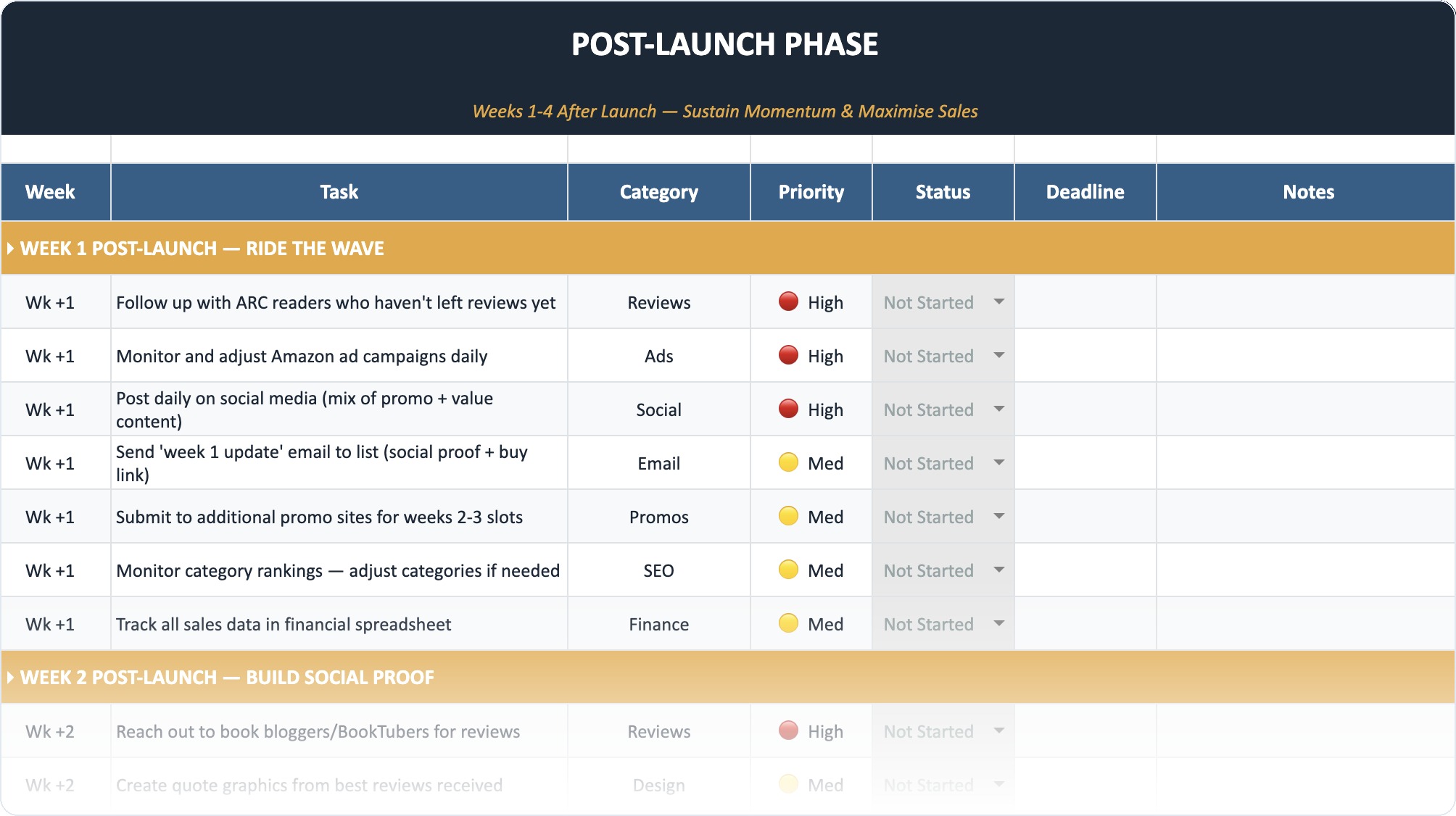
A week-by-week spreadsheet that walks you through every step of launching your book. Available as an Excel file and Google Sheet.
Tools to Analyze Your Writing Mechanics
You don't have to do this entirely by gut feeling. Technology can help.
AI tools have become surprisingly good at analyzing sentence structure. They can spot when you have used the passive voice three times in a row. They can tell you if your sentences are too uniform in length.
However, be careful. Tools like Grammarly or ProWritingAid are prescriptive. They tend to prefer simple, corporate-style writing. They might try to "fix" your intentional fragments or your stylistic run-ons.
If you are looking for software to help with the heavy lifting, check out our comparison of the 7 best writing software for novels. Finding the right tool can act as a second pair of eyes, especially for pacing.
Some AI tools in 2025-2026 even offer "humanizer" features to ensure your rhythm doesn't sound robotic. A report on AI writing tools notes that these platforms are moving beyond spell-check to offer real-time stylistic restructuring. Use them as a critique partner, not a boss.
Practical Exercises to Fix Boring Prose
If you read your work and it feels flat, try these exercises.
1. The Highlighter Method
Print out one page of your writing. Take two highlighters.
- Highlight every "To Be" verb (is, was, were, are) in yellow.
- Highlight every active verb in green.
If the page is mostly yellow, your sentence structure is passive and weak. Rewrite the yellow sentences to make them green.
2. Sentence Combining
Take three short, choppy sentences and combine them into one complex sentence.
- Choppy: "The man stood up. He looked at the door. He was scared."
- Combined: "Trembling, the man stood and fixed his gaze on the door."
This is a classic educational technique. Current educational frameworks emphasize explicit sentence-level instruction to help writers understand how to manipulate syntax for effect.
3. The "First Word" Check
Look at the first word of every paragraph. If you see "The," "He," or "I" starting every single one, you have a structure problem. Change the openers. Start with a preposition ("Under the bridge…"), a gerund ("Running quickly…"), or a conjunction ("But he didn't…").
When to Break the Rules
You master sentence structure so you can break it.
Cormac McCarthy barely used punctuation. Jose Saramago didn't use quotation marks. They got away with it because they were geniuses of rhythm. They knew that the rules exist to serve the sound, not the other way around.
If a sentence is grammatically incorrect but sounds perfect, keep it. If it is grammatically perfect but sounds clunky, cut it.
If you are struggling with creative blocks or feeling stifled by rules, sometimes you just need to get the words out. See our guide on beating writer's block for ways to loosen up your drafting process.
Final Thoughts: It’s All About Intention
The difference between an amateur and a pro isn't that the pro writes perfect sentences every time. It is that the pro writes sentences on purpose.
Every period, every comma, every fragment should be a choice. You are building a machine made of words. Make sure every part has a job.
Refining your prose is a long game. It takes practice. But once you start seeing the matrix of sentence structure, you will never read, or write, the same way again.
The sentence is a lonely place.
Frequently Asked Questions
What is the most common sentence structure mistake?
The run-on sentence and the comma splice are the most frequent errors. This happens when two independent thoughts are smashed together without proper punctuation. It confuses the reader and destroys the rhythm of the paragraph.
How can I improve my sentence variety?
Read your work aloud. If you find yourself falling into a monotone rhythm, mark that section. Deliberately combine short sentences into longer ones, or chop long sentences into fragments. Aim for a mix of simple, compound, and complex structures in every paragraph.
Does sentence structure affect SEO?
Indirectly, yes. Search engines prioritize user experience. If your sentences are convoluted and hard to read, users will leave your page (bounce rate), which signals to Google that your content isn't helpful. Clear, readable structure keeps people on the page longer.
Should I avoid passive voice completely?
No. Passive voice is useful when the object of the action is more important than the subject (e.g., "The President was shot"). However, you should avoid it as a default setting because it weakens the impact of your prose.
How do I fix "choppy" writing?
Choppy writing usually comes from using too many simple sentences in a row. Use transition words (however, therefore, meanwhile) and conjunctions to link these ideas together. This creates a smoother flow for the reader.