

You poured your soul into your manuscript. You spent late nights editing, dreaming of the moment you would hit "publish" and watch the sales roll in. But that moment came and went with silence. The sales dashboard shows a flat line. The reviews are nonexistent. You feel like you failed.
I have been there. I know that specific ache in your chest when a book you believe in fails to find its audience. But here is the good news. A failed launch is not a death sentence for your book. In the digital age, a book does not have a shelf life unless you decide it does. You can revive it. You can fix the packaging, sharpen the hook, and put it back in front of readers who are actually looking for it.
This guide is not about quick hacks. It is about the hard work of identifying why your book stalled and executing a strategic plan to fix it. We are going to cover everything from analyzing your metadata to commissioning new covers and building a launch team from scratch.
- Diagnose the Failure: Most books fail due to packaging (cover/blurb) rather than content. You must audit your assets objectively before spending money on ads.
- The "New Edition" Rule: If you change more than 10% of the content, publish it as a new edition to reset the Amazon algorithm. If it is just a cover swap, update the existing file.
- Asset Overhaul: You need tips for creating an eye-catching cover because your old one likely signaled the wrong genre to readers.
- Data-Driven Launch: Use the relaunch to fix your keywords and categories. Read more about how to write a book description for Amazon to convert browsers into buyers.
The Brutal Audit: Why Did the Book Fail?
Before you can fix the problem, you must admit what went wrong. This is the hardest part. You have to separate your ego from the product. When I look at failed books, the issue is almost never the story itself. The story might be brilliant. The problem is that no one bought the book to find out.
If you had zero sales, you have a traffic or click-through problem. If you had sales but no follow-through (or bad reviews), you have a content or expectation problem.
The Traffic vs. Conversion Problem
We need to diagnose your book like a broken engine. Look at your data.
- Low Impressions: People are not seeing the book cover. This means your keywords are wrong, your categories are too competitive, or you have done zero marketing.
- High Impressions, Low Clicks: People see the book cover but keep scrolling. This is 100% a cover design failure or a title failure. Your cover does not promise what the reader wants.
- High Clicks, Low Sales: People click your ad or cover, read the blurb, and leave. This means your blurb is weak, your price is too high, or your "Look Inside" sample is riddled with errors.
You have to be honest here. Did you design the cover yourself? Did you guess at the keywords? Did you skip professional editing?
The "Dead Book" Statistics
You are not alone in this. The market is crowded. According to recent market analysis, the global book publishing market is massive, yet 90% of books sell fewer than 5,000 copies. The vast majority of titles disappear into the algorithmic abyss within 90 days.
This happens because most authors treat publishing as a creative act rather than a business launch. A relaunch is your opportunity to treat this like a business.
Soft Relaunch vs. Hard Relaunch
You have two paths forward. You need to decide right now which one you are taking.
The Soft Relaunch (The "Update")
This is for books that have some reviews (good ones) and a valid link, but just aren't selling. You do not unpublish the book.
- Action: You upload a new cover file. You rewrite the blurb in KDP/IngramSpark. You update your keywords.
- Pros: You keep your existing reviews and URL. It is less work.
- Cons: You do not get the "New Release" boost from Amazon. You do not get a fresh publication date.
The Hard Relaunch (The "2nd Edition")
This is for books that failed hard. Maybe they have bad reviews, or you realized the writing needed a massive overhaul.
- Action: You unpublish the old version. You rewrite the manuscript significantly (more than 10% change is the general rule for a new ISBN). You publish as a "Second Edition" with a new ISBN.
- Pros: You get a clean slate. New publication date. New release algorithm boost. You can detach from old bad reviews.
- Cons: You lose any good reviews you did have. It costs money for new ISBNs.
I usually recommend a Hard Relaunch if the book has less than 10 reviews or if the rating is below 3.5 stars. If the book has a 4.5 rating but just no traffic, do a Soft Relaunch.
Step 1: The Visual Overhaul (New Covers)
Readers judge books by their covers. It is a biological fact of the book market. If your book looks like a DIY project, readers will assume the writing is also amateur.
In 2026, cover trends are specific. "Romantasy" books need illustrated, vector-art covers. Thrillers need high-contrast, bold typography with minimal imagery. Non-fiction needs clean, white-space dominant designs that scream authority.
The Thumbnail Test
Your cover must work at 100 pixels wide. Most readers browse on mobile phones. If your title is illegible at thumbnail size, you have lost the sale before it started.
I see many authors hold onto their original covers because they are "sentimentally attached" to them. You must kill this sentiment. Does the cover look like the top 100 books in your specific niche? If not, change it.
Market Signaling
Your cover is a signal. It tells the reader the genre immediately. If you wrote a sci-fi space opera but used a cover that looks like a quiet literary memoir, you will attract the wrong readers. Those readers will click, get confused, and bounce. Or worse, they will buy it, hate the genre, and leave a one-star review.
Stop Staring at a Blank Page
Publy is a distraction-free book editor with AI built in. Brainstorm plot ideas, get instant chapter reviews, or rewrite clunky paragraphs. 3 million free words included.

Step 2: Metadata Overhaul (Keywords & Blurbs)
This is the unsexy part of the job that makes all the money. Metadata is how machines understand your book. If Amazon's AI doesn't know what your book is, it cannot sell it.
Keyword Strategy
Stop using single words like "fantasy" or "cooking." Those pools are too big. You need long-tail keywords.
- Bad: "Romance"
- Good: "Enemies to lovers workplace romance clean"
You need to find the phrases actual readers type into the search bar. Use tools like Publisher Rocket or perform manual searches in an incognito browser. Look at the autofill suggestions.
Writing the Blurb
Your blurb is sales copy. It is not a summary. Do not summarize Chapter 1. Do not tell the whole plot.
- The Hook: The first sentence must grab the reader by the throat.
- The Conflict: Who is the character? What do they want? What is stopping them?
- The Stakes: What happens if they fail?
If you are struggling with this, I highly recommend you read up on how to write a book description for Amazon. The difference between a bland summary and a sales hook is usually the difference between a sale and a bounce.
Step 3: The Content Polish (Rewrite)
If you chose a Hard Relaunch, you have the chance to fix the book. Read your negative reviews. Did readers say the pacing was slow? Did they say the dialogue felt wooden?
This is your second chance to hire a professional editor. Do not skip this. If you relaunch a book with the same typos that killed it the first time, you are wasting your time.
Updating the Back Matter
The most valuable real estate in your book is the last page. When a reader finishes your book, they are in a state of high dopamine. They enjoyed it. This is the moment to ask for two things:
- Join my newsletter: Offer a free short story or bonus chapter (a "Reader Magnet") in exchange for their email.
- Leave a review: Ask politely. "If you enjoyed this, a review helps others find it."
Update the links in the back of your book. Ensure they point to your current website or landing page.
Step 4: Strategic Pricing and Distribution
How you price your relaunch matters. You need to reduce friction.
The 99-Cent Launch Strategy
For a relaunch, I often recommend starting at $0.99 for the eBook for the first week.
- Goal: Volume. You want to get the book into as many hands as possible to generate "Verified Purchase" reviews.
- Profit: You will make almost no money during launch week. That is fine. You are buying visibility.
Once the book has traction and reviews, you raise the price to $2.99, $4.99, or higher depending on your genre and length.
Go Wide or Stay Exclusive?
You must decide if you want to be in KDP Select (Kindle Unlimited) or "Go Wide" (Kobo, Apple, Barnes & Noble).
- Kindle Unlimited: Great for new authors in voracious genres like Romance and LitRPG. The "page reads" can generate significant income.
- Going Wide: Better for building a long-term, resilient career that isn't dependent on one retailer.
If you are looking at expanding your reach, check out this guide on getting your self-published book into bookstores. Physical bookstores rarely stock Amazon-printed books, so you may need to use IngramSpark for this part of your relaunch.
Step 5: The Marketing Blitz
You cannot just upload the new files and pray. You need a traffic source.
Building a Launch Team
A launch team is a group of readers who agree to read the book early (ARC – Advanced Reader Copy) and leave a review on launch day.
- Where to find them: Reach out to your newsletter. If you don't have one, this is why you failed the first time. Start building it now.
- Incentive: Give them the book for free. Give them a mention in the acknowledgments.
Newsletter Swaps
Find other authors in your genre who are releasing books. Ask to swap mentions. "I'll mention your book to my list if you mention mine to yours." This is free and highly effective because you are borrowing trust.
Paid Advertising
If you have the budget, Amazon Ads are the most direct way to relaunch. You can target specific similar authors.
- Targeting: Target the authors who write books exactly like yours.
- Bidding: Start low. Monitor daily.
According to data on advertising effectiveness, email marketing continues to outperform social media by a significant margin. Do not rely solely on Instagram or TikTok. You need direct access to reader inboxes.
Step 6: Leveraging New Formats (Audio & Special Editions)
Sometimes a relaunch isn't just about fixing the eBook. It is about releasing a new format that breathes life into the title.
The Audiobook Boom
The audiobook market is exploding. If you can afford a narrator, or if you use high-quality AI narration (which is becoming acceptable in non-fiction), you open up a new audience. Trends indicate that the audiobook sector is growing faster than eBooks in many demographics.
Special Editions
For fiction, consider a "Special Edition" hardback. Add illustrations, a new foreword, or colored endpapers. Relaunch this via a Kickstarter or direct sales on your website. This creates an event around the book. It gives your superfans something to buy even if they own the original.
The Long-Term Plan
A relaunch is not a one-week event. It is the start of a new lifecycle for your product.
You need a plan that extends past week one. This is where a winning book marketing plan becomes vital. You need to schedule regular promos. You need to keep writing the next book. The best marketing for book one is always launching book two.
Consistency Wins
The algorithm favors activity. Consistent sales, even low ones, are better than a huge spike followed by zero. Keep running low-level ads. Keep swapping newsletters. Keep talking about the book.
Comparison: Old Launch vs. New Relaunch
| Feature | The Failed Launch | The Strategic Relaunch |
|---|---|---|
| Cover | Homemade or cheap premade. | Professional, genre-specific, tested at thumbnail size. |
| Blurb | Summarized the plot. | Hook-driven sales copy with stakes and conflict. |
| Keywords | Broad (e.g., "Mystery"). | Long-tail (e.g., "Cozy mystery with cat sleuth"). |
| Reviews | None or family members only. | Launch team of 20+ readers ready on Day 1. |
| Price | Too high ($9.99 eBook). | Strategic ($0.99) to build rank, then raised. |
| Format | eBook only. | eBook, Print, Audio, and potentially Hardcover. |
Managing Your Mindset During a Relaunch
I want to address the elephant in the room. Relaunching is scary. You are risking rejection for the second time on the same project.
But you have data this time. You are not guessing. You know what didn't work, which means you are one step closer to finding what does.
Validating the "Second Chance"
There are countless famous books that failed initially. The Great Gatsby was a commercial flop. It was relaunched and rediscovered. Your book deserves that same chance.
Do not let the "Published Date" on Amazon discourage you. Readers rarely look at that date. They look at the cover. They look at the stars. They look at the "Best Seller" flag. You can control all of those things with a relaunch.
When to Quit
Is there a time to stop relaunching? Yes. If you have done the Hard Relaunch, bought the professional cover, fixed the blurb, ran the ads, and the market still rejects it, then you have your answer. The market does not want that specific story.
That is okay. Take the lessons on metadata, covers, and marketing, and apply them to your next book. You are now a better publisher than you were yesterday.
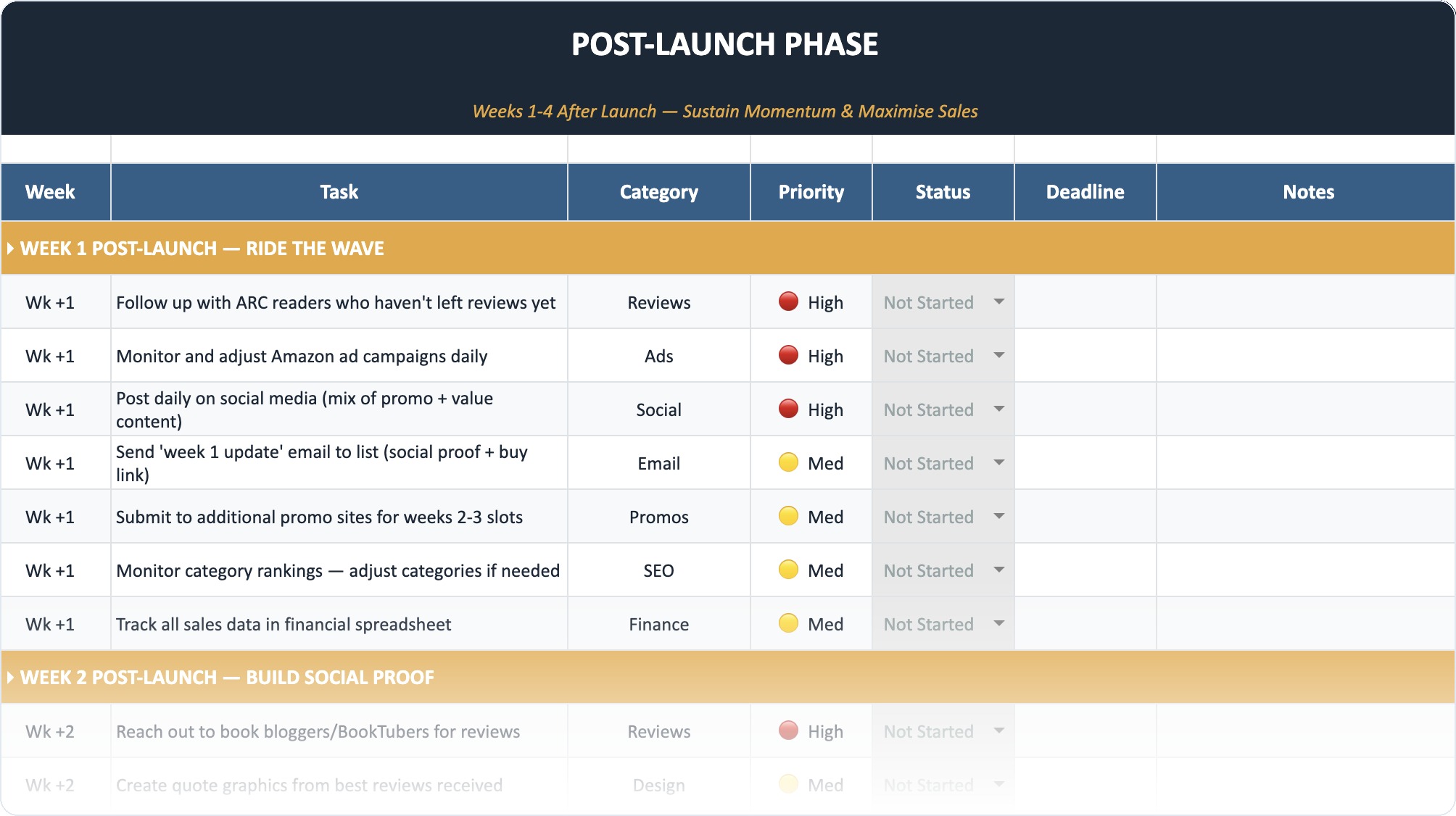
The Self-Publishing Launch Checklist (2026)
A week-by-week spreadsheet that walks you through every step of launching your book. Available as an Excel file and Google Sheet.
Summary Checklist for Relaunching
- Audit: Check your reviews and sales data.
- Decision: Choose Soft Relaunch or Hard Relaunch (New Edition).
- Production: Commission new cover, rewrite blurb, edit text.
- Team: Recruit ARC readers/Launch team.
- Setup: Upload new files, set pricing to $0.99.
- Launch: Coordinate newsletter swaps and paid ads.
- Sustain: Raise price after 7 days, continue low-level ads.
The publishing world is forgiving. It allows for do-overs. Take yours.
Frequently Asked Questions
Can I relaunch a book on Amazon KDP?
Yes, absolutely. You can upload a new cover and manuscript file to your existing project (Soft Relaunch) or unpublish the old version and publish a new one with a new ISBN (Hard Relaunch/Second Edition).
Do I need a new ISBN for a relaunch?
If you are just changing the cover, no. If you are changing the title or making significant changes to the text (usually over 10%), you need a new ISBN. A Hard Relaunch requires a new ISBN to be treated as a new product.
Will I lose my reviews if I republish?
If you unpublish and republish as a new edition with a new ISBN, yes, you will lose the old reviews. However, you can sometimes ask Amazon Author Central to link the editions, which might carry reviews over, but this is not guaranteed and often results in the "bad" reviews coming along too.
How much does it cost to relaunch a book?
It depends on how much work is needed. A new professional cover can cost between $300-$800. Editing can cost $500+. However, a DIY Soft Relaunch cost nothing but your time.
Is it worth rewriting a failed book?
Only if the reviews consistently point out specific flaws in the writing. If the book failed due to lack of visibility (no reviews, no sales), the writing might be fine, and you just need a packaging overhaul.
How long does a relaunch take?
I recommend a 4-6 week runway. This gives you time to get the new cover designed, build a launch team, and schedule marketing promotions.