

* Paulo Coelho's novels are mostly standalone. You can start anywhere, but reading them in the order they were published shows how his ideas evolved.
- His breakthrough, The Alchemist (1988), is the best entry point and one of the best-selling books in history, with over 150 million copies sold.
- For a complete journey, begin with his first major work, The Pilgrimage (1987), which is autobiographical, then move to The Alchemist, and follow the publication dates.
- As of 2026, he has published over 30 books, with recent works like The Archer (2020) and new editions like The Alchemist Deluxe Edition slated for 2025.
Staring at a bookstore shelf or an endless online list of Paulo Coelho titles can be confusing. Where do you even begin? Do you need to read them in a specific order to "get" it? You just want a simple, clear path through the spiritual adventures and life questions his books are famous for.
Good news. You can breathe easy. Most of Paulo Coelho's books are standalone stories. You can pick up the one that calls to you. But if you want the full, rich experience of watching a writer's philosophy unfold, reading them in the order they were published is a powerful way to go. This guide gives you that exact map. We will list every major book, tell you what it's about, and help you decide your own perfect starting point. Let's get straight into it.
Why Read Paulo Coelho's Books in Order?
You don't have to read Paulo Coelho's books in sequence. Each novel presents its own complete world. Picking up Veronika Decides to Die or The Witch of Portobello on its own will still give you a profound experience.
However, there's a special reward in following his publication timeline. You get to witness the evolution of his core ideas about destiny, love, fear, and the "Personal Legend" – his term for one's true purpose in life. His early works, like The Pilgrimage, are deeply personal and instructional. His middle period contains his massive global bestsellers where his parable-like style became iconic. His later works often reflect on fame, relationships, and history with a more mature perspective.
Reading in order also helps you spot the subtle threads connecting them. Characters and themes sometimes echo across different books. For the fullest understanding of Coelho's world, chronological order is the way to go.
Stop Staring at a Blank Page
Publy is a distraction-free book editor with AI built in. Brainstorm plot ideas, get instant chapter reviews, or rewrite clunky paragraphs. 3 million free words included.

The Complete Chronological List of Paulo Coelho's Books
Here is every major book by Paulo Coelho, listed by the year it was first published. We will start with his earliest works and move all the way to his most recent publications and announced titles for 2025 and 2026.
Hell Archives (1982)


This is Coelho's very first book, published long before he became a household name. It's a collection of short stories that delves into dark fantasy and horror. It's quite different from the spiritual, hopeful tone he later became famous for. For dedicated fans, it's a fascinating look at his early literary experiments. For new readers, it's not the place to start, but a curious piece of literary history.
Practical Manual of Vampirism (1986)

Another early, lesser-known work, this book is exactly what the title suggests. It blends Gothic fiction with philosophical musings. Like Hell Archives, it shows a different side of Coelho's writing. These first two books are often considered part of his exploratory phase, before he found the voice that would resonate with hundreds of millions.
The Pilgrimage (1987)
This is where the Paulo Coelho journey truly begins for most readers. The Pilgrimage (originally published as The Diary of a Magus) is an autobiographical account of his own walk along the Camino de Santiago in Spain. It's part travelogue, part mystical guidebook. The book introduces key concepts like the "Personal Legend" and simple, powerful exercises to overcome life's mental obstacles. It’s raw, personal, and lays the entire philosophical foundation for everything that follows, especially The Alchemist. If you want to understand the root of Coelho's teachings, start here.
The Alchemist (1988)
This is the book that changed everything. The Alchemist tells the story of Santiago, an Andalusian shepherd boy who dreams of a treasure and embarks on a journey to find it. What unfolds is a beautiful, simple parable about listening to your heart, recognizing omens, and pursuing your dreams. It’s a story that feels both ancient and deeply personal.
The numbers are staggering. According to publishing industry reports, The Alchemist has sold over 150 million copies worldwide. It holds a Guinness World Record for being the most translated book by a living author, available in over 80 languages. It spent more than 400 consecutive weeks on the New York Times bestseller list. For many, it’s not just a book; it’s a life companion. This is the most common and often best starting point for anyone new to Coelho.
The Valkyries (1988)
Published the same year as The Alchemist, this book continues the autobiographical thread from The Pilgrimage. It recounts Coelho's journey with his wife, Christina, into the Mojave Desert to find and speak with his guardian angel. It's a story about forgiveness, confronting one's past, and the pursuit of a spiritual dialogue. Reading The Pilgrimage first gives this book more context, but it can be read on its own as a desert adventure of faith and self-confrontation.
Brida (1990)
This novel focuses on a young Irish woman named Brida and her search for knowledge through the traditions of witchcraft. It explores themes of soulmates, reincarnation, and the different paths of spiritual learning (the Sun and the Moon traditions). It's one of Coelho's more explicit explorations of magical practices and feminine spirituality. The book delves into the idea that love is an eternal force connecting people across different lifetimes.
By the River Piedra I Sat Down and Wept (1994)

This is the first novel in Coelho's "And on the Seventh Day" trilogy, which focuses on the three aspects of love: eros, philia, and agape. This book is about agape, or divine, sacred love. It tells the story of Pilar, a university student, who reunites with a childhood friend who has become a spiritual teacher and a rumored miracle worker. Their journey through the Pyrenees mountains forces Pilar to confront her faith, her fears, and the possibility of a love that transcends the ordinary.
Maktub (1994)
Maktub is not a novel but a collection of short, inspirational essays and parables. The title is an Arabic word meaning "it is written," reflecting the concept of destiny. Coelho originally wrote these pieces for a Brazilian newspaper column. The book is like a series of small, daily doses of wisdom, perfect for dipping in and out of. It showcases his talent for condensing big ideas into very short, powerful stories.
The Fifth Mountain (1996)
In this book, Coelho turns to biblical narrative, reimagining the story of the prophet Elijah. Set in the 9th century BC, it follows Elijah as he flees persecution, finds refuge in the land of Zarephath, and faces profound trials of faith, love, and leadership. It's a story about resilience, the reasons behind human suffering, and rebuilding one's life from ashes. It demonstrates Coelho's ability to take a ancient, sacred story and fill it with urgent, human emotions.
Veronika Decides to Die (1998)
This is a powerful and poignant departure from Coelho's more mythical tales. It’s a grounded, psychological novel about Veronika, a young Slovenian woman who seemingly has everything but feels nothing. She decides to take her own life, but the attempt fails, and she wakes up in a mental hospital, told she has only days to live due to heart damage. This new "deadline" forces her to live with a freedom and honesty she never had before. The book is a fierce exploration of madness, conformity, and what it means to truly be alive. It resonated globally, selling millions of copies.
The Devil and Miss Prym (2000)
This novel is a gripping moral thriller. A stranger arrives in the remote village of Viscos carrying 11 gold bars. He makes a chilling proposition to the young barmaid, Chantal Prym: if the villagers commit a murder within a week, the gold is theirs. If not, he takes it away. The book becomes a tense examination of human nature, the struggle between good and evil, and the choices that define a community. It’s the final part of the "And on the Seventh Day" trilogy, dealing with the choices we make.
Eleven Minutes (2003)

One of Coelho's most controversial and bestselling novels, Eleven Minutes follows Maria, a young Brazilian woman who, disillusioned by love, travels to Switzerland and ends up working as a prostitute. The title refers to the average time of the sexual act. But the book is not about sex; it's about Maria's search for a connection that transcends the physical, her exploration of sacred sexuality, and her journey back to a more complete understanding of love. It’s raw, honest, and challenges many preconceptions.
The Way of the Bow (2003)
This is another non-fiction, instructional book similar in spirit to The Pilgrimage. Using the metaphor of archery, Coelho breaks down the steps to hitting your target—your Personal Legend. He talks about the bow (intention), the arrow (the individual), the target (the goal), and the posture and technique needed to bring it all together. It's a concise, poetic manual for applying his philosophy to practical, daily action.
The Zahir (2005)
A zahir is something that, once you see it, completely occupies your mind. For the narrator, a bestselling novelist, the zahir is the sudden, mysterious disappearance of his wife, Esther. The book is his obsessive quest to find her, which becomes a journey across Central Asia and into his own soul. It's a story about love, possession, freedom, and the things we take for granted. The novel is partially inspired by Coelho's own relationship with his wife, adding a layer of autobiographical intrigue.
The Witch of Portobello (2006)
This novel is told through a series of interviews with the people who knew Athena, a mysterious woman who was called a witch. Through their conflicting perspectives—her adoptive mother, a journalist, a priest, a former lover—we piece together the life of a woman seeking the divine feminine, challenging religious institutions, and paying a high price for her spiritual independence. It's a fascinating exploration of how society labels and fears powerful, unconventional women.
The Winner Stands Alone (2008)
Coelho shifts gears into a dark, contemporary thriller set against the glamorous backdrop of the Cannes Film Festival. Igor, a wealthy Russian mogul, arrives in Cannes with a terrifying mission: to destroy entire "worlds" (careers, lives) to send a message to his ex-wife and reclaim what he believes is their "superlove." The book is a scathing critique of the vanity, superficiality, and soul-crushing nature of the celebrity and fashion industries. It's a story about the high cost of success and the fragility of modern values.
Aleph (2010)
Marking a return to the autobiographical travel narrative, Aleph finds a successful but unfulfilled Coelho in a personal crisis. He embarks on a sprawling train journey across Russia on the Trans-Siberian Railway. During the trip, he enters the "Aleph," a point where all points in time and space converge, allowing him to confront a betrayal from a past life. It's a story about forgiveness across centuries, the burden of regret, and the need to live in the present.
Manuscript Found in Accra (2012)
Set in 1099 in Jerusalem, on the eve of its invasion by Crusaders, the book is presented as a lost manuscript. The people of the city gather to hear the words of a wise Greek man, the Copt. They ask him not about the coming battle, but about the enduring struggles of life: defeat, solitude, change, anxiety, beauty. His answers form a series of timeless meditations on how to maintain our humanity in times of crisis. It's a book of profound, calm wisdom.
Adultery (2014)
This novel delves into the mind of Linda, a woman in her thirties who has a seemingly perfect life in Geneva: a successful career as a journalist, a loving husband, and wonderful children. Yet, she is plagued by a deep sense of emptiness and routine. This leads her into a passionate, risky affair that forces her to confront her own identity, her marriage, and the meaning of happiness and passion in middle age. It's a candid look at midlife crisis and the search for lost excitement.
The Spy (2016)
Based on the true story of Mata Hari, The Spy is a fictionalized account of the infamous dancer and courtesan who was executed by France for espionage during World War I. Written as a series of letters from prison, it is Mata Hari's defense of her life—a story of a woman fighting for independence and self-invention in a man's world, who became a victim of political intrigue and prejudice. It's a powerful statement on feminism, freedom, and how history judges women.
Hippie (2018)

This is Coelho's most directly autobiographical novel. It follows a young, long-haired Brazilian named Paulo on a journey in 1970. He takes the famous "Magic Bus" from Amsterdam to Kathmandu, across Europe and Central Asia, alongside a diverse group of seekers. On this trip, he meets Karla, a Dutch woman, and they decide to continue their journey together. The book is a vivid, nostalgic capture of the hippie trail, the search for meaning, and the youthful idealism that shaped the author's life.
The Archer (2020)
In this illustrated parable, Coelho revisits and expands on the themes of The Way of the Bow. It tells the story of Tetsuya, a famous but retired archer, and a boy who wants to learn from him. Through the discipline of archery, Tetsuya teaches lessons about the mastery of life: the elegance of practice, the courage to let go, the strength of the bow (life), and the focus on the target (the goal). It's a beautiful, meditative book about the journey toward excellence.
Recent and Upcoming Works (2025 – 2026)
Paulo Coelho remains active. A Swiss news report notes he is scheduled to open a museum in Geneva in September 2025. His publishing schedule also continues.
- Love – Selected Quotations (2025): A curated collection of his most powerful thoughts on love from across his works.
- The Alchemist Deluxe Edition (2025): A special new edition of his classic, often released with new introductions or illustrations.
- Luz: Agenda Paulo Coelho 2026 / Light: Paulo Coelho Planner 2026: An annual planner infused with his inspirational quotes and philosophy, designed for the 2026 year.
Other titles like The Supreme Gift and Journey are also listed among his recent works, often being compilations or special editions.
Where Should You Start Reading Paulo Coelho?
This is the big question. Here’s a simple guide based on what you're looking for:
- For Absolute Beginners & The Curious: Start with The Alchemist. Its global popularity is not an accident. It's short, powerful, and perfectly encapsulates his core message. If it speaks to you, you’ll know.
- For a Thematic, Spiritual Journey: Start with The Pilgrimage. It’s the real-life foundation. Then read The Alchemist to see the philosophy turned into a perfect parable. This one-two punch is transformative for many.
- For a Grittier, More Psychological Read: Start with Veronika Decides to Die. It’s less mystical and more about the human psyche, madness, and society. It showcases his range.
- For a Love Story with Spiritual Depth: Start with By the River Piedra I Sat Down and Wept. It’s a beautiful, poignant novel about sacred love and faith.
- For a Modern Thriller with a Message: Try The Winner Stands Alone. It’s a page-turner that critiques modern celebrity culture.
Remember, the goal is to connect with the book. The order is less important than the act of starting. Once you begin, like Santiago following the omens in The Alchemist, the next book will find you.
Understanding Paulo Coelho's Impact and Legacy
The numbers behind Coelho's success are almost as legendary as his stories. He has sold an estimated 320 to 350 million books worldwide, which industry analysis ranks him among the top-selling authors of all time. His financial success reflects this, with his net worth estimated to be around $500 million.
But his impact goes beyond sales. He pioneered a genre of spiritual fiction that is accessible to everyone, not just religious scholars. He uses simple language to ask the biggest questions. A report on his enduring themes highlights how his messages of hope, action, and pursuing one's purpose continue to resonate strongly in 2026, a world often hungry for meaning.
He also embraced the digital age early, famously sharing parts of his books online and connecting directly with fans, which helped build his colossal global community. Understanding how to build a community is vital for any modern author, something we explore in our guide on how to build a supportive author community online.
Common Themes in Paulo Coelho's Books
As you read through his bibliography, certain ideas will appear again and again. Recognizing them deepens the experience:
- The Personal Legend: This is your true purpose, your destiny. The universe conspires to help you achieve it, but you must have the courage to listen and act.
- The Language of the World: A unifying, spiritual language understood by all things when one is in tune with their legend. It's communicated through omens and signs.
- The Sacrifice Required: Following your dream always requires leaving something behind—comfort, security, old relationships. This "price" is a test of commitment.
- The Alchemy of the Self: Transformation is central. Lead (a mundane life) can be turned into gold (a fulfilled life) through perseverance, love, and faith.
- Love as a Transformative Force: Love appears in many forms—romantic, sacred, divine. It is rarely easy, but it is the most powerful catalyst for personal change.
- Confronting Fear: Fear is the primary obstacle to the Personal Legend. Coelho's characters constantly face and must overcome their fears, often personified as monsters, enemies, or internal voices.
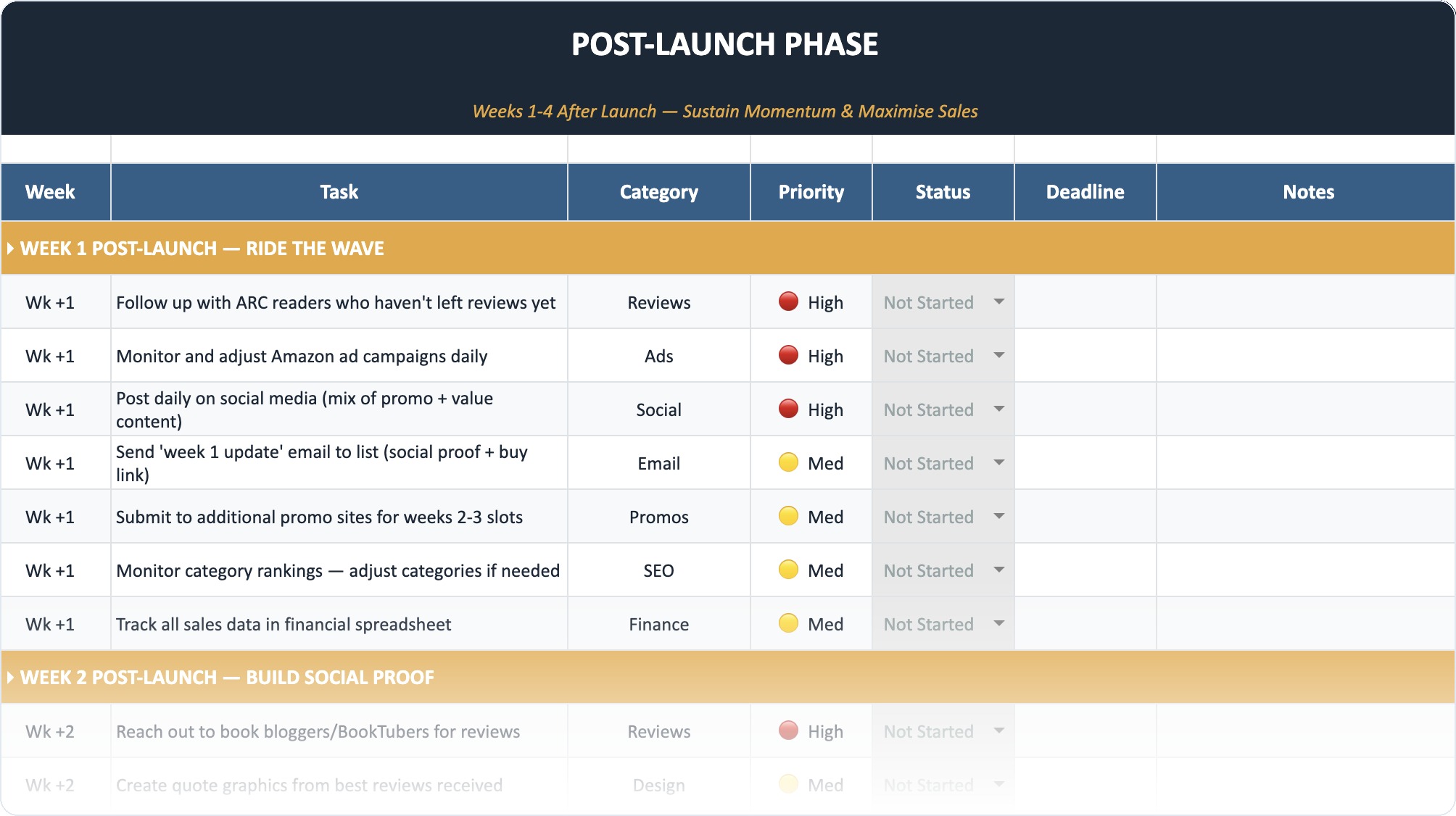
The Self-Publishing Launch Checklist (2026)
A week-by-week spreadsheet that walks you through every step of launching your book. Available as an Excel file and Google Sheet.
How to Approach His Bibliography as a Writer
If you're an aspiring author, reading Coelho is a masterclass in accessible storytelling with profound themes. His success shows the power of a simple, universal parable. Notice his concise chapters, his use of direct dialogue, and how he embeds philosophical lessons seamlessly into narrative action.
For any writer, getting your own work out there is the next step. The modern path often involves self-publishing. Understanding the costs involved is crucial, which we break down in detail in our resource on Amazon KDP self-publishing costs and fees explained. Furthermore, choosing the right platform is a key decision, much like choosing where to start your reading journey. A comparison like IngramSpark vs KDP can help you navigate that choice for wider distribution.
Frequently Asked Questions
Do I need to read Paulo Coelho's books in order?
No, you don't need to read them in a strict order. Almost all of his novels are standalone stories with their own complete narratives. You can pick up any book that interests you and understand it fully. Reading in publication order is only recommended if you want to see the evolution of his ideas over time.
What is the best Paulo Coelho book to start with?
The best book to start with is almost always The Alchemist. It's his most famous work for a reason. It's short, beautifully written, and perfectly introduces his core themes about destiny, dreams, and listening to your heart. If you enjoy it, you'll likely enjoy his other books.
Is The Pilgrimage connected to The Alchemist?
Yes, they are connected thematically. The Pilgrimage is a non-fictional, autobiographical account of Coelho's own spiritual walk, where he introduces concepts like the "Personal Legend." The Alchemist is a fictional parable that explores those same concepts in a symbolic story. Reading The Pilgrimage first gives you the real-life foundation for the philosophy in The Alchemist.
How many books has Paulo Coelho sold?
Paulo Coelho has sold a staggering number of books worldwide. Reliable estimates from publishing trackers put his total sales between 320 and 350 million copies. The Alchemist alone accounts for over 150 million of those sales, making it one of the best-selling books of all time.
What are the main themes in Paulo Coelho's writing?
His main themes revolve around the pursuit of one's destiny (the "Personal Legend"), the importance of listening to omens and your heart, the transformative power of love, the necessity of overcoming fear, and the idea that the universe supports those who pursue their true path. His work blends spirituality, adventure, and self-discovery.
Is Paulo Coelho still writing new books?
Yes, as of 2026, Paulo Coelho is still active. While not releasing full novels as frequently, he publishes new editions, compilations, and special projects. For example, The Alchemist Deluxe Edition is scheduled for 2025, and he releases annual inspirational planners. He also remains active in engaging with his global audience online.