

- Tier Structure: Create distinct value at $3 (Digital Tip Jar), $5 (Early Access), $10 (Exclusive Content), and $25+ (Physical Rewards/Mentorship).
- Consistency is King: Creators promoting daily earn 75% more than those promoting weekly.
- Content Types: Focus on serialized fiction, behind-the-scenes research, and voting rights on future plot points.
- Platform Choice: Compare Patreon with niche competitors like Ream for subscription fiction to see which interface suits your readers best.
You spend hours crafting worlds, refining dialogue, and bleeding onto the page. Then you hit publish, and the financial return often feels like a rounding error. I see this happen constantly. Writers treat their art as a hobby hoping it becomes a career, but they lack the infrastructure to make that transition.
Patreon changes that dynamic. It stops the cycle of hoping for a bestseller and starts the engine of recurring revenue.
In 2026, the creator economy has ballooned to over $202 billion. It is not just about YouTubers or streamers anymore. Writers make up roughly 17% of Patreon’s creator base. The readers are there, and they are willing to pay. But they won't pay for charity. They pay for value, access, and experience.
This guide covers exactly how to structure your page, what rewards actually convert, and how to turn casual readers into high-paying subscribers.
Why Patreon Works for Writers in 2026
The landscape for authors has shifted. The "publish and pray" model is dying. You cannot rely solely on Amazon algorithms to feed your family. You need direct access to your fans.
Patreon provides a stable baseline. According to a 2025 company update from Patreon, annual creator earnings have surpassed $2 billion. That is a massive pot of money, and writers are claiming a larger share of it every year.
The primary benefit here is audience ownership. When you build a following on Twitter or TikTok, you are renting space. If the algorithm changes, you disappear. On Patreon, you own the relationship. You have their email addresses. You have a direct line to their notifications. That security is worth more than a viral post.
However, success isn't automatic. The data shows that creators typically earn between $315 and $1,575 monthly. To get to the upper end of that—or break into the six-figure bracket—you need a strategy that goes beyond "please support me." You need a product ecosystem.
Stop Staring at a Blank Page
Publy is a distraction-free book editor with AI built in. Brainstorm plot ideas, get instant chapter reviews, or rewrite clunky paragraphs. 3 million free words included.

The Foundation: Setting Up Your Tiers
The biggest mistake I see writers make is overcomplicating their tiers. You do not need ten different options. You need three or four clear, distinct choices that guide the reader up the "value ladder."
Psychologically, people want an easy "yes." If they have to read a spreadsheet to understand your rewards, they will close the tab.
The Support Tier ($1 – $3)
This is your digital tip jar. Do not gatekeep your best work here. This tier is for people who love what you do and just want to say thanks.
- Reward Ideas:
- Shout-out: Their name in your next book's acknowledgments.
- Community Access: Access to a patron-only Discord channel.
- The "Good Feeling": Honest gratitude.
I often advise writers to keep this low friction. Do not promise physical goods here. The shipping costs will eat your margins alive. Keep it digital and automated.
The Early Access Tier ($5 – $8)
This is the "sweet spot" for most subscribers. It is the price of a fancy coffee, which makes it an easy impulse buy for a fan. The value proposition here is simple: Time.
- Reward Ideas:
- Early Chapters: Read the next chapter 2 weeks before the public.
- Short Stories: Exclusive flash fiction that won't be published elsewhere.
- Work-in-Progress (WIP) Snippets: Raw, unedited paragraphs from your current draft.
For fiction authors, this works incredibly well with subscription fiction. If you are writing a serial, these patrons are your beta readers and your hype squad. They get the story first, and their excitement spills over onto social media, driving more traffic to you.
The Insider Tier ($10 – $20)
Now we are talking about serious fans. These people want to be part of the process. They want to feel like they are in the writers' room with you.
- Reward Ideas:
- Voting Rights: Let them vote on character names, plot twists, or which story you write next.
- Behind the Scenes: Photos of your messy desk, research notes, or videos discussing your plot holes.
- Digital Downloads: Free copies of your backlist ebooks or high-res character art.
The VIP Tier ($25 – $100+)
This tier is not for everyone. You might only get five people here, but those five people cover your grocery bill. This requires manual labor from you, so price it high enough to make it worth your time.
- Reward Ideas:
- Physical Merch: Signed bookplates, stickers, or exclusive bookmarks sent annually.
- Mentorship: A monthly 15-minute Zoom call to talk about writing.
- Tuckerization: You write them into your book as a background character who dies (or lives!).
Subscription Fiction: The Serial Model
The concept of "subscription fiction" is secondary keyword gold right now because it is exploding. Instead of writing a whole book and selling it once for $4.99, you write a book chapter by chapter and charge a monthly fee to read it as it releases.
Dickens did it. Dumas did it. Now, you can do it digitally.
This model solves the biggest pain point for writers: cash flow. Writing a novel can take a year. That is a year of zero income. By serializing on Patreon, you get paid while you write.
How to Execute Serial Fiction
- Build a Backlog: Never launch without at least 4-5 chapters in the bank. Life happens. You get sick. You need a buffer to maintain consistency.
- The Cliffhanger is Currency: Every chapter must end with a hook. You need the reader to feel a physical need to stay subscribed for next month's update.
- The "Bingable" PDF: At the end of a story arc, compile the chapters into a nice PDF or EPUB and give it to your patrons. It adds value to the archive.
If you are struggling with how to structure a long-form story for this format, you might want to look at strategies for writing and publishing a series. Serial content requires a different pacing structure than a standalone novel.
Non-Fiction & Educational Ideas
If you aren't a novelist, don't worry. Patreon is massive for non-fiction writers, journalists, and educators.
For non-fiction, the value is usually expertise and curation.
- The "Deep Dive": Write extended versions of your public articles with more data, sources, and personal analysis.
- The Research Stack: Share the raw links and papers you are reading this week. Your audience follows you because they trust your filter. Sell that filter.
- Q&A Columns: Let patrons ask specific questions about your niche, and answer them in a detailed weekly post.
Ream vs Patreon: Choosing Your Platform
A major question in the author community right now is the battle of ream vs patreon. Ream is a newer platform built specifically for subscription fiction authors. Patreon is the generalist giant.
Here is a breakdown of how they compare for writers specifically.
| Feature | Patreon | Ream |
|---|---|---|
| Primary Focus | General Creators (Video, Art, Podcasting) | Authors & Fiction Writers |
| Reading Experience | Clunky (Blog post style) | E-reader style (Built for chapters) |
| Discoverability | Low (Internal search is weak) | Moderate (Niche community) |
| App Quality | Excellent, stable mobile app | Web-first, improving mobile experience |
| Payment Options | Global, multiple currencies | Growing, but less robust globally |
| Community Tools | Basic comments, Discord integration | Integrated commenting on specific lines |
My Take: If you are strictly writing serialized fiction, Ream offers a better reading experience for your fans. It feels like a Kindle, not a blog. However, Patreon has the brand name trust. If your audience is not tech-savvy, asking them to join "Patreon" is easier than explaining "Ream."
Many authors actually use both, or they use Patreon for the community/payment processing and deliver the actual files via BookFunnel or other services. If you are curious about other serialization platforms, you should check out guides on Kindle Vella to see how it stacks up against the direct subscription model.
Marketing Your Page: The 75% Rule
You cannot just build the page and wait. Discovery on Patreon is almost non-existent. You have to bring your own traffic.
A Patreon blog post on promotion highlighted a stunning statistic: Creators who promote their page daily earn 75% more than those who promote once a week.
This does not mean you beg for money every day. It means you mention the value daily.
How to Promote Without Being Annoying
- The "Tease": Post a censored screenshot of your latest chapter on Twitter/X. "Patrons are losing their minds over this paragraph right now."
- The "FOMO": "We are voting on the villain's name in the Discord today. Join the $5 tier to cast your ballot."
- The "Milestone": "We just hit 100 patrons! To celebrate, I'm unlocking a bonus story for everyone."
You need a solid funnel. Your free content (blog, social media, newsletter) should always point to the paid content. If you need help structuring that flow, look into content marketing strategies for writers to build that consistent traffic.
Author Income Streams: The Bigger Picture
Patreon should not be your only income. It is one pillar of author income streams.
Successful authors in 2026 are diversifying. You have your direct sales (Patreon/Ream), your retailer sales (Amazon/Kobo), and your rights licensing (Audio/Foreign).
- Merchandise: Once you have a dedicated Patreon following, you can integrate merch. Print-on-demand services link directly to Patreon. You can offer exclusive mugs or shirts to high-tier members.
- Affiliate Income: If you write non-fiction, recommend the tools you use.
- Digital Products: Sell your plotting templates or world-building guides.
Also, consider how this interacts with programs like Kindle Unlimited. If your book is in KU, you cannot offer the digital text on Patreon due to exclusivity clauses. You need to know the rules. Check out this analysis on whether Kindle Unlimited is worth it before you accidentally violate your contract by posting chapters on Patreon.
The Self-Publishing Launch Checklist (2026)
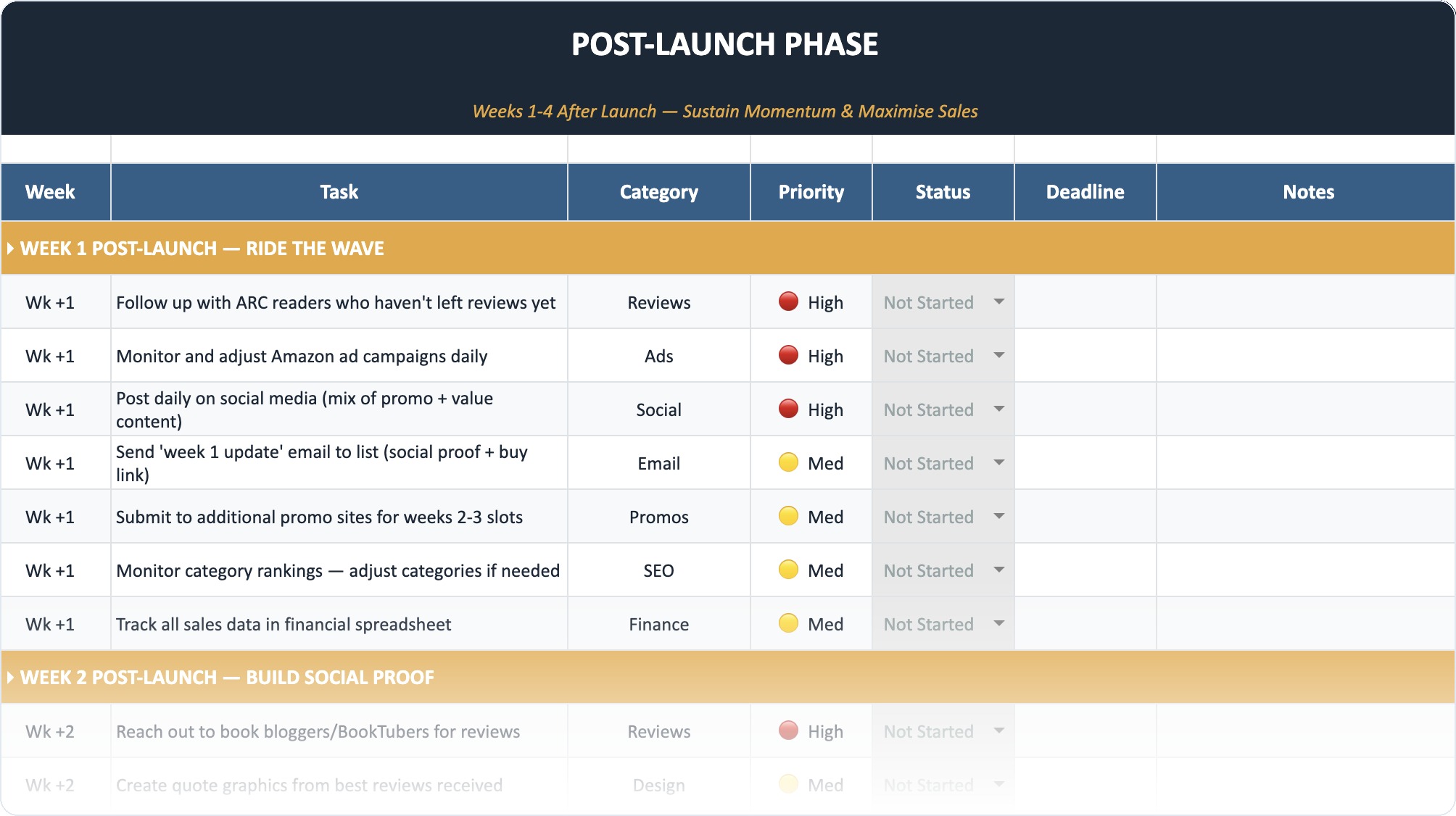
A week-by-week spreadsheet that walks you through every step of launching your book. Available as an Excel file and Google Sheet.
Combating Burnout and Churn
The "hamster wheel" is real. When you promise monthly content, you create a deadline that never goes away.
Churn (people cancelling) is inevitable. Don't take it personally. Credit cards expire, people lose jobs, or they just move on. Your goal is to keep retention high by making them feel valued.
Tips to Avoid Burnout:
- Schedule Breaks: Tell your patrons, "August is a no-content month. I am recharging." Most will stay subscribed to support you.
- Repurpose Content: Did you write a long email to a friend about writing advice? Polish it and post it as an "exclusive essay."
- Use AI for Admin: You are a writer, not an admin assistant. Use tools to help. A recent survey noted that 97% of creators believe AI can help automate repetitive tasks, freeing you up to actually write the stories. Use it for scheduling, drafting social posts, or organizing your discord.
Unique Patreon Ideas for Different Writer Types
The Poet
Poetry is visual.
- Handwritten Drafts: Post photos of your notebook with scribbles and edits.
- Audio Readings: Record yourself reading the poem. Voice adds intimacy.
- Prompt Me: Let high-tier patrons send you a word, and you write a haiku for them.
The Fanfiction Writer
Yes, you can monetize fanfic skills (but be careful with copyright).
- Originals: Write original stories using the tropes your fanfic audience loves.
- Tutorials: Teach them how you plot or handle character dynamics.
- Requests: Take drabble requests for specific scenarios (generic enough to avoid IP issues).
The Journalist/Blogger
- The "Too Hot" File: Stories or opinions you couldn't publish on your main outlet due to editors or controversy.
- Live Commentary: Live blog during major events exclusively for patrons.
Financial Expectations
Let's look at the reality. You likely won't be a millionaire overnight. But the data is encouraging.
According to a 2026 Creator Report, subscription-based creator models average $94,731 in annual earnings. That average is skewed by the top 1%, but it shows the ceiling is high.
Even an extra $500 a month changes your life. It pays for your book covers, your editing, and your coffee. It validates your art.
Start small. Launch with one or two tiers. Listen to what your first ten patrons say. Iterate. The beauty of Patreon is that you can change it. Nothing is set in stone.
The only way to fail is to never launch the page because you are waiting for it to be "perfect." It won't be perfect. Do it anyway.
Frequently Asked Questions
Can I use Patreon if I don't have a large following?
Yes, but growth will be slow. Patreon is not a discovery engine; it is a monetization engine. You should use it to capture the audience you build elsewhere. Even with a small following of 100 true fans, if 10% join at $5/month, that is $50/month to start.
Is Patreon better than Substack for writers?
It depends on your format. Substack is superior for newsletter-style writing and essays where the email is the product. Patreon is better for mixed media, community building (Discord), and serialized fiction where you want to offer tiers of rewards beyond just "reading the text."
How often should I post on Patreon?
Consistency matters more than frequency. One high-quality post per week is better than daily noise. However, ensure you are delivering on your tier promises. If you promised a weekly chapter, you must deliver a weekly chapter.
What happens if I want to take a break?
You can pause billing for a month. This is a great feature that prevents patrons from being charged when you can't produce content. It builds trust. Communicate clearly why you are pausing and when you will be back.
Do fiction writers actually make money on Patreon?
Absolutely. The top fiction writers on the platform earn six figures annually. The key is usually volume (a large backlog of chapters) and a very engaged niche audience (often in Romance, Fantasy, or LitRPG genres).