

You are looking at a genre that has exploded from a niche corner of the internet into a dominant force in modern fantasy. As of 2026, LitRPG isn't just about reading about video games; it is a massive commercial engine. If you are here, you likely want to know how to write LitRPG that sells, ranks, and captures the obsessive loyalty of readers who binge million-word series on Kindle Unlimited and Audible.
Writing LitRPG requires a different skillset than traditional fantasy. You aren't just a writer; you are a game designer, a mathematician, and a storyteller all at once. The readers are smart. They are gamers. They will check your math. If your protagonist gains 10 Strength points but doesn't hit harder in the next chapter, you will get one-star reviews.
This guide covers everything from the "hard math" of system design to the publishing pipelines that turn web serials into six-figure careers.
- Market Dominance: LitRPG now claims roughly 18% of adult fantasy sales, driven heavily by audiobooks and subscription models.
- System Design: You must choose between "Crunchy" (heavy math) and "Lite" (narrative focus) systems, ensuring consistent rules throughout the series.
- Character Stakes: Avoid "cardboard cutouts"; stats should serve the character's emotional arc, not replace it.
- Publishing Pipeline: The most proven path involves serializing on Royal Road, building a Patreon following, and then launching on Amazon KDP.
The State of the LitRPG Market in 2026
Before you type your first stat block, you need to understand the arena you are entering. The days of throwing a generic "trapped in a VR game" story online and hoping for the best are over. The market has matured.
According to recent industry analysis, LitRPG and adjacent progression fantasy genres now account for approximately 18% of all adult fantasy sales. This is not a fringe category anymore. It is a powerhouse. The readership is voracious, often finishing a book a day, which drives the "whale" economy of Kindle Unlimited (KU).
Why Readers Buy LitRPG
The psychology here is different from high fantasy. In Lord of the Rings, Frodo gets tired and traumatized. In LitRPG, the protagonist gets measurably stronger. That dopamine hit of "Number Go Up" is the core appeal.
However, the bar for quality has risen. In 2023 alone, we saw about 760 LitRPG books released on Kindle, a 9% year-over-year increase. If you want to stand out in 2026, you cannot just copy existing hits like Dungeon Crawler Carl or He Who Fights with Monsters. You need a unique hook and a system that feels fresh.
A massive driver of this revenue is audio. The performance of litrpg audiobooks is staggering. A hit series can generate millions in audio revenue alone. For instance, top-tier series like He Who Fights with Monsters have seen estimated lifetime earnings of $3 million from Audible sales across the series. If you are writing LitRPG, you are writing for the ear as much as the eye.
Stop Staring at a Blank Page
Publy is a distraction-free book editor with AI built in. Brainstorm plot ideas, get instant chapter reviews, or rewrite clunky paragraphs. 3 million free words included.

Defining Your System: The Hard Math of Magic
The "System" is the defining characteristic of gamelit writing. It is the set of rules that governs your world. It is the physics engine of your novel. If the System breaks, the story breaks.
Hard Crunch vs. Soft Lite
You need to decide early on how "crunchy" your story will be.
- Hard Crunch: These stories feature frequent blue boxes, detailed stat sheets at the end of every chapter, and math that matters. If a character has 50 Agility, they must be faster than someone with 40 Agility. Readers of "Hard Numbers Dungeon Delve" stories read for the build optimization. They want to see the spreadsheets.
- Lite/Soft Systems: Here, the stats exist, but they take a backseat to the narrative. You might see a level-up notification, but you won't spend three pages analyzing the percentage proc rate of a new dagger.
Pro Tip: If you are bad at math, do not write Hard Crunch. Readers will open Excel spreadsheets to verify your damage calculations.
The Core Attributes
Most systems rely on the standard six attributes derived from Dungeons & Dragons, but you should rename or tweak them to fit your world's flavor:
- Strength (STR): Physical power, carrying capacity, melee damage.
- Dexterity/Agility (DEX/AGI): Speed, reflex, balance, ranged accuracy.
- Constitution/Vitality (CON/VIT): Health points (HP), resistance to poison, stamina.
- Intelligence (INT): Mana pool size, magic damage, processing speed.
- Wisdom/Willpower (WIS/WIL): Mana regeneration, perception, resistance to mind control.
- Charisma/Luck (CHA/LUK): Social influence, critical hit chance, loot drops.
Emerging System Trends
In 2026, we are seeing a move away from standard mana pools. Authors are experimenting with quantum progression systems that introduce probability mechanics, or emotional intelligence systems where attributes like Empathy or Resilience power the magic. This shift allows for more unique storytelling that separates your work from generic clones.
Integrating Game Mechanics with Narrative
The biggest mistake new authors make is letting the game mechanics strangle the plot. This is often called "Spreadsheet Fiction."
Your mechanics must serve the story. If your protagonist unlocks a skill called "Fireball," that is a game mechanic. If they unlock it because they were freezing to death in an ice cave and their desperation forced the system to adapt—that is a story.
The Feedback Loop
Good progression fantasy operates on a tight loop:
- Struggle: The hero faces an obstacle they cannot beat with current stats.
- Adaptation: They exploit the system, train, or take a risk to gain power.
- Reward: They gain a level, skill, or item.
- Victory: They overcome the obstacle using the new tool.
- Escalation: The next obstacle is harder.
If you skip the struggle, the reward feels unearned. If you skip the reward, the genre promise is broken.
Handling the "Blue Boxes"
"Blue boxes" are the text notifications characters see (e.g., You have gained a level!).
- Visuals: In your manuscript, use bolding, brackets, or tables to distinguish these.
[System Notification: Level Up!] - Audio Considerations: Remember the audiobook listeners. If you put a full stat sheet every 5 pages, the narrator has to read it every time. "Strength: 10. Agility: 12. Intelligence: 15…" This ruins the pacing.
- The Fix: In audio versions, or even in the text, summarize changes. Instead of reprinting the whole sheet, write: "She dumped all five free attribute points into Strength, bringing it to a total of 45."
The Self-Publishing Launch Checklist (2026)
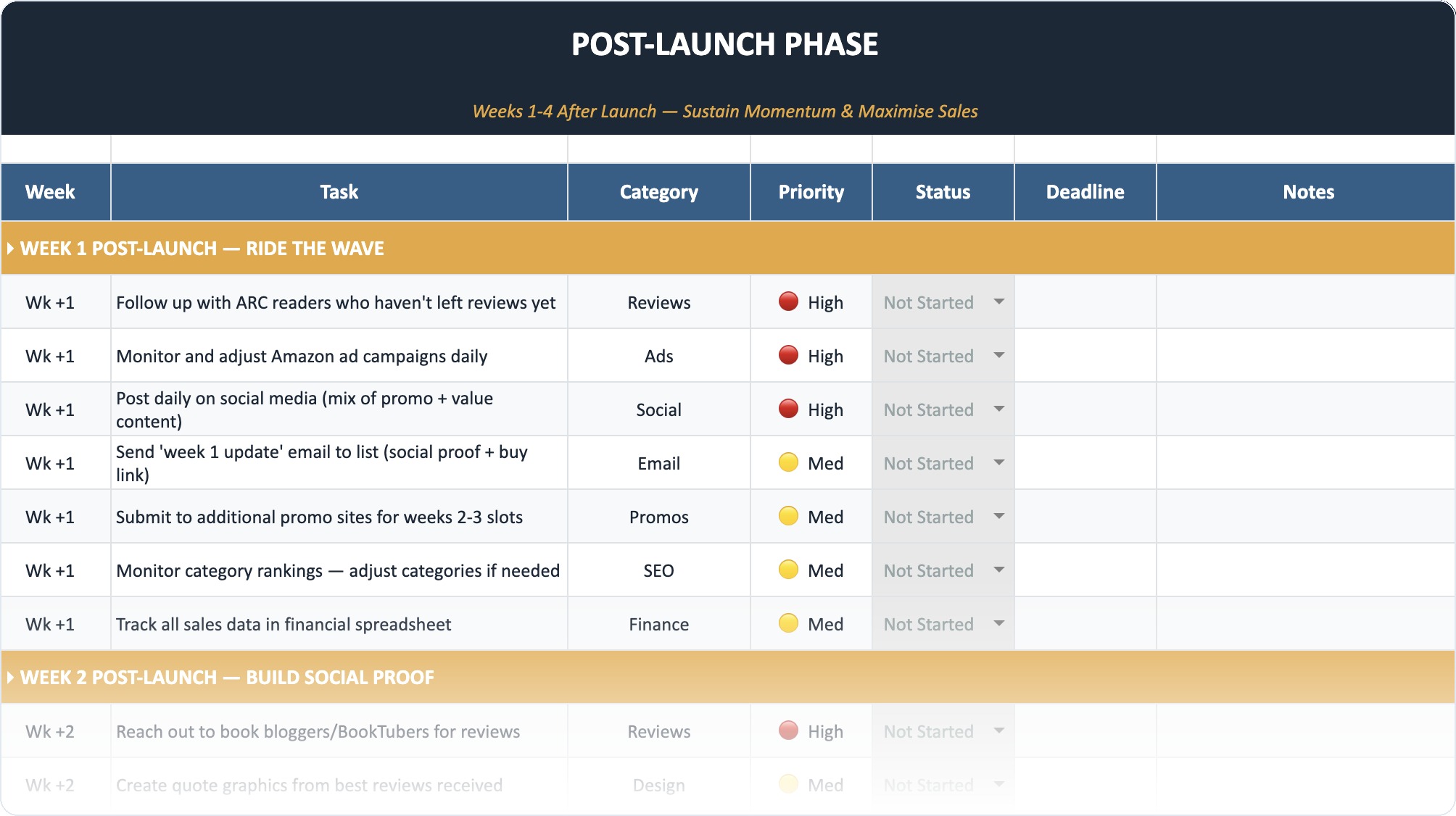
A week-by-week spreadsheet that walks you through every step of launching your book. Available as an Excel file and Google Sheet.
Character Creation: Beyond the Stat Block
A Level 99 Warrior with the personality of a wet napkin will not keep readers for 10 books. The stats are the skeleton, but the character is the meat.
The "Isekai" vs. "System Apocalypse" Protagonist
Most LitRPG falls into two setups:
- Isekai (Portal Fantasy): The protagonist is transported to a game world. They are often a fish out of water.
- System Apocalypse: The game comes to Earth. Modern society collapses, and people must grind mobs in the ruins of Starbucks.
In both cases, your protagonist needs a goal outside of the system.
- Bad Goal: "I want to reach Level 100."
- Good Goal: "I need to reach Level 100 so I can cast the Resurrection spell to save my sister."
Give them a reason to fight. This aligns with the advice on constructing hero's journeys like Percy Jackson, where the mechanics (demigod powers) are cool, but the personal stakes (saving a parent) drive the plot.
Avoiding the "Murder Hobo" Trope
A "Murder Hobo" is a character who wanders around killing things for loot with no moral compass or home base. This gets boring fast. Give your character:
- Relationships: Allies they need to protect.
- A Base: A town or dungeon they must build and defend.
- A Code: Lines they won't cross, even for XP.
World-Building: The "Lived-In" Feel
A common complaint in rpg stats in books is that the world feels like a "screensaver"—static and empty until the hero arrives.
NPCs Are People Too
Non-Player Characters (NPCs) should not just be quest dispensers. In 2026, readers expect NPCs to have agency.
- Do they know they are in a system?
- Do they resent "Players" or "Immortals"?
- Do they have their own economy?
If the hero buys a sword, who forged it? Where did the iron come from? If the economy relies on gold dropped by monsters, why doesn't inflation destroy the kingdom? These details matter.
The Economy of Power
You must balance the economy. If the hero finds a "Legendary" sword in Chapter 3, you have nowhere to go.
- Power Creep: This is the silent killer of long series. If damage numbers go from 10 to 1,000,000 too fast, the numbers lose meaning.
- Diminishing Returns: Implement soft caps. Going from 10 to 20 Strength should feel huge. Going from 100 to 110 should matter less. This keeps the math manageable.
The Writing Process: Production and Consistency
LitRPG authors are known for insane output. Some write 5,000 to 10,000 words a day. You do not have to match that, but you cannot release one book every two years. The market moves too fast.
The "LitRPG Bible"
You need an external document tracking every detail.
- Current Stats: Track the hero's HP, MP, and XP in real-time.
- Cooldowns: If a skill has a 10-minute cooldown, do not let them use it twice in a 2-minute fight. Readers will catch this.
- Loot: What is in their inventory? Did they forget that potion they found in Book 1?
Keeping a "Bible" is essential for maintaining the consistency of your world, similar to the planning required when structuring a long-running book series. If you contradict your own rules, immersion shatters.
Pacing the Grind
You cannot have 50 pages of pure grinding (killing weak monsters for XP) unless you make it interesting.
- Montage it: "Over the next three weeks, I cleared the lower levels of the crypt, gaining two levels and a newfound hatred for skeletons."
- Combine it: Use the grind to show character introspection or dialogue between party members.
Publishing Strategy: The Royal Road Pipeline
The standard publishing advice does not fully apply here. The LitRPG meta is specific.
1. Serialization (Royal Road)
Most big LitRPG stars started on Royal Road (a web serial platform). You post chapters for free, building an audience.
- Feedback: You get instant comments. If a mechanic is broken, readers tell you immediately.
- Speed: You need to post frequently (3-5 times a week) to grow.
2. Monetization (Patreon)
Once you have free readers, you offer "advance chapters" on Patreon. Superfans pay $5 or $10 a month to read 10-20 chapters ahead of the free release. This can generate significant monthly income before you even sell a book.
3. The "Stub" and Amazon KDP
When you have enough chapters for a full book (usually 100k+ words), you take them down from Royal Road (leaving sample chapters) and publish on Amazon Kindle Direct Publishing (KDP).
- Kindle Unlimited: You almost must enroll in KU. LitRPG readers devour books here. The page reads payout is the bread and butter of the genre.
4. Audio Production
Do not ignore audio. As noted in recent market data, LitRPG audiobooks are a massive growth sector, with specific spikes in interest observed in late 2025. You can license your rights to publishers like Podium or Tantor, or produce it yourself (ACX). A good narrator (like Jeff Hays or Travis Baldree) can make a career.
Advanced Mechanics: Trends to Watch
If you want to be ahead of the curve, look at where the genre is going.
Deckbuilding LitRPG
Inspired by games like Slay the Spire, these stories use cards instead of static skills. The protagonist has a "deck" of abilities and can only use what they draw. This adds tension—RNG (Random Number Generation) becomes a plot point.
Cultivation (Xianxia) Hybrids
"Progression Fantasy" often blends LitRPG with Eastern cultivation themes (meditating to gather Qi). The "stats" are internal spiritual stages (Copper, Iron, Gold, Jade). This subgenre is huge.
Visual Integration
With the rise of AI art and easy design tools, some authors are integrating visuals directly into the ebook. However, human artistry is becoming a premium signal. As AI floods the market, using tools or artists to create unique character illustrations for your covers and interior art helps distinguish your book as a high-quality product.
Common Pitfalls to Avoid
1. The "Info Dump" Opening
Do not start Chapter 1 with 10 pages of explaining the history of the magic system. Start with action. Explain the system as the protagonist encounters it.
2. Lack of stakes
If the hero respawns every time they die with no penalty, there is no tension.
- The Fix: Death needs consequences. XP loss, item loss, or permadeath for NPCs.
3. The "Harem" Trap
Some LitRPG devolves into harem fantasies (one guy, many women). While a niche exists for this, it alienates the broader "mainstream" fantasy audience. Be intentional about your target demographic.
Conclusion: Just Write the Damn Book
The LitRPG community is one of the most supportive and hungry audiences in fiction. They want you to succeed because they want more books to read. You don't need to be Tolkien. You need to be consistent, creative with your mechanics, and respectful of the reader's time.
The market is growing, but it waits for no one. Whether you are aiming for a 50,000-word novella or pushing yourself to hit high word counts like a NaNoWriMo challenge every month, the key is to start. Open your blank document, summon your blue box, and let the numbers go up.
Frequently Asked Questions
What is the difference between LitRPG and GameLit?
LitRPG (Literary Role-Playing Game) explicitly features visible game mechanics like stat sheets, levels, and blue boxes that the characters can see and interact with. GameLit is a broader term for any story taking place in a game world, but it might not have the "crunchy" numbers or visible stats.
Do I need to include full stat sheets in every chapter?
No. In fact, you should not. Full stat sheets interrupt the flow of the story. Only include a full sheet at significant milestones (like the end of a book or a major class evolution). For minor updates, summarize the changes in the narrative text.
Can I write LitRPG without being a gamer?
It is possible, but difficult. The audience is primarily gamers who understand the logic of aggro, cooldowns, and tank/DPS/healer dynamics. If you don't understand these concepts, your combat scenes may feel "off" to your core readership.
How long should a LitRPG book be?
LitRPG readers prefer longer books. While standard novels are 80k words, LitRPG novels often range from 100k to 150k words. The audio format benefits from length, as listeners feel they are getting better value for their credit with a 20-hour audiobook.
Is LitRPG saturated in 2026?
While the market is competitive, LitRPG continues to grow with emerging trends like "cute girl" LitRPG and "cozy Xianxia." There is always room for high-quality stories with unique systems, but generic "trapped in VR" stories are harder to sell than they were five years ago.