

Most authors treat the choice between Amazon exclusivity and going wide as a simple math problem. It isn't. It is a philosophy problem that defines your entire career trajectory.
If you choose one path, you might make fast cash but lose ownership of your audience. Choose the other, and you might struggle initially while building an empire that takes five years to mature.
The debate of KDP Select vs Wide distribution is the single most defining business decision you will make as an indie author in 2026. You are either hunting for page reads in a closed ecosystem or building a retailer-agnostic brand across the open web.
- KDP Select (Exclusivity): You give Amazon 100% digital rights for 90 days in exchange for access to Kindle Unlimited (KU) and promotional tools. Best for romance, sci-fi, and new authors seeking visibility.
- Wide Distribution: You sell on Amazon, Apple, Kobo, Google Play, and libraries. Best for building long-term assets, direct sales, and owning your customer data.
- The 2026 Trend: More authors are using a hybrid model, cycling books in and out of KU, or keeping specific series exclusive while selling others wide.
The Golden Handcuffs: What Is KDP Select?
KDP Select is Amazon’s exclusivity program. When you check that box during upload, you sign a contract stating your digital book will not exist anywhere else.
You cannot sell it on your website. You cannot put it on Kobo. You cannot even give it away for free to your newsletter subscribers unless you use Amazon’s specific tools to do so.
In exchange for this digital silence elsewhere, Amazon grants you access to the Kindle Unlimited (KU) ecosystem.
How Kindle Unlimited Drives Income
Kindle Unlimited is a subscription service where readers pay a monthly fee to read as many books as they want. When your book is in KDP Select, these subscribers can download your book for "free." You get paid based on the number of pages they actually read.
This system uses a metric called KENP (Kindle Edition Normalized Page Count). Every month, Amazon establishes a Global Fund. In December 2025, that fund hit a massive $64.9 million.
Authors are paid a share of that fund based on their total reads.
For high-volume genres like LitRPG or contemporary romance, this is incredibly lucrative. Readers in these genres consume books faster than they can buy them. A subscription model removes the friction of the purchase price. They see a cover they like, they download it, and they read it. You get paid.
The Marketing Tools
Exclusivity also unlocks promotional levers inside the Amazon dashboard:
- Kindle Countdown Deals: You can discount your book for a limited time while keeping your 70% royalty rate.
- Free Book Promotions: You can make your book free for up to 5 days every 90-day period.
These tools are powerful because they feed the Amazon algorithm. A free run can generate thousands of downloads. Even though you make zero dollars on those downloads, the activity signals to Amazon that your book is popular.
When the book switches back to paid, it often enjoys a "halo effect" of higher visibility.
Amazon's algorithm cares about one thing: velocity. KDP Select gives you the tools to manufacture that velocity artificially.
The Freedom Route: What Is Wide Distribution?
Going "wide" means you act like a traditional publisher. You upload your book to every retailer that will take it.
Your book appears on Amazon (as a standard title, not in KU), Barnes & Noble, Apple Books, Kobo, Google Play, and potentially dozens of smaller retailers.
This strategy plays the long game. You are not relying on a borrowed audience from a subscription service. You are building real estate on multiple platforms.
The "Eggs in One Basket" Risk
The primary argument for wide distribution is risk mitigation. If you are 100% exclusive to Amazon, your income is tied to a single company's Terms of Service.
If Amazon changes their algorithm, bans your account by mistake, or lowers the KENP payout rate, your income vanishes overnight.
Authors who go wide are diversified. If Amazon sales dip, Kobo sales might rise. If Apple Books features your title, you get a revenue spike that has nothing to do with Jeff Bezos.
Reaching the "Other" 20%
While Amazon dominates the market, they do not own everyone. In fact, specific territories prefer other retailers. Kobo is massive in Canada and Australia. Apple Books has a stronghold on iOS users who prefer the native reading app on their iPhones.
According to data on device usage, smartphones account for approximately 46% of the global ebook market share, which heavily favors platforms like Apple Books and Google Play that come pre-installed on devices. By staying exclusive to Amazon, you remain invisible to these readers.
Stop Staring at a Blank Page
Publy is a distraction-free book editor with AI built in. Brainstorm plot ideas, get instant chapter reviews, or rewrite clunky paragraphs. 3 million free words included.

KDP Select vs Wide: The Income Comparison
Let's look at the money. This is where the debate often gets heated because the payment models are fundamentally different.
The Mathematics of KENP
In KDP Select, you are paid per page. In 2025 and 2026, the rate has hovered around $0.004 to $0.005 per page.
If you write a 300-page novel, a full read-through earns you roughly $1.35. If you sold that same book for $4.99, your 70% royalty would be roughly $3.50.
On the surface, selling a copy seems better. You make more than double the money. But this ignores conversion rates. It is infinitely easier to get a subscriber to "borrow" a book for free than it is to get a customer to pay $5.
If you write short books (under 150 pages), KDP Select is often a bad deal. The page count isn't high enough to generate significant income. Wide distribution usually favors shorter works.
The Wide "Slow Burn"
Wide income does not spike. It trickles. When you first upload to Draft2Digital or Smashwords, you might see zero sales for weeks. You have to teach readers on those platforms that you exist.
However, wide readers are loyal. They are "buyers," not "borrowers." When a Kobo reader buys the first book in your series, they are statistically very likely to buy the rest. They invest cash, not just time.
Over three to five years, a wide catalogue often becomes a stable, predictable asset that requires less aggressive marketing than a KDP Select catalogue.
If you are looking for tips on how to prepare your manuscript for these different ecosystems, check out our guide on Vellum vs Atticus to see which software handles multi-platform formatting best.
Genre Dictates Strategy
Your genre is the biggest variable in the KDP Select vs Wide equation. Some reader bases live almost entirely inside Kindle Unlimited. Others despise it.
The KU Heavyweights
- Romance: This is the engine of KU. Romance readers are voracious. They can read a book a day. Paying $5 per book is unsustainable for them, so they live in the subscription model.
- LitRPG / GameLit: This genre was practically born in KU.
- Sci-Fi / Fantasy: Strong performance in KU, though established authors do well wide.
If you are a debut romance author in 2026 and you try to launch wide, you are fighting an uphill battle. The majority of your target audience is already paying for a subscription that you aren't part of.
The Wide Winners
- Non-Fiction: Readers buy non-fiction to solve a problem. They are happy to pay full price for the solution. They are less likely to browse a subscription catalog for random manuals.
- Literary Fiction: Tends to appeal to a demographic that shops on Apple Books or buys physical copies.
- Children's Books: Often perform better wide or in print.
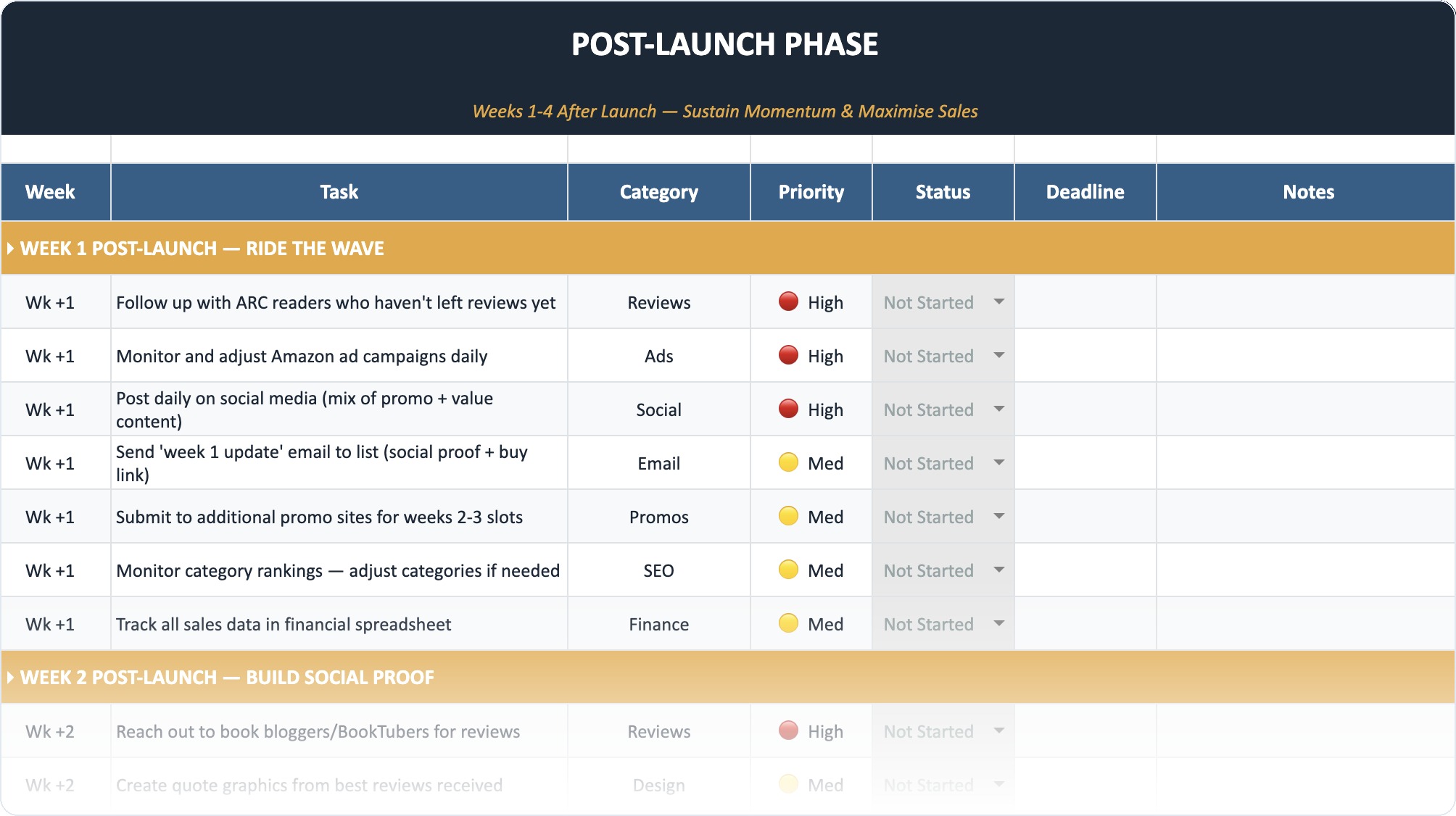
The Self-Publishing Launch Checklist (2026)
A week-by-week spreadsheet that walks you through every step of launching your book. Available as an Excel file and Google Sheet.
The Role of Aggregators (Draft2Digital & Smashwords)
You do not have to upload your book manually to every single site. That would take forever.
Platforms like Draft2Digital and Smashwords (which are now the same company) are essential for wide authors. These are aggregators. You upload your book once, and they distribute it to Apple, Kobo, Barnes & Noble, and hundreds of library systems.
The Cost of Convenience
Aggregators typically take a cut of your royalties, usually around 10% of the retail price. This is the "convenience tax."
For many authors, it is worth it. Managing metadata across twelve different dashboards is a full-time job.
However, most six-figure wide authors suggest going "direct" to the big platforms (Amazon, Kobo, Apple, Barnes & Noble) and using an aggregator for the smaller ones. This maximizes your royalty on the major retailers while still getting you into the corners of the market.
Libraries: The Sleeping Giant of 2026
One of the biggest shifts in the last year has been the explosion of digital lending. Libraries use platforms like OverDrive (Libby), Hoopla, and Palace Marketplace to lend ebooks to patrons.
For a long time, KDP Select authors were locked out of this. You couldn't be in libraries if you were exclusive to Amazon. But the landscape is shifting.
"B08KTZ8249"
Check Price on Amazon →As an Amazon Associate, we earn from qualifying purchases.
Amazon has started opening doors, but the most reliable way to get into libraries is still wide distribution. Aggregators like Draft2Digital have excellent reach into library systems.
Why do libraries matter? Because library readers are super-users. They read constantly. If they discover you in Libby, they tell their friends. They leave reviews.
Furthermore, libraries pay for the books they lend. It is a revenue stream that acts differently than retail; it is less volatile and often surges in Q4 when libraries spend their remaining budgets.
According to recent updates regarding Amazon's policies, there have been moves to allow select KU titles into libraries, but wide distribution remains the primary gatekey. The market data from 2025 suggests the global ebook market is growing, and libraries are a massive part of that ecosystem that exclusive authors largely ignore.
The Hybrid Strategy: The Best of Both Worlds?
You do not have to pick a side and stay there forever. Smart authors in 2026 are fluid.
The Launch-and-Leave Method
Some authors launch a new book in KDP Select for the first 90 days. They use the promotional tools and the KU visibility to rocket up the charts. They gather reviews and build social proof.
Once the 90-day term is up, they uncheck the auto-renew box and take the book wide. They take that Amazon social proof and use it to market the book on Apple and Kobo.
The Series Split
You might keep your erratic, fast-paced alien romance series in KU because that’s where those readers are. Simultaneously, you publish your slow-burn historical mystery series wide. You segment your business based on the product.
This requires knowing your audience intimately. If you aren't sure who your readers are yet, you might want to look at our guide on creating an effective book launch strategy. It breaks down how to identify your target market before you hit publish.
Direct Sales: The Ultimate "Wide"
There is a step beyond wide distribution: Selling direct.
Tools like Shopify, WooCommerce, and Payhip allow authors to sell ebooks and audiobooks directly to readers. You keep 90-95% of the profit. You get the customer's email address. You own the transaction.
If you are in KDP Select, you cannot do this. You cannot sell the digital file on your own site.
For authors who are good at marketing, specifically those who can drive traffic from Facebook ads or TikTok directly to their own store, exclusivity is a massive hindrance. It forces you to send your traffic to Amazon, where you lose data and pay a 30% commission.
If you are interested in this path, we have a deep dive on selling books directly via Shopify that explains the setup process.
Summary of Pros and Cons
Here is the breakdown of the KDP Select vs Wide debate in a nutshell.
- Access to millions of KU subscribers
- Higher royalties per unit sale on wide platforms
- 90-day lock-in period (no freedom)
- No page-read income (must sell units) Promotional tools (Free days/Countdown)
- Risk diversification (safety from bans)
- Income tied to unpredictable KENP rates
- Slower growth and algorithm traction Algorithmic boost from borrows
- Access to library markets (OverDrive)
- No direct sales allowed on your site
- Managing multiple dashboards is work
Which Path Should You Choose?
This decision comes down to your career stage and your goals.
Choose KDP Select if:
- You have a small catalogue (1-3 books).
- You write in a voracious genre like Romance or LitRPG.
- You need immediate money and visibility.
- You hate marketing and just want to focus on one dashboard.
- You are just starting out and want to test the waters. (See: 10 signs you're ready to write your first book).
Choose Wide Distribution if:
- You have a large backlist (10+ books).
- You want to build a resilient business that survives Amazon policy changes.
- You have a strong newsletter and can drive your own traffic.
- You want to sell directly to fans via your website.
- You write non-fiction or literary fiction.
There is no moral superiority in either choice. There is only strategy.
Some authors make seven figures in KDP Select. Some make seven figures wide. The only mistake is not choosing intentionally. Do not drift into exclusivity because it is the default setting. And do not go wide just because you heard an expert say "Amazon is evil."
Look at your books. Look at your readers. Then decide where they meet.
And remember, nothing is permanent. You can try KDP Select for 90 days. If it fails, you can go wide. If wide fails, you can go back. The market is fluid, and your strategy should be too.
If you are struggling with productivity while managing these platforms, you might want to read about the habits of highly productive writers. It helps to have a system when the admin work starts piling up.
Kobo, Apple, and the Long Tail
A final point on the wide platforms. They operate differently than Amazon. Amazon is algorithmic; Kobo and Apple are curated.
On Kobo, real humans largely decide which books get featured on the homepage. Networking matters. Using the specific promotions tab in the Kobo Writing Life dashboard is how you move the needle there.
On Apple Books, pre-orders are king. Apple weighs pre-orders heavily. If you can stack up sales before release day, you can hit their bestseller charts and stick there for a long time.
These are the nuances you learn when you leave the Amazon garden. It is harder work, but the ground you conquer is yours to keep.
Frequently Asked Questions
Can I switch from KDP Select to Wide later?
Yes. KDP Select terms last for 90 days. Ensure you uncheck the "auto-renew" box in your KDP dashboard. Once the term ends, you are free to upload your book to other platforms.
Is Kindle Unlimited worth it for non-fiction?
Generally, no. Non-fiction readers prefer to own reference materials rather than borrow them. However, narrative non-fiction (like memoirs or true crime) can sometimes perform well in KU.
Do I need an ISBN for Kindle Unlimited?
No. Amazon assigns an ASIN (Amazon Standard Identification Number) to your ebook. You do not need an external ISBN if you are publishing exclusively on Amazon.
Can I be in KDP Select and sell print books wide?
Yes. KDP Select exclusivity only applies to the digital (ebook) version of your book. You can sell your paperback and hardcover on Barnes & Noble, IngramSpark, or your own website without violating the agreement.
How much does Amazon pay per page read?
The rate fluctuates monthly based on the KDP Select Global Fund. In 2025/2026, the rate typically lands between $0.004 and $0.005 per page.