

- John Milton's works are best understood in three phases: early poems and minor works (1629-1645), his middle "prose period" of political and religious pamphlets (1641-1660), and his later masterpieces written after blindness and the Restoration (1667-1674).
- His most famous work, Paradise Lost, was published in 1667 (10-book edition) and 1674 (12-book edition), followed by Paradise Regained and Samson Agonistes in 1671.
- Reading his major poetry in publication order (Paradise Lost, then Paradise Regained, then Samson Agonistes) is standard, but tackling his dense prose requires historical context.
- A complete John Milton bibliography includes over 20 major titles, from early lyrics like "Lycidas" to revolutionary tracts like Areopagitica and his epic poems.
Trying to figure out John Milton books in order can feel like a history project. You know Paradise Lost is the big one, but what came before it? What about all that prose he wrote? His writing career spans decades of personal and national turmoil, from the English Civil War to the Restoration of the monarchy.
Getting his bibliography straight is the key to understanding how a poet became a political firebrand and then, against all odds, crafted some of the greatest poetry in the English language. This guide lays it all out chronologically, so you can see the full picture of Milton's incredible journey.
Why Milton's Timeline Matters
John Milton wasn't just a poet who sat in a quiet study. His life was turned upside down by war, revolution, and profound personal loss, including complete blindness by his mid-forties. The order of his books is a direct map of his life and thoughts. His early, elegant poems show a young scholar mastering his craft. The fiery pamphlets of his middle years show a man throwing himself into the political and religious fights of his day. And the great epics of his later life show a reflective, resilient genius synthesizing all his experience into monumental art.
Knowing what he wrote and when helps you see the connections. You can trace how his ideas about freedom, from divorce to speech to choosing a leader, evolve across decades. You can see how the classical beauty of his early verse gets channeled into the cosmic scope of Paradise Lost. Let's break it down, phase by phase.
Phase 1: The Early Poems & Minor Works (1629 – 1645)
This period covers Milton's youth, his education at Cambridge, his six years of private study at his father's estate (the " Horton period"), and his early travels. The works here are shorter, often lyrical or occasional, showcasing his incredible technical skill and deep learning in classical and Renaissance literature.
"On Shakespeare" (1630)


This was Milton's first published poem, though it appeared anonymously. It was printed in the Second Folio of Shakespeare's plays in 1632 when Milton was just 23. It's a 16-line epigram that praises Shakespeare's creative power, suggesting that the playwright built himself a lasting monument not in stone, but in the hearts and minds of his admirers. It’s a young poet’s respectful nod to the towering giant who came before him.
"L'Allegro" and "Il Penseroso" (circa 1631)
This famous pair of companion poems is a brilliant study in contrasts. "L'Allegro" (the happy man) invites the goddess Mirth and celebrates a day filled with rustic pleasures, country dances, and cheerful storytelling. "Il Penseroso" (the thoughtful man) dismisses that world for the goddess Melancholy, preferring the solitary joys of star-gazing, philosophical study, and the sound of music in a shadowy cloister. Together, they show Milton’s mastery of mood and his ability to argue persuasively for two completely opposite ways of life. It’s like he’s testing different voices and perspectives, a skill that would later define the complex speeches in Paradise Lost.
"Arcades" (1632)

"Arcades" is a short, pastoral masque—a kind of aristocratic theatrical entertainment with music and dance. Milton wrote it for the family of the Earl of Bridgewater. In it, shepherds and shepherdesses ("Arcadians") stumble upon the noble estate and sing praises to the Countess Dowager of Derby, comparing her to a heavenly presence. It’s a minor, commissioned work, but it was his first step into drama and led directly to his next, more significant masque.
"Comus" (1634)
Formally titled A Masque Presented at Ludlow Castle, this is Milton's most important early work. He wrote it for the installation of the Earl of Bridgewater as Lord President of Wales. The story follows the Lady, who gets lost in a wood and is trapped by the sorcerer Comus, who tries to tempt her with a magical drink that would enslave her to sensual pleasure. The Lady’s unwavering virtue and powerful arguments for chastity and temperance defeat him. While it’s an entertainment, it’s deadly serious about its moral theme. According to a Google Vertex AI search on Milton's early works, this emphasis on inner, spiritual strength over external force becomes a central Miltonic idea. The work also gave Milton his first major collaborator: the composer Henry Lawes wrote the music.
"Lycidas" (1638)
This poem is a masterpiece of the pastoral elegy tradition—a poem that mourns a death by using the convention of shepherds in an idealized countryside. Milton wrote it for Edward King, a fellow student at Cambridge who drowned in the Irish Sea. But "Lycidas" is so much more than a simple memorial. Milton uses the occasion to rage against the unfairness of death, to bitterly criticize lazy and corrupt clergy ("the blind mouths" who neglect their flocks), and to ultimately find a fragile comfort in Christian resurrection. The poem’s intense emotion, political anger, and stunning language mark a huge leap forward. It was the final poem in his 1645 collection and feels like the explosive end of his early, pastoral phase.
Poems of Mr. John Milton, Both English and Latin (1645)

This was Milton’s first published collection of poetry. It gathered most of the works listed above, along with many of his Latin and Greek poems written during his university years. Publishing it in 1645 was a strategic move. As noted in a historical summary of Milton's career, England was deep in the Civil War, and Milton was known as a controversial pamphleteer. This book was a reminder to the public that he was also a serious, refined poet of the first order. It was his way of preserving his artistic legacy amid the political chaos.
Stop Staring at a Blank Page
Publy is a distraction-free book editor with AI built in. Brainstorm plot ideas, get instant chapter reviews, or rewrite clunky paragraphs. 3 million free words included.

Phase 2: The Middle Period – The Prose Polemicist (1641 – 1660)
For nearly twenty years, Milton put his epic poetry ambitions on hold. He said he felt a duty to use his education and eloquence in the service of his country during its moment of crisis. This period produced almost all of his famous prose works. They are dense, learned, and fiercely argued, covering church reform, divorce, freedom of the press, and the right to overthrow tyrants. Understanding this body of work is crucial, as it’s the forge where his mature ideas were hammered out.
Of Reformation in England (1641) and The Reason of Church Government (1642)

These are Milton’s opening shots in the pamphlet wars. Of Reformation argues against the hierarchical structure of bishops (the episcopacy) and for a Presbyterian model of church governance. The Reason of Church Government is more personal and expansive. In its famous preface, Milton lays out his own literary ambitions, listing the epic poem, the tragedy, and the ode as forms he hopes to one day write for England’s glory. He justifies his current turn to prose as a necessary, temporary duty. It’s a fascinating glimpse of the epic poet waiting impatiently inside the political activist.
The Doctrine and Discipline of Divorce (1643, Augmented 1644)

This is perhaps Milton’s most personally motivated and controversial prose work. Written shortly after his unhappy and short-lived marriage to Mary Powell (who left him within weeks), Milton argues that incompatibility of mind and spirit is a far more legitimate reason for divorce than adultery alone, which was the only ground under English law at the time. He bases his argument on a close reading of scripture and on the idea that marriage is primarily for intellectual and spiritual companionship. The pamphlet caused a scandal and branded Milton as a dangerous radical. It also led directly to his next, and most famous, prose work.
Areopagitica (1644)
This is Milton’s immortal defense of free speech and a free press. It’s structured as a speech to Parliament (the "Areopagus" was a council in ancient Athens). Parliament had passed a law requiring all books to be licensed and approved by government censors before publication. Milton, still stinging from the attacks on his divorce tracts, argues passionately against this "prior restraint." His core idea is that truth must do battle with falsehood in an open marketplace; censoring ideas before they are published assumes the censor is infallible and prevents truth from strengthening itself through conflict. Lines like "As good almost kill a Man as kill a good Book" and "Let [Truth] and Falsehood grapple; who ever knew Truth put to the worse, in a free and open encounter?" have echoed for centuries. It remains a foundational text for liberal democratic thought, as highlighted in analyses of his political writings.
The Tenure of Kings and Magistrates (1649) and Eikonoklastes (1649)
These two works cement Milton’s role as the chief literary defender of the new English Commonwealth. The Tenure of Kings and Magistrates was published just two weeks after King Charles I was executed. It argues that power originates with the people, who may depose and punish a tyrant who breaks his contract with them. Its timely publication was so impressive that the new government soon hired Milton as Secretary for Foreign Tongues. His first major task in that job was Eikonoklastes ("Image-Breaker"), a point-by-point demolition of Eikon Basilike, a bestselling book purportedly written by the martyred king that painted him as a saintly figure. Milton’s job was to smash that popular image, which he did with ruthless logic and biting sarcasm.
The Latin Defenses (1651, 1654, 1655)
Milton’s international fame (and infamy) came from these works, written in Latin for a European scholarly audience. Defensio pro Populo Anglicano (First Defence) was a response to Defensio Regia, a work by the French scholar Salmasius that defended the executed king. Milton’s reply was so successful that it reportedly led to Salmasius’s death from shame. Defensio Secunda (Second Defence) answered a subsequent attack and included moving passages about Milton’s own blindness, which had become complete by 1652. He frames his loss of sight as a sacrifice for the cause of liberty. These dense works are less read today but were central to his life and reputation in the 1650s.
Phase 3: The Later Major Works – The Blind Poet & Epic Master (1667 – 1674)
After the monarchy was restored in 1660, Milton was in grave danger. He was arrested, briefly imprisoned, and lived in quiet retirement. All his political hopes were shattered. It was from this defeated position, blind and in his late fifties, that he composed the works that would make him immortal. He returned to the epic ambition he had expressed decades earlier in The Reason of Church Government.
Paradise Lost (1667 – First Edition in 10 Books; 1674 – Second Edition in 12 Books)

This is the summit of Milton’s achievement and one of the greatest poems in world literature. His goal, as stated in the opening lines, is to "justify the ways of God to men." He tells the biblical story of the Fall of Man: Satan’s rebellion in Heaven, his corruption of Eden, and Adam and Eve’s fateful choice. But Milton’s version is staggeringly original. He gives Satan charismatic, tragic grandeur. He depicts a dynamic, conversational relationship between Adam and Eve. He envisions cosmic warfare, the creation of the world, and vast historical panoramas. The poem grapples with obedience, free will, knowledge, and the paradox of a benevolent God allowing evil to exist.
The first edition of 1667 had ten books. For the 1674 second edition, Milton split Books VII and X into two each, creating the now-standard twelve-book structure, which more closely aligns with classical epics like Virgil’s Aeneid. If you're studying the poem, knowing which edition a reference comes from is key. The effort behind this work was monumental. As a summary of his later life notes, he composed the entire epic orally, dictating it to aides (often his daughters) in fits of inspiration, sometimes lying awake at night waiting for lines to come to him.
Paradise Regained (1671) and Samson Agonistes (1671)
Published together in one volume in 1671, these two works are often seen as companion pieces to Paradise Lost, but they are very different in tone and style.
Paradise Regained is a brief epic in four books. It tells the story of Christ’s temptation in the wilderness. Unlike the cosmic scale of Paradise Lost, this poem is an intense, claustrophobic drama of words and ideas. Satan tempts Jesus with food, wealth, earthly glory, and classical learning, but Jesus rejects each offer with steadfast, reasoned faith. The "paradise regained" is not a garden, but an inner, spiritual kingdom of the faithful individual—a quiet, intellectual victory to contrast with the violent rebellion of the first epic.
Samson Agonistes is a poetic drama, modeled on Greek tragedy. It depicts the blinded, enslaved Hebrew hero Samson in his final day, arguing with friends and enemies, grappling with his failure and God’s seeming abandonment, before pulling down the Philistine temple in a final act of catastrophic strength. The parallels to Milton’s own life—blindness, political defeat, service to a seemingly ungrateful public—are impossible to ignore. But the poem is more than autobiography; it’s a profound exploration of suffering, patience, and the mysterious ways divine purpose can work through human despair. It’s a powerful, somber finale to his poetic career. Understanding how to structure a dramatic work like this can be complex; if you're interested in narrative forms, our guide on short story vs novella structure explores different approaches to pacing and plot.
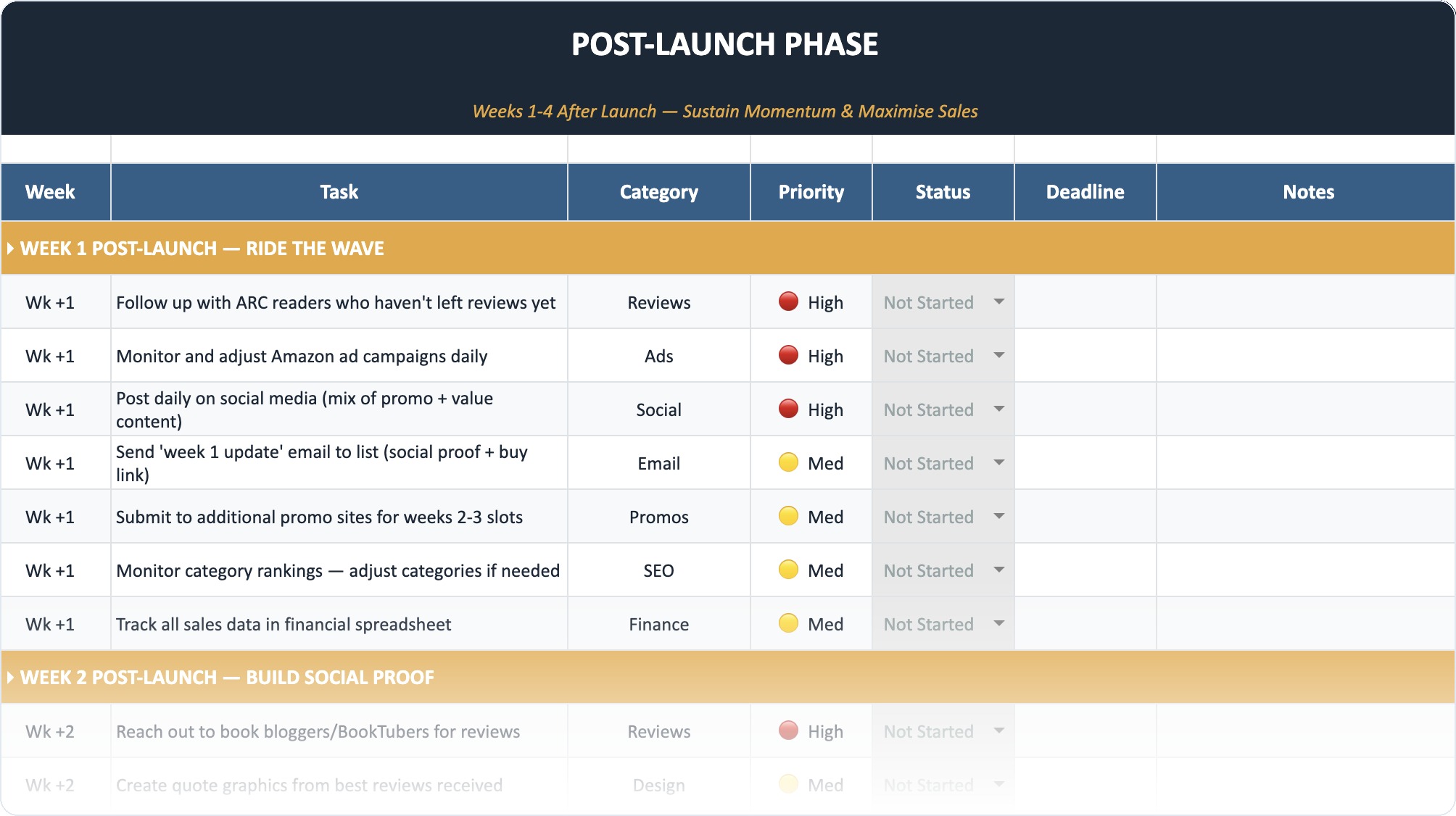
The Self-Publishing Launch Checklist (2026)
A week-by-week spreadsheet that walks you through every step of launching your book. Available as an Excel file and Google Sheet.
John Milton Complete Works: A Chronological Table
For a quick, at-a-glance reference, here is a table of John Milton's major publications in order. This is your go-to Milton bibliography timeline.
| Year | Title | Genre | Key Notes |
|---|---|---|---|
| 1630 | "On Shakespeare" | Poem | First published work, in Shakespeare's Second Folio. |
| c. 1631 | "L'Allegro" & "Il Penseroso" | Paired Poems | Contrasting visions of the joyful and contemplative life. |
| 1632 | "Arcades" | Masque | Short pastoral entertainment. |
| 1634 | "Comus" (A Masque) | Masque | Major early work arguing for virtue and chastity. |
| 1638 | "Lycidas" | Pastoral Elegy | Masterful poem mourning a friend, with sharp criticism. |
| 1641 | Of Reformation in England | Prose Pamphlet | First anti-episcopal tract. |
| 1642 | The Reason of Church Government | Prose Pamphlet | Includes famous preface on his poetic ambitions. |
| 1643/44 | The Doctrine and Discipline of Divorce | Prose Pamphlet | Controversial argument for divorce on grounds of incompatibility. |
| 1644 | Of Education | Prose Treatise | His plan for reforming schools and universities. |
| 1644 | Areopagitica | Prose Speech | Landmark defense of free speech and a free press. |
| 1645 | Poems of Mr. John Milton | Poetry Collection | First collection of his English and Latin verse. |
| 1649 | The Tenure of Kings and Magistrates | Prose Pamphlet | Justifies deposing and executing a tyrannical king. |
| 1649 | Eikonoklastes | Prose Pamphlet | Official rebuttal to the king's purported book. |
| 1651 | Defensio pro Populo Anglicano | Latin Prose | First "Defence" of the English people to Europe. |
| 1654 | Defensio Secunda | Latin Prose | Second "Defence," includes passages on his blindness. |
| 1667 | Paradise Lost (10-book ed.) | Epic Poem | First edition of his masterpiece. |
| 1670 | History of Britain | Prose History | A historical work covering early Britain. |
| 1671 | Paradise Regained | Brief Epic Poem | Published in same volume as Samson Agonistes. |
| 1671 | Samson Agonistes | Poetic Drama | Greek-style tragedy about the blinded Samson. |
| 1673 | Of True Religion | Prose Pamphlet | Late tract arguing for Protestant toleration. |
| 1674 | Paradise Lost (12-book ed.) | Epic Poem | Revised, definitive second edition. |
What's the Best John Milton Reading Order?
You're not alone in wondering where to start. Do you dive straight into the deep end with Paradise Lost? Should you read his prose first? Here’s a practical guide based on your goals.
For the First-Time Reader Focused on the Poetry:
- Start with the early poems. Read "L'Allegro" and "Il Penseroso" to appreciate his lyrical beauty. Then read "Lycidas" to see his power and complexity. This is a manageable, rewarding start.
- Go straight to Paradise Lost. Don't be intimidated. Use a good annotated edition (like the Norton Critical or Longman). Read it slowly, maybe a book at a time. The first two books, set in Hell, are the most thrilling.
- Follow with Paradise Regained and Samson Agonistes. Read them as a pair, published together. They show Milton’s final, more austere and personal vision.
For the Student or Dedicated Reader Who Wants Full Context:
- Begin with the 1645 Poems. Get a feel for the poet before the polemicist.
- Read Areopagitica. It’s his most accessible and relevant prose work. You’ll see his brilliant, passionate argumentative style.
- Read The Reason of Church Government (Book I Preface). It’s short and reveals his life’s poetic plan.
- Proceed to Paradise Lost. Now you’ll have a sense of the man who wrote it.
- Explore his later poetry and selected prose (like The Tenure of Kings) based on your interests.
The journey from a polished lyric like "L'Allegro" to the cosmic despair and hope of Paradise Lost is one of the most remarkable in literature. It requires patience, but the reward is a deeper understanding of a writer who shaped the very idea of individual liberty and artistic ambition. For modern authors, building a body of work across a career is its own challenge; our resource on creating a successful book series talks about planning long-term literary projects.
Milton's Prose Timeline: Key Themes
While the poetry gets most of the attention, Milton's prose timeline tells its own epic story of a mind engaged with the biggest problems of his time. The themes evolve but are deeply connected:
- Church Reform (1641-1642): It starts with attacking bishops and arguing for a purer, simpler church government.
- Personal Liberty (1643-1645): This shifts to the rights of the individual in marriage (Divorce) and in the realm of ideas (Areopagitica, Education). He’s applying his radical principles to everyday life.
- Political Liberty (1649-1660): With the king gone, Milton becomes the theorist of the new republic. He defends the people’s right to revolution (Tenure), acts as the state’s propagandist (Eikonoklastes), and becomes its international spokesperson (Defences).
- Late Reflection (1659-1673): After the Restoration, his prose becomes more about preserving principles in defeat (The Ready and Easy Way) and arguing for basic religious toleration (Of True Religion).
The through-line is liberty: liberty from oppressive church hierarchy, liberty from a bad marriage, liberty to speak and publish, liberty to choose and remove rulers. This lifelong obsession finds its ultimate poetic expression in Paradise Lost, where the central drama is about the gift and the terrible cost of free will. Researching and integrating such complex themes into writing is a skill; for insights on blending fact with creative narrative, see our article on the role of research in creative writing.
Finding and Reading Milton Today
You don't need a rare book collection to read Milton. His complete works and individual titles are widely available.
- Print: Look for respected academic editions from publishers like Oxford University Press, Longman, or Norton. These have essential introductions, notes, and glossaries.
- Digital: Sites like Project Gutenberg offer free, public-domain versions of his works, though they lack annotations.
- Audiobooks: Paradise Lost and other works are available in audio format. Hearing the majestic blank verse read aloud can be a revelation.
Remember, Milton is challenging. His sentences are long, his references are many. Don't hesitate to use summaries, guides, or even modern translations of his prose to help you along. The goal is to engage with his ideas and his unparalleled poetic music. The path from his first youthful poem to his final tragic drama is the record of a monumental intellect and spirit, and following it in order is the best way to meet John Milton, the man and the legend. For any author, getting from the first idea to a finished book is a process; if you're embarking on your own writing journey, our complete self-publishing timeline can help you plan each step.
Frequently Asked Questions
What is the correct Paradise Lost reading order?
There is only one Paradise Lost, but it has two editions. You should read the standard 12-book edition from 1674. Within the poem, read the books in numerical order from 1 to 12. The story is linear, beginning with Satan in Hell and ending with Adam and Eve leaving Eden.
Should I read Paradise Regained before Paradise Lost?
No. Paradise Regained was written and published after Paradise Lost as a kind of thematic sequel. It assumes you know the cosmic story of the fall. Read Paradise Lost first to understand the larger context and see how Milton's style and focus change in the later, shorter poem.
What is John Milton's most famous prose work?
His most famous and influential prose work is Areopagitica (1644). It is a passionate argument against government censorship and for freedom of the press. Its ideas became cornerstones of modern liberal democracy and are still cited in debates about free speech today. A review of his political impact confirms its enduring significance.
How did Milton write Paradise Lost if he was blind?
Milton became completely blind around 1652, over a decade before Paradise Lost was published. He composed the entire epic orally. He would hold lines or long passages in his memory, sometimes lying awake at night, and then dictate them to a scribe—often one of his daughters, a nephew, or paid assistants—in the morning. The poem was then read back to him for correction.
What is a good starting point for reading Milton's poetry?
A great starting point is the pair "L'Allegro" and "Il Penseroso." They are short, beautifully crafted, and don't require extensive background knowledge. After that, read the elegy "Lycidas." These three poems give you a perfect taste of his early skill and depth before tackling the epic scale of Paradise Lost.
Did Milton write anything besides Paradise Lost?
Yes, absolutely. While Paradise Lost is his masterpiece, Milton's complete works are vast. He wrote numerous other major poems like "Lycidas," Paradise Regained, and Samson Agonistes. He also wrote over 25 major prose pamphlets on topics ranging from divorce and education to freedom of speech and political theory. He was a prolific and versatile writer across his entire life.