
If you just want to know where to start without the history lesson, here is the quick answer. Most fans agree that the best way to read Isaac Asimov's massive saga is a hybrid order. Start with I, Robot to understand the basics. Next, read the Robot Novels (starting with The Caves of Steel) to meet R. Daneel Olivaw. After that, jump to the original Foundation Trilogy. Save the prequels and sequels for last. This gives you the best narrative payoff and avoids spoilers.
Introduction
Isaac Asimov is a titan of science fiction. Along with Arthur C. Clarke and Robert Heinlein, he forms the "Big Three" who defined the genre in the 20th century. If you are here in 2026, you might have discovered his work through the Apple TV+ Foundation series or perhaps you just want to tackle one of the most ambitious fictional universes ever created. But there is a problem. Asimov wrote over 500 books.
That number is not a typo. While not all of them are science fiction, the sheer volume of his bibliography is overwhelming. He did not write his major series—the Robot series, the Empire series, and the Foundation series—in a straight line. He wrote them out of order over several decades and later tied them together into a single cohesive history of the future.
This creates a dilemma for new readers. Do you read them in the order he published them? Do you read them in the chronological order of the story?
We are going to solve that for you today. We will break down the exact reading orders you can use, the pros and cons of each, and help you navigate the Galactic Empire without getting lost in hyperspace. Whether you are looking for the Foundation series reading order or the I, Robot timeline, this guide has you covered.
Why the Reading Order Matters
You might wonder why you cannot just pick up any book with Asimov's name on it. The issue is that Asimov eventually merged three separate series into one.
In his later years, Asimov returned to his earlier works and wrote connecting novels. These books bridge the gap between his near-future robot stories and the distant future of the Galactic Empire. If you read these connecting books too early, you will encounter massive spoilers for the original mysteries. If you read them too late, you might miss the subtle clues he planted along the way.
We will start with the recommended hybrid order, often called the "Machete Order" by fans, as it offers the best balance of mystery and world-building. Then we will detail the chronological and publication orders for purists.
Stop Staring at a Blank Page
Publy is a distraction-free book editor with AI built in. Brainstorm plot ideas, get instant chapter reviews, or rewrite clunky paragraphs. 3 million free words included.

The Robot Series: Where Artificial Intelligence Begins
The best place to enter Asimov's universe is with his robots. These stories set the ground rules for everything that follows. They introduce the "Three Laws of Robotics" which dictate how artificial intelligence must behave.
I, Robot (1950)


This is not a single novel but a collection of short stories. It is the perfect primer. You get to see the history of robotics from the clumsy, non-speaking models of the early 21st century to the highly advanced machines that run the world economy.
The stories are framed by an interview with Dr. Susan Calvin, a robopsychologist. Through her recollections, we learn how robots evolved. This book is essential because it teaches you the logic puzzles that Asimov loves. Every story usually involves a robot appearing to break the rules, only for the characters to figure out that the robot is actually following the rules perfectly in an unexpected way.
The Caves of Steel (1954)

Once you understand the laws, you are ready for the novels. The Caves of Steel is a murder mystery. It pairs Elijah Baley, a detective from an overpopulated Earth, with R. Daneel Olivaw, a human-looking robot.
This book is critical. It introduces R. Daneel Olivaw, who is arguably the most important character in the entire Asimov universe. The dynamic between Baley, who distrusts robots, and Daneel, who cannot take offense, is the heart of this series.
The Naked Sun (1957)
The sequel takes Baley and Daneel to the planet Solaria. Unlike the crowded underground cities of Earth, Solaria is sparsely populated. Humans live on vast estates and avoid physical contact, relying entirely on robots. This book expands the universe and shows the sociological differences between Earth and the "Spacer" worlds.
The Robots of Dawn (1983)
Written much later but taking place directly after The Naked Sun, this novel returns to the detective duo. It is longer and more complex than the previous two. It also introduces Giskard Reventlov, another robot who plays a pivotal role in the future of the galaxy.
Robots and Empire (1985)
Warning: This book acts as the bridge to the Foundation series. Some fans suggest waiting to read this until after you have read the original Foundation trilogy. Why? Because it reveals the fate of Earth and explains why the galaxy eventually forgot about robots. If you read it now, you get a chronological story. If you wait, you preserve a mystery that lasts for thousands of years in the timeline.
The Galactic Empire Series: The Forgotten Middle Child
Between the invention of robots and the rise of the Foundation, humanity colonized the galaxy. These three books are loosely connected and are often considered the "skippable" part of the cycle. However, for a completionist, they offer a look at how the Galactic Empire formed.
The Stars, Like Dust (1951)
Set long before the Empire is unified, this story deals with a rebellion against the Tyrann, a repressive regime holding back the galaxy. It is a straightforward space opera.
The Currents of Space (1952)
This novel deals with the rise of Trantor, the planet that will eventually become the capital of the galaxy. It involves a brainwashed man who knows a secret about the destruction of a planet.
Pebble in the Sky (1950)
This was actually Asimov's first novel. It involves a man from the 1940s who is transported thousands of years into the future. He finds an Earth that is radioactive and looked down upon by the rest of the galaxy. This establishes the tragic state of Earth that becomes a plot point in the Foundation series.
According to a biographical summary of Asimov's career, his ability to weave these disparate stories into a single tapestry is what earned him his legendary status in the field.
The Foundation Series Reading Order
This is the main event. The Foundation series covers the fall of the Galactic Empire and the effort to shorten the ensuing dark ages from 30,000 years to just 1,000. It centers on Hari Seldon and his science of Psychohistory, which uses mathematics to predict the behavior of massive populations.
If you are looking to plan out a complex saga of your own, Asimov's structure here is the gold standard.
The Original Trilogy (Read These First)
Even if you read the Robot novels chronologically, you should pause and read these three books before reading the Foundation prequels.
-
Foundation (1951)
This consists of five interconnected stories. It introduces Hari Seldon, the trial on Trantor, and the establishment of the Foundation on the edge of the galaxy (Terminus). It spans about 150 years of history as the Foundation faces various "Seldon Crises." -
-
Foundation and Empire (1952)
The Empire attacks the Foundation, but the real threat is "The Mule," a mutant who can manipulate emotions. The Mule is a statistical outlier that Seldon's math could not predict. This book shifts the genre from political thriller to psychological suspense. -
-
Second Foundation (1953)
With the Seldon Plan in ruins, the search begins for the mysterious "Second Foundation" that Seldon established as a backup. This is a game of cat and mouse between the Mule and the secret guardians of the plan.


The Sequels (Read These Next)
Written in the 1980s, these books continue the story of the First and Second Foundations.
-
Foundation's Edge (1982)
This book won the Hugo Award for best novel. It follows Golan Trevize as he suspects that the Seldon Plan is working too perfectly. He goes looking for the lost planet of Earth to find answers. -
-
Foundation and Earth (1986)
This is the conclusion to the future timeline. Trevize continues his search for Earth. This is the book that explicitly ties the Robot series and the Foundation series together into a single knot. -

The Prequels (Read These Last)
These were written last, just before Asimov died. They detail Hari Seldon's life and how he developed Psychohistory.
-
Prelude to Foundation (1988)
We meet a young Hari Seldon arriving on Trantor. He is on the run from the Emperor and explores the various sectors of the planet-city. -
Forward the Foundation (1993)
This consists of four novellas recounting different stages of Seldon's life as he grows older and the Empire crumbles around him. It is a poignant goodbye from Asimov himself. -

Detailed Breakdown: The "Machete" Hybrid Order
We mentioned a "Machete" order earlier. This is the sequence we recommend for the absolute best experience in 2026. It maximizes suspense and minimizes confusing retcons.
- I, Robot (Sets the stage)
- The Caves of Steel (Introduction to Daneel)
- The Naked Sun
- The Robots of Dawn
- The Stars, Like Dust (Optional)
- The Currents of Space (Optional)
- Pebble in the Sky (Good for understanding Earth's fate)
- Foundation (The Core Mystery)
- Foundation and Empire
- Second Foundation
- Foundation's Edge
- Foundation and Earth (The Grand Unification)
- Prelude to Foundation (The Backstory)
- Forward the Foundation (The End)
- Robots and Empire (The Final Puzzle Piece)
Wait, why is "Robots and Empire" last?
Technically, it takes place after The Robots of Dawn. However, it contains a massive revelation about why Earth is radioactive. If you read it early, you know the answer to the mystery that the characters in Foundation and Earth are trying to solve. Reading it last treats it as a flashback that fills in the final gap in history.
Asimov's Writing Style and Themes
Asimov was known for his clear, unadorned prose. He focused on dialogue and ideas rather than flowery descriptions. His characters often sit in rooms and discuss politics, sociology, and logic.
If you are looking for social commentary in fiction, Asimov provides it through the lens of falling empires. The Foundation series was modeled after Edward Gibbon's The History of the Decline and Fall of the Roman Empire. Asimov replaced Rome with Trantor, a planet entirely covered in metal, housing 40 billion bureaucrats.
The Role of Psychohistory
Psychohistory is one of the most fascinating concepts in science fiction. It proposes that while you cannot predict what one person will do, you can predict what a quadrillion people will do. It treats humanity like a gas; you cannot know where a single molecule will go, but you can predict the pressure and volume of the gas as a whole.
This concept has influenced real-world social sciences. In fact, many economists and sociologists cite the Foundation series as an inspiration for their careers.
The Three Laws of Robotics
You cannot discuss Asimov without the Three Laws. They are:
- A robot may not injure a human being or, through inaction, allow a human being to come to harm.
- A robot must obey the orders given it by human beings except where such orders would conflict with the First Law.
- A robot must protect its own existence as long as such protection does not conflict with the First or Second Law.
According to a study on Asimov's concepts, these laws introduced the words "robotics" and "positronic" into the English language and remain a standard reference for ethics in AI today.
Differences Between Books and TV Show
If you are coming from the Apple TV+ show, you need to be prepared for some major differences. The show remixes the timeline heavily.
- The Genetic Dynasty: In the show, the Emperor is a clone dynasty (Brother Dawn, Day, and Dusk). This does not exist in the books. The Emperors in the books are regular humans, often incompetent or corrupt.
- Demerzel: The character of Eto Demerzel appears in the show. In the books, this character's true identity is a major twist revealed in Prelude to Foundation.
- Salvor Hardin and Gaal Dornick: In the books, these are male characters with different roles. The show reimagines them significantly to modernize the story and add more action.
- Action vs. Dialogue: The books are intellectual puzzles. The show is a visual spectacle with more physical conflict.
The adaptation has been successful in bringing the story to a modern audience. As noted in coverage regarding the TV adaptation's release, the series premiered in 2021 and has sparked renewed interest in the original texts.
Standalone Novels You Should Not Miss
While the interconnected universe gets all the attention, Asimov wrote incredible standalone books. If you need a break from the 15-book saga, try these.
The Gods Themselves (1972)
Many critics consider this his best work. It deals with contact between parallel universes and the cost of free energy. The middle section, which takes place in the alien universe, features some of the most unique biological concepts Asimov ever wrote. It explores a species with three genders and a very different view of life and death.
The End of Eternity (1955)
This is a time travel story. It involves an organization called "Eternity" that exists outside of time and alters history to prevent disasters. Some fans argue this is actually a secret prequel to the Foundation universe, explaining why there are no aliens in the galaxy (the Eternals erased them to make room for humans).
Nemesis (1989)
This story is about a colony ship and a rogue star. It is technically a standalone, but Asimov hinted that it might take place in the very early days of the Foundation timeline, long before robots were common.
The Prolific Nature of Asimov
Asimov's pace of his output was legendary. He wrote every day, usually from 7:30 AM to 10:00 PM. He typed 90 words per minute and rarely did second drafts. This is why his bibliography is so vast.
He wrote books on the Bible, Shakespeare, chemistry, math, and history. He even wrote a joke book. However, his science fiction remains his most enduring legacy.
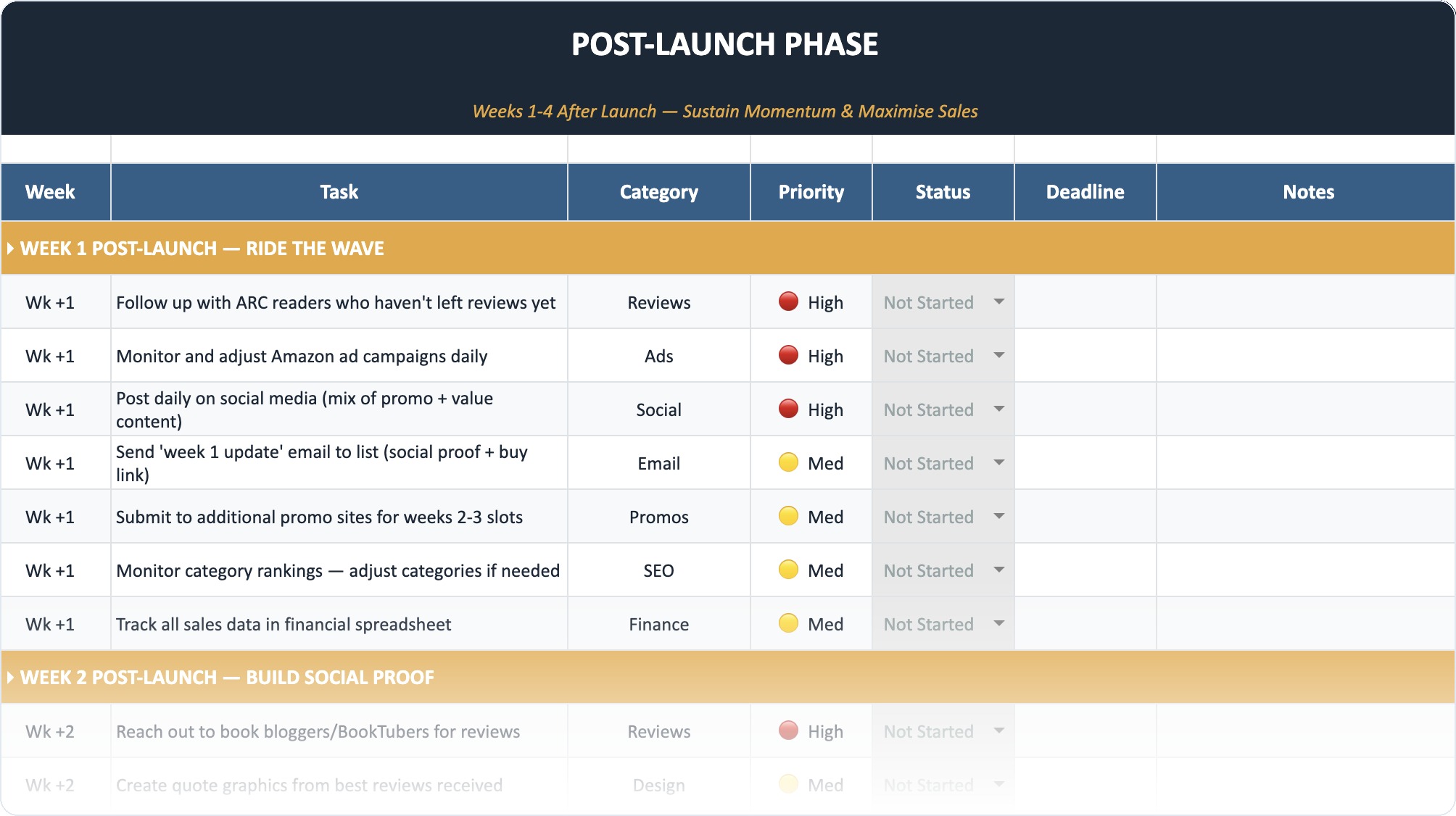
The Self-Publishing Launch Checklist (2026)
A week-by-week spreadsheet that walks you through every step of launching your book. Available as an Excel file and Google Sheet.
Comparison Table: Reading Orders
| Feature | Publication Order | Chronological Order | Hybrid (Machete) Order |
|---|---|---|---|
| Starting Book | I, Robot or Foundation | I, Robot | I, Robot |
| Narrative Flow | Disjointed timeline, but follows author's growth | Linear history, but writing style varies wildly | Best narrative arc |
| Spoiler Risk | Low | High (Spoilers for Foundation mysteries) | Minimal |
| Best For | Purists / Historians | Hardcore Lore Fans | First-time Readers |
| Robot Series Position | Read first or interspersed | Read first | Read first (mostly) |
| Prequels Position | Read last | Read after Robots | Read last |
Final Thoughts on the Grand Master
Isaac Asimov received a special Hugo Award for the Best All-Time Series in 1966, beating out The Lord of the Rings. That level of acclaim is rare. His work is optimistic about human intelligence. He believed that if we used reason and science, we could solve any problem, even the collapse of civilization itself.
In 2026, with the rapid advancement of real-world AI, his stories feel more relevant than ever. We are currently grappling with the very ethical questions he posed 70 years ago. Can we trust autonomous machines? How do we program ethics? What happens when the creation surpasses the creator?
Whether you are looking for world-building concepts for your own writing or just want to get lost in a good story, the Asimov reading list is a journey worth taking. Start with the robots, move to the empire, and end with the foundation.
Frequently Asked Questions
What is the best Isaac Asimov book to start with?
For most readers, I, Robot is the best entry point. It is a collection of short stories that requires no prior knowledge and sets up the themes of logic and robotics that permeate his later works. Alternatively, The Caves of Steel is a great starting point if you prefer a traditional novel structure over short stories.
Are the Robot and Foundation series connected?
Yes, they are connected. Originally, Asimov wrote them as separate series. However, in the 1980s, he wrote Foundation's Edge, Foundation and Earth, and Robots and Empire to explicitly link the two universes. The character R. Daneel Olivaw serves as the primary thread connecting the two eras.
Do I need to read the Galactic Empire books?
You do not strictly need to read them to understand the Foundation or Robot series. They are loosely connected and generally considered of lower quality than his major works. However, Pebble in the Sky is worth reading to understand the history of Earth within the Foundation universe.
Is the Apple TV Foundation show faithful to the books?
The Apple TV series is not a direct adaptation. It takes the core concepts—Psychohistory, the fall of the Empire, the Foundation—and creates a largely new story with different characters and action sequences. It is best to view the show and the books as separate entities that share a setting.
How many Isaac Asimov books are there?
Isaac Asimov wrote or edited over 500 books in his lifetime. While not all are science fiction (he wrote extensively on history, science, and literature), his science fiction bibliography alone includes dozens of novels and hundreds of short stories.