

You just received an offer. A publisher wants your book. The validation feels electric. Finally, someone sees the value in your work. You are ready to sign on the dotted line immediately so you can share the news with the world.
Stop. Put the pen down.
That document in front of you determines the financial future of your intellectual property for years, perhaps decades. In 2026, the publishing world has shifted. We have seen a massive rise in small presses, hybrid models, and AI-driven contracts. While 93% of independent authors report satisfaction with their path, those who sign bad deals often find themselves trapped in agreements that drain their income and hold their rights hostage.
This guide details exactly what to look for. I will walk you through the specific clauses that should make you run, the subtle wording changes that cost you thousands of dollars, and the new threats emerging in the age of artificial intelligence.
- Check the Grant of Rights: Never sign away "all rights" or rights "in perpetuity" without a reversion clause.
- Verify Royalty Calculations: Ensure royalties are paid on the cover price (list price), not "net receipts" or "net profit," which publishers can manipulate. To learn more about this, read our guide on understanding book royalties in self-publishing.
- Beware of Hidden Fees: Reputable traditional publishers never charge you. If there is a "setup fee" or forced purchase of copies, it is likely a vanity press scam.
- Watch for AI Clauses: In 2026, ensure you are not granting the publisher the right to use your text to train AI models or create AI-generated derivatives without extra compensation.
The State of Publishing in 2026
The industry looks different today than it did five years ago. We are seeing a massive shift toward author empowerment. Writers are no longer content to be passive participants. You have options. The digital publishing market is valued at over $257 billion as of 2025. This growth means there is more money on the table, but it also means predatory companies are more aggressive in trying to take a slice of your earnings.
In early 2026, we saw 40% of debut book deals secured through preempts. Publishers are hungry for new voices. They want your work. This puts you in a stronger negotiating position than you might think. You do not have to accept the first terms offered.
However, complexity has increased alongside opportunity. We now have to worry about audio rights, foreign translation markets that authors can manage themselves, and the integration of AI in editing and marketing. If you do not understand what you are signing, you might inadvertently give away the right for a computer to narrate your audiobook while you receive zero royalties for it.
The "Grant of Rights" Trap
The "Grant of Rights" section is usually at the very top of the contract. This is where you legally transfer control of your work to the publisher. The most dangerous phrase here is "throughout the universe, in perpetuity, in all media now known or hereafter invented."
The Problem with "In Perpetuity"
"In perpetuity" means forever. If you sign this, the publisher owns the rights to your book until the copyright expires, which is your life plus 70 years. If the publisher does a terrible job, fails to market the book, or simply loses interest, you cannot take your book back. It sits in their catalog, gathering dust, and you are legally forbidden from publishing it elsewhere.
You want a contract with a fixed term (e.g., 5 or 7 years) or a very strong "reversion clause." A reversion clause allows you to demand your rights back if sales drop below a certain number (e.g., fewer than 50 copies sold in a year). Without this escape hatch, your book is in prison.
Excessive Territory Rights
Does a small independent press in Ohio really need the exclusive rights to sell your book in Print and Ebook formats in Japan, Germany, and Brazil? Probably not.
If the publisher does not have an active distribution partner in foreign territories, they should not demand "World English" or "World All Languages" rights. If you grant them World Rights, and they only sell the book in the US, you are losing out on income from the UK, Australia, and Canada. You could have sold those rights yourself or used a distributor.
Keep your foreign rights unless the publisher proves they can exploit them. As noted in recent industry data, more authors are choosing to retain translation rights to maximize their global reach directly.
Format Grabs
Be careful of the phrase "all media now known or hereafter invented."
In the past, authors signed this and accidentally gave away ebook rights before ebooks existed. Today, this applies to VR adaptations, interactive gaming versions, and AI training sets. If a new format is invented ten years from now, you want to be able to negotiate a new deal for it, not have it bundled into a contract you signed in 2026 for zero extra dollars.
Financial Red Flags: Royalties and Advances
This is where the math gets tricky. Publishers often use confusing language to disguise how little they plan to pay you.
Net Receipts vs. List Price
This is the single most common way authors get ripped off.
- List Price (Cover Price): This is the sticker price of the book (e.g., $20).
- Net Receipts (Net Revenues): This is the amount the publisher receives after giving a discount to the retailer (Amazon, Barnes & Noble).
Scenario A: List Price Royalty
Your contract says: "10% of List Price."
Book costs $20.
You get $2.00 per book.
Scenario B: Net Receipts Royalty
Your contract says: "10% of Net Receipts."
Book costs $20.
Publisher sells to Amazon at a 55% discount. Publisher receives $9.00.
You get 10% of $9.00.
You get $0.90 per book.
See the difference? A royalty based on Net Receipts is usually less than half of a royalty based on List Price. Standard traditional publishing contracts for hardcovers used to be based on List Price. However, many small presses and digital-first publishers now use Net Receipts.
If the contract uses Net Receipts, the percentage must be much higher to match the income. A 10% Net Receipts royalty is terrible. You should be looking for 50% of Net Receipts for ebooks and at least 20-25% for print if the calculation is based on Net.
The "Net Profit" Scam
Avoid "Net Profit" at all costs. "Net Receipts" is the money the publisher gets from the store. "Net Profit" is what is left over after the publisher deducts their expenses.
If you sign a Net Profit deal, the publisher can deduct the cost of editing, cover design, printing, shipping, and even "office overhead" from the book's income before paying you a dime. Creative accountants can easily ensure a book never shows a "profit," meaning you never get a royalty check. This is famously known in the film industry as "Hollywood Accounting," and it exists in publishing too.
Withheld Royalties for Returns
Bookstores can return unsold books to the publisher for a full refund. To protect themselves, publishers withhold a portion of your royalties (usually 20-30%) in a "reserve for returns."
This is standard practice, but there must be limits.
- Red Flag: The reserve is unlimited (e.g., "a reasonable amount" with no cap).
- Red Flag: The money is held forever.
- The Fix: Ensure the contract states the reserve cannot exceed 20% and must be paid out to you after a specific time (e.g., 12 or 18 months).
The Hybrid Publishing Gray Zone
Hybrid publishing has become a respectable path in 2026, but it is also a playground for scammers. A true hybrid publisher vets manuscripts, has professional distribution (not just uploading to KDP), and shares the risk.
However, many vanity presses pretend to be hybrid publishers. They will tell you that your book is "perfect" but the market is "tough," so they need you to contribute to the production costs.
The "Setup Fee" Warning
If a publisher asks you for $5,000 upfront to publish your book, check the terms carefully. Are they providing developmental editing, professional cover design, and a marketing team? Or are they just formatting a PDF?
I have seen contracts where the author pays $10,000, and in exchange, they get 10% royalties. This is a scam. If you are paying for production, you are the investor. You should own 100% of the rights and receive 80-100% of the profit, similar to self-publishing.
Before paying anyone, search for an Olympia Publishers review or reviews of similar companies to see if other authors have labeled their practices as predatory.
The Satisfaction Clause
In traditional contracts, there is a clause stating the manuscript must be "satisfactory in form and content." If you deliver the book and the publisher hates it, they can reject it.
The danger arises if they reject it after you have spent the advance or if they use this clause to get out of the contract because they simply changed their mind about the marketability of the genre.
The Fix: Ask to add the phrase "commercially satisfactory" or request that the publisher must give you a detailed letter of required changes and a chance to revise the manuscript before they can reject it.
Stop Staring at a Blank Page
Publy is a distraction-free book editor with AI built in. Brainstorm plot ideas, get instant chapter reviews, or rewrite clunky paragraphs. 3 million free words included.

Audiobook Rights and AI Clauses
The audiobook market is exploding. Production costs have plummeted from thousands of dollars to under $100 in some cases due to AI technology. This has made audiobooks a battleground in modern contracts.
The Voice Clone Grab
Some contracts now include clauses that allow the publisher to use your voice (if you narrate) or the "voice of the author's writing style" to train AI models.
You might see language like: "Publisher retains the right to utilize the Work for data analysis, machine learning training, and synthetic media generation."
Delete this. Do not let them feed your novel into a Large Language Model (LLM) without specific payment and consent. If they want to license your work for AI training, that should be a separate deal with a separate check.
AI Narration Rights
Publishers might try to grab your audiobook rights and then produce a cheap AI-narrated version while paying you a standard royalty. If you want a human narrator, or if you want to use AI audiobook narration yourself to keep the profits, you need to retain these rights.
If you sign away audio rights, ensure there is a clause stating the publisher must produce an audiobook within 12 months. If they don't, the rights should revert to you. Otherwise, they will sit on the audio rights, preventing you from making an audiobook yourself.
Termination and Reversion: The Escape Hatch
A contract without an exit strategy is a trap. You need a clear way to end the relationship if things go wrong.
The "Out of Print" Definition
In the old days, "out of print" meant there were no physical copies in the warehouse. Today, with Print on Demand (POD) and ebooks, a book is technically never "out of print." It is always available on Amazon.
This means a publisher can keep your rights forever even if they are only selling one copy a year.
You must redefine "out of print" in the contract.
Good Clause: "If the Work sells fewer than 50 copies in all formats during a 12-month period, the Work shall be considered out of print."
If the book hits this low threshold, you should be able to send a letter demanding they revert the rights to you. If they don't reprint or boost sales within 6 months, the rights come back to you. This is non-negotiable for a career author.
Bankruptcy Clauses
What happens if the publisher goes bust? In 2026, small presses come and go frequently.
If your contract does not mention bankruptcy, your book's rights could be considered an "asset" of the bankrupt company. They could be sold to a creditor or another publisher you never agreed to work with.
The Fix: Ensure there is a clause stating that in the event of bankruptcy, liquidation, or receivership, all rights immediately revert to the author automatically.
Non-Compete and Option Clauses
These clauses control what you can write next. They are often overly restrictive and can kill your momentum.
The Non-Compete
A bad non-compete clause might say: "Author shall not publish any work that competes with the Work."
This is vague. If you write a Sci-Fi novel, does writing another Sci-Fi novel "compete" with it? Some publishers might argue yes and sue you for publishing a sequel or a similar book with another press.
The Fix: Limit this to "Author shall not publish a substantially similar work that would directly injure the sales of the Work." It should prevent you from rewriting the exact same book, not from writing in the same genre.
The Option Clause (Right of First Refusal)
This gives the publisher the first look at your next book.
- Red Flag: The option is for "the author's next work." (This blocks you from writing a short story, a poem, or a non-fiction article).
- Red Flag: The publisher has unlimited time to decide.
- The Fix: Limit the option to "the Author's next full-length novel in the same series/genre." Set a time limit: The publisher has 30 days to decide after you submit the proposal. If they don't offer a contract, you are free to go elsewhere.
Marketing Promises vs. Reality
Authors often sign because they believe the publisher will make them famous. The contract usually says something like: "Publisher shall publish the Work in a style and manner they deem appropriate."
This commits them to nothing. They can put up a generic cover, list it on Amazon, and do zero marketing.
Unless you are a celebrity, you will likely have to do most of the marketing yourself. If the publisher promises a marketing budget, get it in writing. "Publisher agrees to spend a minimum of $2,000 on launch marketing." If it is not in the contract, it is not real.
A 2024 survey of authors highlighted that nearly 70% of writers felt misled by royalty statements and marketing efforts, underscoring the need for specific, written commitments.
Work-For-Hire and Copyright
Be extremely cautious if you see the phrase "Work Made for Hire."
If you sign a Work-For-Hire agreement, you are not the author. The publisher is the legal author. You own no copyright, no rights, and get no royalties (usually just a flat fee).
This is common if you are writing for a massive franchise (like Star Wars) or if you are the ghostwriter. But if this is your original novel, never sign a Work-For-Hire deal. You should own the copyright.
If you are on the other side of this equation and looking to hire someone to write for you, understanding these distinctions is vital. You can read more on how to hire a ghostwriter to ensure you own the rights to the work you paid for.
Indemnity Clauses
The indemnity clause protects the publisher if you get sued (e.g., for plagiarism or libel). It usually states that you have to pay the publisher's legal fees.
Red Flag: The clause makes you liable for "all claims," even frivolous ones.
The Fix: Change it to "all breaches of the warranties." You should only have to pay if the court actually finds you guilty of plagiarism, not just because someone decided to sue you for no reason.
Comparison Table: Standard vs. Predatory Terms
| Clause | Standard / Fair Term | Red Flag / Predatory Term |
|---|---|---|
| Copyright | Author retains copyright; Publisher gets a license. | Publisher demands full copyright ownership or "Work for Hire." |
| Term | Fixed term (5-7 years) or Reversion based on sales. | "Life of copyright" or "In perpetuity" with no exit. |
| Royalties | Based on List Price (Cover Price). | Based on "Net Profit" or confusing "Net Receipts" without high %. |
| Audio Rights | Author retains or 50/50 split if Publisher produces. | Publisher grabs rights but has no plan to produce audio. |
| Next Book | Option on next work in same series (30-day limit). | Option on next work of any kind (unlimited time). |
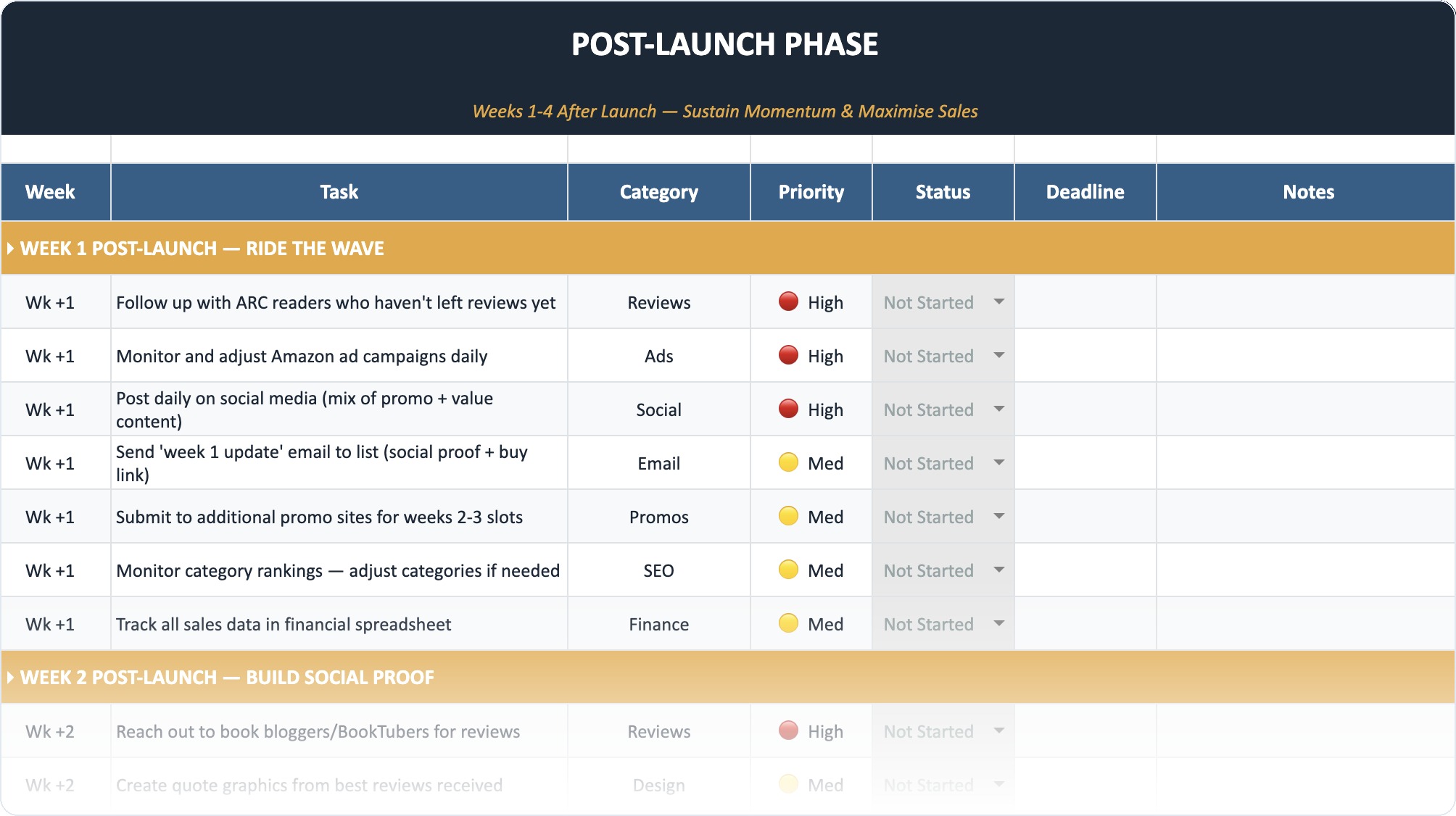
The Self-Publishing Launch Checklist (2026)
A week-by-week spreadsheet that walks you through every step of launching your book. Available as an Excel file and Google Sheet.
Final Thoughts on Negotiation
Do not be afraid to negotiate. If a publisher pulls the offer because you asked for clarification on a "Net Profit" clause, they did you a favor. You dodged a bullet.
Publishing is a business partnership. You are bringing the product; they are bringing the distribution. It should be an equal exchange of value. In 2026, with the digital publishing market projected to reach nearly $450 billion by 2030, your content has immense value. Do not sell it short.
Read every word. Ask questions. And if your gut tells you something is wrong, trust it.
Frequently Asked Questions
What is a reversion of rights clause?
A reversion of rights clause allows an author to regain the rights to their book from the publisher. This typically happens if the book goes out of print or if sales fall below a specific threshold (e.g., fewer than 50 copies sold in a year). It prevents a publisher from holding a book hostage when they are no longer actively selling it.
Should I sign a contract based on net receipts?
It depends on the percentage. If the royalty rate is high (e.g., 50% for ebooks), a net receipts contract can be fair. However, if the rate is low (e.g., 10-15%) and based on net receipts, you will earn very little per book. Always calculate the actual dollar amount you will receive per sale before signing.
Do I need a lawyer to review my publishing contract?
While not strictly mandatory, it is highly recommended. Intellectual property lawyers or author organizations (like the Authors Guild or Alliance of Independent Authors) can spot red flags that a standard reader might miss. Investing a few hundred dollars now can save you thousands in lost royalties later.
What is the difference between exclusive and non-exclusive rights?
Exclusive rights mean only that specific publisher can sell your book in the agreed format and territory. You cannot sell it yourself or to anyone else. Non-exclusive rights allow the publisher to sell the book, but you can also sell it elsewhere or license it to other partners simultaneously.
Can I negotiate a standard publishing contract?
Yes. Most legitimate publishers expect some negotiation. You can often negotiate the advance amount, the royalty percentages, the territory rights, and the definition of "out of print." If a publisher tells you their contract is "take it or leave it," be very cautious.