

Authors often get the concept of how to write a self-help book backward. They begin with their autobiography, mix in some advice, then expect strangers to pay for it. This method usually results in a garage stacked with unsold boxes.
Writing a book that sells requires starting with the reader's pain rather than your own ego.
The self-help sector is packed yet starving for content. Recent analysis valued the global books market at over USD 147 billion in 2024, and it keeps expanding. People need answers. They rarely want a memoir pretending to be advice; they need a manual to fix a concrete problem.
This article walks through the process from the first idea to hitting the "publish" button. We skip theory to focus on the labor required to build a meaningful book.
- Target the Result: Readers purchase an outcome rather than pages. Define their current state (Point A) and their future state after reading (Point B).
- Verify First: Stop guessing. Review Amazon data and search volume to confirm people pay to solve this issue.
- Build for Action: Each chapter requires a hook, lesson, story, and a direct step to take.
- Publish Strategically: Choose between KDP and wide distribution soon. Align your launch with seasonal spikes like the New Year.
The "Transformation Framework": Why People Buy Self-Help
Grasp why someone uses their credit card before typing your draft. They aren't purchasing paper. They are paying for a better version of themselves.
You must construct a bridge.
On one side sits Point A, the reader's current reality full of pain and confusion. Point B lies on the other side, representing a peaceful or profitable existence. Your text connects these two points.
If you can't define Point A and Point B in a single sentence, you aren't ready to start.
Identifying the "Bleeding Neck" Problem
Marketers refer to "bleeding neck" problems. These issues are so severe that the person experiencing them will pay almost anything for an immediate fix.
"General wellness" books act like vitamins; they are optional. A guide on "curing chronic back pain in 30 days" functions as a painkiller because people need relief instantly.
Locate urgency to find your topic.
- Health: Weight loss, sleep, chronic pain, anxiety.
- Wealth: Getting out of debt, investing, real estate, salary negotiation.
- Relationships: Dating, divorce recovery, parenting difficult teenagers.
We see a move toward hyper-niche content in 2026. Broad "be happy" titles are fading while precise, actionable guides gain traction. For instance, Accio’s 2026 market analysis notes that hyper-niche self-help outperforms broad topics due to data personalization and exact targeting.
The "Expert" Myth
You don't need a PhD to write self-help. You only require one of two elements:
- Results: You solved this problem for yourself or others.
- Research: You curated the best answers from people who solved the problem.
When you write a book with no experience, you act as a reporter. You interview experts while compiling data to present findings. Having experience allows you to act as a mentor. Both paths work, but faking authority you lack is a mistake.
Phase 1: Validating Your Topic
Many authors bypass this phase. They get attached to a title and begin writing, only to realize six months later that nobody is searching for that subject.
Validation is straightforward; it means proving people already spend money to fix this problem.
The Amazon Review Audit
Visit Amazon and search for bestsellers in your potential niche. Skip the 5-star reviews since they often come from fans, and ignore the 1-star reviews because they usually come from trolls.
Focus on the 3-star reviews.
These contain the real value. A 3-star review typically admits the book was okay but points out flaws.
- "It didn't tell me how to do the exercises."
- "It was too theoretical."
- "The author talked about himself too much."
Note these complaints. Your manuscript will fix these exact gaps. If 50 people say the top "Dog Training" book lacks pictures, yours will include diagrams. That becomes your edge.
Use Amazon's "Look Inside" feature to view competitor Tables of Contents. Don't copy them. Instead, identify the standard structure and ask yourself what is missing.
Stop Staring at a Blank Page
Publy is a distraction-free book editor with AI built in. Brainstorm plot ideas, get instant chapter reviews, or rewrite clunky paragraphs. 3 million free words included.

Phase 2: Outlining Your Self-Help Book Structure
Non-fiction isn't a stream of consciousness; it is a built argument. A weak structure causes readers to get lost and leave poor reviews.
The Standard Chapter Anatomy
Each chapter should follow a predictable rhythm. This helps readers absorb information without exhaustion.
- The Hook: Open using a question, shocking statistic, or micro-story illustrating the problem.
- The Shift: Explain why the reader's current thinking is wrong or incomplete. Challenge their worldview.
- The Method: Provide precise steps, tools, or frameworks. This is the core material.
- The Evidence: Use a case study or personal example to prove the method works.
- The Action: End with a concrete exercise. "Do this now."
Using Case Studies
Data informs, but stories sell. Listing facts creates a textbook, while telling stories creates a bestseller.
Coaches should change client names and tell their stories. If you write about your own life, select moments where you failed. Perfection bores people; vulnerability builds connection.
Display the struggle, the moment the "Method" clicked, and finally the result.
Phase 3: The Drafting Process
This stage is where the dream dies for many. Writing a book is hard labor rather than a romantic endeavor. It involves typing until your fingers ache.
The "Vomit Draft"
Your initial draft should be terrible—frankly, unreadable.
Attempting to edit while writing causes you to get stuck. You might obsess over a single sentence for an hour. The goal for the first draft is speed, so get ideas out of your head and onto the paper. You can't fix a blank page, but you can fix a bad one.
Set a target. A standard self-help book runs between 30,000 and 50,000 words. Writing 1,000 words daily yields a completed draft in roughly six weeks.
According to a guide by the Author Learning Center, aspiring authors frequently fail due to vague targets. The guide suggests setting SMART goals, such as hitting a defined word count like 5,000 words per week, rather than merely hoping to finish.
Dealing with Writer's Block
Writer's block is usually perfectionism in disguise. You aren't blocked; you fear writing something poor.
Permission granted: Write something terrible.
Try talking instead of typing if you get stuck. Most smartphones have great dictation features. Talk out your chapter while walking the dog, then transcribe it later. You speak faster than you type, and the tone stays conversational.
The scariest moment is always just before you start.
Need more help with the mental game? Check our guide on how to overcome writer's block to regain momentum.
Phase 4: Editing and Polishing
Put the draft away for a week once it's done. Let it cool down. Returning to it requires switching from "Writer Mode" to "Editor Mode."
The Self-Edit Checklist
- Kill the Passive Voice: Change "The ball was thrown by John" to "John threw the ball." It’s stronger.
- Cut the Fluff: Look for words like "very," "really," "just," and "actually." Delete them.
- Check the Flow: Does Chapter 3 logically lead to Chapter 4? Or did you jump around?
You need fresh eyes after self-editing. Swap manuscripts with another author or hire a professional. Don't rely on your mother; she loves you too much to say your book is boring.
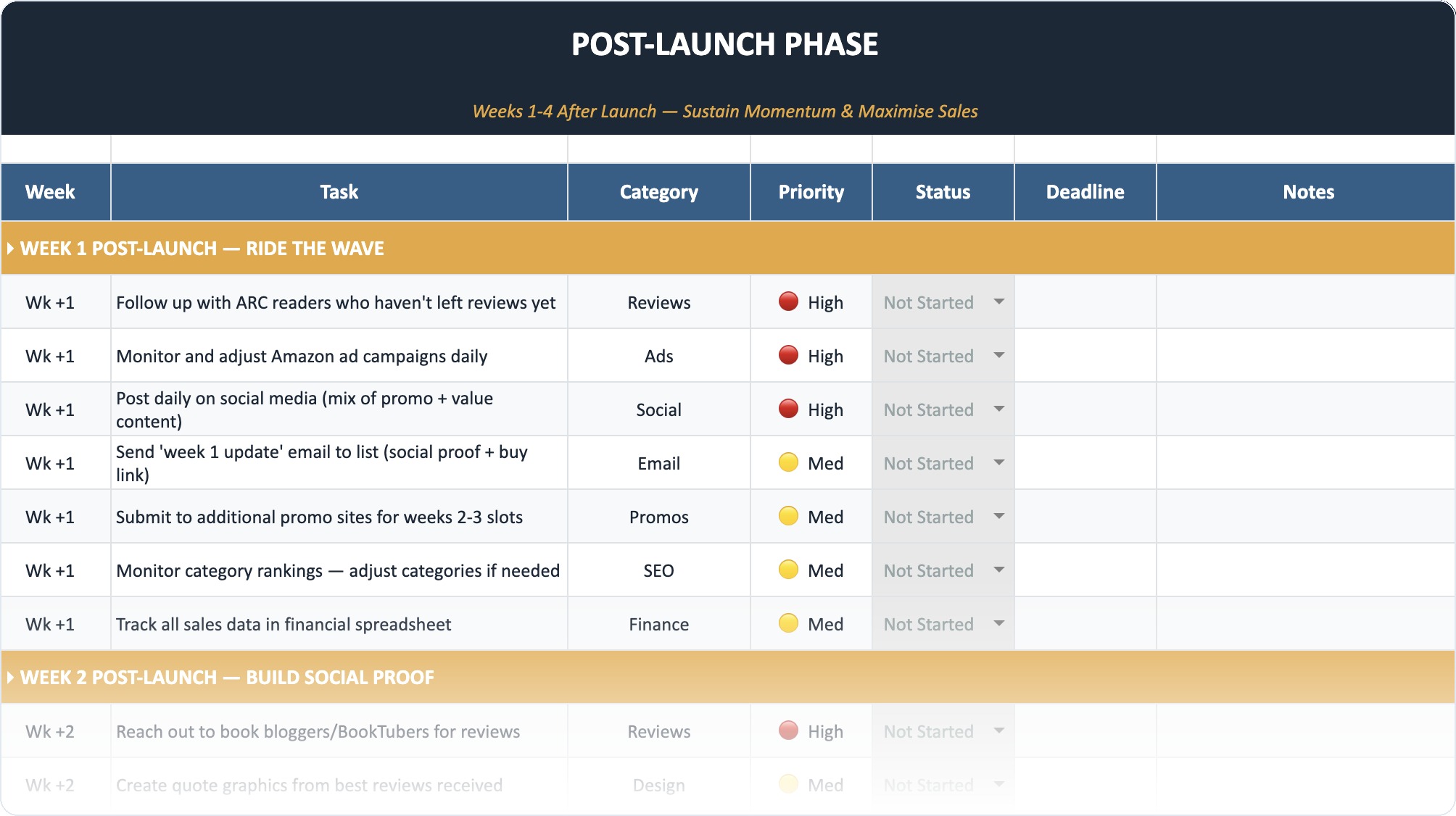
The Self-Publishing Launch Checklist (2026)
A week-by-week spreadsheet that walks you through every step of launching your book. Available as an Excel file and Google Sheet.
Phase 5: Publishing Your Self-Help Book
You have two main paths: Traditional Publishing or Self-Publishing.
- Traditional Publishing
- Prestige and validation
- No upfront costs
- Distribution to bookstores
- You lose creative control
- Royalties are low (10-15%)
- Takes 1-3 years to publish Self-Publishing
- Total creative control
- High royalties (up to 70%)
- Speed to market (publish in days)
- You pay for editing/covers
- You are responsible for marketing
- harder to get into physical stores
Self-publishing is usually the smartest route for first-time authors. It allows you to build an audience, keep your rights, and pivot quickly if the market shifts.
The Title and Cover
People judge books by their covers; that's a fact.
Your cover must resemble other bestsellers in your category. If every "Finance" book is blue and gold while yours is pink with a cartoon dog, people will ignore it. They need to recognize the genre instantly before reading the title.
Your title must offer a promise.
- Bad: My Journey to Health
- Good: The 30-Day Keto Reset: Burn Fat and Boost Energy
Read our IngramSpark setup guide if you struggle with the technical setup to get your book into retailers beyond Amazon.
Seasonal Timing
Timing counts. A diet book launched in December usually fails, while one launched on January 1st often takes off.
Align your launch with public interest. BookTrib's 2026 reading list notes that self-improvement interest peaks around the New Year and "Back to School" periods. Plan your schedule to hit "publish" when demand is highest.
Phase 6: Marketing and Launch
Writing represents only half the work; selling accounts for the rest.
You can't simply upload it to Amazon and wait. You need a launch team consisting of friends, family, and early readers who commit to buying the book on Day 1 and leaving a review.
Amazon Optimization
Amazon functions as a search engine rather than a bookstore. Using the right keywords helps people find you.
Writing about "Anxiety" puts you against 50,000 other titles. However, writing about "Anxiety for New Moms" reduces competition and targets a defined audience.
Learn how to get your book on the first page of Amazon through mastering keywords and categories.
The Rise of Audio
You can't ignore audiobooks in 2026. Many self-help consumers "read" while driving or exercising.
Record it yourself if you have a decent voice and equipment, or hire a narrator. AI narration is a rising, cheaper trend, though some listeners still prefer a human touch.
"B07XQ9XW39"
Check Price on Amazon →As an Amazon Associate, we earn from qualifying purchases.
The Hyphen Online wellness report states that successful recent launches included simultaneous audiobook releases, using the shift toward audio-first consumption.
Your Book is a Business Card
For many authors, the profit isn't in book sales but in the backend.
A book establishes you as an authority, securing speaking gigs, coaching clients, and consulting contracts. It acts as the ultimate business card. The dynamic changes when you hand someone a book you wrote. You aren't asking for their time; you're offering value.
Exercises and Worksheets
Include downloadable resources in your book to add value, such as a prompt to "Go to my website to download the budget worksheet."
This accomplishes two goals:
- It helps the reader solve the problem.
- It gets the reader on your email list.
You can sell them courses, coaching, or your next book once they join your list.
Final Thoughts
Writing self-help is an act of service. It requires getting out of your own way to focus entirely on the reader.
The process is hard. You might want to quit or doubt if you have anything to say. But remember the "Bleeding Neck." Someone out there is in pain and waiting for the answer only you can provide.
Don't let them down.
Frequently Asked Questions
How long should a self-help book be?
Most standard self-help books fall between 30,000 and 50,000 words. This is long enough to cover the topic fully but short enough to be digestible. Readers today prefer concise, actionable content over massive doorstops.
Do I need to be a famous expert to write a self-help book?
No. You need to be helpful, not famous. If you have a fix for a problem and can articulate it clearly, you have authority. Many bestsellers are written by ordinary people who found a unique answer to a common problem.
How much does it cost to self-publish?
It varies wildly. You can do it for free if you do everything yourself (not recommended). A professional quality self-published book typically costs between $1,000 and $3,000 for editing, cover design, and formatting.
Should I write the book or the outline first?
Always outline first. "Pantsing" (writing by the seat of your pants) works for some fiction, but it is a disaster for non-fiction. You need a logical argument structure before you start writing prose.
Can I use AI to write my book?
You can use AI for brainstorming, outlining, and organizing, but be careful with generating prose. Readers crave authentic human connection and stories. An entirely AI-written book often feels flat and lacks the emotional resonance required for self-help.