
Publishing poetry used to be a waiting game. You would submit to literary journals, wait six months for a rejection slip, and hope a small press eventually picked up your manuscript. That era is over. In 2026, self-publishing poetry is not just a viable option; it is often the smarter financial choice for modern poets. You keep creative control. You keep the rights. Most importantly, you keep the royalties.
If you are reading this, you likely have a collection of poems gathering dust on a hard drive or scribbled in notebooks. You want to know if there is a market for them. The answer is yes. But moving from a Word document to a professional paperback requires specific steps. It requires you to stop thinking like a writer and start thinking like a publisher.
- Market Growth: Self-published poetry now accounts for roughly 40% of all new poetry books, with digital sales making up 35% of the market in 2023.
- Higher Earnings: Independent authors typically retain 50-70% of royalties compared to the 5-20% offered by traditional publishing houses.
- Formatting Matters: Poetry requires fixed-layout formats for eBooks to preserve line breaks and visual structure.
- Social Strategy: "Instapoetry" and visual platforms are critical for building an audience before you launch.
The State of Poetry Publishing in 2026
I often hear people say that "nobody reads poetry anymore." The numbers tell a completely different story. We are seeing a renaissance in verse, largely driven by digital accessibility and the shift in how we consume short-form content.
According to a recent NEA survey report, over 11.7% of adults read poetry at least once a year. That might sound small until you realize it represents a 75% increase over the last decade. This surge isn't happening in dusty academic halls. It is happening on phones, tablets, and through independent paperbacks sold online.
Why Choose Self-Publishing?
The traditional route is slow. A university press might accept one or two manuscripts a year out of thousands of submissions. Even if you win a contest, the prize often replaces an advance, and marketing support is minimal.
When you self-publish, you bypass the gatekeepers. You also earn significantly more per unit sold. While a traditional contract might net you $0.80 per book, a self-published poet can earn $4.00 to $6.00 per copy depending on the print cost.
This financial difference is massive. A 2025 publishing market analysis indicates that self-published titles have surpassed traditionally published books by more than two million units in recent years. This volume proves that authors are waking up to the benefits of independence.
Curating Your Collection
Before we worry about fonts and cover prices, we need to look at the manuscript. A poetry book is not just a random heap of poems. It needs a thread.
Finding the Arc
I recommend printing every single poem you intend to include. Lay them out on the floor. Look for common themes. Is there a narrative arc? Does the collection move from grief to healing? Does it move from winter to spring?
Group your poems into sections. This structure gives the reader a chance to breathe. It also makes the book feel like a cohesive project rather than a scrapbook. If a poem doesn't fit the theme, cut it. It can go in the next book.
The Role of Literary Devices
Your poems need to be sharp. Self-publishing has a stigma of low quality, and the only way to beat that is to produce work that rivals the masters. You should be ruthlessly editing your work for rhythm, meter, and imagery. If you are unsure if your metaphors are landing or if your structure is sound, I suggest spending time brushing up on and understanding literary devices to ensure every line earns its place on the page.
Formatting Poetry: The Technical Challenge
This is where most poets fail. Formatting a novel is easy; it is just blocks of text that flow from page to page. Poetry formatting is a nightmare if you do not know what you are doing.
The White Space Problem
In poetry, the white space is part of the poem. Where a line breaks matters. How much space is left at the bottom of the page matters.
When you upload a Word document to Amazon KDP or IngramSpark, the system attempts to "reflow" the text. This means if a reader increases the font size on their Kindle, your carefully crafted stanza might break in the wrong place. A line intended to be solitary might get wrapped into the previous line.
Print Formatting
For print books, you have total control. You set the margins, and they stay there.
- Margins: Give your poems room. I prefer a minimum of 0.75 inches on the outside and 0.875 inches for the gutter (the inside edge near the binding).
- Fonts: Stick to classic serifs like Garamond, Caslon, or Minion Pro. Sans-serif fonts can look too clinical for verse, though they work for modern, minimalist styles.
- Page Breaks: Use manual page breaks (Ctrl+Enter) after every poem. Never hit "Enter" repeatedly to get to the next page.
If you are on a budget, you can do this yourself. There are excellent guides on formatting your manuscript in Microsoft Word that can help you set up professional headers and footers without buying expensive software.
eBook Formatting
For eBooks, you have two choices:
- Reflowable Text: You accept that lines might wrap. You use "hanging indents" to show the reader that a wrapped line belongs to the verse above it. This is the industry standard and ensures compatibility with all devices.
- Fixed-Layout: This forces the eBook to look exactly like the PDF. It preserves your visual structure perfectly. The downside is that readers cannot change the font size, which makes it unreadable on small phone screens. I generally recommend avoiding fixed-layout unless your poetry is heavily visual or experimental.
Stop Staring at a Blank Page
Publy is a distraction-free book editor with AI built in. Brainstorm plot ideas, get instant chapter reviews, or rewrite clunky paragraphs. 3 million free words included.

Designing a Cover That Sells
People judge poetry books by their covers. In the age of Instagram, your cover is a marketing asset. It needs to look good at full size and it needs to look good as a tiny thumbnail on Amazon.
The Trend of Minimalism
Look at the bestsellers lists. You will see a trend toward minimalism. Sketches, line art, and bold typography are popular. This style, often associated with "Instapoetry," signals to the reader that the content is accessible and modern.
Typography
The title should be legible. Do not use papyrus or comic sans. If you cannot afford a designer, use tools like Canva, but be careful with templates. You want your book to stand out, not look like a generic flyer.
The "Instapoetry" Phenomenon
You cannot talk about self publishing poetry without discussing instapoetry. This genre, characterized by short, aphoristic poems often accompanied by illustrations, changed the industry.
Data from a Publisher's Weekly report on poetry trends highlights that Instapoetry significantly boosted the genre's popularity, with nearly half of all poetry sales in recent years originating from these social-media-first authors.
Leveraging Social Media
You do not have to write simple 3-line poems to benefit from this trend. You just need to understand the visual nature of the medium.
- Visual Teasers: Take a stanza from your longer poem. Type it out on a vintage typewriter or create a clean graphic. Post it on Instagram or TikTok.
- Audio: Read your poem over a trending sound.
- Captioning: Use the caption to tell the story behind the poem.
This builds an audience before you even have a product to sell. When you finally release the book, you aren't shouting into the void; you are announcing it to a room of people who already like your work.
Distribution: Where to Sell
You have formatted the book. You have a cover. Now, where do you put it?
Amazon KDP (Kindle Direct Publishing)
KDP is the heavyweight. It is free to upload. They handle printing and shipping. They pay royalties 60 days after the end of the month. For most self-published authors, Amazon will account for 80-90% of sales.
IngramSpark
IngramSpark connects you to libraries and independent bookstores. Amazon is great for direct-to-consumer sales, but bookstores rarely order from Amazon. They order from Ingram. If you want a chance at getting on a physical shelf, you need IngramSpark.
I recommend a hybrid approach. Use KDP for Amazon sales (paperback and eBook) and use IngramSpark to distribute the paperback to everyone else. For a deeper dive into how this platform works, read up on distribution via IngramSpark to avoid common setup mistakes.
Selling Direct
You can also sell signed copies directly from your website. This allows you to keep 100% of the profit after printing costs. It also lets you build an email list, which is the most valuable asset an author can have.
Marketing and Selling Poems
Selling poems is different from selling thrillers. You aren't selling a plot twist; you are selling an emotion.
The Launch Strategy
Do not just publish the book quietly. Build anticipation.
- Cover Reveal: Show the cover 4 weeks early.
- Pre-orders: Set up pre-orders if possible (easier on IngramSpark/KDP eBooks than KDP print).
- ARC Team: An ARC (Advance Reader Copy) team is a group of readers who get the book for free in exchange for an honest review on launch day. Social proof is vital.
- Launch Party: Go live on social media or host a local reading.
Reviews
Reviews convince strangers to buy your book. You need to chase them. Reach out to book bloggers who focus on poetry. Ask your newsletter subscribers. If you are struggling to get traction, look into strategies for securing early book reviews to boost your algorithm visibility.
Pricing
Poetry books are usually shorter than novels. A 60-page chapbook cannot be priced at $18.99.
- eBook: $2.99 – $4.99
- Paperback: $9.99 – $12.99
Check the printing costs. You want to make at least $2.00 to $3.00 profit per book.
Copyright and Legalities
Many poets worry about theft. "If I post my poem on Instagram, will someone steal it?" It happens, but obscurity is a bigger threat than piracy.
Legally, you own the copyright the moment you write the poem. However, registering with your country's copyright office adds a layer of protection if you ever need to sue.
ISBNs
You need an ISBN (International Standard Book Number) for your book to be distributed.
- Free ISBN: Amazon and IngramSpark offer free ISBNs, but they list the platform as the publisher, not you.
- Paid ISBN: Buying your own ISBN (from Bowker in the US or Nielsen in the UK) allows you to list your own publishing imprint name. This looks more professional.
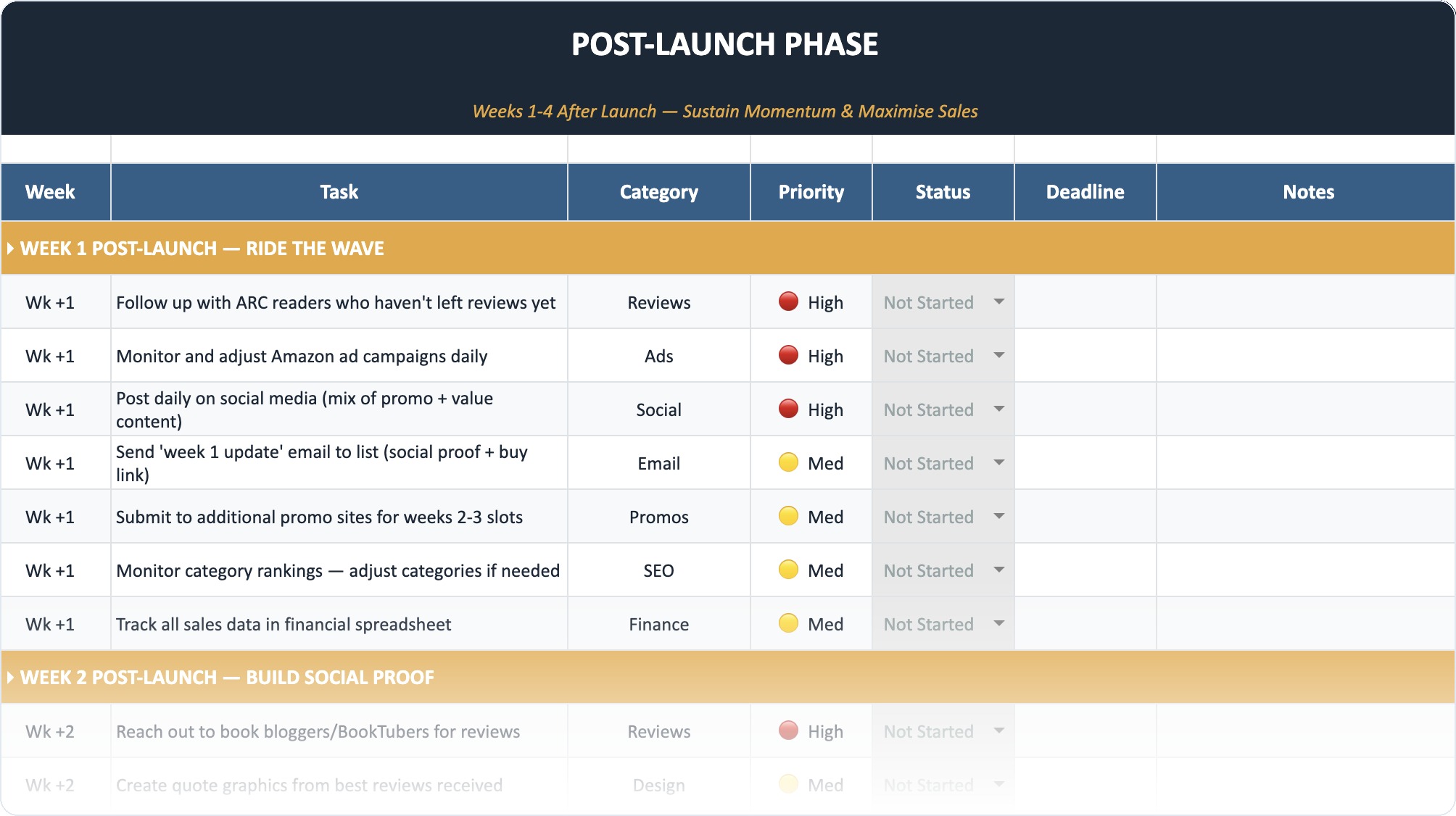
The Self-Publishing Launch Checklist (2026)
A week-by-week spreadsheet that walks you through every step of launching your book. Available as an Excel file and Google Sheet.
Financial Expectations
Let's be real about the money. Most poets do not get rich. However, self-publishing offers a much higher ceiling than traditional publishing.
As noted in a salary and royalty survey, self-published authors can retain 50-70% of their book's price as royalties. Compare this to the 5-15% standard in traditional contracts. Even if you sell fewer copies, your per-unit profit is much higher.
If you sell 500 books at a $4.00 profit, you have made $2,000. That might not pay the mortgage, but it pays for the next book. And unlike a magazine publication which pays once, a book pays you forever.
The Long Tail
Books do not expire. A poem you wrote five years ago can still sell today. I encourage you to view your publishing career as a catalog. The first book markets the second. The second markets the first. Over time, these assets build up a passive income stream.
Final Thoughts
Self-publishing poetry is hard work. It requires you to be a writer, editor, designer, and marketer. But the reward is total freedom. You do not need permission to share your voice.
The tools are here. The audience is reading. The only missing piece is your manuscript.
Frequently Asked Questions
Is self-publishing poetry profitable?
Yes, it can be. While poetry is a niche market, self-publishing allows you to keep a much higher percentage of royalties (up to 70%) compared to traditional publishing. Success depends on your ability to market your work and build an audience.
Do I need to copyright my poems before publishing?
Technically, you own the copyright the moment you create the work in a fixed form. However, registering your copyright with your government office (like the US Copyright Office) provides legal benefits if you ever need to pursue a claim against infringement.
What is the best format for a poetry eBook?
Reflowable text is the standard for Amazon KDP, but it can mess up line breaks. Many poets prefer fixed-layout (print replica) for eBooks to preserve visual structure, though this can be harder to read on small phones.
How many poems should be in a chapbook?
A chapbook is typically 20 to 40 pages long. A full-length poetry collection is usually 50 to 100 pages. There is no hard rule, but you want enough content to justify the price for the reader.
Can I publish poems I posted on Instagram?
Yes. Posting on social media counts as "publication" for some literary journals (who often want first rights), but it does not stop you from including them in your own self-published book. In fact, popular Instagram poems can help sell the book.
Do I need an editor for poetry?
Absolutely. Even though poetry is subjective, you need fresh eyes to catch typos, awkward rhythms, and weak line breaks. Self-editing is rarely enough for a professional product.