

You finish your book. You upload it. You stare at the sales dashboard, waiting for the numbers to jump. But often, they don't. The silence that follows a book launch is one of the hardest things an author faces. You know your story is good, but you just can't get enough eyes on it.
I see this happen constantly. Authors burn thousands of dollars on Facebook ads or waste hours dancing on TikTok, trying to chase an algorithm that changes every week. They ignore the most powerful, free asset sitting right in front of them: other authors.
There is a better way to find readers. It doesn't cost money. It doesn't require you to be an influencer. It’s called an author newsletter swap. This is the single most effective "free" marketing tactic for 2026. It allows you to borrow the credibility of another writer and put your book directly into the inboxes of readers who already love your genre.
- Newsletter swaps are agreements between two authors to promote each other's books to their respective email lists.
- Email marketing offers a significantly higher ROI ($36-$42 per $1 spent) compared to social media, making it a priority for growth.
- Platforms like BookFunnel and StoryOrigin automate the process, helping you find partners, track clicks, and manage links securely.
- Success depends on vetting; always check a partner’s cover quality and genre fit before agreeing to a swap to protect your reputation.
What Is an Author Newsletter Swap?
A newsletter swap is a simple agreement between two authors. I agree to feature your book in my next email newsletter, and you agree to feature my book in yours. That’s it.
It sounds basic, but the mechanics behind it are powerful. Unlike social media, where a post might be seen by 2% of your followers if you are lucky, email has a much higher engagement rate. You are not shouting into the void; you are getting a recommendation from a trusted source.
When I tell my subscribers, "Hey, I loved this sci-fi novel by Jane Doe, and I think you will too," they listen. My endorsement carries weight. When Jane does the same for me, I get access to a pool of potential fans I could never reach on my own.
The Two Main Types of Swaps
You will generally encounter two flavors of swaps in the wild:
- Direct 1-on-1 Swaps: This is where I email you and say, "Let's swap." We pick a date, exchange links and images, and send. This is the most personal and often the most effective method because the recommendation stands alone.
- Group Promos: These are organized events where 20, 30, or even 50 authors all agree to share a single landing page. That page lists everyone's books. While this gets you exposure to many lists at once, the reader's attention is split between dozens of covers.
Why Email Swaps Beat Social Media Every Time
I know many authors who spend 90% of their marketing time on Instagram or X (formerly Twitter). They are chasing viral moments. But let’s look at the cold, hard data.
Social media is rented land. You do not own your followers. If the platform changes its rules, you lose your audience. An email list is an asset you own. No one can take it away from you.
According to recent market research, global email users have reached approximately 4.6 billion. That is half the planet. But the real value is in the return on investment.
The ROI of the Inbox
For every $1 spent on email marketing, businesses see an average return of $36 to $42. Compare that to the pennies you might make from a boosted post.
Why is the difference so huge? Intent. When someone opens an email, they are in a reading mindset. They aren't scrolling past cat videos. A dedicated newsletter specifically achieves a higher average open rate of around 40.08%, with a click-through rate that dwarfs social platforms, as noted in this industry analysis.
If you want to sell books, you need to be in the inbox. And the fastest way to grow your list so you can be in the inbox is by swapping with people who are already there.
Stop Staring at a Blank Page
Publy is a distraction-free book editor with AI built in. Brainstorm plot ideas, get instant chapter reviews, or rewrite clunky paragraphs. 3 million free words included.

Where to Find Swap Partners
The hardest part of this process used to be finding other authors. You had to stalk people on forums or send cold emails that got ignored. Today, specific tools make this much easier.
1. BookFunnel
BookFunnel is the heavyweight champion of book funnel promos and swaps. While it started as a delivery service (helping readers get the ebook file onto their Kindle), it is now a massive marketing hub.
On BookFunnel, you can join "Group Promos." You browse a list of promos looking for your genre, say, "Cozy Mystery Winter Sale" or "Space Opera Reader Magnets." You click join, submit your book, and grab a tracking link. You share that link with your newsletter.
Pros:
- Huge user base.
- Excellent technical support for readers who can't load books.
- Strict reputation management (promoters can kick out authors who don't share).
Cons:
- It is a paid service (though worth it).
- Group promos can be crowded.
2. StoryOrigin
StoryOrigin is a fantastic alternative that focuses heavily on the "swap" aspect. It has a dedicated "Newsletter Swaps" tab where you can find individual authors to partner with, not just group promos.
You can browse authors by list size and open rate. This is a game-changer. You can see if an author actually has an engaged list before you agree to swap. Storyorigin swaps allow you to propose a date, and the system handles the link exchange.
Pros:
- Transparent data (you see their click history).
- Built-in cross-promotion tools.
- Often more affordable than competitors.
3. Facebook Groups & Communities
If you prefer a more manual approach, Facebook groups are still very active. Groups like "20BooksTo50k" or genre-specific groups (e.g., "Romance Author Swaps") are full of writers looking for partners.
The benefit here is networking. You aren't just a data point; you are finding a supportive group of writers who might become long-term friends. I have found some of my best partners by simply posting, "Hey, I have a 5k subscriber list in Urban Fantasy, looking for a swap in November."
How to Organize a Swap (The Workflow)
You have found a partner. Now, how do you actually do it without messing up?
Step 1: Vetting Your Partner (The "Trust Swap")
In 2026, we are seeing a shift toward "Trust Swaps." Readers are smart. If you recommend a book that is poorly edited or has an AI-generated cover that looks weird, you lose trust.
Before you agree to swap, look at their book.
- The Cover: Does it look professional? Does it fit the genre?
- The Blurb: Is it catchy? Does it use the right tropes?
- The Reviews: Go to Amazon. Does it have a 3.5-star average or a 4.5? Read the bad reviews to see if there are quality issues.
Your reputation is on the line. Protect it.
Step 2: Set Up the Tracking
Never just use a raw Amazon link. You need to know if the swap worked.
If you use StoryOrigin or BookFunnel, they give you a unique tracking link automatically. If you are doing this manually, use a link shortener or an affiliate link. You want to be able to look at your dashboard the next day and say, "Wow, Jane sent me 50 clicks!" or "Huh, Bob only sent 2."
This data helps you decide who to swap with again.
Step 3: Crafting the Content
Do not just paste the link and say "Buy this." You need to sell it.
Write a personal intro.
"I recently read The Space Between Stars by Jane Doe and I couldn't put it down. If you loved the character dynamics in my book, you'll adore her protagonist. Plus, it's free this week!"
Include the book cover image. Visuals drive clicks. Make sure you are writing a book description or hook in your email that grabs them immediately. You can usually copy the author's own blurb, but a personal touch works better.
Step 4: Scheduling
Consistency is vital. Put the swap in your calendar. If you promised to mail on Tuesday the 12th, mail on Tuesday the 12th. Flaking on a swap is the quickest way to get blacklisted in the author community.
Common Mistakes to Avoid
1. Swapping with the Wrong Genre
This is the most common error. If you write Horror, do not swap with a Sweet Romance author just because they have a big list.
It doesn't matter if they have 50,000 subscribers. Those subscribers want kissing and happy endings. They do not want chainsaws. You will get zero clicks, or worse, you will get clicks from people who then leave bad reviews because the book wasn't what they expected. This can confuse the Amazon algorithm, which looks at "Also Boughts" to decide who to show your book to next.
2. Hiding the Link
Do not bury the swap at the very bottom of a 2,000-word email. If you agreed to a swap, give it prime real estate. Put it near the top or in the middle. Be a good partner. The more clicks you send them, the more likely they are to swap with you again.
3. Ignoring Mobile Users
Most people read email on their phones. Current data shows that over 75% of emails are opened on mobile devices.
If your email has giant blocks of text, tiny links that are hard to tap, or massive images that don't scale, you are losing readers. Keep your paragraphs short. Use buttons for links. Test your email on your phone before you send it.
The Self-Publishing Launch Checklist (2026)
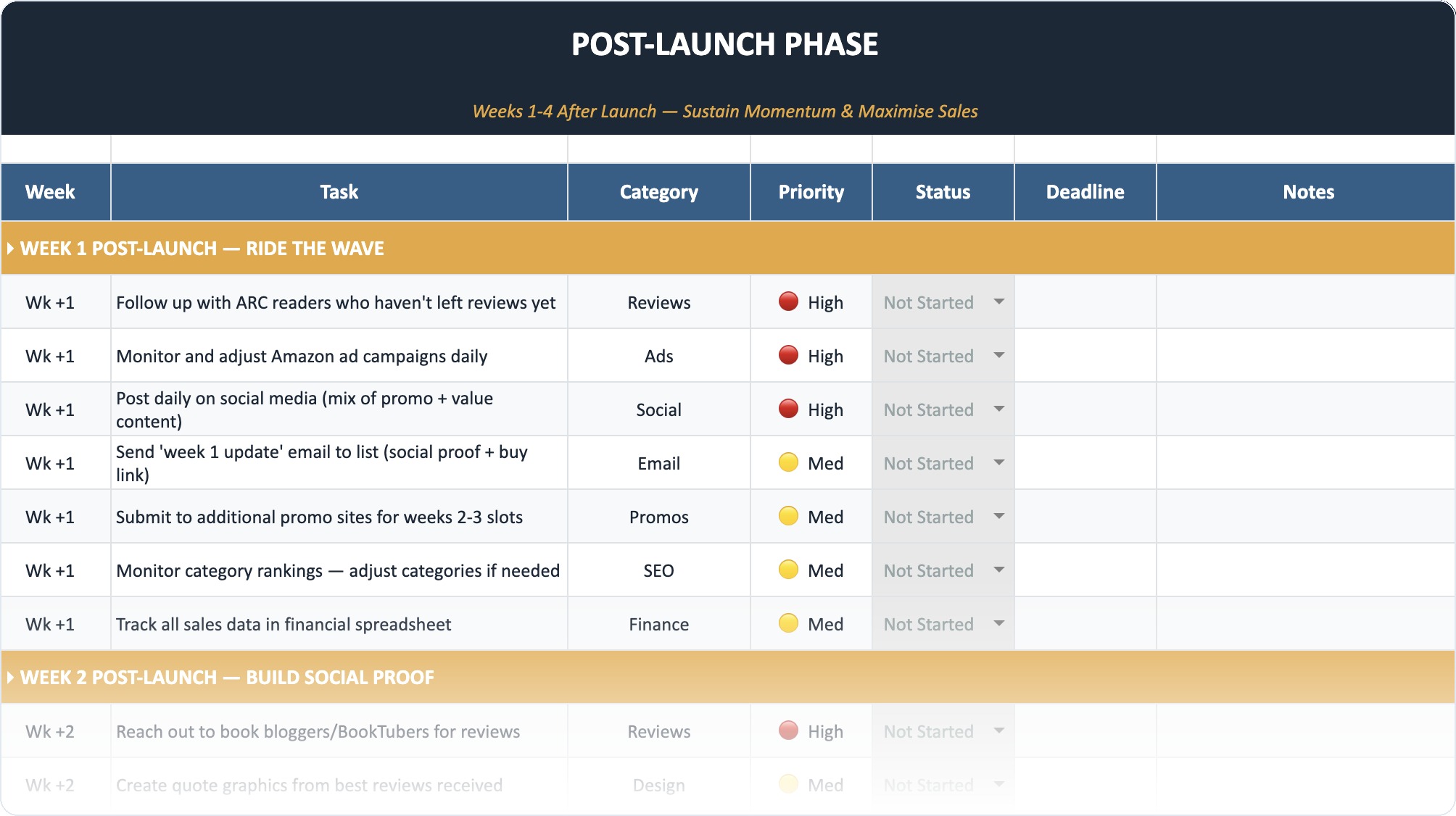
A week-by-week spreadsheet that walks you through every step of launching your book. Available as an Excel file and Google Sheet.
Advanced Strategies: Cross Promotion for Authors
Once you master the basic swap, you can get creative.
The Newsletter Magnet Swap
Instead of swapping links to a book for sale, swap links to your "Reader Magnets" (a free short story or novella you give away in exchange for an email address).
This is pure list building. I send my subscribers to your signup page; you send yours to mine. We both grow. This is the fastest way to go from 100 subscribers to 1,000.
The "Takeover"
This is a deeper collaboration. You write the entire newsletter for your partner. You introduce yourself, tell a funny story, and offer your book. It feels like a guest post. This works exceptionally well for authors with similar voices.
Building a Syndicate
Stop looking for new partners every month. Find 5-10 authors you trust and form a rotation. You promote Author A in January, Author B in February, etc. This reduces the stress of hunting for partners and guarantees quality. This is part of a content marketing approach that creates stability in your business.
Comparison: Platforms vs. DIY
| Feature | BookFunnel / StoryOrigin | Manual (DIY) |
|---|---|---|
| Cost | Monthly Fee ($10-$20/mo) | Free |
| Trust | High (Data is verified) | Variable (Must trust their word) |
| Ease of Use | High (Automated links) | Low (Lots of copy-pasting) |
| Tracking | Automatic | Manual (Need bit.ly or similar) |
| Best For | Beginners & High Volume | Close Friends & Specialized Niches |
Measuring Success
How do you know if it worked?
- Click-Through Rate (CTR): How many people clicked the link?
- Conversion Rate: Of the people who clicked, how many downloaded or bought the book?
- Subscriber Growth: For magnet swaps, how many new emails did you get?
If you get 100 clicks and 0 sales, the problem isn't the swap, it's your book page. Maybe your cover is weak, or the price is too high. If you get 0 clicks, the problem is your email copy or the placement of the link.
You should also keep an eye on your selling tips for Kindle to ensure your Amazon page is ready to convert that traffic once it arrives. This resource highlights that mobile optimization is a key part of that conversion puzzle, so ensure your Amazon blurb looks good on mobile too.
Frequently Asked Questions
Do I need a big list to swap?
No. You can start with 50 subscribers. Look for other authors at your level. Everyone starts somewhere, and many "big" authors are willing to help newer ones if the book quality is high.
Will swapping hurt my deliverability?
As long as you are not spamming or swapping with low-quality partners, no. In fact, sending links that people click on tells Gmail and Outlook that your emails are valuable, which can actually help keep you out of the spam folder.
How often should I swap?
I recommend no more than once per email if you mail weekly. If you mail monthly, you can include 2-3 books in a "Books I Love" section. Do not turn your newsletter into nothing but ads. You must provide value and entertainment first.
Is it better to swap paid books or free books?
Free books (Reader Magnets) usually get significantly more clicks and are better for list growth. Paid books get fewer clicks but result in direct income. A healthy strategy mixes both.
Can I swap with authors on different platforms?
Yes. It doesn't matter if they use MailerLite and you use ConvertKit. You are just exchanging links and images. The tech stack doesn't matter, only the audience fit matters.