

- The Short Answer: The average cost for a professional book cover design reached $880 in 2025, with the majority of high-quality projects landing between $625 and $1,250.
- The Options: You can spend anywhere from $0 (DIY) to $5,000+ (top-tier agencies). Pre-made covers usually sit in the $100–$450 sweet spot.
- The Impact: This isn't just aesthetic. Data shows professionally designed covers generate a 34% higher sales rate compared to amateur attempts.
- The Trend: In 2026, typography is king. Designs are prioritizing thumbnail readability for mobile stores, often pushing costs up for custom font work.
You have finished your manuscript. The hard part is supposed to be over. But now you face a different kind of pressure: the cover.
We have all heard the cliché about not judging books by their covers. We also know it is a lie. Readers judge. They judge instantly. In the scroll-heavy world of 2026, you have less than a second to stop a thumb from swiping past your life's work.
So, what does it cost to stop that scroll?
If you look for a simple number, here it is: $880. That was the average price paid for a professional book cover design in 2025. But averages can be misleading. A fantasy epic requiring custom illustration will cost significantly more than a minimalist non-fiction book using stock photography.
This guide breaks down exactly where that money goes, how to spot a fair price, and how to allocate your cover design budget without getting ripped off.
The Real Cost of Book Cover Design in 2026
The market has shifted. A few years ago, you could get away with a decent $200 gig-economy cover. Today, standards are higher, and the competition is fiercer.
Based on recent market data, here is how the pricing tiers break down right now:
| Design Option | Price Range | Best For | What You Generally Get |
|---|---|---|---|
| DIY (Do It Yourself) | $0 – $262 | Designers, zero-budget authors | Complete control, but high risk of amateur look. |
| Pre-Made Covers | $100 – $450 | Tight budgets, standard genres | Professional quality, fast turnaround, limited customization. |
| Freelance (Beginner) | $50 – $300 | Testing concepts | Stock manipulation, basic typography. |
| Freelance (Pro) | $500 – $1,500+ | Serious authors, series | Custom concepts, advanced compositing, pro typography. |
| Design Agency | $1,000 – $5,000+ | Publishers, high-stakes launches | Full branding, marketing assets, custom illustration. |
According to an analysis of 2025 design rates, most serious authors are spending between $625 and $1,250. This creates a specific quality band that readers now expect. If you drop too far below this, your book risks looking like a "home project." If you go way above, you face diminishing returns unless you have a massive marketing machine behind you.
Let’s look at what each tier actually buys you.
Option 1: The DIY Route ($0 – $262)
This is the most tempting path for new authors. Tools like Canva or Adobe Express make it look easy. You drag a photo, type your title, and export.
The Hidden Costs of Free
While the software might have a free tier, a "free" cover is rarely actually free.
- Stock Photos: You cannot just grab images from Google. You need commercial rights. High-quality stock photos cost between $10 and $50 each.
- Fonts: The standard fonts on your computer (Arial, Times New Roman) scream "amateur." Professional font licenses can run from $20 to $100.
- Software Subscriptions: To get the features you need (like transparent backgrounds or high-res export), you often need a Pro subscription, costing around $12-$15 a month.
When to DIY
I generally advise against this unless you have a background in graphic design. The money you save upfront is often lost in missed sales. However, if you are writing a lead magnet (a free book to build your email list) or a very niche family history book, DIY is acceptable.
If you are going this route, make sure you consult an ultimate beginners checklist for self-publishing to ensure you don't miss other technical specs like bleed margins or CMYK color profiles for print.
Option 2: Pre-Made Covers ($100 – $450)
This is the smartest option for authors with a limited cover design budget.
A pre-made cover is a design the artist has already created. They sell it once, change the title and author name to yours, and then remove it from their store. You get professional composition and lighting without the custom price tag.
Why Are They Cheaper?
The designer creates these on their own schedule, usually using stock images they already licensed. They don't have to go through rounds of revisions with you. They don't have to read your brief or understand your specific character descriptions. You buy what you see.
The "Cheap Book Covers" Trap
You will see pre-mades for $10 or $20. Be careful. These are often mass-produced templates sold to hundreds of authors. A true pre-made should be sold only once. If you buy a non-exclusive cover, five other books on Amazon might look exactly like yours. That is a branding disaster.
Stop Staring at a Blank Page
Publy is a distraction-free book editor with AI built in. Brainstorm plot ideas, get instant chapter reviews, or rewrite clunky paragraphs. 3 million free words included.

Option 3: Freelance Designers ($500 – $1,500+)
This is where the magic happens for most successful self-published authors. You hire a professional to create something unique for your story.
The Process
Working with a freelancer involves a dialogue. You fill out a creative brief details about your plot, your tone, your characters, and comparable books in your genre.
The cost variance here is huge. A generalist might charge $400. A specialist fantasy book cover artist might charge $1,200 because the genre demands complex digital painting or heavy photo-manipulation.
Genre Pricing is Real
Not all genres cost the same. A genre-specific pricing breakdown shows distinct differences in median costs:
- Fantasy: $910 (Requires world-building visuals, custom typography, magic effects).
- Romance: $800 (Heavily dependent on specific "heat levels" and character models).
- Non-Fiction: $700 (Focus on bold typography and single conceptual images).
If you are writing a Thriller, you might pay less for the imagery (often a dark road or a silhouette) but you need to pay for a designer who understands tension and bold, massive fonts.
Option 4: Design Agencies ($1,000 – $5,000+)
Agencies are for authors who treat their book like a startup business. You aren't just paying for a JPEG. You are paying for a team.
An agency package often includes:
- Paperback, Hardcover, and Ebook wraps.
- Audiobook cover formatting.
- Social media banners and 3D mockups.
- Sometimes, even an illustrated logo for your book series.
The downside is the price and potentially slower communication channels. But if you have the capital, this ensures your book looks indistinguishable from a Big Five publishing house release.
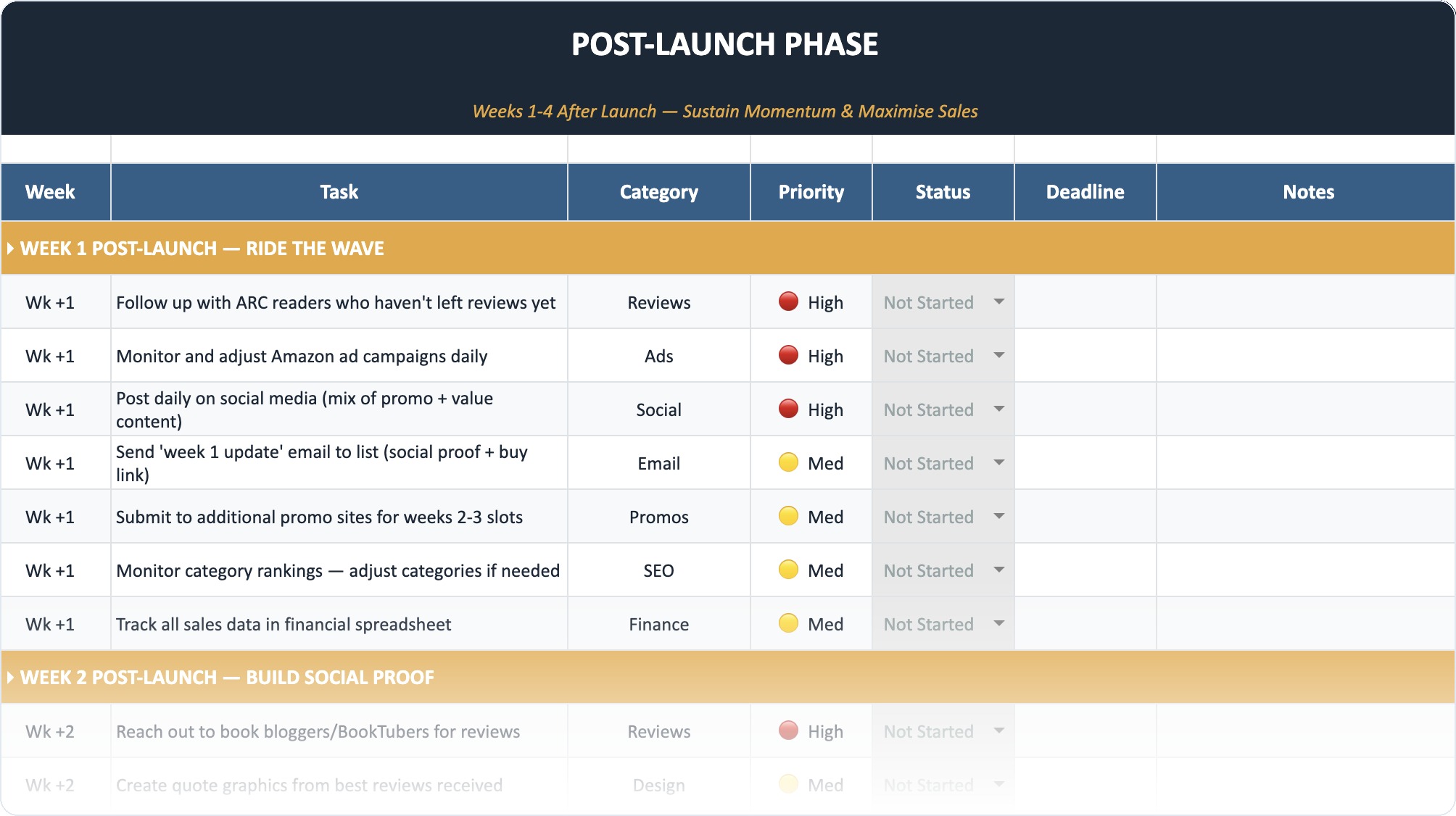
The Self-Publishing Launch Checklist (2026)
A week-by-week spreadsheet that walks you through every step of launching your book. Available as an Excel file and Google Sheet.
Does a Better Cover Actually Sell More Books?
Yes. The data is aggressive on this point.
A recent report on book sales performance found that books with professionally designed covers see a 34% higher sales rate on average. Even more telling is the click-through rate (CTR). If you run Amazon ads, a better cover can increase your CTR by over 50%.
Think about the math.
If you spend $5,000 on ads but your cover is weak, your ads are expensive because nobody clicks.
If you spend $500 on a great cover, your $5,000 ad spend goes twice as far. The cover pays for itself by lowering your advertising costs.
This is why skimping on design is often more expensive in the long run. It is the same logic as hiring professional editors. You can skip it to save money, but the market will punish you with bad reviews and low sales.
2026 Design Trends Affecting Price
The market changes fast. What worked in 2023 looks dated today. These current trends are driving the complexity (and cost) of design up.
1. Typography Dominance
Fonts are no longer just labels; they are the main event. In 2026, we see covers where the title takes up 80% of the space. This requires designers who are expert typographers, not just photo manipulators. Custom lettering costs money.
2. Thumbnail Readability
Most books are bought on mobile phones. Your cover needs to look amazing at 100 pixels wide. Designers now have to "stress test" designs for small screens. This means bolder contrast and simpler compositions. Ironically, creating a "simple" design that pops often takes more skill than a cluttered one.
3. Human-Guided AI
This is the elephant in the room. AI tools are everywhere. Some designers use them to generate textures or backgrounds, speeding up the workflow. However, the trend in 2026 is strictly "Human-Guided." Readers are savvy. They can spot a lazy AI generation with six fingers or weird artifacts.
The best designers use AI to build a base and then paint over it manually to ensure human authenticity. This hybrid workflow helps keep costs from exploding while maintaining high artistic standards.
How to Budget for Your Genre
You cannot price your cover in a vacuum. You have to look at your neighbors.
Fantasy and Sci-Fi
This is the most expensive category. Readers expect to see the world you built. A fantasy book cover artist has to blend multiple stock photos (a castle, a dragon, a warrior, a storm) into a seamless image. Or they have to hand-paint it.
- Budget: $800 – $1,500.
- Look for: Great lighting effects and custom title treatments.
Romance
Romance readers are voracious but specific. The cover tells them the "trope" (Enemies to Lovers, Billionaire, etc.). If you get the visual code wrong, they won't buy.
- Budget: $500 – $900.
- Look for: Character emotion. If it's an illustrated cover (very popular in Rom-Com), you need a specific illustrative style, which costs more than stock photos.
Thriller / Mystery
These covers rely on mood, shadow, and bold text.
- Budget: $400 – $800.
- Look for: High contrast. The title should be massive. The image should be unsettling but clear.
Non-Fiction / Business
Credibility is the currency here. It needs to look authoritative.
- Budget: $500 – $1,000.
- Look for: Clean layout. Use of negative space. If you are using a graph or icon, it must look premium, not like free clip-art.
To help your designer, you need to know exactly what your competitors are doing. I recommend reading my guide to selecting the best ones regarding Amazon keywords. Understanding your keywords helps you find the bestselling books in your niche so you can show your designer: "I want to look like this."
Hidden Costs You Might Forget
The $880 average covers the design fee. But there are often extras.
1. Stock Photo Licensing
Most designers include the "Standard License" for stock photos. This usually covers up to 500,000 print copies. If you become a massive bestseller (good problem to have), you might need an "Extended License," which can cost $100+ per image.
2. Full Wrap vs. Front Only
Ebooks only need a front cover. Print books need a spine and back cover. Some designers charge an extra $50-$150 to turn the front cover into a full print wrap (PDF).
3. Source Files
Designers rarely give you the editable Photoshop (PSD) source files. They retain the copyright to the design; you get the license to use the final image. If you want the source files to make changes later yourself, expect to pay double or triple the fee.
4. Revisions
Most contracts include 2 or 3 rounds of revisions. If you keep changing your mind ("Make the title blue. No, red. Actually, green."), you will be billed hourly for the extra time.
According to a general design industry overview, scope creep regarding revisions is the number one reason final costs exceed the initial quote. Be clear about what you want from the start.
How to Hire the Right Designer (Without Losing Money)
You have your budget. You know the average costs. Now, how do you pick the human to do the work?
Step 1: Check the Portfolio for Your Genre
Do not hire a horror designer to do a cozy mystery. It sounds obvious, but authors do it all the time because they like the artist's "style." Style is secondary to genre expectations. If the designer doesn't have examples of books that look like yours, walk away.
Step 2: Look at the Typography
This is the tell-tale sign of a pro. Amateur designers slap text on top of a picture. Pros weave the text into the picture. Look for shadows behind the letters, textures on the font, and how the letters interact with the image elements.
Step 3: Ask About Assets
Ask specifically: "Do you use AI generation? Do you use stock photos? If so, where do you license them?" You need to know that your cover is legal. You do not want to get sued because your designer stole an image from DeviantArt.
Step 4: Get a Contract
Never work without a written agreement. It should state the price, the deadline, the number of revisions, and exactly what rights are being transferred to you.
The ROI of a Good Cover
Let's say you want to make a living writing. You are essentially starting a small business.
A restaurant pays for signage. A tech startup pays for a logo. You pay for a cover.
If you are getting your self-published book into bookstores, the cover is even more vital. A bookstore manager will not stock a book that looks amateurish. It lowers the perceived value of their shelf space.
If you spend $880 on a cover and your book profit is $4 per copy, you need to sell 220 books to break even on the design. For a career author, selling 220 copies over the lifetime of a book should be the bare minimum goal. If the cover helps you sell 1,000 copies, that $880 investment just turned into $4,000 profit.
Final Thoughts: Spending Smart
You do not have to spend $5,000. But please, do not try to spend $0.
The average book cover design cost of roughly $900 is a safe benchmark for a high-quality, custom visual that can compete with traditional publishing. If that is out of reach, aim for a $200-$300 pre-made from a reputable site.
Your book cover is the promise you make to the reader. It promises them adventure, or romance, or knowledge. A cheap cover breaks that promise before they even read the first page. Invest in the promise.
Frequently Asked Questions
What is the average cost of a book cover in 2026?
The average cost for a professional custom book cover is approximately $880. However, prices range widely from $100 for pre-made designs to over $3,000 for complex illustrations or agency branding.
Is it cheaper to design my own book cover?
Yes, it is cheaper upfront, often costing under $100 for software and stock photos. However, it can be more expensive in the long run due to lost sales if the design does not meet professional market standards.
Do different genres cost different amounts?
Yes. Fantasy and Sci-Fi covers generally cost more (median $910) because they require complex compositing or custom digital painting. Romance and Non-Fiction covers often cost slightly less ($700-$800) as they rely more on photography and typography.
What is the difference between a pre-made and a custom cover?
A pre-made cover is designed in advance and sold to an author "as-is," with only the text changed. A custom cover is built from scratch based on your specific story, characters, and preferences. Custom covers are more expensive but offer unique branding.
How much does a fantasy book cover artist charge?
Experienced fantasy artists typically charge between $800 and $1,500. This higher rate accounts for the time-intensive work of world-building, creating magic effects, and detailed character illustrations required by the genre.
What usually determines the price of a book cover?
The main factors are the designer's experience level, the complexity of the design (photo manipulation vs. custom illustration), the type of usage rights (stock photo licensing), and the number of deliverables (ebook only vs. full print wrap).