

You watch the clicks roll in on your KDP dashboard. You see the ad spend creeping up. But the sales rank? It stays flat.
This is the nightmare scenario for independent authors in 2026. You successfully drove traffic to your book, but you failed to close the deal. This metric—the percentage of visitors who actually buy your book after landing on your page—is your amazon book conversion rate.
In the Amazon ecosystem, they call this "Unit Session Percentage."
If you ignore this number, you are setting money on fire. You cannot fix a sales problem by pouring more traffic into a leaking bucket. You must plug the holes first.
I am going to break down exactly what a "good" conversion rate looks like for authors this year, how to find your specific number, and the specific levers you can pull to double it.
- The Benchmark: A “good” conversion rate for books is between 10% and 15%. Anything below 2% requires immediate changes to your cover or blurb.
- The Metric: Amazon calls this “Unit Session Percentage” in your business reports.
- The Fix: High traffic but low sales usually means your cover hooks them, but your description or reviews fail to close the deal.
- The Strategy: Improving conversion lowers your advertising costs (ACOS) and boosts organic ranking via the A10 algorithm.
Understanding Unit Session Percentage
Before we look at the benchmarks, you need to know where to find the data. Amazon does not label a column "Conversion Rate." They use the term Unit Session Percentage.
Here is how you find it:
- Log in to your KDP Dashboard.
- Click on the "Reports" tab at the top.
- Select "Orders" or "Historic" and look for the "Month-to-Date" or "Prior Months' Royalties" section, but for the conversion data, you actually need to go to Amazon Author Central or look at your Ad Dashboard for specific campaign data.
- Correction: For organic data, KDP reports are limited. Most professional authors rely on the "Business Reports" section if they have a Seller Central account (for print copies sold FBM/FBA) or they deduce it from their Ad Dashboard data.
If you are running Amazon Ads, the math is simple:
Orders ÷ Clicks = Conversion Rate.
If you had 100 clicks and 5 orders, your conversion rate is 5%.
Why This Metric Determines Your Profit
Your conversion rate is the single most important factor in your book's profitability.
Imagine you pay $0.50 per click.
- At a 2% conversion rate: You need 50 clicks to sell 1 book. Cost to sell = $25.00. Unless your book is $50, you are losing money.
- At a 10% conversion rate: You need 10 clicks to sell 1 book. Cost to sell = $5.00. Now you have a chance at profit.
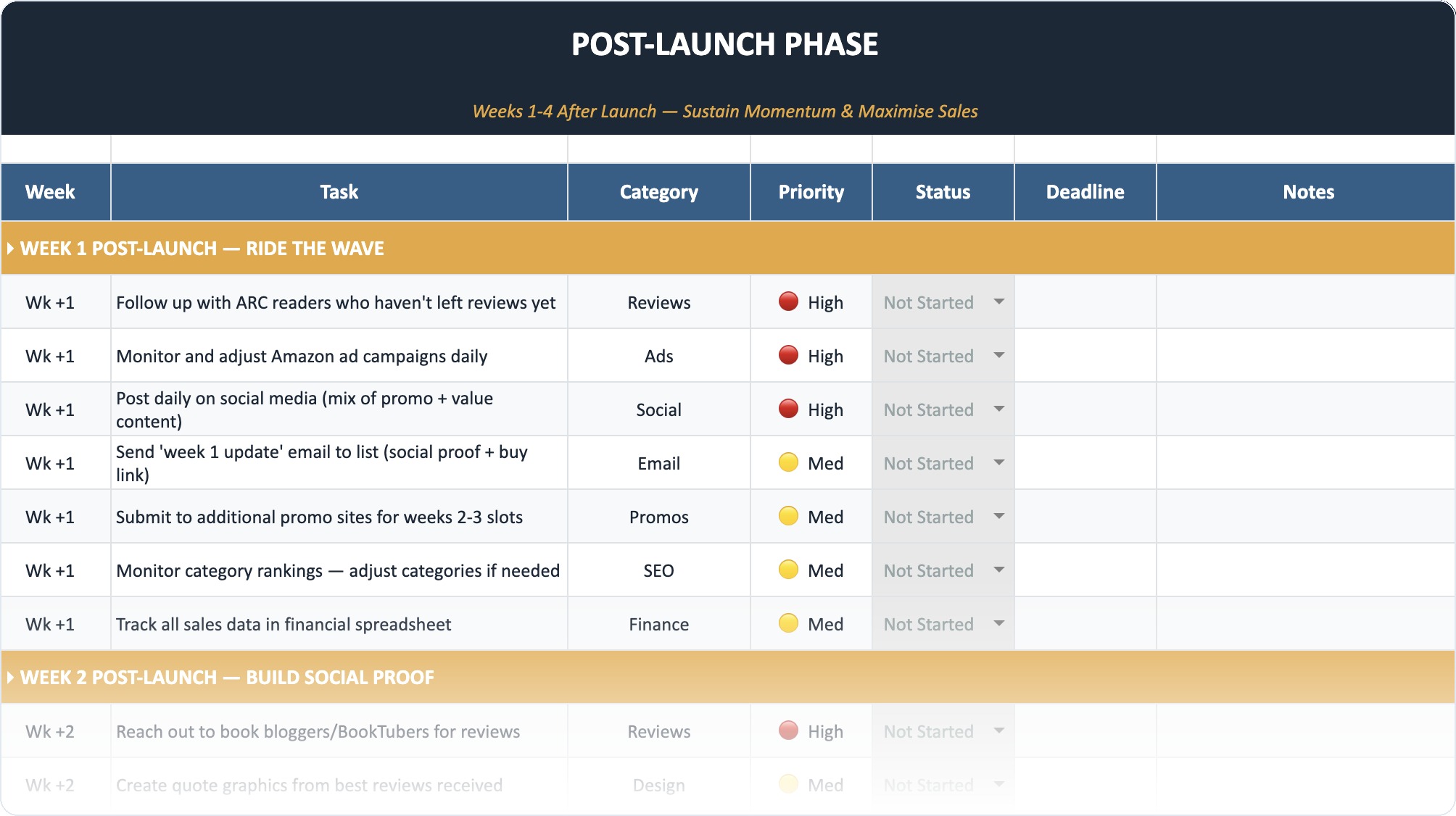
The Self-Publishing Launch Checklist (2026)
A week-by-week spreadsheet that walks you through every step of launching your book. Available as an Excel file and Google Sheet.
Amazon Book Conversion Rate Benchmarks (2025-2026)
Context is everything. You cannot compare your book's performance to a pair of headphones or a bottle of vitamins. Books are low-ticket items with high emotional buy-in.
According to 2025 market data, the average conversion rate across all Amazon categories sits between 9.87% and 11.1%. However, books behave differently.
The Breakdown by Performance Tier
I have analyzed data across hundreds of author accounts. Here is where you likely stand:
| Performance Level | Conversion Rate | Diagnosis |
|---|---|---|
| Critical Condition | 0% – 2% | Something is broken. Your cover, price, or reviews are repelling readers. |
| Average / Struggling | 2% – 5% | Common for new authors. You are getting traffic, but not convincing enough people. |
| Healthy / Profitable | 6% – 10% | You can run profitable ads here. Your page elements are working. |
| Top Performer | 10% – 15% | This is the "Good" standard. For every 10 people who look, 1 buys. |
| Bestseller Status | 15% – 25%+ | Usually driven by warm traffic (email lists) or a viral TikTok hit. |
Important Note on Prime Members:
Prime members convert at a much higher rate than non-Prime shoppers. Data indicates that Prime members exhibit a conversion rate of nearly 74% for eligible products, though for books specifically, this number is lower but still significant. If your paperback is not Prime-eligible, you are losing sales.
Traffic vs Sales: Diagnosing the Problem
The relationship between traffic vs sales tells you exactly what to fix.
Scenario A: High Impressions, Low Clicks
Your book appears in search results, but nobody clicks on it.
- The Problem: Your Cover or Title.
- The Fix: Your cover thumbnail is illegible or unappealing at small sizes. Your title does not promise a clear benefit or genre experience.
Scenario B: High Clicks, Low Sales (Low Conversion)
People are interested enough to click, but once they see your page, they leave.
- The Problem: The "Closing" elements. Your blurb is boring, your price is too high, or you have bad reviews.
- The Fix: This is a conversion rate problem. We will focus on fixing this below.
Stop Staring at a Blank Page
Publy is a distraction-free book editor with AI built in. Brainstorm plot ideas, get instant chapter reviews, or rewrite clunky paragraphs. 3 million free words included.

7 Factors That Kill Book Conversion Rates
If you are stuck in the 2% range, one of these seven elements is the culprit.
1. The "Reader Expectation" Mismatch
This is the most common reason for low conversion on ads. If you advertise a book as a "gripping thriller" but the cover looks like a "cozy romance," the reader clicks expecting one thing and finds another. They bounce immediately.
Your cover must signal the genre instantly.
2. The "Wall of Text" Description
Mobile shopping dominates book sales in 2026. If your book description (blurb) is a solid block of 300 words without paragraph breaks, bold text, or bullet points, nobody will read it.
You need to hook the reader in the first sentence. The first two lines of your description are visible before the "Read More" tag. If those two lines do not sell the book, the conversion is lost.
3. Lack of Social Proof (Reviews)
A book with zero reviews has a conversion rate near zero unless you drive extremely warm traffic (like friends and family).
- 1-5 Reviews: Buyers are skeptical.
- 20+ Reviews: Conversion stabilizes.
- 100+ Reviews: Social proof actively boosts sales.
If you are struggling to get past the initial hurdle, you might need to look into strategies for gathering reviews from legitimate sources.
4. Pricing Psychology
Books are price-sensitive.
- $0.99: High conversion, low royalty. Good for series starters.
- $2.99 – $4.99: The sweet spot for full-length fiction eBooks.
- $9.99+: Standard for non-fiction or established trad-pub authors.
If you are an unknown author selling a debut novel for $9.99, your conversion rate will suffer. Readers do not know if you are worth the risk yet.
5. Weak "Look Inside" Content
Smart readers click the "Read Sample" or "Look Inside" button. If your formatting is messy, or if the first page is full of typos and slow pacing, they leave. Your first 10% must be your best writing.
6. Ignoring A+ Content
In 2026, A+ Content (those graphical banners below the description) is no longer optional for serious authors. It increases conversion by keeping the reader on the page longer. It pushes competitor ads further down the screen.
7. Ad Optimization Failures
Sometimes the page is fine, but the traffic is bad. If you are bidding on broad keywords, you might be paying for clicks from people looking for "free books" or a completely different genre.
You need to be ruthless with negative keywords. Using free keyword research tools can help you identify exactly what terms to target—and which to avoid—so you stop paying for low-intent traffic.
Optimization Strategies to Double Your Rate
You know the benchmarks. You know the errors. Now let's fix them.
Step 1: Optimize the "Above the Fold" Experience
On mobile, the "fold" (what you see before scrolling) is just the cover, title, price, and star rating.
- Title: Ensure it includes a subtitle with keywords if non-fiction, or a clear series tag if fiction.
- Price: Ensure it is competitive. If your competitors are $3.99 and you are $5.99, you better have a good reason.
Step 2: Rewrite Your Blurb Using the H.I.P. Formula
Do not just summarize the plot. Sell the experience.
- H – Hook: A one-sentence grabber. "She thought she was alone. She was wrong."
- I – Intrigue: Present the conflict or the problem.
- P – Promise: Tell the reader how they will feel or what they will learn.
Step 3: Use Data to Refine Ads
If you are running Amazon Ads, look at your "Search Term Report." Sort by clicks.
- If a keyword has 15 clicks and 0 sales, turn it off. It is hurting your conversion rate.
- If a keyword has a 20% conversion rate, bid higher.
For authors just starting, knowing how to pick the right targets is half the battle. You should read my guide on selecting the best keywords to ensure you aren't wasting budget on terms that will never convert.
The Role of External Traffic
Amazon's A10 algorithm (still the core of their ranking logic in 2026) loves external traffic.
Why?
Because traffic sent from an email list, a Facebook ad, or a TikTok video usually converts higher than cold Amazon search traffic. These people have already been "pre-sold" by your email or video.
When you send 100 people from your newsletter and 15 of them buy (15% conversion), Amazon's algorithm notices. It sees your book as a high-converting asset and begins to show it to more organic shoppers.
However, you must be careful. If you send "dirty" traffic—like a broad, untargeted Facebook audience—that clicks but doesn't buy, you can actually tank your conversion rate and hurt your organic rank.
One advanced tactic is capturing reader email addresses inside your book via a lead magnet. This builds the "warm traffic" engine that sustains high conversion rates for future launches.
Format-Specific Benchmarks
Conversion varies by format. You cannot expect the same behavior from an audiobook listener as a paperback reader.
eBook Conversion
- Benchmark: Higher (10-15%).
- Reason: Instant gratification. Impulse buy. Lower price point.
- Market Context: Self-published books account for roughly 30% to 34% of all e-book sales in the U.S., meaning readers are very comfortable buying indie titles digitally.
Paperback Conversion
- Benchmark: Lower (5-8%).
- Reason: Higher price, shipping time involved.
- Market Context: Despite the digital hype, print is dominant. In the U.S., Amazon accounts for over 50% of all new print book sales.
Audiobook Conversion
- Benchmark: Variable.
- Reason: Often purchased via credits (Audible) rather than cash. The "price" barrier is psychological—"Is this worth my monthly credit?"
- Market Context: This sector is booming. The audiobook market is projected to grow significantly, with some forecasts showing strong CAGR through 2031.
Ad Optimization and Unit Session Percentage
Many authors panic when they see a low conversion rate on their ads. But you need to look closer.
There are three types of keyword matches, and they convert differently:
- Exact Match: Should have the highest conversion (10%+). These people searched specifically for what you have.
- Phrase Match: Moderate conversion (5-8%).
- Broad Match / Auto: Lower conversion (2-5%). These are discovery mechanisms.
If your Broad match campaigns have a 3% conversion rate, that might actually be acceptable if the Cost Per Click (CPC) is low enough to remain profitable.
The Golden Rule of Ad Optimization:
Never optimize for Conversion Rate alone. Optimize for ACOS (Advertising Cost of Sales) or Profit.
A campaign with a 5% conversion rate and $0.10 clicks is more profitable than a campaign with a 20% conversion rate and $3.00 clicks (assuming a $4.00 royalty).
Improving Mobile Conversion
In 2026, the majority of browsing happens on phones. The mobile interface hides much of your description.
Mobile Optimization Checklist:
- Short Title: Long subtitles get truncated.
- Contrast: Cover text must be readable at thumbnail size (100 pixels wide).
- First Sentence: The first sentence of your description must be a hook, because that is all they see before clicking "Read More."
Conclusion: Monitor and Adjust
Your amazon book conversion rate is not a static number. It changes with the seasons, with your pricing experiments, and with the accumulation of reviews.
Do not obsess over daily fluctuations. Look at 30-day trends. If you are consistently below 5%, stop spending money on ads. Pause. Revise your cover. Polish your description. Get three more reviews.
Only when the foundation is solid should you turn the traffic tap back on.
Frequently Asked Questions
What is a good conversion rate for a new author?
For a brand new author with few reviews, a conversion rate of 3% to 5% is normal. Once you cross the threshold of 20+ reviews, you should aim for 10% or higher.
How do I calculate my conversion rate?
Divide your total orders by the number of clicks (or sessions). For example, 10 orders from 100 clicks equals a 10% conversion rate.
Does Kindle Unlimited (KU) affect conversion rate?
Yes. KU "borrows" counts as sales for ranking purposes, but they may show up differently in reports depending on where you look. Generally, KU reads indicate high conversion because the barrier to entry (free for subscribers) is zero.
Why is my click-through rate (CTR) high but conversion low?
This is a classic "clickbait" issue. Your cover or ad promised something that your book page did not deliver. It often happens when the cover suggests one genre (e.g., Thriller) but the description reads like another (e.g., Romance).
Can changing the price improve conversion?
Absolutely. Lowering the price usually increases conversion percentage, but it lowers profit per unit. You must find the balance where total profit is maximized, not just the number of units sold.