

Jack London collected 600 rejection slips before selling a single story. If he had stopped at number 599, The Call of the Wild wouldn't exist. Aspiring writers usually see a rejection slip as a stop sign, but successful authors treat it like a toll booth. It's just the cost of getting where you want to go.
The history of literature is paved with "no" letters sent to famous authors rejected by short-sighted publishers. Stephen King threw his first hit in the trash. J.K. Rowling was told her book was too long for children. Talent doesn't separate these icons from the thousands who gave up. Stubbornness does. This post breaks down 15 incredible stories of literary rejection, the numbers behind them, and specific lessons for your own writing career today.
- Stephen King and J.K. Rowling faced dozens of rejections before becoming billionaires.
- Indie authors like Beatrix Potter and Lisa Genova proved that self-publishing can lead to massive traditional deals.
- Persistence is the only metric that matters. Some authors faced over 100 rejections before landing a deal.
- Rejection is subjective. A "no" often means the agent just didn't connect with the work personally.
Famous Authors Rejected: The Icons Who Didn't Quit
We often look at bestsellers and assume they had an easy path to the top. The reality is grimier, longer, and filled with more failure than most people can stomach.
1. Stephen King: Saved From the Trash
The Book: Carrie
The Rejections: 30+
Stephen King defines horror now. Back in the early 1970s, he lived in a double-wide trailer and taught high school English. He was broke. He even cut the telephone line because the bill was too high.
Writing Carrie felt wrong to him. He didn't think he could nail the female perspective. Frustrated, he crumpled the first few pages and tossed them in the wastebasket.
His wife, Tabitha, pulled them out. She brushed off the coffee grinds and said she wanted to know the rest of the story.
King finished the manuscript and mailed it. Hardcover rejections stacked up. One letter famously stated: "We are not interested in science fiction which deals with negative utopias. They do not sell."
Doubleday eventually bought the hardcover rights for a tiny $2,500 advance. It felt like a small win until the paperback rights sold for $400,000. King's cut was $200,000. He never taught high school again.
The Lesson: You are often the worst judge of your own work. Don't reject yourself before you even query.
By the time I was fourteen the nail in my wall would no longer support the weight of the rejection slips impaled upon it. I replaced the nail with a spike and went on writing.
Stephen King
2. J.K. Rowling: "Too Long for Children"
The Book: Harry Potter and the Philosopher’s Stone
The Rejections: 12
It's hard to picture a world without Hogwarts, yet 12 different publishing houses decided it wasn't worth their time. J.K. Rowling was a single mother living on state benefits in Edinburgh. She wrote in cafes while her daughter slept because heating her apartment cost too much.
She sent the manuscript to major houses. HarperCollins said no. Penguin said no. Most editors agreed the book was "too long for children." Kids' books were supposed to be short and simple. Rowling wrote a complex fantasy novel instead.
Bloomsbury, a smaller London publisher, finally picked it up. Why? Because the chairman gave the first chapter to his eight-year-old daughter, Alice. She demanded the rest. They paid Rowling roughly £1,500. Her editor still advised her to get a day job since children's books rarely make money.
As noted in Aerogramme Studio's collection of writer accounts, Rowling pinned her first rejection letter to her kitchen wall. It reminded her that she shared a struggle with her favorite writers.
The Lesson: Gatekeepers often rely on outdated market rules. "Too long" became the series' biggest selling point.
3. Dr. Seuss: A Lucky Sidewalk Encounter
The Book: And to Think That I Saw It on Mulberry Street
The Rejections: 27
Theodore Geisel, known to the world as Dr. Seuss, walked down Madison Avenue in New York City seething with anger. He clutched the manuscript for his first children's book. 27 publishers had just rejected it. They claimed it was too different. It wasn't "moral" enough. It didn't fit the mold of 1930s children's literature.
Geisel headed home to burn the manuscript. He was done.
On that specific block of Madison Avenue, he bumped into an old college friend, Mike McClintock. McClintock had just become the juvenile editor at Vanguard Press that morning. He asked what Geisel was carrying. They went up to McClintock's office. Vanguard bought the book.
Had Geisel walked on the other side of the street, the Grinch and the Cat in the Hat would not exist. A report by Authors Publish regarding famous rejections highlights how this chance meeting changed the course of children's literacy.
The Lesson: Success often mixes persistence with blind luck. You have to stay in the game long enough for the luck to find you.
4. James Patterson: From Advertising to Alex Cross
The Book: The Thomas Berryman Number
The Rejections: 31
James Patterson is currently one of the highest-paid authors in the world. He runs a book factory. His start was much slower.
He worked in advertising at J. Walter Thompson. He wrote his first novel in the early mornings. It was a thriller. He sent it out to 31 publishers. They all passed. They said it was too messy. Too dark.
When it was finally published, it won an Edgar Award for best debut mystery. It didn't sell millions immediately, but it launched a career that has since sold over 300 million copies. Patterson applied his advertising brain to books, changing how covers looked and how thrillers were marketed.
The Lesson: Even commercial gold can look like dirt to 31 different experts.
5. John Grisham: Selling From the Trunk
The Book: A Time to Kill
The Rejections: 28
John Grisham was a lawyer in Mississippi. Watching a young girl testify in court sparked an idea. He woke up at 5 AM every day to write before work. It took him three years to finish A Time to Kill.
He sent it to agents. Most didn't reply. Those who did rejected it. Finally, a small publisher called Wynwood Press agreed to print a modest run of 5,000 copies. Grisham bought 1,000 of them himself. He drove around libraries and bookstores in the south, selling them out of the trunk of his car.
The book didn't become a hit until after his second novel, The Firm, exploded. Then readers went back and discovered his debut.
The Lesson: Your first book might not be your breakout. It might be the book that your second book makes famous.
Stop Staring at a Blank Page
Publy is a distraction-free book editor with AI built in. Brainstorm plot ideas, get instant chapter reviews, or rewrite clunky paragraphs. 3 million free words included.

The Record Breakers: Triple-Digit Rejections
Some famous authors rejected didn't just hear "no" a dozen times. They heard it over a hundred times. These stories prove that the line between a crazy person and a genius is simply whether they eventually sell the book.
6. Robert Pirsig: The Guinness World Record Holder
The Book: Zen and the Art of Motorcycle Maintenance
The Rejections: 121
This book wraps a dense philosophical treatise inside a motorcycle road trip story. It's not an easy sell. Publishers had no idea what to do with it. Was it a novel? A philosophy textbook? A memoir?
Pirsig persisted through 121 rejections. This number actually landed him in the Guinness Book of World Records for the most rejected bestseller. When an editor finally bought it, he told Pirsig that the book forced him to rethink why he was in publishing. It sold millions of copies and became a cultural touchstone of the 1970s.
According to a detailed list of rejected bestsellers by LitHub, Pirsig's editor accepted the book with a standard advance, never predicting it would become a philosophy classic.
The Lesson: If your book defies categorization, it will be harder to sell. But if it breaks through, it will have no competition.
7. Jack Canfield & Mark Victor Hansen: 144 No's
The Book: Chicken Soup for the Soul
The Rejections: 144
This anthology series has sold over 500 million copies worldwide. It's a publishing empire. But in the beginning, it was just two motivational speakers with a binder full of sappy stories.
New York publishers laughed at them. They said, "Anthologies don't sell." They said the title was stupid. Canfield and Hansen went to the American Booksellers Association convention and walked booth to booth. They were rejected by 144 publishers.
A small publisher in Florida, Health Communications, finally took a chance. The authors hit the road, giving interviews to anyone who would listen. They built the success brick by brick.
The Lesson: "Market rules" (like anthologies don't sell) are only true until someone breaks them.
If you are receiving rejection after rejection, look at your query letter. This is your sales pitch. For help crafting one, see our guide on how to write a query letter for your novel.
8. James Lee Burke: The Lost Manuscript
The Book: The Lost Get-Back Boogie
The Rejections: 111
James Lee Burke is a titan of crime fiction. Yet for nine years, he couldn't sell his novel The Lost Get-Back Boogie. The manuscript circulated New York for nearly a decade. It was rejected 111 times.
Burke had already published books before, but his career had stalled. He was broke and working odd jobs. When Louisiana State University Press finally published the book, it was nominated for a Pulitzer Prize.
The Lesson: Quality does not guarantee a quick sale. Sometimes the timing is just wrong for nine years straight.
The Indie Path: Betting on Themselves
Rejection used to mean the end of the road. Today, and even in the past, some authors took rejection as a sign to do it themselves.
9. Beatrix Potter: The Original Self-Publisher
The Book: The Tale of Peter Rabbit
The Rejections: Multiple
Beatrix Potter wrote a letter to a sick child about four little rabbits. She later turned it into a book. She sent it to six publishers. They all returned it.
She didn't wait. She withdrew her savings and printed 250 copies herself in 1901. She sold them to friends and family. The book was a hit locally. Frederick Warne & Co, one of the publishers who had originally rejected her, saw the sales and changed their mind. They republished it in color. It has now sold over 45 million copies.
The Lesson: Proof of concept is powerful. If you can prove readers want it, publishers will follow.
10. Lisa Genova: From Self-Pub to Hollywood
The Book: Still Alice
The Rejections: 100+ (Agents)
Lisa Genova was a neuroscientist who wrote a novel about a woman with early-onset Alzheimer's. She queried literary agents. She was rejected or ignored by nearly every single one. They said the topic was too depressing.
Genova self-published the book in 2007. She sold it out of the trunk of her car (a common theme here). She got it into local bookstores. Word of mouth spread. Simon & Schuster eventually bought the rights for six figures. The book spent 40 weeks on the New York Times bestseller list and was adapted into a movie that won Julianne Moore an Oscar.
The Lesson: "Too depressing" is industry code for "we don't know how to market this." Readers, however, crave emotional depth.
11. Marcel Proust: Paying for Persistence
The Book: Swann’s Way (In Search of Lost Time)
The Rejections: All major houses
Proust is considered a genius today. In 1912, he was a joke to publishers. Andre Gide, a famous writer and editor at NRF, rejected the manuscript. He famously said he couldn't understand a writer who spent 30 pages describing how he tosses and turns in bed before falling asleep.
Proust paid a publisher, Grasset, to print the book. Essentially, it was a vanity press deal. Later, Gide apologized and begged Proust to move his future books to NRF.
The Lesson: Even the most "literary" works sometimes need to buy their way into the market initially.
"B00457X432"
Check Price on Amazon →As an Amazon Associate, we earn from qualifying purchases.
More Notable Failures That Became Hits
The list goes on. The variety of famous authors rejected shows that no genre is safe from the skepticism of editors.
12. William Golding: "Rubbish & Dull"
The Book: Lord of the Flies
The Rejections: 21
One editor at Faber & Faber read the manuscript and wrote a note: "Absurd & uninteresting fantasy. Rubbish & dull. Pointless."
This "pointless" book became required reading for nearly every high school student in the English-speaking world. It explores the darkness of human nature. The editor who rejected it likely just saw a weird story about kids on an island.
13. Agatha Christie: Five Years of Silence
The Book: The Mysterious Affair at Styles
The Rejections: 6
The Queen of Crime didn't start with a bang. She wrote her first Poirot novel and sent it out. It was rejected repeatedly. She eventually forgot about it.
Five years later, a publisher at The Bodley Head accepted it. But they made her change the ending. She agreed. She signed a terrible contract that bound her next five books to them for very little money. But it got her foot in the door.
The Lesson: Sometimes you have to take a bad deal to get the career started. You can negotiate better later.
14. Marlon James: The "Delete" Button
The Book: John Crow’s Devil
The Rejections: 78
Marlon James is the first Jamaican author to win the Man Booker Prize. But his first novel was rejected 78 times.
He was so devastated that he actually deleted the file from his computer. He destroyed the manuscript. He gave up writing.
Years later, he retrieved an old email outbox copy he had sent to a friend. He decided to try one more time. He workshopped it. It got published.
The Lesson: Despair is a temporary state. Do not make permanent decisions (like deleting your work) based on temporary feelings.
15. The Diary of Anne Frank
The Book: The Diary of a Young Girl
The Rejections: 15
It seems impossible that such an important historical document could be rejected. Yet 15 publishers turned it down. One editor noted, "The girl doesn't, it seems to me, have a special perception or feeling which would lift that book above the curiosity level."
This profound misunderstanding of the book's value highlights how subjective reading is. The editor was looking for "literary perception." The world was looking for honest humanity.
Rejection By The Numbers
To give you perspective, here is a breakdown of rejection counts for famous works. This data helps normalize the experience of failure.
| Author | Book | Estimated Rejections | Outcome |
|---|---|---|---|
| Jack London | Various Stories | 600 | Became first millionaire author |
| Chicken Soup | Chicken Soup for the Soul | 144 | 500M+ copies sold |
| Robert Pirsig | Zen & Art of Motorcycle Maintenance | 121 | Sold 5M+ copies |
| James Lee Burke | The Lost Get-Back Boogie | 111 | Pulitzer Nomination |
| Stephen King | Carrie | 30 | King of Horror |
| Dr. Seuss | Mulberry Street | 27 | Household name |
| Frank Herbert | Dune | 23 | Best-selling Sci-Fi ever |
Data regarding Chicken Soup for the Soul confirms the 144 rejection count, a statistic verified by LitRejections' bestseller analysis.
Why Do Publishers Get It Wrong?
You might wonder how professionals can be this bad at their jobs. How do you miss Harry Potter?
The truth is, publishing is a gambling business. Editors are overworked. They are reading manuscripts at 10 PM on a Tuesday after a full day of meetings. If the first page doesn't grab them, they pass. If they just bought a similar book last week, they pass. If they had a bad lunch, they might pass.
Rejection is rarely a comment on the quality of your writing. It is a comment on the commercial viability of your book at that specific moment in time, according to one specific person.
If you are struggling with the emotional toll of this process, consider how you handle feedback. Dealing with rejection is similar to handling negative reviews; you must separate your self-worth from the product.
How to Keep Going When You Want to Quit
Reading about famous authors rejected is inspiring, but it doesn't make opening your own rejection email hurt less. Here is how to survive the trench warfare of querying.
1. The "Next" Rule
Jack Canfield (Chicken Soup) used a simple psychological trick. Every time he got a no, he said "Next!" out loud. He treated it like a numbers game. He knew there was a "Yes" out there; he just had to clear the "No's" out of the way first.
2. Focus on Voice, Not Trends
Trends change. Vampires are in, then they are out. Dystopian is hot, then it's dead. If you chase trends, you will always be behind. The authors on this list succeeded because they had a unique voice that didn't sound like anyone else. To develop this, you need to focus on finding your writer's voice.
3. Consider Self-Publishing
We live in 2026. You don't need a gatekeeper to reach readers. Beatrix Potter and Lisa Genova proved that. If you have a niche audience and a good book, you can bypass the query trenches entirely. However, you need to treat it like a business. This means understanding the financial side, including taxes for authors.
- Complete Creative Control
- Higher Royalties
- Speed to Market
- No Advance Payment
- You Pay for Editing/Cover
- Marketing is 100% on You
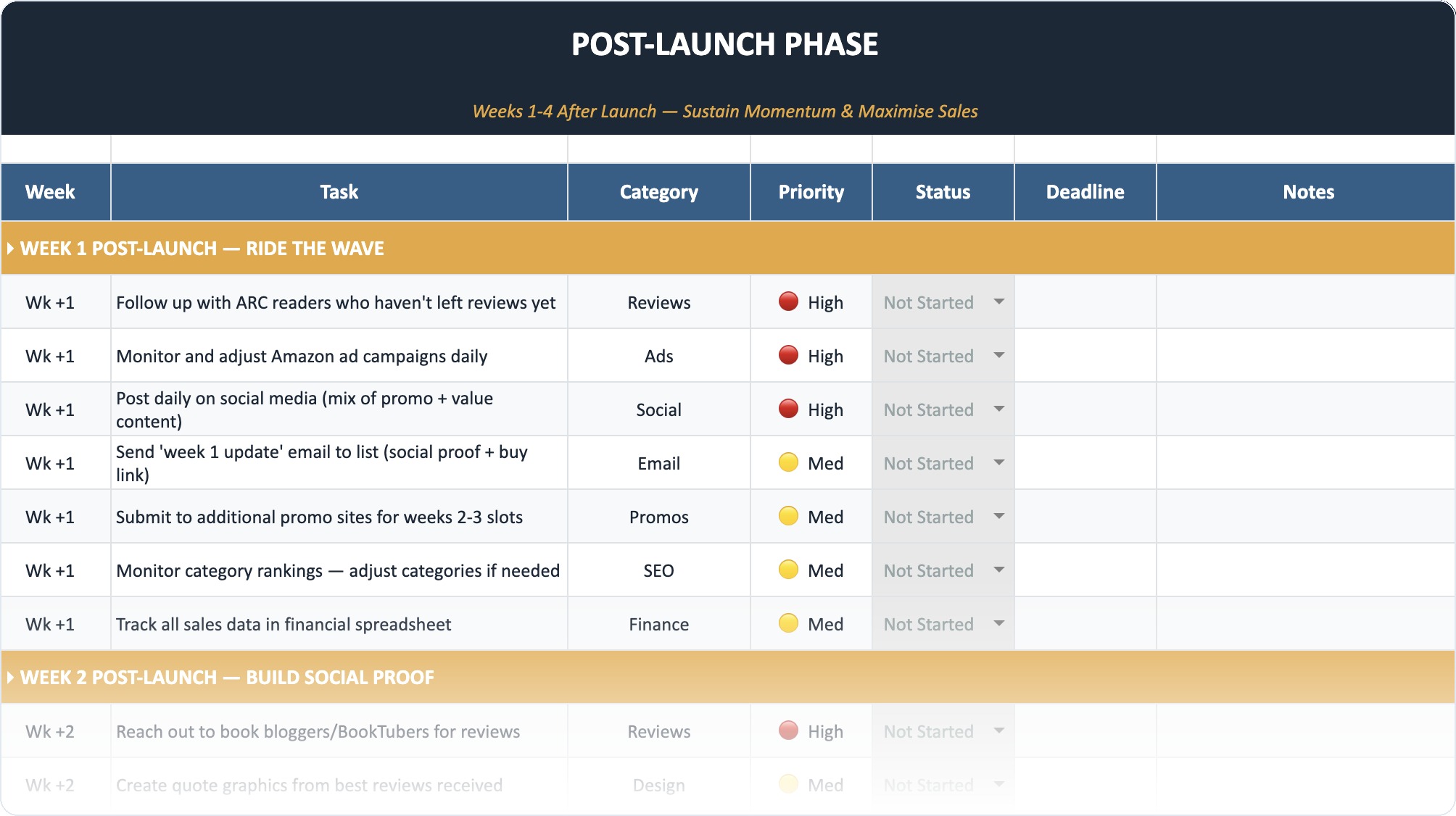
The Self-Publishing Launch Checklist (2026)
A week-by-week spreadsheet that walks you through every step of launching your book. Available as an Excel file and Google Sheet.
Final Thoughts
The only difference between a published author and an unpublished author is that the published author refused to give up.
Stephen King could have left Carrie in the trash.
Marlon James could have left his file deleted.
J.K. Rowling could have listened to the editor who told her to get a day job.
They didn't.
If you are staring at a rejection slip right now, print it out. Put it on a spike. Stick it to your wall. It's not a stop sign. It's a badge of honor. You are in excellent company.
Frequently Asked Questions
Which famous author had the most rejections?
Jack London is often cited as receiving over 600 rejections before selling his first story. For a single specific book, Chicken Soup for the Soul received 144 rejections, and Robert Pirsig's Zen and the Art of Motorcycle Maintenance received 121 rejections.
Why was Harry Potter rejected so many times?
Publishers felt Harry Potter was too long for a children's book. At the time, the industry standard for middle-grade novels was much shorter. They also worried the boarding school setting was too exclusive or "British" for a global audience.
Did Stephen King really throw Carrie in the trash?
Yes. Stephen King threw the first few pages of Carrie into the wastebasket because he felt he couldn't write the female perspective convincingly. His wife, Tabitha, retrieved the pages and encouraged him to finish the story.
Is self-publishing a good option if I get rejected?
Absolutely. Authors like Lisa Genova (Still Alice) and Beatrix Potter (Peter Rabbit) started by self-publishing after facing rejection. If your book has a clear audience, self-publishing can demonstrate proof of sales, which may lead to a traditional deal later.
What is the average number of rejections for a debut author?
There is no hard rule, but many agents suggest that getting 50 to 100 rejections is normal for a debut novel. The "overnight success" stories are statistical anomalies. Most working authors queried for years before landing representation.
How do I handle the emotional pain of rejection?
Treat writing as a business. Separate your personal identity from your work. Remember that a rejection is a business decision about a product, not a critique of your value as a human being. Start the next project while you are querying the current one.