

TL;DR
- Best Starting Point: Start with A Curtain of Green for short stories or The Optimist’s Daughter for a novel.
- Reading Strategy: Publication order is ideal to see her style evolve, but her short story collections stand alone perfectly.
- Genre Focus: She is a titan of Southern Gothic literature, blending humor, myth, and deep character studies.
- Must-Read: The Optimist’s Daughter (Pulitzer Winner) and The Golden Apples.
Eudora Welty stands as one of the most significant figures in American literature. Her work captures the voice, heat, and complex social structures of the American South with a precision that few others have matched. For readers looking to experience the Mississippi Delta through the eyes of a master, figuring out where to start can be a challenge. Her bibliography spans decades and shifts between intimate short stories, fairy-tale-inspired novellas, and dialogue-heavy novels.
This guide breaks down Eudora Welty books in order, helping you navigate her bibliography from her early snapshots of Southern life to her Pulitzer Prize-winning masterpiece. Whether you are a student of Southern Gothic literature or a casual reader looking for a new favorite author, this list provides the roadmap you need.
Who Was Eudora Welty?
Before opening her books, it helps to understand the woman behind the words. Born in Jackson, Mississippi, in 1909, Welty lived a life deeply rooted in her home region. Unlike many writers who fled the South to find their voice, Welty stayed. Her fiction grows directly out of the soil of Mississippi.
She began her creative life as a photographer. During the Great Depression, she worked for the Works Progress Administration (WPA), traveling across Mississippi snapping photos of people from all walks of life. This experience trained her eye. She learned to capture a moment, a gesture, or a facial expression that told a whole story. When she transitioned to writing, she brought that photographer’s observational skill with her.
Her career gained traction in the late 1930s, and by the 1940s, she was a recognized force. She did not just write about the South; she wrote about the universal human condition using the South as her stage. Her ability to listen—really listen—to how people talked gave her work a distinctive auditory quality. You can hear the cadence of the porch conversations in every sentence.
Eudora Welty Short Stories in Order
Many critics and fans argue that Welty was, first and foremost, a short story writer. Her ability to condense a lifetime of emotion into a few pages is unparalleled. If you are new to her work, the short stories are an excellent place to begin.
A Curtain of Green (1941)


This is Welty’s debut collection, and it remains one of her most beloved. It contains several of her most famous stories, including “Why I Live at the P.O.,” “A Worn Path,” and “Petrified Man.”
“Why I Live at the P.O.” is a hilarious monologue delivered by a young woman who feels slighted by her eccentric family. It displays Welty’s incredible ear for the absurdity of family squabbles and Southern speech. On the other end of the spectrum, “A Worn Path” tells the touching tale of an elderly African American woman named Phoenix Jackson making a long, arduous journey to get medicine for her grandson.
This collection showcases her range. She moves from slapstick humor to profound tragedy without missing a beat. It serves as a perfect introduction to Southern Gothic literature, where the grotesque and the beautiful often sit side by side.
The Wide Net and Other Stories (1943)

Published just two years later, The Wide Net shows a shift in style. These stories are dreamier, more atmospheric, and often deal with historical figures or myths. The title story follows a man named William Wallace who drags a river for his pregnant wife, believing she has drowned herself, only to turn the grim task into a strange, celebratory procession.
Critics at the time were confused by the shift from the sharp realism of A Curtain of Green to this more impressionistic style. However, modern readers often appreciate the lush descriptions and the way Welty captures the thick, humid atmosphere of the Natchez Trace.
The Golden Apples (1949)
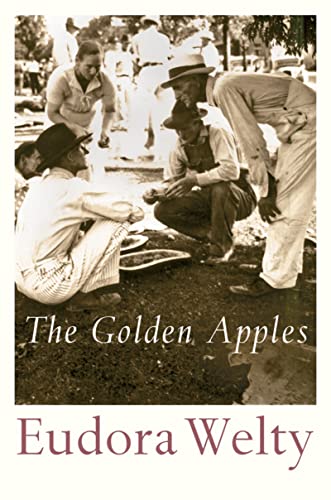
The Golden Apples is often called a “story cycle” rather than a simple collection. The stories are linked, all taking place in the fictional town of Morgana, Mississippi. Characters appear in each other’s stories, aging and changing as the book progresses.
The book draws heavily on Greek mythology, transplanting ancient archetypes into a small Southern town. It deals with the passage of time, the constriction of small-town life, and the desire for escape. For those interested in mastering the craft of short fiction, this book is a masterclass in how to weave separate narratives into a cohesive whole.
Reading The Golden Apples feels like living in Morgana for forty years. You see the secrets, the affairs, and the quiet disappointments that define the community.
The Bride of the Innisfallen and Other Stories (1955)
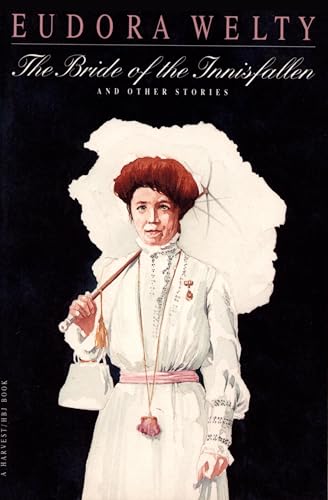
In this collection, Welty expands her geographic reach. While she is known for the South, these stories take readers to Europe and on journeys. The title story is set on a train and a boat traveling from London to Cork.
This volume is challenging. Welty experiments with perspective and plot, often discarding traditional narrative structures in favor of capturing a mood or a fleeting feeling. It reflects a writer who is confident enough to take risks and refuse to repeat herself.
The Collected Stories of Eudora Welty (1980)

If you want everything in one place, this is the book to buy. It gathers all her previous collections plus two uncollected stories. It won the National Book Award for Fiction in paperback. For a reader who wants to see the full arc of her career in the short form, this volume is essential.
Stop Staring at a Blank Page
Publy is a distraction-free book editor with AI built in. Brainstorm plot ideas, get instant chapter reviews, or rewrite clunky paragraphs. 3 million free words included.

Eudora Welty Novels in Order
While her stories are celebrated, Eudora Welty’s novels allowed her to dig deeper into the complexities of family and history. Her novels vary wildly in tone, from fairy tale to comedy to drama.
The Robber Bridegroom (1942)

Her first novella is a departure from realism. The Robber Bridegroom is a fairy tale set on the Natchez Trace. It blends the Grimm Brothers with Mississippi folklore and history. The story features legendary figures like Mike Fink and creates a world where bandits and planter’s daughters collide in a magical forest.
It is short, wild, and incredibly fun. It shows Welty playing with the oral traditions of the South, mixing history and tall tales until you cannot tell which is which.
Delta Wedding (1946)

Delta Wedding is perhaps her most “Southern” novel in terms of setting. It takes place in 1923 at the Fairchild family plantation in the Mississippi Delta. The book details the preparations for a wedding, but there is very little “plot” in the traditional sense.
Instead, the novel immerses you in the Fairchild family dynamic. You are dropped into a swirl of aunts, cousins, and children. The focus is on the subtle shifts in relationships, the unspoken rules of the family, and the way the outside world (represented by the groom) threatens their insular existence. It is a dense, beautiful book that requires patience but rewards the reader with a deep understanding of a specific time and place.
The Ponder Heart (1954)

If Delta Wedding is dense and serious, The Ponder Heart is pure comedy. Narrated by Edna Earle Ponder, who runs a hotel, it tells the story of her eccentric Uncle Daniel Ponder. Uncle Daniel is rich, generous to a fault, and not quite all there.
The book reads like a long, hilarious gossip session on a front porch. Welty’s skill with voice is at its peak here. Edna Earle is one of the great narrators in American fiction—opinionated, sharp-tongued, and fiercely loyal. The novel was so popular it was adapted into a Broadway play.
Losing Battles (1970)

After a long silence, Welty returned with Losing Battles. This is a massive novel, taking place over two days during a family reunion in the 1930s.
The book is almost entirely dialogue. There is very little internal monologue or narration. The story unfolds through the constant talking of the Renfro family. It is a celebration of storytelling itself, as the family members recount histories, argue, and tease one another. It can be a demanding read because of the sheer volume of voices, but it is a joyous, boisterous book about survival and family bonds.
The Optimist’s Daughter (1972)

This is Welty’s masterpiece. Awarded the Pulitzer Prize, The Optimist’s Daughter is a tight, powerful novel about grief and memory.
The story follows Laurel McKelva Hand, who returns to New Orleans and then Mississippi to tend to her dying father, Judge McKelva. She finds herself in conflict with her father’s young, foolish second wife, Fay.
Unlike the sprawling Losing Battles, this book is concise and devastating. It examines the clash between the old South (Laurel and the Judge) and the “new” South (Fay), but more importantly, it looks at how we remember the dead. It is widely considered her best novel and serves as a perfect capstone to her career in fiction. According to the Pulitzer Prize archive, Welty won the award in 1973 for this profound work, cementing her legacy in American letters.
Non-Fiction and Essays
Eudora Welty was also a brilliant critic and memoirist. Her non-fiction offers vital context for her novels.
One Time, One Place (1971)
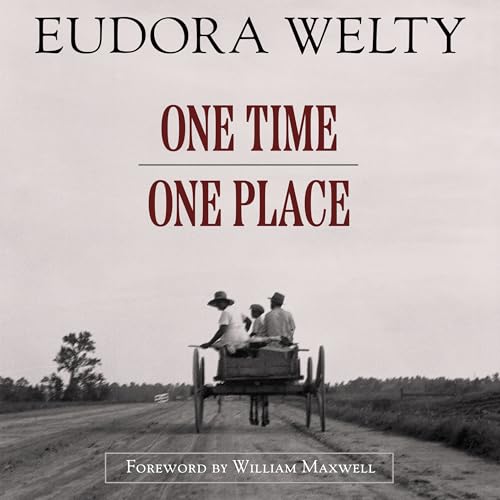
This book collects her photographs from the 1930s. Seeing these images helps you understand the visual nature of her writing. You see the faces that likely inspired her characters. It is a visual record of the Great Depression in Mississippi that stands alongside the work of Walker Evans or Dorothea Lange.
The Eye of the Story (1978)

This collection of essays and reviews offers insight into her creative process. She discusses authors she admires, like Jane Austen and Willa Cather, and writes about the craft of fiction. For writers interested in developing a distinct writer’s voice, hearing Welty analyze the mechanics of storytelling is invaluable.
One Writer’s Beginnings (1984)

Based on a series of lectures she gave at Harvard, this memoir is a beautiful account of her childhood. She does not just list dates and events; she describes how she learned to listen and to see. She structures the book around three concepts: Listening, Learning to See, and Finding a Voice.
It became a bestseller, a rare feat for a literary memoir. It is arguably the best entry point into her non-fiction and pairs beautifully with The Optimist’s Daughter.
Themes and Style: Why Read Welty?
Eudora Welty’s work is often categorized as Southern Gothic literature, sharing shelf space with William Faulkner and Flannery O’Connor. However, Welty is distinct. She is less interested in the dark, violent grotesque than O’Connor, and less concerned with the heavy weight of history than Faulkner.
Welty’s focus is human connection. She writes about the difficulty of truly knowing another person. Her characters are often isolated, even when surrounded by family. She finds humor in the darkest places and dignity in the poorest characters.
Her style is defined by:
- The Ear: She captures dialogue perfectly. You do not just read her characters; you hear them.
- The Eye: Her background in photography means her physical descriptions are vivid and precise.
- The Myth: She often weaves classical mythology into mundane settings, elevating ordinary lives to epic status.
For authors hoping to publish their own life stories, studying how Welty handled her memoir is instructive. As noted in resources regarding publishing personal histories, the ability to turn memory into structured narrative is a skill Welty mastered perfectly in One Writer’s Beginnings.
Suggested Reading Order for Beginners
If you are daunted by the list, here is a simple path to get started:
- Start with A Curtain of Green: Read “Why I Live at the P.O.” and “A Worn Path.” If you like the voice, keep going.
- Move to The Optimist’s Daughter: It is short, accessible, and emotionally powerful.
- Try The Ponder Heart: For a taste of her humor.
- Tackle Delta Wedding: Once you are comfortable with her style, immerse yourself in this denser work.
- Read One Writer’s Beginnings: To understand the source of her genius.
The Legacy of Eudora Welty
Welty passed away in 2001, but her influence remains enormous. She was the first living author to have her works collected by the Library of America, a testament to her standing in the canon.
Her home in Jackson is now a museum and garden, attracting visitors from all over the world. Official historical records confirm her home is a National Historic Landmark, preserving the environment where she wrote nearly all her fiction.
Her work proves that you do not need to travel the world to write great literature. You only need to look closely at the world right in front of you. Whether she was writing about a beauty parlor in a small town or a jazz pianist in San Francisco, she brought the same level of empathy and acuity to every page.
Welty’s commitment to balancing observation with storytelling serves as a model for writers today. She did not invent her world; she watched it, absorbed it, and transmuted it into art.
Summary of Works Table
| Book Title | Year | Genre | Key Note |
|---|---|---|---|
| A Curtain of Green | 1941 | Short Stories | Includes “A Worn Path” |
| The Robber Bridegroom | 1942 | Novella | Fairy tale / Folklore |
| The Wide Net | 1943 | Short Stories | Atmospheric / Mythic |
| Delta Wedding | 1946 | Novel | Family Drama |
| The Golden Apples | 1949 | Story Cycle | Interconnected stories |
| The Ponder Heart | 1954 | Novel | Humorous |
| The Bride of the Innisfallen | 1955 | Short Stories | Experimental / Travel |
| Losing Battles | 1970 | Novel | Dialogue-heavy |
| The Optimist’s Daughter | 1972 | Novel | Pulitzer Prize Winner |
| The Collected Stories | 1980 | Collection | Complete short works |
| One Writer’s Beginnings | 1984 | Memoir | Autobiography |
Frequently Asked Questions
What is Eudora Welty’s most famous book?
The Optimist’s Daughter is likely her most famous novel because it won the Pulitzer Prize, but her short story “Why I Live at the P.O.” is arguably her most famous single piece of writing and is widely anthologized.
Did Eudora Welty win the Nobel Prize?
No, Eudora Welty did not win the Nobel Prize in Literature. However, she received the Presidential Medal of Freedom and the Order of the South, among many other accolades.
Is Eudora Welty considered a Southern Gothic writer?
Yes, she is a central figure in Southern Gothic literature. However, her work is generally considered less grotesque and violent than that of Flannery O’Connor and more focused on the nuances of community and speech.
Can I read her short stories out of order?
Absolutely. While the collections were published in a specific order, the stories themselves (with the exception of the interconnected stories in The Golden Apples) stand alone and can be enjoyed in any sequence.
Where can I visit Eudora Welty’s home?
Her home is located in the Belhaven neighborhood of Jackson, Mississippi. It is open to the public as a museum, where visitors can see her writing desk and the books that surrounded her. According to the Eudora Welty Foundation, the house and garden have been restored to how they looked in 1986.