

You have finished your manuscript. The editing is done. The cover art looks fantastic. Now, the marketing advice starts rolling in, and one suggestion keeps popping up: "You need a book trailer."
I see this advice given to authors every single day. The immediate reaction is usually a mix of excitement and dread. Excitement because seeing your story come to life in a video format is a dream come true. Dread because video production sounds expensive, complicated, and time-consuming.
Here is the brutal truth about effective book trailers in 2026: Most of them are ignored. But the ones that work? They work incredibly well. They stop the scroll. They capture attention in less than three seconds. They convert casual browsers into paying readers.
The difference between a vanity project that drains your budget and a marketing asset that pays for itself comes down to strategy, not just "cinematic" visuals. If you are wondering if you should bother making one, the short answer is yes—but only if you treat it as a sales tool, not a mini-movie.
- Video drives sales: Viewers are 64% more likely to buy a book after watching a compelling trailer.
- Keep it short: The sweet spot for retention is 60 to 90 seconds, with 15-second cuts for social media.
- ROI is real: Landing pages with video content can see conversion rate boosts of up to 80%.
- Distribution matters more than production: A great trailer hidden on a YouTube channel with zero subscribers is useless; focus on TikTok, Reels, and Amazon ads.
The Data Behind Video Marketing for Books
I often hear authors claim that "book trailers don't sell books." That might have been true a decade ago when trailers were just slideshows of stock images with comic sans text. Today, the landscape is entirely different. We are living in a video-first internet.
The numbers paint a very clear picture. Video isn't just "nice to have" anymore; it is the primary way people consume content online.
According to recent market research on global video production, the book trailer industry has grown massively, with projections hitting over USD 336 million by 2033. This growth isn't happening because authors like wasting money. It is happening because video assets work.
Why Viewers Buy
When a potential reader lands on your Amazon page or website, you have a tiny window to convince them to buy. Text requires active effort to read. Video is passive. It washes over the viewer.
Data shows that viewers are 64% more likely to purchase a book after watching a trailer. That is a massive lift. If you are driving traffic to a sales page, you are leaving money on the table if you don't have a video element.
Video engages the senses in a way a blurb cannot. Music sets the mood. Visuals establish the setting. The pacing creates tension. You are bypassing the intellectual brain and hitting the emotional brain. That is where sales happen.
Conversion Rates and ROI
Let's talk about the bottom line. Marketing is about Return on Investment (ROI). If you spend $500 on a trailer, you need to know it will help you sell more than $500 worth of books.
Sales landing pages that incorporate video can see an 80% boost in conversion rates. Think about that. If you are running Amazon KDP advertising campaigns to a book page, an 80% increase in conversion makes your ad spend significantly more efficient.
Approximately 70% of marketers report a positive ROI from video content. The key is to stop thinking of the trailer as a standalone piece of art. It is a funnel element. Its job is to move the viewer to the "Buy Now" button.
What Makes a Book Trailer Effective?
Not all trailers are created equal. I have seen thousands of book trailers. 90% of them fail because they try to tell the whole story.
An effective book trailer is a tease. It is a hook. It should leave the viewer with questions, not answers.
The Three-Act Structure of a Trailer
Just like your novel, your trailer needs a structure. But unlike your novel, this structure needs to play out in under 90 seconds.
- The Hook (0-5 seconds): You have to grab them immediately. This is not the time for a slow fade-in or a logo. Start with a bang. A shocking statement. A gripping visual. A question that demands an answer. If you lose them here, the rest doesn't matter.
- The Conflict (5-45 seconds): Introduce the protagonist and the problem. What is at stake? Don't explain the plot details. Focus on the emotion. Is it scary? Romantic? Thrilling? Use visuals and text overlays to convey the feeling of the book.
- The Cliffhanger/CTA (45-60 seconds): Leave them hanging. Cut the music. Fade to black. Then, hit them with the Call to Action (CTA). Show the book cover. Show where to buy it. "Available now on Amazon." "Read it on Kindle Unlimited."
Cinematic Quality vs. Authentic Content
There is a misconception that you need a "cinematic trailer" that looks like a Marvel movie. While high production value is great, it is not always necessary. In fact, on platforms like TikTok, overly polished content can sometimes feel like an ad, causing people to scroll past.
Authenticity wins in 2026. A simple, well-edited video that clearly communicates the trope and the vibe often outperforms a glossy, expensive production that is vague about the genre.
Audio is 50% of the Experience
Never underestimate sound. You might have the best visuals in the world, but if your music doesn't match the tone, the trailer will fail.
- Horror: Needs dissonant chords, silence, and sudden spikes in volume.
- Romance: Needs sweeping strings or upbeat pop, depending on the heat level.
- Thriller: Needs a fast, ticking tempo that builds anxiety.
Bad audio quality screams "amateur." If you are doing a voiceover, ensure it is professional. Nothing kills credibility faster than a narrator who sounds like they are recording in a bathroom.
Stop Staring at a Blank Page
Publy is a distraction-free book editor with AI built in. Brainstorm plot ideas, get instant chapter reviews, or rewrite clunky paragraphs. 3 million free words included.

The Role of AI in Trailer Production
The year is 2026, and we cannot ignore the elephant in the room: Artificial Intelligence.
AI tools have completely revolutionized mastering the basics of book trailers. What used to cost thousands of dollars and take weeks can now be done for a fraction of the cost.
AI Video Generation
Tools like Sora and Runway allow authors to generate custom video clips from text prompts. You no longer have to rely on generic stock footage of "woman walking in field." You can describe your specific protagonist, your specific setting, and get a usable clip.
This allows for a level of specificity we never had before. You can match the visuals to your book's description perfectly.
AI Voiceovers
Gone are the days of hiring expensive voice actors for a simple 30-second spot. AI narration has become indistinguishable from human speech. You can choose the accent, the tone, the emotion, and the pacing.
This lowers the barrier to entry significantly. Independent authors can now produce trailers that sound just as professional as those from big publishing houses.
Tailoring Content for Different Platforms
One big mistake I see is authors making one video and posting it everywhere. That does not work.
You need a distribution strategy. A video that works on YouTube will flop on TikTok.
YouTube: The Search Engine
YouTube is the second largest search engine in the world. Here, you can post your "full" trailer. This is the 60 to 90-second version. It should be horizontal (16:9).
Optimize your title and description with keywords. "Fantasy Book Trailer," "Best Romance Books 2026," etc. This video will live on your channel forever and can be embedded on your website and Amazon Author Central page.
TikTok and Reels: The Viral Engine
Short-form video is dominant. For TikTok and Instagram Reels, you need vertical video (9:16).
You cannot just crop your horizontal trailer. You need to edit specifically for these platforms.
- Length: 15 to 30 seconds max.
- Pacing: Extremely fast.
- Format: Use trending audio. Use text-to-speech overlays. Focus on "BookTok" tropes.
- Strategy: Don't just post the trailer. Post "behind the scenes" of making the trailer. Post reaction videos. Make the trailer part of a larger content strategy.
According to insights on video engagement, vertical video formats are seeing significantly higher engagement rates compared to static promotional materials, largely due to mobile-first consumption habits.
Amazon Product Page
This is arguably the most important place for your trailer. Amazon allows you to upload a video to your book's sales page (usually under the image gallery or "From the Author" section).
When a reader is on your Amazon page, they are already considering buying. The video can be the final nudge they need. Keep this version professional, polished, and focused on the hook.
Cost Breakdown: What Should You Spend?
This is the most common question I get: "How much does it cost?"
The answer depends entirely on your approach.
The DIY Route ($0 – $100)
If you are handy with software like Canva, CapCut, or DaVinci Resolve, you can make a trailer for free. You will use stock footage (Pexels, Pixabay) and royalty-free music.
- Pros: Cheap. You have full control.
- Cons: Time-consuming. Can look amateur if you don't have an eye for design.
The Semi-Pro/AI Assisted Route ($100 – $500)
This involves using paid AI tools, buying premium stock footage (Shutterstock, Adobe Stock), or hiring a freelancer on Fiverr or Upwork for specific tasks (like editing or voiceover).
- Pros: Better quality. Faster production.
- Cons: Costs can add up if you aren't careful with licensing fees.
The Professional Studio Route ($1,000 – $5,000+)
There are boutique studios that specialize in book trailers. They handle everything: scripting, casting, filming, editing, sound design.
- Pros: Hollywood quality. distinct and unique.
- Cons: Expensive. Might not yield a positive ROI unless you have a massive marketing budget and a wide distribution plan.
For most independent authors, I recommend the middle ground. Use high-quality tools and maybe hire a freelancer for the tricky parts, but don't mortgage your house for a 60-second video.
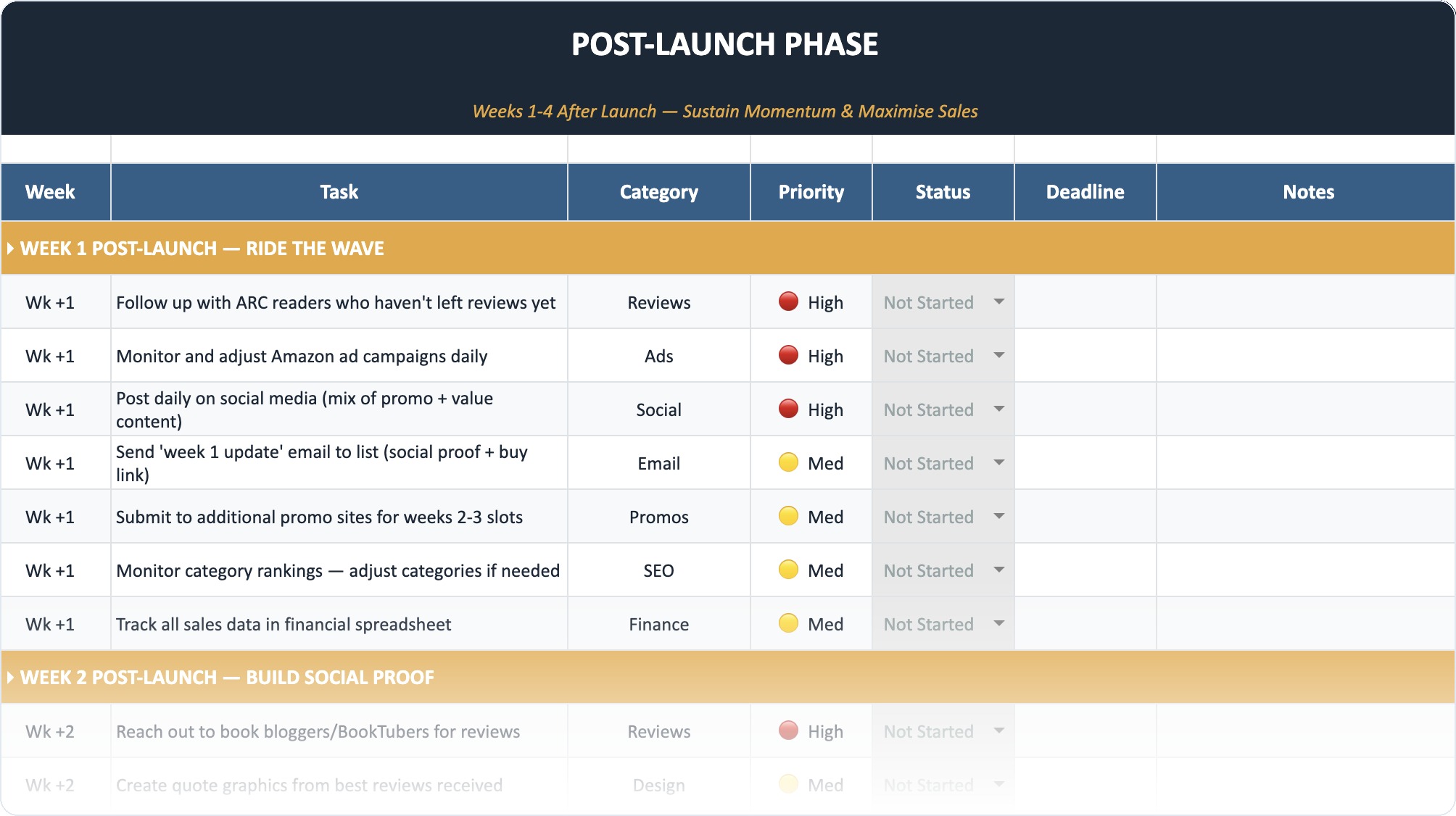
The Self-Publishing Launch Checklist (2026)
A week-by-week spreadsheet that walks you through every step of launching your book. Available as an Excel file and Google Sheet.
Common Mistakes to Avoid
Even with the best tools, you can still mess this up. Here are the pitfalls I see authors falling into constantly.
1. Spoilers
Do not give away the ending. It sounds obvious, but you would be surprised. You want to create curiosity, not satisfaction. If they know how it ends, they don't need to read the book.
2. Too Long
If your trailer is three minutes long, nobody is watching it. Data shows viewer retention drops off a cliff after 90 seconds. Keep it tight. Kill your darlings.
3. Misleading Genre
If your trailer looks like a horror movie but you wrote a cozy mystery, you are going to attract the wrong readers. They will buy the book, realize it is not what they expected, and leave negative reviews.
Your trailer must match the finding your unique writer's voice that is present in your manuscript. Tone consistency is key.
4. Text Overload
Do not make people read paragraphs of text in a video. Use short, punchy phrases. "One Girl." "One Choice." "A Deadly Secret."
If viewers have to pause the video to read the text, you have failed.
Measuring Success
How do you know if your trailer is working? You need to track the metrics.
- View Count: Vanity metric, but good for ego.
- Watch Time: Important. Are people watching to the end? If they drop off at 5 seconds, your hook is weak.
- Click-Through Rate (CTR): If you are running ads, how many people click the link after watching?
- Conversion Rate: The holy grail. Did they buy the book?
A 2012 survey on book purchasing habits indicated that nearly 16% of people bought a book solely due to a trailer. While that data point is older, modern engagement metrics suggest this influence has likely increased as video has become more ubiquitous.
Integrating Trailers into a Launch Strategy
A trailer is not a standalone tactic. It is part of a comprehensive book launch strategy.
Pre-Order Phase
Release a "Teaser" trailer (15 seconds) when you announce your pre-order. This builds hype without giving too much away.
Launch Week
Release the "Full" trailer (60-90 seconds) on launch day. Blast it to your newsletter. Post it on all social channels. Run ads targeting your genre.
Post-Launch
Use snippets of the trailer for ongoing maintenance ads. Keep the book visible. Update the video if you get great reviews (add a "Five Stars from Reader's Favorite" overlay).
Comparing Trailer Types
| Trailer Type | Best For | Approx Cost | Difficulty |
|---|---|---|---|
| Cinematic/Live Action | Thrillers, Fantasy, Sci-Fi | High ($1k+) | High |
| Motion Graphics | Non-Fiction, Business, Self-Help | Medium ($300-$800) | Medium |
| Character Aesthetics | Romance, YA, New Adult | Low ($0-$100) | Low |
| Kinetic Typography | Mystery, Literary Fiction | Low-Medium ($50-$300) | Medium |
The "Author Bling" Debate
There is a cynical view in the industry that book trailers are just "author bling"—shiny objects that make the author feel good but don't sell books.
I understand where this comes from. I have seen authors spend $5,000 on a trailer and sell 10 copies. But that is not the trailer's fault. That is a marketing failure.
If you make a TV commercial for a car and never air it on TV, you won't sell any cars. The commercial itself isn't useless; the distribution was non-existent.
The same applies here. A book trailer is an asset. It is content. In a world where content is king, having a high-quality video asset gives you an advantage. It gives you something to share on Instagram. It gives you something to put in your Facebook header. It gives you something to show to librarians and bookstore owners.
Competitor Landscape and Services
The market for book trailer production is diverse. You have everything from AI-powered SaaS platforms to boutique creative agencies.
Boutique Studios: Companies like Film 14 or booktrailer.com offer high-end, custom productions. These are great if you have a publisher's budget or are investing heavily in a series starter.
Freelance Market: Platforms like Upwork and Fiverr are flooded with editors. The quality varies wildly. You need to vet portfolios carefully. Look for editors who understand pacing.
DIY Tools: Canva, Animoto, and specialized AI video tools are empowering authors to take control. This is where the most growth is happening. The barrier to entry is lower than ever.
Final Thoughts
The question isn't "Do book trailers work?" The question is "Can you make a book trailer that works for your book and your audience?"
If you approach it as a strategic marketing exercise—focusing on the hook, the emotion, and the call to action—it can be one of the most powerful tools in your arsenal. If you approach it as a vanity project, it will just be a pretty video that nobody watches.
The choice is yours. But in 2026, ignoring video marketing is a risk I wouldn't recommend taking.
Frequently Asked Questions
How long should a book trailer be?
The ideal length for a standard book trailer is between 60 and 90 seconds. This provides enough time to establish the hook and mood without losing viewer interest. However, for social media platforms like TikTok or Instagram Reels, shorter cuts of 15 to 30 seconds are significantly more effective.
Do I need to hire professionals?
Not necessarily. While professional studios produce high-quality cinematic trailers, many effective trailers are created by authors using DIY tools like Canva or AI video generators. The most important elements are a strong hook, clear audio, and pacing, which can be achieved on a budget if you are willing to learn the skills.
Where should I post my book trailer?
You should distribute your trailer across multiple platforms. YouTube is best for the full-length version and search discoverability. TikTok and Instagram Reels are essential for viral reach using vertical formats. Additionally, upload the video directly to your Amazon Author Central page and book sales page to help conversion rates.
How much does a book trailer cost?
Costs vary wildly depending on the method. A DIY trailer using stock footage might cost under $100. Hiring a freelancer could range from $200 to $800. Professional, cinematic productions from boutique studios can cost anywhere from $1,500 to over $5,000.
Can a trailer actually hurt my book sales?
Yes, a poorly produced trailer can have a negative impact. If the audio is bad, the acting is cheesy, or the visuals look cheap, it can signal to potential readers that the book itself is low quality. Recent market analysis suggests that high-quality video content is crucial for building trust with audiences. It is often better to have no trailer than a bad one.
What should be included in the trailer?
Every effective trailer needs three main components: a hook to grab attention in the first 3 seconds, a conflict or emotional setup that conveys the genre and stakes, and a clear Call to Action (CTA) at the end telling viewers where to buy the book or download a sample.