
Writing a book blurb is often harder than writing the actual book. You have spent months, maybe years, living inside your story. Now you have to condense 80,000 words into 200 compelling ones. It feels impossible to choose what to keep and what to cut. Most authors stare at a blank screen, terrified that a bad description will kill their sales.
You are not alone in this struggle. The pressure to hook a reader in three seconds is real. But you do not have to do it alone. AI tools can break that writer's block instantly. They do not replace your voice; they act as a tireless brainstorming partner.
In this post, I will show you exactly how to use specific chatgpt prompts for book blurbs to generate high-converting descriptions. We will look at prompts for hooks, character stakes, and genre-specific tones. You will get the exact formulas to turn a messy synopsis into a sales machine.
- Context is King: AI needs detailed input about genre, tropes, and conflict to work well.
- Iterate, Don't Copy: Use ChatGPT to generate variations, then mix and match the best lines.
- Focus on the Hook: The first sentence determines if the reader clicks "Read More."
- Refine Manually: Always edit for "AI-speak" and generic adjectives to keep your unique author voice.
- Optimize for Keywords: Use Publisher Rocket review insights to feed SEO terms into your prompts.
Why You Should Use AI for Your Book Blurb
The publishing industry is shifting fast. Speed and quality are both required now. You cannot afford to spend three weeks agonizing over a single paragraph.
The Efficiency Factor
Time is your most valuable asset. Recent data shows that marketers save an average of 1-5 hours per week using these tools. According to a 2026 AI marketing report, adoption of generative AI has led to a 66% boost in productivity for content creation teams.
When you use ChatGPT, you are not cheating. You are accelerating the "vomit draft" phase. You can generate ten different angles for your story in the time it takes to write one bad sentence.
Overcoming "Author Blindness"
You know your story too well. This is actually a disadvantage when writing a blurb. You want to explain the backstory, the magic system, and the subplot about the main character's grandmother.
A potential reader does not care about those details yet. They only care about the conflict. An ai copywriting for authors tool does not know your backstory. It only knows what you tell it. This forces the output to be simpler and more direct. It mimics the perspective of a cold reader who knows nothing about your world.
Market Standards are Rising
Readers scroll fast. If your blurb looks like a wall of text or starts with "In a world where…", they click away. The standard for book description generator outputs has improved significantly with models like GPT-4.5. The market for AI in marketing is projected to reach over $47 billion by 2025, per global market projections. This means your competitors are using these tools to optimize their sales copy. You need to stay competitive.
The "Garbage In, Garbage Out" Rule
Before we look at the prompts, we must address the biggest mistake authors make. If you give ChatGPT a vague prompt, you get a vague blurb.
If you type: "Write a blurb for a romance novel about a baker," the AI will give you clichés about "sweet treats" and "rising dough." It is painful to read.
To get a blurb formula that actually converts, you need to feed the AI specific ingredients:
- Genre and Sub-genre: (e.g., Paranormal Romance, not just Romance).
- Tropes: (e.g., Enemies-to-lovers, forced proximity).
- Main Character (MC) Goal: What do they want?
- The Conflict: What stands in their way?
- The Stakes: What happens if they fail?
If you are struggling to even conceptualize these elements before you start, you might find our list of fantasy writing prompts and plot ideas useful for fleshing out the core conflict.
Stop Staring at a Blank Page
Publy is a distraction-free book editor with AI built in. Brainstorm plot ideas, get instant chapter reviews, or rewrite clunky paragraphs. 3 million free words included.

10 ChatGPT Prompts for High-Converting Blurbs
Here are the specific prompts. Copy and paste these into your chat window, but fill in the bracketed information with your book's details.
1. The "Hook First" Strategy
This prompt focuses entirely on the first sentence. The first sentence is 80% of the battle. If you lose them there, the rest does not matter.
The Prompt:
"Act as a professional book marketing copywriter. I need 5 variations of a 'hook' opening sentence for a [GENRE] novel. The story features [PROTAGONIST NAME], a [JOB/ROLE], who wants [GOAL] but is stopped by [ANTAGONIST/OBSTACLE]. The tone should be [TONE: e.g., dark, witty, suspenseful]. Avoid clichés like 'In a world.' Focus on the immediate danger or emotional contradiction."
Why It Works:
It forces the AI to isolate the hook from the summary. By asking for 5 variations, you can see different angles. One might focus on the character's internal pain, while another focuses on the external threat.
Example Output Analysis:
- Input: Sci-fi thriller, pilot, save earth, alien virus.
- Bad AI Output: "John is a pilot who must save the world."
- Good AI Output (using prompt): "The last time Kael touched the controls of a starship, three billion people died."
2. The "Comparative Title" Mashup
Readers understand stories through comparison. "It's X meets Y." This prompt helps you find the right vibe by using existing bestsellers.
The Prompt:
"Write a book blurb for a novel that is a cross between [BOOK A] and [BOOK B]. It combines the [ELEMENT FROM BOOK A, e.g., grit and violence] of the first with the [ELEMENT FROM BOOK B, e.g., romantic tension] of the second. The plot involves [BRIEF SUMMARY]. Keep the sentences punchy and short. Maximum 150 words."
Why It Works:
It sets a tonal benchmark. If you say "Stephen King meets The Notebook," the AI understands the strange mix of horror and romance you are aiming for.
3. The "Character Stakes" Deep Dive
A blurb is not a plot summary; it is a promise of emotion. This prompt digs into what the character stands to lose.
The Prompt:
"Write a blurb focusing deeply on the internal and external stakes for [CHARACTER NAME].
Context:
Who they are: [DETAILS]
What they want: [GOAL]
The inciting incident: [EVENT]
The dilemma: They must choose between [OPTION A] and [OPTION B].
End with a question that highlights this impossible choice."
Why It Works:
The "dilemma" section is key. Great stories are about hard choices. By forcing the AI to frame the ending as a choice between two bad options (or two good ones), you create instant tension.
4. The "Villain's Perspective" (For Thrillers/Fantasy)
Sometimes the standard hero-centric blurb feels flat. Flipping the script can generate unique phrases you can steal for the final version.
The Prompt:
"Write a book description from the perspective of the antagonist/villain. Describe the hero, [HERO NAME], as a nuisance or a threat to their grand plan. The plan is [VILLAIN GOAL]. The tone should be arrogant and menacing. Then, rewrite this paragraph in the third person focusing on the threat the hero faces."
Why It Works:
It helps you identify the specific threat. Often, authors are too vague about the "bad guy." This prompt forces you to articulate the villain's concrete plan, which makes the stakes feel real.
5. The "Three-Act Structure" Formula
This is the classic standard for Amazon descriptions. It provides a safe, reliable structure.
The Prompt:
"Create a 3-paragraph book blurb using this structure:
Paragraph 1: Introduce the protagonist and their 'status quo' life, ending with the inciting incident that breaks their world.
Paragraph 2: Introduce the central conflict, the antagonist, and the rising action. Mention the specific journey they must take.
Paragraph 3: High stakes conclusion. State clearly what happens if they fail.
Book details: [INSERT SYNOPSIS]"
Why It Works:
It mimics the industry standard. If you are self-publishing on Amazon, this format is familiar to readers. They know exactly how to parse it.
6. The "Bullet Point" Tease (Fiction & Non-Fiction)
Bullet points break up text walls. They are visually appealing and easy to skim.
The Prompt:
"Write a short introductory paragraph for a [GENRE] book about [TOPIC/PLOT]. Then, provide 5 fascinating bullet points that tease specific scenes or mysteries in the book without giving away spoilers.
Format specific bullets like:
- The truth behind [MYSTERY]
- A betrayal that [CONSEQUENCE]
- Why [CHARACTER] can never go home"
Why It Works:
This is technically called "fascination bullets" in copywriting. It creates curiosity loops. The reader feels they must buy the book to close the loop and find the answer.
7. The "Keyword Integrator" for Amazon SEO
Your blurb is also metadata. It needs to contain keywords so Amazon's algorithm shows it to the right people.
The Prompt:
"I need an Amazon book description for a [GENRE] novel.
Please naturally integrate these keywords: [KEYWORD 1], [KEYWORD 2], [KEYWORD 3], [KEYWORD 4].
Do not stuff them in awkwardly. The flow must remain engaging and emotional. The story is about [SYNOPSIS]."
Why It Works:
It balances human readability with machine indexing. If you don't have your keywords yet, you need to do that research first. Check out our guide on how to write a book description for Amazon for more on why these keywords matter.
8. The "Review Highlight" Simulator
Social proof sells books. This prompt helps you simulate the feeling of a review to understand what readers might love.
The Prompt:
"Imagine you are a raving fan writing a review for this book. What specific emotional moments or plot twists would you mention? Write a 'blurb' that sounds like an excited reader recommending this to a friend. Focus on the 'unputdownable' nature of the story."
Why It Works:
This helps you find the emotional core. While you can't use this as your actual blurb, the adjectives and enthusiasm generated here can be sprinkled into your official copy to make it punchier.
9. The "Genre Trope" Signal
Readers buy tropes. They want to know exactly what flavor of story they are getting.
The Prompt:
"Identify the top 3 tropes in this summary: [SYNOPSIS].
Now, write a blurb that explicitly signals these tropes to the reader using genre-specific language. For example, if it is 'enemies-to-lovers', use words like 'tension', 'rivalry', 'sparks'. If it is 'grimdark', use 'gritty', 'unforgiving', 'blood'."
Why It Works:
It signals to the correct audience immediately. A cozy mystery reader hates grimdark descriptions. A grimdark reader hates cozy descriptions. This prompt ensures you are waving the right flag.
10. The "Short & Punchy" Mobile View
Most sales happen on mobile. Amazon collapses descriptions after a few lines. You need a version that hits hard in 50 words.
The Prompt:
"Condense the following blurb into 50 words or less. It must retain the main character, the central conflict, and the stakes. It must be punchy and urgent.
Original text: [PASTE LONG BLURB]"
Why It Works:
This forces ruthless editing. You can often use this short version as your bolded lead-in at the very top of your Amazon page.
Refining Your AI Content: The Human Touch
An AI draft is just a draft. It is "clay on the wheel." You must shape it. One major issue with AI content is that it can lack a distinct voice or unique style. As noted in recent analysis, readers are increasingly skeptical of generic content and demand authenticity. About 26% of marketers report their content is more successful with AI involvement, but only when paired with human oversight, according to HubSpot's 2024 state of marketing report.
Step 1: Remove the "AI Glaze"
ChatGPT loves certain words. If your blurb contains these words, delete them:
- Testament
- Showcase
- Realm
- Tapestry
- Symphony
- Enigmatic
- Unwavering
These words signal to readers that a machine wrote the text. Replace them with concrete, sensory details. Instead of "a testament to the human spirit," say "a story about a boy who refused to quit."
Step 2: Check the Rhythm
AI sentences often have a uniform length. They go: Subject-Verb-Object. Subject-Verb-Object. It is hypnotic and boring.
Manual fix: Combine two sentences. Chop one in half. Make a sentence just one word. Vary the beat.
Step 3: Verify the Truth
AI hallucinates. It might say your main character has a sword when they actually use a gun. It might invent a love interest you never wrote. Always double-check facts against your manuscript.
For those organizing their thoughts during this editing phase, learning how to outline your book for faster writing can actually help in reverse-engineering your blurb structure.
Tools of the Trade: Beyond ChatGPT
While ChatGPT is the leader, other tools can assist in this process. Here is a quick comparison of the landscape.
| Tool | Best For | Pros | Cons |
|---|---|---|---|
| ChatGPT (Plus) | Ideation & Structure | Versatile, creative, conversational | Can be wordy, prone to clichés |
| Claude (Anthropic) | Tone & Nuance | Better at mimicking specific author voices | Less accessible for some users |
| Jasper AI | Marketing Copy | Built-in copywriting templates (AIDA, PAS) | Expensive subscription |
| Publisher Rocket | Keyword Research | Finds the terms to put into the AI | Not a writing tool itself |
We specifically recommend looking into tools that help with the before and after of the writing process. For instance, read our Publisher Rocket review to see how finding the right categories can inform the "keywords" prompt we discussed earlier.
Advanced Strategy: A/B Testing Your Blurbs
Once you have your AI-generated options, how do you know which one works? You test them.
- Facebook Ads: Run two identical ads with the same image, but different blurb text. Spend $20 on each. See which one gets more clicks.
- Survey Your Newsletter: Send option A and option B to your readers. Ask "Which story would you buy?"
- Amazon A/B Testing: If you have the A+ content capability or use tools that monitor listing changes, you can rotate your blurb every two weeks and watch the conversion rate.
This data-driven approach removes the ego. It does not matter which blurb you like best. It matters which one potential readers click on.
Common Mistakes When Using AI for Blurbs
1. The "Kitchen Sink" Syndrome
Do not paste your entire 80,000-word manuscript into ChatGPT. The context window is large, but the AI gets confused about what is important. Write a 500-word synopsis first, then feed that to the AI.
2. Ignoring Genre Conventions
A thriller blurb is short and punchy. A fantasy blurb is longer and more descriptive. A romance blurb focuses on the couple's dynamic. If you don't tell the AI the genre rules, it will default to a generic "high school essay" style.
3. Settling for the First Draft
The first output is rarely the winner. It is usually the "average" of all text on the internet. You need to push the AI. Ask it to "make it darker," "make it funnier," or "cut the word count by half." The gold is in the iteration.
The Future of Book Marketing
The landscape is changing rapidly. We are moving toward hyper-personalization. In the near future, AI might generate a different blurb for different readers based on their browsing history.
According to recent industry analysis, 85% of marketers are already using AI tools for content creation, and this number is only growing. You can read more about these stats in the 2026 AI adoption report.
This means the "average" quality of blurbs will go up. To stand out, you need to master these prompts and add your unique human spark. The authors who combine AI speed with human creativity will own the market.
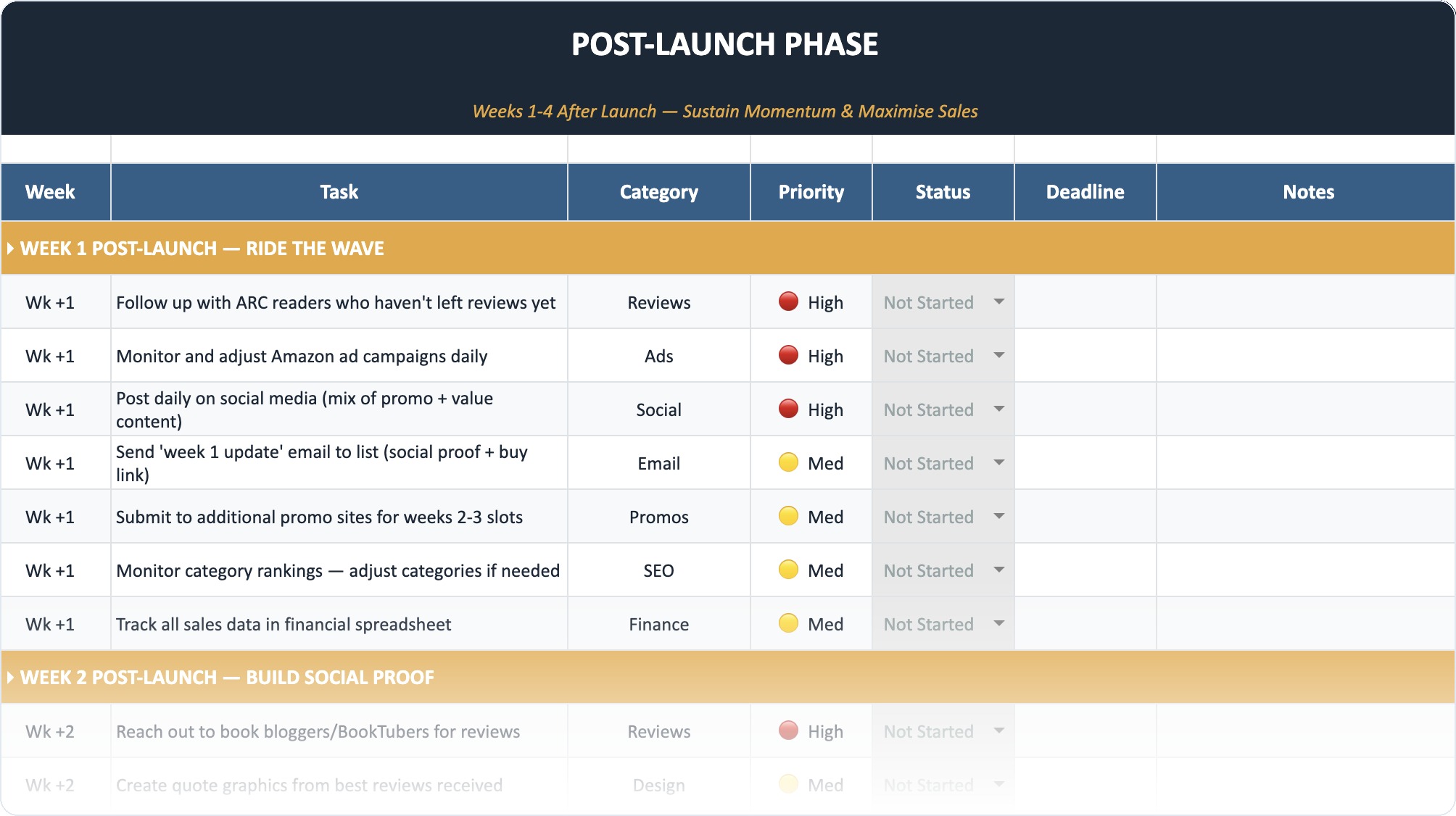
The Self-Publishing Launch Checklist (2026)
A week-by-week spreadsheet that walks you through every step of launching your book. Available as an Excel file and Google Sheet.
Frequently Asked Questions
Can I use the exact output from ChatGPT for my book description?
You technically can, but you shouldn't. AI output often triggers "spam filters" in readers' brains because it sounds generic. Use the AI text as a strong skeleton, then rewrite the verbs and adjectives to match your unique voice.
Will Amazon ban my book if I use AI for the blurb?
No. Amazon asks if you used AI to create the content of the book (the actual story or images). Using AI to write marketing copy like blurbs, emails, or ads is standard industry practice and does not require a disclaimer on KDP at this time.
How detailed should my prompt be?
The more detailed, the better. Include the protagonist's name, age, job, the central conflict, the antagonist, and the stakes. If you can, include the tone (e.g., "witty and sarcastic" or "dark and brooding").
What if the AI blurb sounds too cheesy?
This is common. It usually happens because the AI is trying too hard to sell. Add the instruction: "Write in a grounded, realistic tone. Avoid hyperbolic words like 'unbelievable', 'breathtaking', or 'rollercoaster of emotions'."
Does this work for non-fiction?
Yes, but the prompts need to change. For non-fiction, focus on the "Problem-Agitation-Solution" framework. Ask ChatGPT to highlight the specific pain points the reader has and how your book solves them.
Which AI model is best for creative writing?
GPT-4 (and newer versions like GPT-4.5) is generally superior to GPT-3.5 for creative nuance. Claude is also excellent for maintaining a consistent, human-like tone and is less prone to "purple prose."