

- An ARC (Advance Reader Copy) team is your most powerful tool for launching a book with social proof and triggering Amazon's algorithm on day one.
- Recruitment must focus on quality over quantity; a small team of 20 reliable reviewers is worth more than 200 silent free-loaders.
- You must use dedicated distribution tools like BookFunnel or StoryOrigin to protect your files and track downloads rather than emailing PDFs directly.
You spend months, maybe years, writing a book. You pay for editing. You agonize over the cover design. Finally, release day arrives. You hit publish. And then? Silence.
No one buys a book with zero reviews. It is the classic chicken-and-egg problem of self-publishing. Readers wait for social proof to buy, but you cannot get social proof without buyers. This is where an ARC (Advance Reader Copy) team saves the day.
I believe building a reliable ARC team is the single most important marketing asset an author can own in 2026. It is not just about getting five stars; it is about training a dedicated squad of superfans who help you launch every future book with immediate momentum.
Here is exactly how I approach building an ARC team that actually shows up, does the work, and helps you sell books.
What Is an ARC Team?
An ARC team is a group of volunteers who receive a free, early copy of your book in exchange for an honest review. The "exchange" part is critical. This is not a giveaway. It is a professional handshake agreement. You provide early access and entertainment; they provide the social proof you need to survive in the algorithm.
These readers are your ground troops. When you wake up on launch day, your goal is to have reviews waiting for you. This signals to retailers that your book is relevant, active, and worth showing to paying customers.
According to independent analysis on sales data, there is an 88% correlation between the number of reviews a product has and its sales figures. You cannot afford to skip this step. Without an ARC team, you are essentially launching into a void.
Stop Staring at a Blank Page
Publy is a distraction-free book editor with AI built in. Brainstorm plot ideas, get instant chapter reviews, or rewrite clunky paragraphs. 3 million free words included.

Why You Need a Team in 2026
The book market has shifted. In previous years, you might have relied on organic discovery or cheap ads. Today, the volume of content is overwhelming.
The Algorithm Needs Fuel
Amazon, Kobo, and Barnes & Noble rely on data points. A sudden influx of reviews and verified downloads tells their systems that your book is a "hot new release." This visibility is what drives organic traffic. If you want to know more about tactics to boost Amazon book sales, it almost always starts with this initial surge of activity.
Review Rates Are Dropping
Organic review rates are abysmal. Data suggests that only about 1% to 2% of buyers leave a review naturally. That means for every 100 copies you sell, you might get one or two reviews. That math does not work for a new author. You need a system to guarantee feedback.
Niches Are Deeper
Readers in 2026 are highly specific. We are seeing the rise of micro-genres like "cozy fantasy" or "dark academia" dominating the charts. General audiences might not get your book, but your specific niche will devour it. An ARC team allows you to target these specific super-readers directly.
Step 1: Finding Your Ideal Readers
You do not want just anyone on your team. You want your readers. A bad ARC match is worse than no reviewer at all because they might leave a negative review simply because the genre wasn't for them.
Where to Look
Start with your existing newsletter. These people already like you. If you don't have a list, you have to hit the streets, digitally speaking.
Social Media Scouting
Instagram and TikTok are goldmines. Search for hashtags related to your genre (e.g., #fantasybooks, #romancereaders). Look for users who post reviews, not just pretty pictures. Engaging with using TikTok for author marketing is incredibly effective here. You can post a simple video: "I'm looking for 5 people to read my new dragon rider book for free. Comment 'ARC' if interested."
Facebook Groups
There are hundreds of "ARC Reader" groups. Be careful here. Many people in these groups just want free stuff. You have to filter them heavily.
The "Similar Author" Strategy
Look at reviews of books similar to yours. Click on the profiles of reviewers who left thoughtful, detailed reviews. You can sometimes find their contact info or blog link on their profile. Reach out politely. "I saw you loved [Book X]. I wrote something similar and would love to send you a copy."
Step 2: Vetting Your Team
Never post a direct download link on the internet. You will get piracy, not reviews. You must vet every applicant.
Create a Google Form or Typeform for potential team members to fill out. Do not make it too hard, but ask enough to verify they are serious.
Questions to Ask:
- Name and Email: obviously.
- Link to Amazon/Goodreads Profile: This is the most important question. Click the link. Do they review often? Are they mean? Do they only read cookbooks when you write sci-fi?
- What genres do you read?
- Are you able to leave a review by [Date]? Get a commitment upfront.
I reject anyone who does not provide a profile link. I also reject people whose average review rating is 2 stars. Some people are just impossible to please, and you do not need that energy during launch week.
Step 3: Distributing Your Book Safely
Do not email a PDF attachment. It looks unprofessional, it is hard to read on a Kindle, and it is easy to pirate.
Use a service like BookFunnel or StoryOrigin.
These tools allow you to upload your EPUB and PDF files. They generate a unique landing page for your readers.
- Support: They handle the tech support. If a reader can't get the file onto their Kindle, BookFunnel's support team helps them, not you.
- Watermarking: Some services offer watermarking to discourage sharing.
- Tracking: You can see exactly who downloaded the file and when.
This small investment separates professional authors from amateurs. It creates a smooth experience for your reviewers.
Step 4: Managing the Team for Maximum Reviews
Getting them to download the book is easy. Getting them to actually read and review it is the hard part. Consumer review habits show that people are busy and forgetful. You must be the project manager.
The Communication Schedule
Do not ghost your team. Here is the schedule I use:
- Acceptance Email: "Welcome to the team! Here is your link. Review due by [Date]."
- The "Halfway" Check-in: Two weeks before the deadline. "Hope you are enjoying the book! Here is a favorite quote of mine from Chapter 10."
- Launch Day (The Big Ask): "The book is live! Here is the direct link to the review page. Thank you so much!"
- The Follow-Up: 3-5 days after launch. "Just a gentle reminder for those who haven't had a chance yet."
The 80% Rule
You will never get 100% participation. Life happens. People get sick. If you get 80% of your ARC team to review, you are winning.
However, you must prune your list. After the launch is over, check who reviewed. If someone took the book and ghosted you, remove them from the list for the next book. A small, active team is better than a massive, silent one.
Platforms vs. DIY: Which is Right for You?
You can build your own team manually, or you can pay a service to put your book in front of established reviewers.
| Feature | DIY (Email List) | BookSirens | NetGalley |
|---|---|---|---|
| Cost | Free (Time-intensive) | $10/book + $2/reader | $450+ (Expensive) |
| Reader Quality | High (They know you) | High (Vetted readers) | Mixed (Professionals & casuals) |
| Control | 100% Control | Moderate | Low |
| Best For | Long-term career building | New authors with no list | Big budget / Trad pub feel |
NetGalley is the industry standard for traditional publishers, but it is pricey. BookSirens is excellent for indie authors because you largely pay for results.
If you are just starting, I recommend a hybrid approach. Use BookSirens to find new readers, and then invite those reviewers to join your private DIY list for the next book. This helps with strategy for publishing a book series, as you carry fans from Book 1 to Book 2.
The Self-Publishing Launch Checklist (2026)
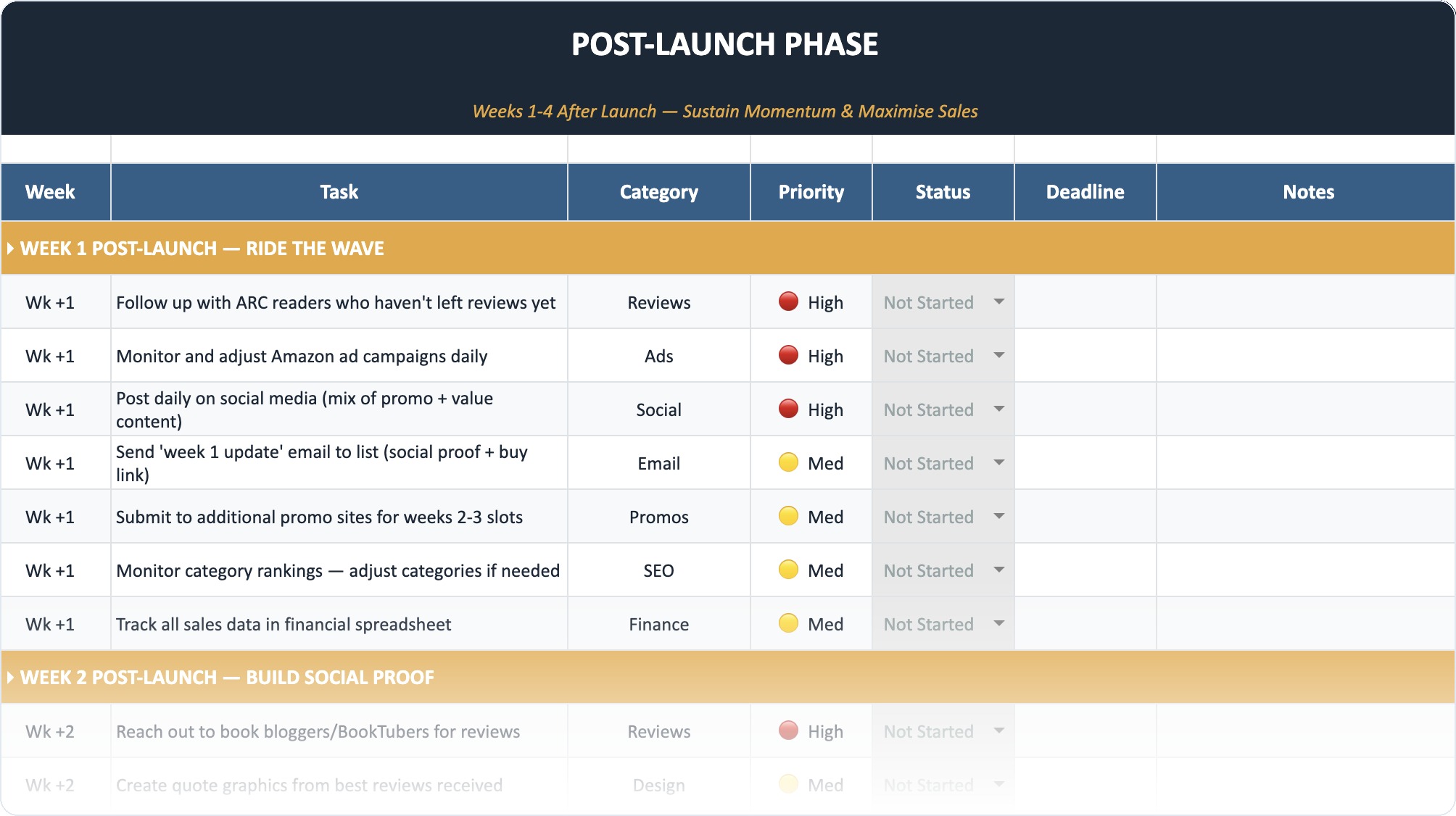
A week-by-week spreadsheet that walks you through every step of launching your book. Available as an Excel file and Google Sheet.
Avoiding the Amazon Ban Hammer
Amazon is strict about reviews. They want unbiased customer feedback. If they suspect you are gaming the system, they will block your reviews or even suspend your account.
The Golden Rules of Compliance:
- No Payment: Never pay someone to review your book. Paying for a service like NetGalley is fine because you are paying for access to the platform, not the review itself. But you cannot PayPal a reader $50 for a 5-star rating.
- No Family: Do not ask your mom or your cousin to review. Amazon knows who your relatives are through shipping addresses and gift history.
- The Disclaimer: Remind your readers to include the standard disclaimer: "I received a free copy of this book and am voluntarily leaving a review." This is required by the FTC and Amazon.
Recent industry data on review generation suggests that Amazon is getting faster at detecting "review swaps" (I review yours, you review mine). Avoid formal swap rings. Stick to genuine readers.
Advanced Tactics for 2026
Once you have the basics down, you can level up.
Gamification
Make it fun. Offer a prize for the "Best Review Headline" or a giveaway for everyone who reviews within 24 hours of launch. Note: You are rewarding the act of reviewing quickly, not the star rating.
Using Tools for Precision
Before you send your ARCs, ensure your book is positioned correctly. I use tools like Publisher Rocket to ensure my categories and keywords are perfect. When your ARC team reviews hit, you want them to propel you up the right charts, not obscure ones where real readers won't find you.
Tiered Teams
As your team grows, create an "Elite" tier. These are the 50 people who always review on day one. Send them physical swag, signed bookplates, or exclusive bonus content. Treat them like VIPs. They are the engine of your business.
The Long Game
Building an ARC team is not a one-time task. It is a career-long project. Your first team might be five people. That is fine. Treat those five people like gold.
Remember that reader tastes change. 2025 reading trends indicate a shift toward shorter, serialized content and audiobooks. You might need to adapt your ARC team to include audiobook listeners or people who prefer shorter novellas.
Be patient. Be professional. And most importantly, write a book that is worth reviewing. No amount of marketing can fix a bad story, but a great story with a strong ARC team is unstoppable.
Frequently Asked Questions
What does ARC stand for?
ARC stands for Advance Reader Copy. It is a pre-publication version of the book sent to reviewers, librarians, and booksellers to generate buzz before the official release date.
Can I sell my ARC copies?
No. ARC copies are not for resale. They are promotional materials. If you see your ARC on sale at a used bookstore, it usually means a reviewer traded it in, which is frowned upon but hard to prevent.
How many ARC readers do I need?
Aim for 20 to 50 reliable readers when starting out. A team of 20 people who actually review is far superior to a list of 500 people who ignore you.
Is it against Amazon's terms to give free books for reviews?
No, as long as you do not require a positive review and you do not pay money for the review. Providing the product itself (the book) for free is standard industry practice.
When should I send out ARCs?
Ideally, send them out 2 to 4 weeks before your release date. This gives people enough time to read the book without feeling rushed, but keeps the story fresh in their minds for launch day.