

- A strong backlist is the only reliable way to stabilize monthly income as an author.
- Focus on series read-through rates rather than individual book launches to maximize profit.
- Update covers and blurbs every 18 to 24 months to keep older titles relevant in search results.
- Use aggressive pricing strategies like permafree first-in-series to funnel readers into your paid library.
Authors obsess over launch day. But the real money arrives three years later on a random Tuesday afternoon. If you want a career that pays the mortgage, you don't need a single bestseller. You need to build a book backlist that works for you while you sleep.
The math is simple but brutal. A single book fights for attention every day. A library of twenty books creates a net that catches readers and won't let them go. With one book, you spend 100% of your marketing budget to sell one product. With ten books, you spend that same budget to sell the first one. The other nine sell themselves.
Let's break down exactly how to construct this asset. We'll look at why old books sell better than new ones and how to fix a "dead" book. We will also cover the exact pricing ladders that turn casual browsers into superfans. This isn't about writing faster; it's about writing smarter.
The "Iceberg" Economy of Publishing
New releases get all the glory. They get the release parties, the social media buzz, and the newsletter blasts. Check the bank accounts of full-time indie authors though. New releases are just the tip of the iceberg. The massive, unseen bulk of their income comes from books they wrote five, ten, or fifteen years ago.
Traditional publishing relies heavily on this model too. According to The New York Times sales data analyzed by Jane Friedman, backlist titles dominated the charts in 2025. Only one of the top ten bestselling print nonfiction titles was a new release. The industry runs on old books.
Why Backlist Beats Frontlist
Frontlist sales are volatile. They spike during launch week and then drop off a cliff. This "shark fin" sales curve gives most authors anxiety. You make $5,000 in January and $200 in February. That isn't a business. That's a gamble.
Backlist sales are a flat line. They're boring. Frankly, boring is good for paying bills. When you build a book backlist effectively, you stack these flat lines on top of each other.
- Book A makes $50 a month.
- Book B makes $100 a month.
- Book C makes $75 a month.
Individually, they look like failures. Together, they equal a salary.
The Reader's Perspective
Readers don't care when a book was published. They only care if it's new to them. A reader discovering your 2020 mystery novel today gets the exact same thrill as the person who bought it on launch day. In fact, they might be happier because they don't have to wait for the sequel.
Data supports this shift in consumption. A recent breakdown of reading habits from Buried in Print showed a significant drop in new release consumption. It moved from 52% new releases in 2024 to just 35% in 2025. Readers are digging into the archives.
The Series Strategy: Your Read-Through Engine
Writing in series is the most efficient way to build a book backlist. Standalone novels are hard mode. You have to convince a reader to trust you all over again with every single book.
With a series, you only have to sell the reader once.
Calculating Read-Through
Read-through rate (RTR) is the percentage of people who buy Book 1 and go on to buy Book 2. If you sell 100 copies of Book 1 and 60 people buy Book 2, your RTR is 60%.
Your goal is to increase this number. A high RTR means you can afford to lose money advertising Book 1 because you know you'll make it back on Books 2, 3, and 4.
Calculate your read-through rate every 90 days. If the drop-off from Book 1 to Book 2 is higher than 50%, stop writing new books. Fix Book 1. It is likely the problem.
The "Completed Series" Hook
Readers in 2026 are impatient. They've been burned by authors who never finish their series (we won't name names). Slap "The Complete Series" on your Amazon page and your conversion rate often doubles.
This changes your writing strategy. Instead of releasing one book a year for three years, consider writing all three and rapid-releasing them over three months. This keeps the algorithm hot and captures readers who binge-read. If you want to learn more about structuring multiple books, check out our guide on how to create a successful book series.
Stop Staring at a Blank Page
Publy is a distraction-free book editor with AI built in. Brainstorm plot ideas, get instant chapter reviews, or rewrite clunky paragraphs. 3 million free words included.

Keeping Ghosts Alive: Visibility for Older Titles
A book isn't dead just because it stopped selling. It's usually just invisible. Amazon's algorithm prioritizes recency and sales velocity. If a book hasn't sold a copy in thirty days, it falls into the abyss.
You have to drag it back out.
The "First in Series" Funnel
The most common tactic involves making the first book in a series permanently free (Permafree) or $0.99. This removes the barrier to entry. You're essentially giving away a sample to sell the rest of the backlist.
Does it work? Yes, but you need volume. A permafree book needs thousands of downloads to generate significant read-through revenue.
| Strategy | Price | Pros | Cons |
|---|---|---|---|
| Full Price | $4.99+ | Higher royalty, perceived value | Lower volume, harder to get new readers |
| The 99c Loss Leader | $0.99 | Impulse buy range, ranks on paid charts | Low royalty (35%), attracts bargain hunters |
| Permafree | $0.00 | Maximum volume, massive email signups | No royalty, ineligible for some ad sites |
Automated Email Sequences
Your newsletter is the only algorithm you own. When a reader signs up for your list, don't just send them a monthly update. Build an automated welcome sequence (autoresponder) that sells your backlist.
- Email 1 (Day 0): Here is your free book (Lead Magnet).
- Email 2 (Day 3): Did you know I wrote a book about [Topic]? Here is a 99c coupon.
- Email 3 (Day 7): Here is the backstory of my most popular character.
This sequence runs 24/7. It sells books you wrote five years ago to people who joined your list five minutes ago. For more on setting this up, read our article on building a newsletter signup flow.
The Art of the Relaunch
Sometimes a book fails because the packaging was wrong. Covers age faster than text. A cover that looked trendy in 2020 might look amateur or dated in 2026.
When to Re-Cover a Book
Look at the Top 100 bestsellers in your genre right now. Do their covers look like yours? Be honest. Your thriller has a shadowy figure and a gun, but the current bestsellers all have bold yellow typography and abstract shapes. You're signaling to readers that your book is "old."
Changing a cover is the single highest-ROI activity for a backlist book. It resets the reader's perception. They see it as a "new" product.
For tips on visual consistency across multiple titles, see our guide on book series cover design.
Rewriting Blurbs
Your book description (blurb) is a sales pitch, not a summary. If your conversion rate is low (people click your ad but don't buy), the blurb is usually the culprit.
Test new hooks. Try starting with a question. Try starting with a quote. You don't need to rewrite the book, just the wrapper. Authors often find that a relaunch strategy can revive a title that's been dormant for years.
Cross-Promotion: The Silent Salesman
Never have dead ends in your books. The last page of Book A must sell Book B.
The "Also Bought" Algorithm
Amazon's "Customers who bought this also bought" section is powerful social proof. You influence this by cross-promoting with authors in your genre. If you and a similar author shout each other out in your newsletters on the same day, Amazon sees customers buying both books simultaneously. It links your books together forever.
Back Matter Sales
The "back matter" is the pages after "The End." Most authors waste this space with acknowledgments.
Put a massive link and image of your next book right there. "Enjoyed this? Grab the sequel now." Make it impossible to miss. If you have ten books, every single one of them should point to another one. It's a closed loop.
Realistic Timelines: The 3-Year Rule
Building a backlist takes time. It isn't a get-rich-quick scheme.
- Year 1: You are writing. You are losing money. You are shouting into the void. You might have 3 books out.
- Year 2: You have 6-8 books. You start to see consistent monthly income, maybe $500-$1000/month if you market well.
- Year 3: You have 10+ books. The compound effect kicks in. Fans of Book 10 go back and buy Book 1. Fans of Book 1 finally get around to buying Book 10.
Predictions from industry experts suggest this long-tail is getting longer. The Bookseller's 2026 forecast notes that books are maintaining sales momentum over extended periods rather than fading out. This rewards authors who stay in the game.
The most important thing for an author's career is not the next book, but the body of work.
Joanna Penn
Ads for Old Books
Many authors think they can only run ads on new releases. This is false. In fact, it's often more profitable to run ads on the first book of a completed series.
Advertise a new release and you make the royalty on that one book. Advertise Book 1 of a 10-book series and you make the royalty on Book 1, plus the read-through revenue of the other nine books. Your "Cost Per Click" (CPC) can be higher because your "Average Customer Value" (ACV) is much higher.
If you're new to paid traffic, start small. Read our Amazon KDP advertising guide to understand the bid mechanics before you spend your budget.
Quality Control Over Time
The book you wrote five years ago might not be your best work. As you improve, your backlist can start to look like a liability.
Don't delete old books. They are assets. But do consider "remastering" them. Fix the typos. Tighten the pacing. Upload a new interior file. The "edition" stays the same, but the product improves. This prevents bad reviews from new readers who expect your current level of quality from your debut novel.
The Mental Shift
You stop being just a writer. You become an asset manager. Your job is to monitor your portfolio. Which assets are underperforming? Which ones need a facelift? Which ones are your reliable cash cows?
This detachment is healthy. It stops you from taking bad sales personally. If a book isn't selling, it isn't because you're a bad person. It's because the asset isn't optimized for the current market. Fix the asset.
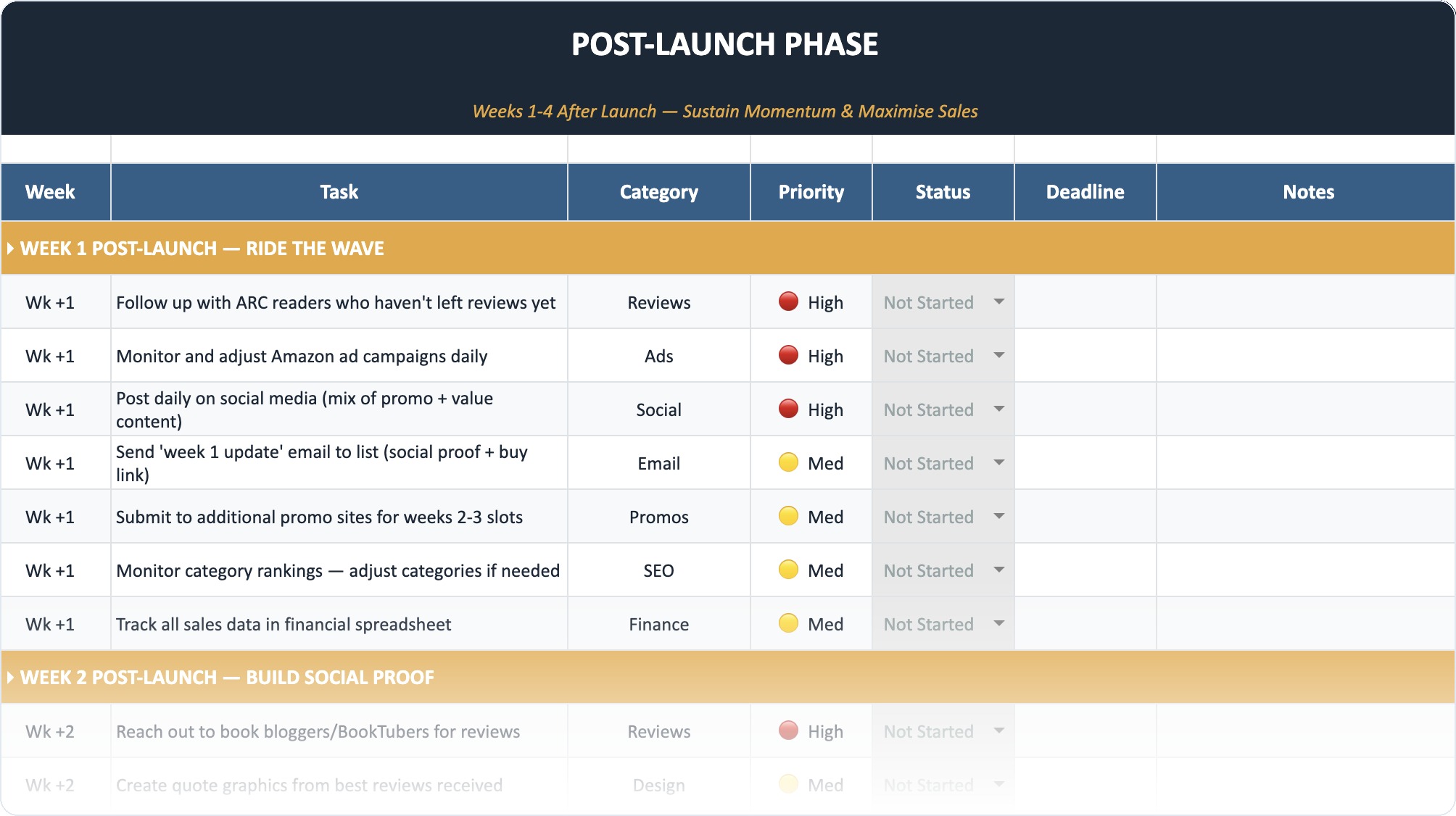
The Self-Publishing Launch Checklist (2026)
A week-by-week spreadsheet that walks you through every step of launching your book. Available as an Excel file and Google Sheet.
Future-Proofing Your Backlist
Audiobooks and translations are multipliers. Once you have the manuscript, you can license it into other formats. An audio listener is often a completely different customer than a Kindle reader. You're selling the same story to two different markets.
Indie authors are seeing massive growth here. Joanna Penn's 2026 trends discussion highlights how AI narration and direct sales are making it easier to monetize a backlist in multiple formats. You don't need the massive overhead of traditional production anymore.
Summary Checklist
If you want to build a book backlist that pays, follow this order of operations:
- Write more books. You can't market a backlist you don't have.
- Focus on series. They monetize better than standalones.
- Optimize the First in Series. It's the gateway to your income.
- Update covers regularly. Keep the packaging fresh.
- Build an email list. Own your customer data.
It's a slow climb. But the view from the top, where you earn money from work you did a decade ago, is worth every step.
- Consistent monthly income
- Higher ROI on ads
- Compound growth over years
- Takes 3-5 years to build
- Requires cover updates
- "Boring" marketing work
Frequently Asked Questions
How many books do I need for a backlist?
You need at least three books to see any real momentum. The "magic number" for many full-time authors is around twenty titles. This provides enough inventory to run effective promotions and ads where the read-through pays for the marketing costs.
Should I rewrite my first book?
Only if the reviews consistently mention poor quality or typos. If the book is just "early work" but technically sound, leave it. Your time is better spent writing the next book. Readers often enjoy seeing an author's progression.
Can I build a backlist with standalone novels?
Yes, but it's harder. You need to connect them by genre or theme. Market them as a "collection" rather than a series. Make sure your branding and cover design are identical so readers instantly recognize they are from the same author.
How often should I discount my backlist?
Rotate your promotions. Discount Book 1 in January. Discount a box set in April. Never let your entire catalog sit at full price for too long without some activity to drive traffic. Use sites like BookBub or Fussy Librarian to push these discounts.
Is permafree still effective in 2026?
Permafree is less effective for rank boosting than it was ten years ago, but it's still the best tool for lead generation. Use it to build your newsletter rather than expecting direct income.
What if my genre changes?
If you switch genres (e.g., from Sci-Fi to Romance), consider using a pen name. If you keep one name, separate the backlists on your website. Don't confuse the Amazon algorithm by having customers buy a spaceship novel and a Regency romance at the same time.
How do I market a book released 10 years ago?
Treat it like a new release. Give it a new cover. Write a new blurb. Run an "anniversary edition" sale. To a reader who has never seen it, it's a brand new book.