

- Writers can deduct up to 20% of net income via the Qualified Business Income (QBI) deduction.
- The "One Big Beautiful Bill Act" made TCJA tax cuts permanent and raised the SALT cap to $40,000 for 2025 returns.
- You must prove a profit motive (3 out of 5 years) to avoid the IRS "hobby loss" limitations.
- [External Source] Track expenses using software as the IRS has discontinued Direct File for 2026.
Writing is often seen as a low-overhead career. You grab a laptop, find a coffee shop, and start typing. However, the moment you decide to publish and sell your work, you enter the complex world of self-employment taxation. For the 2026 tax season (filing for the 2025 tax year), the rules have shifted yet again. I know that staring at a Schedule C form is far less exciting than plotting a novel, but understanding tax deductions for writers 2026 is the only way to keep your hard-earned royalties.
The government does not make it easy. Between the self-employment tax rate of 15.3% and the confusing thresholds for 1099-K forms, it feels like the system is designed to trip us up. But there is good news. The "One Big Beautiful Bill Act" (OBBBA), signed in July 2025, has solidified many tax breaks that were set to expire. If you know where to look, you can legally lower your taxable income significantly.
I am going to walk you through everything you need to know. We will look at the new laws, the standard deduction changes, and a massive list of write-offs that many authors forget to claim.
The 2026 Tax Landscape for Writers
Before we get into the specific list of deductions, you need to understand the playing field. The 2025 tax year brings a few major changes that affect how you file in 2026. If you are used to the old rules, pay attention because the OBBBA has altered the math.
The "One Big Beautiful Bill Act" Impact
The biggest news for this filing season is the OBBBA. This legislation effectively made the Tax Cuts and Jobs Act (TCJA) tax cuts permanent. For years, accountants warned us that tax brackets might snap back to higher 2017 levels. That did not happen. The current brackets remain lower, ranging from 10% to 37%.
More importantly for writers in high-tax states like New York or California, the State and Local Tax (SALT) deduction cap has changed. It used to be stuck at $10,000. For 2025 returns, this cap has increased to $40,000. This is a massive win if you own a home or pay significant state income taxes.
Standard Deduction vs. Itemizing
You have a choice to make every year. You can take the standard deduction or you can itemize. For the 2026 filing season, the standard deduction has jumped again due to inflation and the OBBBA boost.
- Single Filers: Approximately $15,750
- Married Filing Jointly: Approximately $31,500
- Heads of Household: Approximately $23,625
Most writers will stick with the standard deduction for their personal taxes. However, business deductions are different. You claim business deductions on Schedule C in addition to your standard deduction. You do not have to choose between writing off your editor and taking the standard deduction. You get both.
The Self-Employment Tax Reality
This is where new authors often get hit hardest. When you worked a day job, your employer paid half of your Social Security and Medicare taxes. Now that you are the boss, you pay both halves.
- Total Rate: 15.3%
- Breakdown: 12.4% for Social Security + 2.9% for Medicare.
- Calculation: Applied to 92.35% of your net earnings.
The silver lining here is that you can deduct half of this tax from your gross income. It lowers your overall adjusted gross income (AGI), which can help you qualify for other credits.
1099-K Threshold Reversion
There was a lot of panic regarding payment platforms like PayPal and Venmo. The threshold was supposed to drop to $600, meaning almost everyone would get a form. The IRS realized this was a logistical nightmare. For the 2026 tax season, they reverted to the old rule. You will generally only receive a Form 1099-K if you have gross payments exceeding $20,000 AND more than 200 transactions.
Warning: Just because you do not get a form does not mean you can ignore the income. You must report every cent of royalties or freelance fees.
Hobby vs. Business: The IRS "Profit Motive"
I see writers make this mistake constantly. They spend thousands on covers and ads but earn very little, so they try to write off the loss against their spouse's income. The IRS has a weapon against this called the "Hobby Loss Rule."
If the IRS classifies your writing as a hobby, you cannot deduct expenses in excess of your income. You cannot claim a loss. To prove you are a legitimate business, you generally need to show a profit in three out of the last five tax years.
If you are not profitable yet, you need to operate like a business to prove your intent.
- Maintain a separate business bank account.
- Keep a rigorous log of hours worked.
- Create a business plan.
- Actively market your work (do not just write and hope).
If you treat your writing like a business, the IRS is more likely to respect your deductions.
Stop Staring at a Blank Page
Publy is a distraction-free book editor with AI built in. Brainstorm plot ideas, get instant chapter reviews, or rewrite clunky paragraphs. 3 million free words included.

The Big Three: Major Author Deductions
These are the heavy hitters. These three categories usually make up the bulk of your schedule c for writers deductions.
1. The Home Office Deduction
This is the most common deduction for writers, but it is also the most misunderstood. To qualify, you must use a portion of your home exclusively and regularly for business. The dining room table does not count if you also eat dinner there. It must be a dedicated space.
You have two ways to calculate this:
- Simplified Method: You deduct $5 per square foot of your office area, up to 300 square feet. The maximum deduction is $1,500. This is easy, requires less paperwork, and is less likely to trigger an audit.
- Regular Method: You calculate the percentage of your home used for business (e.g., your office is 10% of the house). You then deduct 10% of your mortgage interest, rent, utilities, insurance, and repairs.
Pro Tip: If you live in a high-cost area, the regular method usually yields a much higher deduction than $1,500.
2. Qualified Business Income (QBI) Deduction
This is a gift from the tax code to small business owners. Most self-published authors operate as sole proprietors. Under current law, you may be able to deduct up to 20% of your net business income from your taxes.
This is not an expense you pay; it is a deduction based on profit. If your net profit after expenses is $50,000, you might be able to knock another $10,000 off your taxable income just because you are a business owner. High earners have phase-out limits, but for most mid-list authors, this is substantial.
3. Startup Costs
Did you launch your publishing business in 2025? You can deduct up to $5,000 in startup costs in your first year. This includes market research, business entity formation fees (LLC costs), and initial advertising before you officially opened for business. If your startup costs exceed $50,000, this deduction reduces, but for most writers, the $5,000 cap covers the initial launch nicely.
50 Unexpected Tax Deductions for Writers
Now, let’s get into the weeds. You spend money to make money. Here is a comprehensive checklist of author expenses you should be tracking.
Writing & Research Expenses
- Books and Audiobooks: Yes, reading is part of your job. You need to know the market. If you write thrillers, buying the latest bestsellers in your genre is market research.
- Streaming Subscriptions: If you write screenplays or analyze plot structures in TV shows, services like Netflix or Hulu can be partially deductible. Be careful to calculate the business-use percentage honestly.
- Magazine Subscriptions: Subscriptions to Writer’s Digest, Poets & Writers, or genre-specific magazines are fully deductible.
- Research Trips: If you are writing a book set in Rome, a trip to Rome might be deductible. However, the primary purpose must be business. You cannot take a two-week vacation and spend one hour taking notes. The itinerary must be research-focused.
- Museum Tickets: Essential if you are researching historical fiction or art history for a manuscript.
- Software Subscriptions: Scrivener, Vellum, Microsoft Office 365, ProWritingAid, and Grammarly are all standard business deductions.
- Stock Photos: Images used for character inspiration boards or cover mockups.
- Cloud Storage: Dropbox, Google Drive, or iCloud storage fees used to back up your manuscripts.
- Sensitivity Readers: Payments to professionals who review your work for cultural accuracy.
- Transcription Services: Tools like Otter.ai or Rev used to transcribe interviews or dictation.
Marketing & Promotion
- Website Hosting & Domain Names: Your author website is your storefront. GoDaddy, Bluehost, Squarespace, and Wix fees are 100% deductible.
- Email Marketing Services: Monthly fees for MailerLite, ConvertKit, or Mailchimp.
- Advertising: Facebook Ads, Amazon Ads, BookBub features, and TikTok promotions.
- Social Media Schedulers: Buffer, Hootsuite, or Later subscriptions.
- Book Covers: Payments to cover designers.
- Beta Reader Gifts: Gift cards or small tokens of appreciation sent to your beta reading team.
- Swag: Bookmarks, stickers, mugs, and t-shirts used for giveaways.
- Contest Entry Fees: Fees for submitting your book to the Pulitzer, Hugo, or local library awards.
- Review Services: Fees paid to legitimate review services like Kirkus or NetGalley (not paying for positive reviews, but paying for the platform access).
- Giveaway Postage: The cost of mailing signed paperbacks to contest winners.
- Launch Party Expenses: Venue rental, catering, and decorations for a book launch event.
Office & Technology
- Computers and Laptops: You cannot write without one. You can depreciate the cost over several years or use Section 179 to deduct the full price in the year of purchase.
- Tablets and E-readers: Kindles or iPads used for proofing ebooks.
- Printers and Ink: Manuscripts consume a lot of ink.
- Paper and Office Supplies: Notebooks, pens, staples, and sticky notes.
- Office Furniture: Ergonomic chairs, standing desks, and bookshelves.
- Internet Service: You can deduct the percentage of your internet bill used for business.
- Cell Phone: Similar to internet, deduct the business percentage of your mobile bill.
- Headphones: Noise-canceling headphones are essential for focus in noisy environments.
- Computer Repairs: Geek Squad visits or hard drive recovery services.
Professional Development & Networking
- Conferences: Tickets to NINC, 20BooksTo50k, or local writer’s conferences.
- Online Courses: MasterClass, Udemy, or private courses on craft and marketing.
- Writing Retreats: The cost of the retreat itself (lodging/fees). Travel to the retreat is also deductible.
- Organization Dues: Memberships to the Authors Guild, RWA, SFWA, or similar professional bodies.
- Coaching/Mentoring: Fees paid to a writing coach or marketing mentor.
- Business Meals: You can generally deduct 50% of the cost of a meal if you are meeting with an agent, editor, or co-author to discuss business.
Fees & Professional Services
- Editing: Developmental editors, copy editors, and proofreaders.
- Formatting: Payments to formatters or software like Vellum.
- Illustration: Art for children’s books or fantasy maps.
- Legal Fees: Lawyers hired to review contracts or handle copyright infringement.
- Tax Preparation: The fee you pay your accountant to prepare your Schedule C.
- Copyright Registration: The fee paid to the US Copyright Office.
- ISBNs: Purchasing ISBNs from Bowker.
- Agent Commissions: If your agent takes 15% before you get paid, you report the gross income and deduct the commission.
- Merchant Fees: PayPal or Stripe processing fees.
- Virtual Assistants: Payments to VAs who handle your email or social media.
Lifestyle & Financial
- Health Insurance: If you are self-employed and not eligible for a spouse’s plan, you may be able to deduct premiums on Schedule 1 (not Schedule C), but it still lowers your tax bill.
- Retirement Contributions: Contributions to a SEP IRA or Solo 401(k) reduce your taxable income dollar-for-dollar.
- Bank Fees: Service charges on your business bank account.
- Interest on Business Loans: Interest paid on credit cards or loans used exclusively for business expenses.
Understanding Schedule C: Where to Put It All
The Schedule C (Form 1040) is the scorecard for your writing business. It lists your "Profit or Loss From Business."
Part I: Income
This is where you list your gross receipts. This includes royalties from Amazon KDP, payments from draft2digital, direct sales from your website, and freelance writing checks. You must compare this number against the 1099s you received. According to tax experts, underreporting income here is the fastest way to trigger an automated audit notice.
Part II: Expenses
This is where the magic happens. The form breaks expenses down into categories like "Advertising," "Legal and professional services," and "Office expense."
- Advertising: Ads, website hosting, swag.
- Legal/Professional: Editors, cover designers, accountants.
- Office Expense: Software, postage, supplies.
- Other Expenses: This is a catch-all section on the back of the form where you can list specific items that do not fit the main categories, like "Research Materials" or "Dues and Subscriptions."
If your expenses (Part II) exceed your income (Part I), you have a business loss. This loss can usually be deducted from other income you have, such as wages from a day job. This effectively refunds some of the taxes you paid on your W-2 income.
The Self-Publishing Launch Checklist (2026)
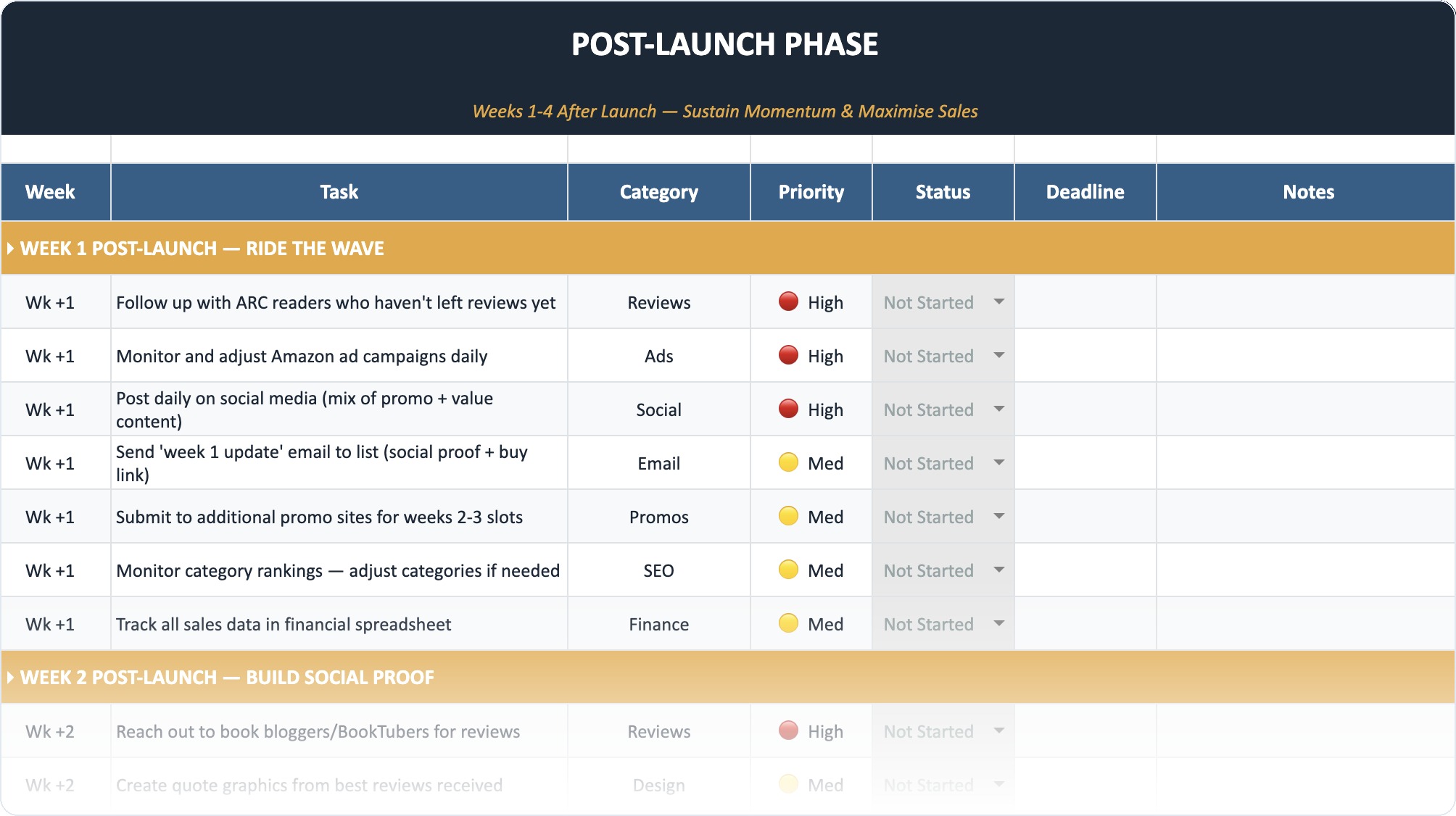
A week-by-week spreadsheet that walks you through every step of launching your book. Available as an Excel file and Google Sheet.
The Strategy of Internal Consistency
One concept you must grasp is internal consistency. The IRS computer systems look for outliers. If you earn $2,000 in royalties but claim $15,000 in travel expenses, that raises a red flag. It does not mean the deduction is illegal, but it invites scrutiny.
You need to ensure your story makes sense. If you are writing non-fiction about gardening, a trip to a botanical garden makes sense. If you are writing sci-fi set in space, a trip to Hawaii is harder to justify.
When you are buying tools to improve your craft, consistency matters. If you are studying styles, perhaps analyzing how to write a book like Ernest Hemingway counts as educational research, provided you buy his books for study. Similarly, if you invest in software, verify it is industry standard. Whether you use Vellum or check out a Book Bolt review to decide on software, keep that receipt and note why you bought it.
Marketing platforms are another huge expense. Setting up your profile and understanding what Amazon Author Central is takes time, and while time isn't deductible, the costs associated with your brand assets are.
Finally, platform fees add up. When deciding between IngramSpark vs KDP, remember that setup fees or revision fees for either platform are fully deductible business expenses.
Quarterly Estimated Taxes: Avoid the Penalty
Since no employer is withholding taxes from your book sales, the IRS expects you to pay as you go. If you owe more than $1,000 in tax at the end of the year, you should have been making quarterly payments.
Deadlines:
- April 15
- June 15
- September 15
- January 15 (of the following year)
You use Form 1040-ES to calculate these. If you skip them, the IRS will charge you an underpayment penalty. I recommend setting aside 25% to 30% of every royalty check into a separate savings account so you are not scrambling when these dates arrive.
Record Keeping: Your Shield Against Audits
You can have all the deductions in the world, but if you cannot prove them, they are worthless. The "Cohen Rule" (a famous court case) allows for some estimation, but you do not want to rely on that.
Digital vs. Paper
The IRS accepts digital receipts. I highly recommend using a scanner app or simply taking photos of receipts and saving them to a dedicated Google Drive folder.
- Bank Statements are NOT enough: A line on a bank statement saying "Target – $50" proves you spent money, but it does not prove what you bought. You need the itemized receipt showing you bought printer paper and not groceries.
- Mileage Log: If you drive for business (to the post office, to a conference), you must keep a log of the date, miles driven, and business purpose.
According to sources from the IRS, you must be able to substantiate that expenses are both ordinary (common in your industry) and necessary (helpful for your business).
Frequently Asked Questions
What if I made no money this year?
You can still file a Schedule C and claim a loss, provided you are genuinely attempting to make a profit. However, repeated losses (more than 2 years in a 5-year period) may cause the IRS to classify your writing as a hobby, disallowing future loss deductions.
Can I deduct my morning coffee?
Generally, no. If you go to a coffee shop to write, the coffee is considered a personal expense. However, if you are meeting a client or an agent for a business discussion, 50% of the meal/beverage cost is deductible.
Is my writing attire deductible?
No. Unless you are buying a uniform that cannot be worn as everyday clothing (like a costume for a promotional event), clothing is not deductible. A suit for a book signing is considered suitable for general wear and is not a write-off.
Do I need an LLC to deduct expenses?
No. Sole proprietors (writers without an LLC) can take the exact same deductions as an LLC. An LLC provides legal liability protection, but it does not unlock new tax deductions.
How does the SALT cap increase affect me?
The SALT cap increase to $40,000 for 2025 returns is significant for writers in states with high income taxes. Per Tax Foundation analysis, this allows you to deduct more of your state income taxes and property taxes on your federal return, potentially saving thousands if you itemize.
Can I deduct a home office if I rent?
Yes. You do not need to own the home. You calculate the deduction based on the percentage of your rent and utilities equivalent to the square footage of your dedicated office space.
What is the self-employment tax rate for 2026?
The self-employment tax rate remains at 15.3% for the 2026 tax season. This covers Social Security and Medicare taxes. You can verify current rates via IRS Topic No. 554.
Are expenses for a book that isn't published yet deductible?
Yes. You can deduct expenses incurred while writing the book, even if it hasn't been published or sold yet. These are considered operating expenses for your ongoing business. If it is your very first book, some costs might need to be categorized as "startup costs."