

- AI can give solid feedback on pacing, dialogue, and show vs. tell in fiction manuscripts
- Character arc analysis is improving but still misses emotional subtlety
- AI catches consistency errors (timeline, eye color, name spelling) faster than any human
- The biggest fiction-specific win is dialogue analysis: AI spots when characters all sound the same
- AI editing works best on completed drafts, not on works-in-progress
The Fiction Writer’s Fear
Fiction writers worry about AI editing more than non-fiction writers do. The concern is real: “Can a machine understand my story? Can it feel the tension in Chapter 12? Can it tell me if my character’s grief feels authentic?”
Short answer: no. AI doesn’t feel anything. It processes patterns.
Longer answer: pattern processing is more useful than you think.
Your pacing problem isn’t emotional. It’s mathematical. Chapter 8 is 6,000 words and Chapter 9 is 1,200 words. The AI sees that imbalance. Your dialogue problem isn’t about emotion either. Characters 2 and 3 use the same vocabulary, sentence length, and speech patterns. The AI measures that overlap.
The emotional stuff? AI misses it. A scene where a character processes grief might be perfectly paced, grammatically clean, and structurally sound, but emotionally hollow. AI won’t catch that. A human beta reader will.
So the question isn’t “should fiction writers use AI editing?” The question is “what parts of fiction editing should AI handle, and what parts shouldn’t it touch?”
What AI Catches in Fiction
Pacing Problems
This is AI’s strongest fiction skill. Pacing is math. Chapter lengths. Scene lengths. The ratio of action to description to dialogue within a chapter.
I ran a 75,000-word thriller through Publy’s AI Review. The Pacing score flagged three chapters:
- Chapter 5: 5,800 words of backstory before any forward plot movement. Score: 3/10.
- Chapter 11: The action climax resolves in 400 words after 2,000 words of buildup. Score: 4/10.
- Chapter 14: Two consecutive scenes with the same emotional beat (character reflecting). Score: 4/10.
All three flags were accurate. I’d read the manuscript five times without noticing the Chapter 14 issue. Sometimes you’re too close.
Dialogue Quality
This might be where AI gives fiction writers the most value.
Characters who all sound the same is one of the most common problems in fiction manuscripts. It’s hard to catch yourself because you wrote all the characters. They all filter through your voice.
Publy’s Dialogue score analyzes speech patterns across characters. In my test, it flagged two characters who averaged the same sentence length (12-15 words), used the same contractions, and had zero distinctive speech patterns. It pulled example lines from both characters and put them side by side.
I couldn’t tell who was speaking in either example. Neither could the AI. That’s the point.
Show vs. Tell
“Show don’t tell” is the most repeated and least understood writing advice. AI is actually good at catching the pattern because it’s identifiable at the word level.
- Telling: “Sarah felt angry.” (Naming the emotion directly)
- Showing: “Sarah’s jaw tightened. She set the mug down hard enough that coffee splashed across the counter.” (Dramatizing the emotion)
AI scans for named emotions (felt angry, was happy, seemed nervous) and flags them. The Show vs. Tell score in Publy’s review pulls the worst examples from your text and suggests dramatizing them instead.
Consistency Errors
Your protagonist has brown eyes in Chapter 2 and blue eyes in Chapter 14. A secondary character’s name is spelled “Katharine” in six chapters and “Katherine” in three. The timeline says it’s Tuesday but the protagonist references “yesterday” being Saturday.
Humans miss these. You read your manuscript 10 times and your brain autocorrects the errors because you know what you meant. AI doesn’t autocorrect. It catches every inconsistency because it reads the text literally.
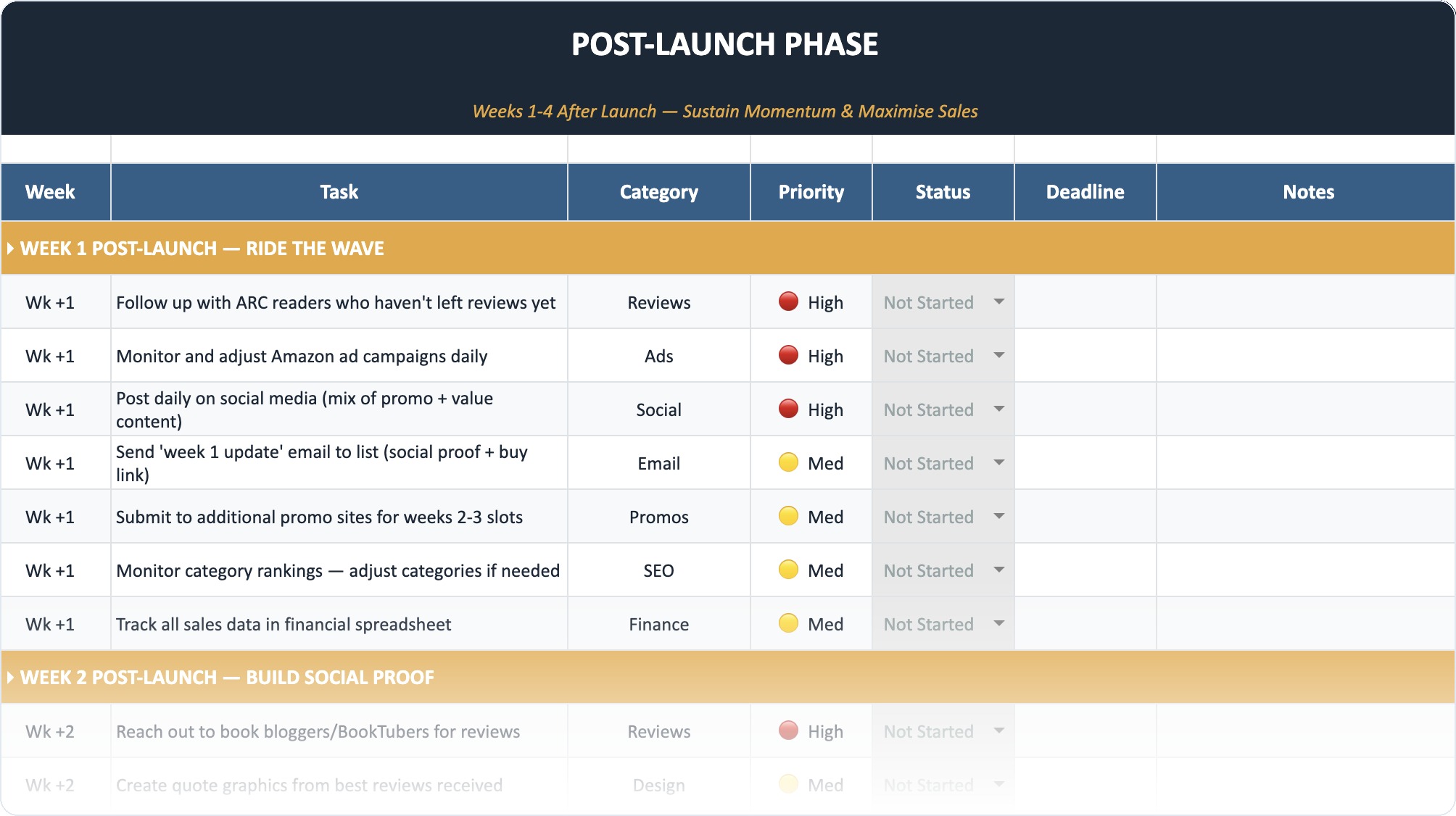
The Self-Publishing Launch Checklist (2026)
A week-by-week spreadsheet that walks you through every step of launching your book. Available as an Excel file and Google Sheet.
What AI Misses in Fiction
Emotional Resonance
The grief scene that makes a reader cry? AI will tell you it’s structurally sound and the pacing is good. It won’t tell you whether it’s moving. It can’t cry. It can’t feel the weight of the silence between two characters who just lost someone.
This is the hard limit. Emotional impact is subjective and experiential. AI evaluates patterns. Emotions aren’t patterns. They’re responses. A human beta reader or editor is irreplaceable here.
Theme and Subtext
If your novel has a thematic thread about the cost of ambition, AI won’t recognize it unless you ask directly. It doesn’t read for theme. It doesn’t notice when a symbol recurs across chapters. It doesn’t understand irony unless the irony is obvious.
Ask it: “What are the recurring themes in this manuscript?” and you’ll get a decent answer. But it won’t volunteer that analysis. A human editor sees theme naturally because they read the book as a reader, not as a pattern-matching process.
Genre-Specific Expectations
A romance novel’s “black moment” is supposed to feel devastating. A cozy mystery’s violence level should stay low. A literary fiction chapter might have intentionally slow pacing that a thriller-trained AI would flag as problematic.
AI editors are getting better at genre awareness, but they still miss conventions. If Publy’s Pacing score gives your literary fiction chapter a 5/10, ask yourself: “Is this slow because it’s bad, or slow because the genre requires it?” AI can’t make that judgment call for you. Yet.
Voice Preservation
Some AI rewrite tools flatten your voice. You paste in a sentence with personality and get back something grammatically perfect but stripped of everything that made it yours.
Publy’s Smart Rewrite is better about this than most tools. It tries to preserve your style while improving clarity. But always read the rewrite before accepting it. If it sounds like you, keep it. If it sounds like a textbook, reject it and rewrite manually.
Real Results: AI Scores vs. Human Editor Notes
I ran the same manuscript through both Publy’s AI Review and sent it to a professional freelance editor who specializes in literary fiction. The editor charges $0.03/word. For 75,000 words, that’s $2,250.
The overlap between AI feedback and human feedback was roughly 65-70%. Both caught the pacing problems, the dialogue similarity between two characters, and the overuse of “suddenly” (31 times across the manuscript). Both noticed that Chapter 8 went six pages without any dialogue.
Where they diverged:
The AI caught three timeline inconsistencies the human editor missed. A character refers to “last winter” in Chapter 4, but the internal timeline places that scene in summer. The AI reads literally and caught it. The human editor, reading for story flow, skipped over the temporal mismatch.
The human editor caught that the mother-daughter relationship in the subplot lost emotional weight after Chapter 10. The AI gave the Structure score a 6/10 on those later chapters but didn’t specifically identify why those chapters felt flat. The human editor wrote: “After the argument in Chapter 10, the mother disappears for 40 pages. When she returns, the emotional stakes have reset to zero.”
That note was worth the entire editing fee. The AI couldn’t have written it. But the AI saved me $900-1,400 on the rest of the feedback because the editor didn’t have to catch the mechanical problems.
Stop Staring at a Blank Page
Publy is a distraction-free book editor with AI built in. Brainstorm plot ideas, get instant chapter reviews, or rewrite clunky paragraphs. 3 million free words included.

How Genre Changes What AI Catches
AI editing isn’t one-size-fits-all for fiction. The scoring means something different depending on your genre:
Thrillers: A Pacing score below 6/10 on any chapter is a warning sign. Thrillers live on momentum. Every chapter should end on a hook or a question. If the AI flags slow pacing in a thriller, take it seriously. In literary fiction, a 5/10 Pacing score might be intentional. In a thriller, it’s a problem.
Romance: The Dialogue score is your most important metric. Romance readers expect banter, tension, and distinct vocal identities for the love interests. If the AI can’t tell your two leads apart from their dialogue alone, neither can your reader. Focus your AI Chat questions on “do these characters sound different from each other?”
Fantasy/Sci-Fi: Consistency matters more than pacing. Your worldbuilding rules need to stay constant across 100,000+ words. Use AI Chat to audit your magic system, technology rules, or political structures chapter by chapter. “In Chapter 3, I said iron blocks magic. In Chapter 22, does this rule still hold?” AI catches contradictions humans forget.
Literary Fiction: The Show vs. Tell score matters less than in genre fiction. Literary fiction is allowed to tell. The narrative voice IS the point. A skilled literary fiction author might intentionally use “She felt tired” because the blunt telling reflects the character’s emotional numbness. AI doesn’t understand that choice. Use Show vs. Tell scores as data points, not directives.
Horror: Sentence rhythm matters. Short sentences create dread. Long sentences create unease. If Publy’s Style score shows uniform sentence length across a scare sequence, vary it intentionally. AI can show you the pattern. You decide what rhythm the fear needs.
Series Writers: The Consistency Advantage
If you’re writing a series, AI editing becomes significantly more valuable with each book.
Book 1 establishes your world, characters, and rules. Book 3 needs to remember all of them. Human editors working on Book 3 may not have read Book 1 recently. They might miss that your protagonist’s scar moved from her left hand to her right, or that a secondary character’s birthday contradicts the holiday timeline from two books ago.
AI Chat handles this. Paste your series bible (character descriptions, world rules, timeline) alongside the new manuscript. Ask: “Does anything in this chapter contradict the established character information?” The AI cross-references systematically.
For series writers producing a book every 6-12 months, this consistency checking saves hundreds of revision hours over a multi-book arc. It’s one of the highest-ROI applications of AI editing because the complexity grows with every installment.
Fiction Editing Workflow with AI
Here’s the order I recommend for fiction manuscripts:
Round 1: Structural review. Run AI Review on every chapter. Look at Pacing and Structure scores. Are there chapters that drag? Scenes that peak too early? This is the big-picture pass.
Round 2: Dialogue and character. Check Dialogue scores. Ask AI Chat: “Do my two main characters sound distinct from each other? Show me examples of their speech patterns.” Fix any characters who sound identical.
Round 3: Show vs. Tell. Go through the flagged passages. Rewrite the telling into showing. This is tedious work but it makes the biggest difference sentence by sentence in fiction.
Round 4: Consistency check. Ask AI Chat about timeline, physical descriptions, and name spellings. Fix errors.
Round 5: Line editing. Use Style & Voice scores and Smart Rewrite for clunky passages. Then run through Hemingway for readability.
Round 6: Human editor. Send the cleaned manuscript to a human who reads your genre. They handle emotional resonance, theme, and the subjective stuff AI can’t touch. The manuscript is now clean enough that the human editor focuses on the hard problems, not the easy ones.
For non-fiction authors who need a different approach, check my AI editing guide for non-fiction books. For the bigger picture on how AI is changing publishing, read AI in the publishing industry.
Publy’s free tier gives you 10,000 AI words per month. Run AI Review on your weakest chapters first. The scored feedback on dialogue and pacing alone is worth signing up.
Frequently Asked Questions
Can AI edit a novel as well as a human editor?
For pacing, dialogue patterns, consistency, and show vs. tell, AI catches problems as well as or faster than human editors. For emotional resonance, theme, subtext, and genre-specific conventions, human editors are still better. The best approach is both: AI for the pattern-based problems, human for the judgment-based problems.
Which AI tool is best for fiction?
Publy gives the most fiction-relevant feedback with scored categories for pacing, dialogue, show vs. tell, and structure. Sudowrite is strong for co-writing and generating content. ProWritingAid is best for line-level prose cleanup. For full manuscript editing, Publy covers the most ground.
Does AI editing work for literary fiction?
Yes, with caveats. Literary fiction often uses intentionally slow pacing, experimental structure, or unconventional dialogue. AI might flag these as problems when they’re deliberate choices. Use the scores as data, not gospel. If the AI says your pacing is slow, decide whether it’s slow-because-it-needs-fixing or slow-because-the-genre-demands-it.
Should I edit while writing or after finishing the draft?
After. Always after. Editing mid-draft kills momentum and leads to over-polished opening chapters with unfinished endings. Write the full draft. Then bring in the AI. The scores mean nothing on a half-finished manuscript because the AI can’t evaluate structure when the structure isn’t complete.