

You wrote a book. You edited it until your eyes blurred. You designed a cover that looks professional. Yet, after hitting publish, your sales dashboard remains flat. The problem is rarely the quality of your writing. The problem is almost always discoverability. If Amazon cannot figure out what your book is about, it cannot show your work to the readers who are actively looking for it.
The best KDP keywords strategy in 2026 is not about guessing words or stuffing random synonyms into your metadata. It is about communicating directly with the Amazon A10 algorithm and its AI assistant, Rufus. You have seven backend slots. Using them correctly is the difference between being invisible and ranking on page one.
- Fill every slot: You have 7 slots with 50 characters each. Use all of them to maximize your search footprint.
- Focus on intent: Amazon’s A10 algorithm and AI assistant “Rufus” prioritize semantic relevance over exact keyword matches.
- Target the sweet spot: Aim for phrases with 2,000–20,000 monthly searches and a competitor score below 50.
- Update regularly: Check your keyword performance every 4 to 6 weeks and swap out underperforming terms.
The Core Logic: Why Your Keywords Fail
Most authors fail at Amazon SEO because they treat the keyword slots like tags on a blog post. They type in single words like "thriller" or "romance" and call it a day. This is a waste of prime real estate.
Amazon gives you seven backend keyword fields. Each field allows for 50 characters. That is 350 characters of space to tell Amazon exactly where to place your book. When you use a broad term like "mystery," you compete against millions of other titles. You will not win that fight.
The winning approach involves "long-tail" keywords. These are specific phrases that describe the sub-genre, the trope, or the specific reader need. Instead of "cookbook," you might use "easy keto diet recipes for beginners." This phrase has lower search volume than "cookbook," but the people searching for it know exactly what they want. When your book matches that specific intent, your conversion rate goes up.
According to data on search habits, approximately 70% of readers discover books via the Amazon search bar. If you do not appear in those results, you do not exist to the majority of your potential audience.
The Self-Publishing Launch Checklist (2026)
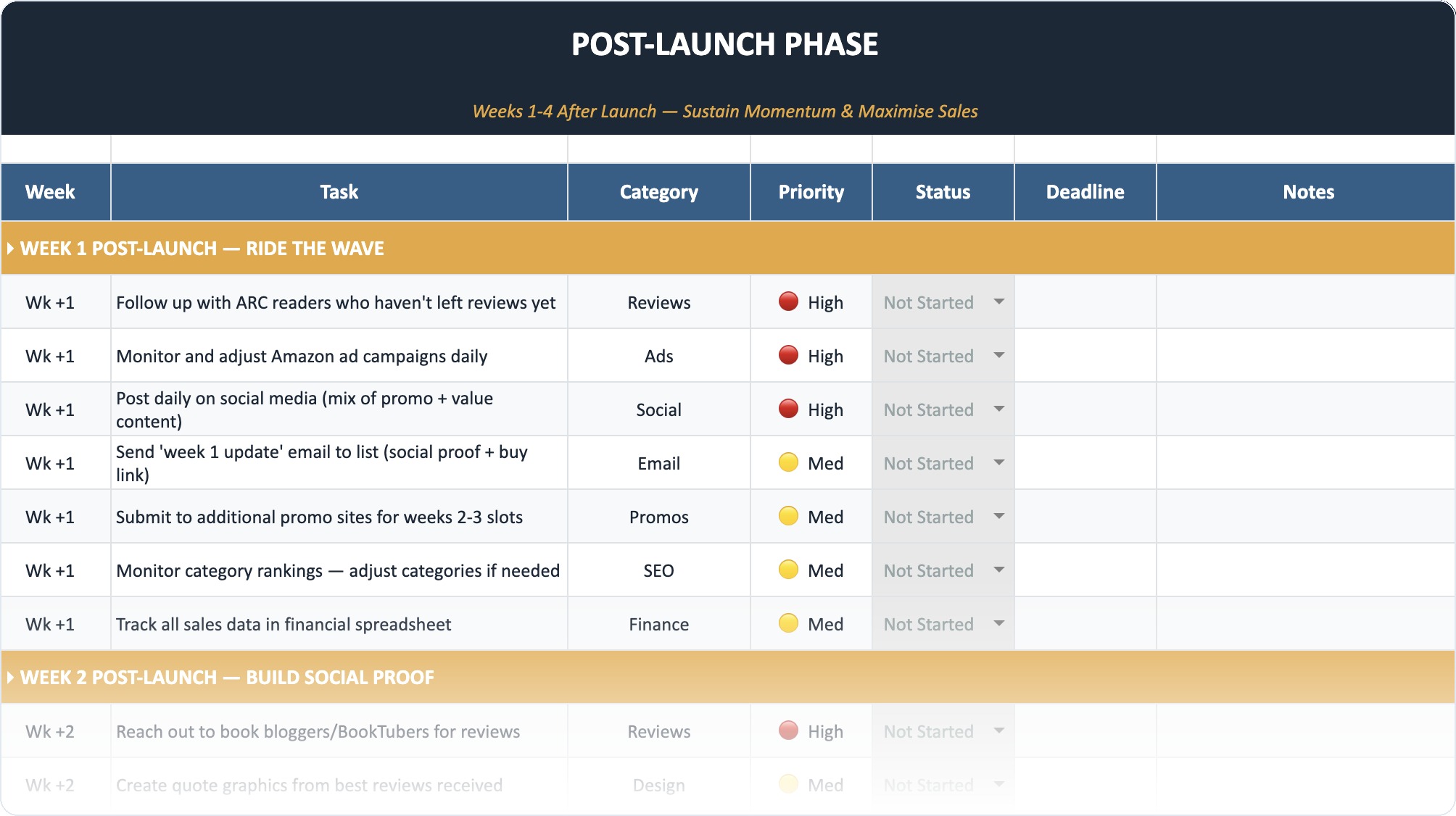
A week-by-week spreadsheet that walks you through every step of launching your book. Available as an Excel file and Google Sheet.
Understanding the A10 Algorithm and AI in 2026
The Amazon algorithm changes frequently. In 2026, we are dealing with the A10 update and the integration of generative AI features. The old tricks of repeating keywords fifty times do not work anymore.
Semantic Relevance Over Exact Match
In the past, you had to type the exact phrase "scifi space opera" to rank for it. Today, Amazon's systems are smarter. They understand context. If your book is about "intergalactic war" and "alien empires," the AI knows it belongs in the space opera category even if you do not use that exact phrase in every slot.
This shift means you should focus on meaning. Think about the themes, the emotional tone, and the specific plot elements. The algorithm scans your title, subtitle, backend keywords, and even your A+ content to build a profile of your book.
The "Rufus" Factor
Amazon introduced "Rufus," a generative AI shopping assistant. This tool answers customer questions like "What are some good cozy mysteries with a baking theme?" Rufus reads your metadata to answer these questions. If your keywords are generic, Rufus skips you. If your keywords are descriptive and natural, Rufus is more likely to recommend your title.
Recent analysis of the algorithm updates suggests that semantic relevance and engagement metrics now outweigh raw keyword density.
Step-by-Step: Constructing Your 7 Backend Slots
You need a systematic way to fill your 7 slots. I recommend a mixed approach that covers genre, tropes, and reader intent.
1. Brainstorming Reader Intent
Before you open any tools, sit down with a notepad. Ask yourself what a reader would type to find your book if they forgot the title.
- Who is the character? (e.g., single dad, strong female lead, amateur sleuth)
- What is the setting? (e.g., Victorian London, Mars colony, small town)
- What is the mood? (e.g., dark, humorous, tearjerker, inspirational)
- What are the plot devices? (e.g., enemies to lovers, locked room mystery, fake marriage)
If you are struggling to categorize your story, looking at popular book genres can spark ideas for specific sub-niches you might have missed.
2. The Data Validation Phase
Once you have a list of phrases, you must validate them. You cannot rely on gut feeling. You need numbers.
You are looking for a "sweet spot." If a keyword has 100 searches a month, it is not worth your time. If it has 500,000 searches, you will get buried.
- Search Volume: Look for phrases with 2,000 to 20,000 monthly searches.
- Competitor Score: On a scale of 1-100 (where 100 is extremely hard), you want a score below 50.
Current market research indicates that keywords with a competitor score below 50 yield the best results for new and intermediate authors.
3. Formatting the Slots
Here is the golden rule: Do not repeat words.
If you have "Romance" in your title, do not put "Romance" in your backend keywords. You are already indexing for it. Use that space for something else.
Bad Strategy:
- Slot 1: Thriller book
- Slot 2: Mystery thriller
- Slot 3: Crime thriller
Good Strategy:
- Slot 1: Psychological suspense novel with twist ending
- Slot 2: Serial killer police procedural detective
- Slot 3: Dark crime fiction for women
Notice how the good strategy covers much more ground. You do not need commas. You do not need to make grammatical sentences. Just list the relevant words in a logical order.
Advanced Tactics: Clustering and Micro-Niches
In 2026, general categories are saturated. You win by dominating micro-niches.
Keyword Clustering
Keyword clustering involves grouping related terms into a single slot to capture a specific theme. Instead of one slot for "magic" and another for "school," you combine them into a cluster like "magic academy school for wizards."
This tells Amazon that your book is highly relevant for that specific cluster. When a user searches for any combination of those words, your book has a higher relevance score.
Target the "Long Tail"
Long-tail keywords are phrases of 3 or more words. They convert better because the user intent is higher. A user searching for "history" might want a textbook, a novel, or a map. A user searching for "World War 2 aviation history non-fiction" knows exactly what they want to buy.
Using tools like Book Bolt for niche research can help you identify these long-tail opportunities that other authors overlook.
Comparison Table: Broad vs. Micro-Niche Keywords
| Broad Keyword (High Competition) | Micro-Niche Keyword (High Opportunity) | Why It Works |
|---|---|---|
| Fantasy | Urban fantasy with female bounty hunter | Targets a specific trope fans love. |
| Cookbook | Gluten free meal prep for busy moms | Solves a specific problem for a specific person. |
| Self Help | Overcoming anxiety for teenage girls | Defines the demographic and the pain point. |
| Sci-Fi | Dystopian cyberpunk with AI rebellion | Clarifies the sub-genre immediately. |
Stop Staring at a Blank Page
Publy is a distraction-free book editor with AI built in. Brainstorm plot ideas, get instant chapter reviews, or rewrite clunky paragraphs. 3 million free words included.

The Role of External Traffic in Ranking
Your keywords are vital, but they are not the only factor. The A10 algorithm places heavy emphasis on external traffic. Amazon loves it when you bring customers from outside their website.
If you drive traffic from a newsletter, a TikTok video, or a blog post, Amazon rewards you with a higher organic rank. This "sales velocity" proves to the algorithm that your book is desirable.
If you are planning an effective launch plan, ensure your backend keywords are set before you start sending external traffic. This ensures that once the algorithm notices the spike in sales, it already knows exactly which keyword buckets to put you in.
According to recent SEO studies, organic sales driven by external traffic sources now have a stronger impact on long-term rankings than Amazon PPC ads alone.
Common Mistakes That Kill Discoverability
I see authors making the same mistakes repeatedly. Avoid these pitfalls to keep your book visible.
1. Repeating Title and Subtitle
I cannot stress this enough. Every word in your title and subtitle is already a keyword. Repeating them in the backend slots is like throwing money in the trash. Use the backend for variations and synonyms.
2. Using Brand Names
Do not use names of other authors or famous book titles. If you write horror, do not put "Stephen King" in your keywords. It is a violation of Amazon's terms of service and can get your account banned. Instead, use phrases like "for fans of dark horror."
3. Subjective Words
Avoid words like "best," "amazing," "great," or "bestseller." These are subjective marketing terms, not search terms. Readers do not search for "amazing book." They search for "scary book" or "funny book."
4. Ignoring Metadata Updates
The market changes. A keyword that worked in 2024 might be dead in 2026. You cannot set it and forget it. I recommend reviewing your keywords every quarter. If a book is not selling, your keywords are the first thing you should audit.
Tools of the Trade
While you can do research manually by using the Amazon search bar's autocomplete feature, it is slow. Professional authors use tools to speed up the process.
- Publisher Rocket: excellent for finding keyword search volume and competitor difficulty.
- Helium 10: Originally for physical products, but their "Magnet" tool is powerful for KDP.
- BookBeam: specifically designed for book analytics.
These tools give you the estimated searches per month. This data allows you to make informed decisions rather than guessing.
Analyzing Performance and Iteration
How do you know if your strategy is working? You watch your rank and your sales.
If you update your keywords and see a spike in impressions (views) but no sales, your cover or blurb might be the issue. If you see no impressions, your keywords are likely too competitive or too obscure.
You also need social proof to make those keywords convert. A reader might find you via a keyword, but they buy because of the reviews. Strategies for getting organic reviews should run parallel to your keyword strategy.
The 4-Week Rule
When you change your keywords, give the algorithm time to re-index your book. It usually takes Amazon about 24 hours to index the new words, but it takes weeks to see the effect on ranking. Do not change them every day. Wait 4 to 6 weeks, gather data, and then tweak.
Conclusion
The best KDP keywords strategy is a blend of art and data. You must understand the human element—what readers are feeling and looking for—and the machine element—how the A10 algorithm processes text.
Fill all seven slots. Be specific. Use long-tail phrases. And most importantly, keep testing. The market is always moving, and your keyword strategy needs to move with it.
Frequently Asked Questions
How many keywords can I use on KDP?
You can use up to 7 backend keyword slots. Each slot has a limit of 50 characters (bytes), allowing you to enter multiple words or phrases in each slot.
Can I put author names in my keywords?
No. Amazon strictly prohibits using other authors' names or trademarked book titles in your backend keywords. This can lead to your book being blocked or your account being suspended.
Should I use commas between keywords?
No, you do not need commas. Amazon's algorithm simply looks for the words. Using commas wastes valuable character space. Just use a space to separate words.
How often should I update my KDP keywords?
You should review your keywords every 4 to 6 weeks. If your book is selling well, leave them alone. If sales dip, or if you are launching a new promotion, research new trends and update your slots.
What is a "long-tail" keyword?
A long-tail keyword is a specific phrase usually containing three or more words (e.g., "vegan slow cooker recipes for beginners"). These phrases have lower search volume but higher conversion rates because they target a specific user intent.